

A yacht can feel private without being private by default. A yacht charter for a confidential board meeting can offer a distinctive setting, but the privacy plan matters more than the view. In the United Arab Emirates, as with any venue, organisers need to consider who can enter the meeting area, when crew may need access, and how sensitive materials and devices will be handled.
It’s reasonable to compare a yacht with a hotel meeting room or conference venue. Conventional spaces may offer familiar room setups and connectivity, while a yacht can create a more contained, memorable atmosphere. Neither setting removes the need to plan carefully. Treat privacy as an operating protocol, not a feature you can assume from the venue.
This guide will help you weigh a yacht against conventional venues and plan a board session around its format, sensitivity, and executive needs. Use the practical checks for access, onboard logistics, connectivity, comfort, and privacy expectations to keep the setting in service of the agenda.
Key Takeaways
- Compare a yacht’s distinctive setting with a hotel or private offsite venue before choosing the meeting space.
- Plan a yacht charter for a confidential board meeting around clear access rules, careful handling of sensitive information, and attendee conduct. Don’t assume the setting guarantees privacy.
- Assess each venue’s privacy boundaries, layout, access control, technical needs, and potential distractions against the board’s priorities.
- Set the agenda and list connectivity and audiovisual requirements early. Treat them as planning checks, not assumed features.
- Prepare a concise charter brief with the attendee count, timing, agenda, and operational needs to keep the experience polished and focused.
Why Consider a Yacht Charter for a Confidential Board Meeting?
The organiser’s challenge is to choose a venue that feels distinctive without letting the atmosphere outrank discretion. A yacht can create a more contained setting than a busy hotel or shared conference space, but the view alone doesn’t make sensitive discussions secure. A yacht charter for a confidential board meeting works best when the venue supports the agenda and the organiser sets realistic privacy expectations.
A confidential working session has different needs from a corporate reception or networking event. Directors may discuss strategy, financial performance, leadership matters, or other sensitive topics. The meeting needs an appropriate setting and clear expectations for access and conduct. A private atmosphere can limit exposure to shared public spaces, but it can’t guarantee confidentiality or prevent every information-security risk.
What makes a yacht different from a conventional meeting venue?
A private yacht booking may reduce the shared circulation common in hotel lobbies, corridors, and conference floors. That can make the gathering feel more contained, although crew access and the vessel’s layout still matter. A change of environment may also help attendees step away from routine interruptions and focus on the planned discussion. It can’t promise sharper thinking or better decisions.
Suitability comes down to practical details: guest count, seating arrangement, discussion format, and the need for separate spaces. A compact leadership discussion has different requirements from a presentation with multiple speakers or breakout sessions. Match the layout to the work, rather than reshaping the work to fit the venue.
When is a yacht a strong fit for board-level work?
A yacht may suit a focused strategy session, a leadership discussion, or a meeting with a select group of stakeholders, particularly when a distinctive setting supports the occasion. Board meetings depend on a clear purpose and well-defined roles. An overview of the Advisory board concept offers helpful context on how such groups can be structured.
Consider another venue if the session depends on extensive technical infrastructure, complex audiovisual production, or tightly controlled access procedures that the setting can’t readily support. Start with the agenda: list what participants must do, the equipment required, and the level of access control the meeting needs. If the setting risks becoming a talking point or complicating the session, choose a more functional fit. A polished venue should serve the board’s work, not compete with it.
How to Protect Confidentiality on a Yacht Charter
A yacht’s private atmosphere isn’t a confidentiality guarantee. Access, people, devices, and documents still need active management. Treat the setting as one part of your plan, then apply your organisation’s existing security policies. For a useful overview of why sensitive board discussions need protection, see this guide to Board meeting confidentiality.
Before booking a yacht charter for a confidential board meeting, define the safeguards the session requires. Make them practical and specific, without assuming that any vessel or crew can eliminate every information-security risk.
What privacy controls should the organiser plan?
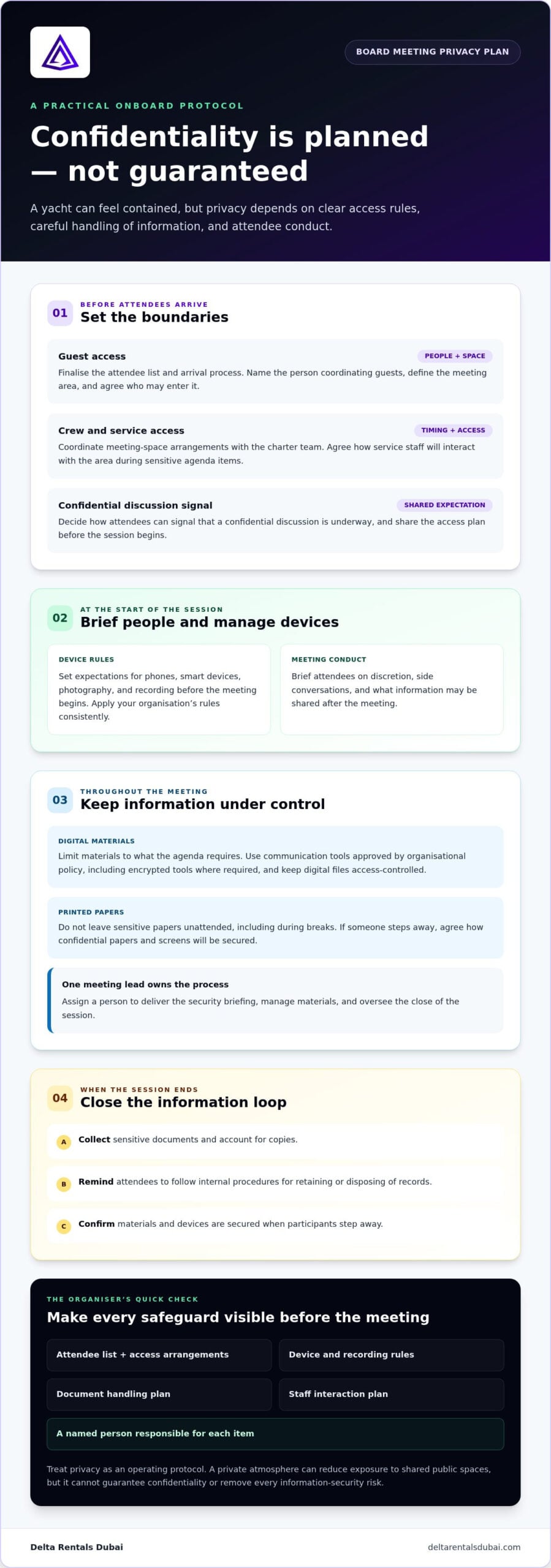
Set clear boundaries before attendees arrive. Share the access plan with participants and coordinate meeting-space arrangements with the charter team. Agree how service staff will interact with the meeting area during sensitive agenda items. For example, establish how attendees can signal that a confidential discussion is underway.
- Guest access: Finalise the attendee list, arrival process, and person responsible for coordinating guests. Define which areas are part of the meeting and who may enter them.
- Devices and recording: Set expectations for phones, smart devices, photography, and recording before the session begins. Apply your organisation’s rules consistently.
- Meeting conduct: Brief attendees on discretion, side conversations, and what information may be shared after the meeting.
How should sensitive information be handled onboard?
Limit materials to what attendees need for the agenda. Use communication tools approved by your organisation’s policies, including encrypted tools where required, and keep digital files access-controlled. Don’t leave printed papers unattended, even during breaks.
Assign one meeting lead to deliver the security briefing, manage materials, and oversee the close of the session. At the end, collect sensitive documents, account for copies, and remind attendees to follow internal procedures for retaining or disposing of records. If a participant needs to step away, agree how confidential papers and screens will be secured in their absence.
A concise pre-meeting checklist keeps these steps visible without turning the session into a security exercise. Confirm the attendee list, access arrangements, device rules, document handling, staff interaction plan, and the person responsible for each item. Delta Rentals Dubai offers luxury yacht rentals in the United Arab Emirates. Share the meeting’s goals and operational needs in your charter brief, then share your yacht charter requirements.
Yacht vs. Hotel Meeting Room: Which Venue Fits Your Board?
The best venue is the one that supports the board’s work, not simply the one with the most memorable setting. A yacht may suit a small, contained session with a distinctive hosting objective. A hotel meeting room can be more practical for a fixed presentation layout or extensive technical needs. A private offsite venue may offer another balance, depending on its access arrangements and facilities.
Use this comparison as a planning framework. For a yacht charter for a confidential board meeting, assess the specific vessel and arrangements against your requirements. Privacy language and ambience are worth considering, but they should never replace essential controls.
Compare the practical requirements
| Decision factor | Yacht | Hotel meeting room | Private offsite venue |
|---|---|---|---|
| Privacy boundaries | A private booking may reduce shared public circulation, but it doesn’t guarantee confidentiality. Define meeting-area boundaries and staff access. | A reserved room provides a defined meeting space, although corridors and other hotel areas may be shared. | Boundaries vary by site. Establish which spaces are reserved and who may enter. |
| Access control | Plan the attendee list, arrival process, and guest coordination. Establish how access to the meeting area will work. | Understand how room access and attendee arrivals will be managed within the venue’s arrangements. | Assess the entrance, shared areas, and process for admitting invited attendees. |
| Layout | Suitability depends on the vessel’s layout, attendee count, and meeting format. Check that the arrangement supports the work. | May suit a fixed boardroom or presentation setup. Confirm the room configuration. | Room shape and furnishings vary. Check that the layout supports discussion and presentations. |
| Connectivity and AV | Match connectivity, power, display, and audio arrangements to the specific requirements of the meeting. | Compare the room’s internet and audiovisual setup with the agenda. | Check the connection, equipment needed, and any setup constraints. |
| Accessibility and contingencies | Consider practical access for attendees and agree on a response if conditions disrupt the plan. | Review attendee access needs and identify alternatives if room arrangements change. | Assess access needs and establish a backup plan for venue or equipment issues. |
| Potential distractions | The setting may feel distinctive, but onboard activity or the environment could compete with the agenda. | Other venue activity or interruptions may affect focus. | Consider nearby activity, noise, and how the venue is used during the session. |
Match the venue to the board’s priorities
Start with the meeting’s must-haves. If the session is a small leadership discussion and a distinctive hosting experience matters, a yacht may be worth considering when its layout, access, and technical arrangements fit. For a presentation-heavy agenda with fixed seating, dependable AV, or multiple workstreams, a conventional meeting room may be the more straightforward choice. A private offsite can work if its boundaries and facilities meet the same practical test.
Attendee numbers and access requirements can rule options in or out. Separate essentials from preferences: confidentiality controls, accessibility, and workable technology are requirements; ambience is a preference. Make the choice only after the essentials align.
How to Plan a Confidential Board Meeting on a Yacht
A focused board session starts well before embarkation. Plan in sequence: define the meeting’s purpose, map its operational requirements, build an agenda, then brief attendees. For a yacht charter for a confidential board meeting, treat facilities and arrangements as requirements to discuss during planning, not assumed features of the charter.
Set the requirements before shaping the agenda
Begin with the decisions the board needs to make. Set the attendee count, session length, and preferred layout around that work. Then list practical needs such as presentation equipment, connectivity, accessibility, power, and document handling. Be specific: if directors must review a presentation together or join a secure call, state that as a requirement and decide how the session can proceed if it isn’t met.
Build an agenda with clear decision points, time for discussion, and planned breaks. Mark which conversations are formal board business and which are informal. This helps keep hospitality in its place: refreshments and service transitions should fit around deliberations, not cut across them. Put the agenda and operational needs in one concise brief so the charter arrangements can be planned around the meeting’s purpose.
Keep the day controlled and adaptable
Before the meeting, brief attendees on arrival timing, confidentiality expectations, device rules, and how materials will be distributed and collected. Name one organiser to manage the run of show. That person can coordinate arrivals, keep the agenda on track, and lead technology checks before the board begins its discussions.
Plan transitions as carefully as the agenda. Allow time for boarding and settling in before sensitive items begin. Where possible, schedule service or refreshment breaks between agenda blocks, and make clear when formal discussion resumes. A calm, predictable rhythm helps the group stay oriented without making the meeting feel over-managed.
- Technology: Test required connections and audiovisual equipment in advance. Have a non-digital way to continue essential discussions if a technical issue arises.
- Timing: Decide which agenda items can move if arrival or setup takes longer than planned.
- Conditions: Agree on a fallback plan if the setting becomes unsuitable for the work, including how to pause, adjust, or relocate the session.
Use a final readiness check to confirm the agenda, attendee arrangements, room setup, technology plan, and responsibilities. Delta Rentals Dubai offers luxury yacht rentals in the United Arab Emirates, with charter planning shaped around meeting goals and requirements. Discuss your yacht charter requirements for an executive meeting.
Arrange a Yacht Charter That Fits Your Board Meeting
Choose the venue after the board’s privacy expectations and essential meeting requirements are clear. A distinctive setting can add a polished touch, but the agenda, attendee needs, access arrangements, and practical setup should lead the decision. Plan a yacht charter for a confidential board meeting from a concise brief that separates non-negotiables from preferences.
Keep the brief focused. It should give the charter team a useful picture of the session without including sensitive board papers or unnecessary confidential detail.
What information belongs in a charter brief?
Summarise the meeting purpose, expected guest count, preferred timing, and the experience you have in mind. Then outline the requirements that will shape the arrangement:
- Agenda and timing: Share the session length, key discussion blocks, breaks, and important decision points.
- Privacy and access: State attendee coordination expectations, meeting-area access boundaries, and how staff interaction should be handled during sensitive discussions.
- Technical needs: List presentation, connectivity, audiovisual, power, and document-handling requirements. Discuss how each will be addressed as part of planning.
- Attendee needs: Include accessibility considerations and other practical requirements that affect participation.
Mark each item as essential or adaptable. For example, a secure connection or a particular access arrangement may be central to the meeting, while refreshments or the order of breaks may allow flexibility. This distinction keeps planning focused and makes trade-offs easier to assess.
How can Delta Rentals Dubai support the next step?
Delta Rentals Dubai offers luxury yacht rentals in the United Arab Emirates and can discuss a charter around your meeting goals and requirements. Bring the brief to the conversation and explain how the agenda, attendee count, timing, and operational needs shape the experience. Plan vessel-specific arrangements around the requirements you’ve identified.
Before settling on a plan, revisit the essentials: does the arrangement fit the meeting format, support your privacy expectations, and leave room for the board to work without avoidable interruptions? Keep confidentiality safeguards under the organiser’s control and aligned with your organisation’s policies. A charter can provide a memorable backdrop, but it can’t guarantee confidentiality.
Prepare your meeting brief and discuss your yacht charter requirements with Delta Rentals Dubai. Put the meeting plan first, then shape the setting around it.
Plan the Meeting First, Then Choose the Setting
A yacht can bring distinction to a board session, but the right choice depends on the agenda, practical requirements, and privacy expectations. Treat confidentiality as an organiser-led plan, not a feature guaranteed by the venue. Compare the yacht with conventional options, then assess access, layout, connectivity, and attendee needs before deciding.
A concise charter brief helps turn those priorities into a workable plan. Include the attendee count, agenda, timing, technical requirements, and access expectations, separating essential needs from preferences. That clarity keeps the meeting at the centre of the experience.
Delta Rentals Dubai offers luxury yacht rentals in the United Arab Emirates, with a premium approach shaped around your meeting goals and requirements. If a yacht charter for a confidential board meeting suits your plans, discuss a yacht charter for your confidential meeting. With the right preparation, you can create a polished setting that supports the board’s work and leaves room for a memorable experience.
Frequently Asked Questions
Is a yacht suitable for a confidential board meeting?
A yacht charter for a confidential board meeting can offer a more contained setting than a shared venue, but a private charter doesn’t guarantee confidentiality. Suitability depends on who can access the meeting area, whether the layout fits the agenda, and the organisation’s information-security and operational requirements. Define safeguards in advance, then compare the arrangement with your organisation’s confidentiality standards.
How can we protect confidential information during a yacht meeting?
Set an attendee list and clear access expectations before the meeting, then brief participants on device, photography, and recording rules. Use secure communication tools approved by your organisation, and keep digital files access-controlled. Bring only necessary printed materials, keep them attended, and collect them after the session. Follow existing security policies throughout. These precautions can reduce avoidable exposure, but they can’t guarantee complete confidentiality.
Can a yacht support presentations and video calls during a board meeting?
A yacht may support presentations or video calls when the vessel and charter arrangements meet your needs, but don’t assume equipment or internet service is included. Identify what the agenda requires, such as a display, audio, stable connectivity, and suitable power. Discuss these requirements during planning and arrange a backup, such as downloadable materials or another way to continue the discussion if a connection or device fails.
What size yacht do we need for a board meeting?
The right capacity depends on the attendee count, seating layout, and space for people to move comfortably around the meeting area. Consider whether hospitality will happen alongside formal sessions, since that can affect how much room the group needs. Define the working group and agenda first, then compare suitable options. Confirm that the specific vessel’s arrangements suit your meeting rather than relying on a general capacity figure.
Is a yacht better than a hotel meeting room for a board session?
Neither is universally better. A yacht offers a distinctive private-charter environment, while a hotel meeting room may provide more predictable facilities and meeting infrastructure. Let the board’s agenda lead the choice. Compare the sensitivity of the discussion, access controls, technology, layout, accessibility, and contingency needs. Choose a yacht when its practical arrangements fit; favour a conventional room if its established setup better supports the work.
What should we include in a yacht charter brief for a board meeting?
Include the meeting purpose, attendee count, preferred timing, agenda format, privacy expectations, access arrangements, technical needs, accessibility requirements, and hospitality preferences. Mark which items are essential and which can be adapted during planning. A clear brief helps shape a charter discussion around the board’s goals. Keep sensitive board papers separate and share requirements rather than unnecessary confidential content.