

What if the safest undercarriage check is the one that never puts you beneath the car? With a low-slung sports car, limited visibility can make collection-day checks feel uncertain. Knowing what to inspect on the undercarriage before driving away a rented sports car starts with a simple rule: look from a safe position, and never crawl beneath or lift the vehicle.
It’s natural to worry that an existing scrape or mark could later be mistaken for damage that happened during your rental. A careful visual check and clear photos can help create a useful record before you leave. You don’t need to diagnose every mark yourself. Document what you can see and flag anything that concerns you.
This guide gives you a practical no-lift checklist for a premium rental, whether you’re collecting a Porsche 911 GT3 RS or another sports car. You’ll learn which visible areas to scan, how to capture pre-existing marks clearly, and when to pause the handover and raise a concern with the rental team. Start your drive with a clear record and greater confidence.
Key Takeaways
- Learn what to inspect on the undercarriage before driving away a rented sports car with a safe visual sweep, without lifting the vehicle.
- Know which visible areas to check, including the front splitter, side sills, undertray edges, and rear diffuser.
- Recognize why scuffs, cracks, loose parts, or fresh-looking wetness deserve a clear report.
- Follow a simple pre-drive routine to capture visible marks with timestamped photos or video from safe exterior angles.
- Share concise observations during handover so the vehicle’s visible condition is recorded before you set off.
Why inspect a rented sports car undercarriage before driving away?
At collection, a sports car’s low stance can make the space beneath its front and sides difficult to see. That limited view is why a deliberate walkaround matters. Before setting off, look at the lower body from outside the vehicle and note anything visible that concerns you. The goal isn’t to find fault with the car. It’s to create a clear record of its visible condition at the start of the rental.
An undercarriage check is a safe visual review of visible lower-body areas, not a mechanical assessment. You can record a scrape or a panel that appears out of place, but shouldn’t try to determine what caused it or whether a component is mechanically sound. In the broader context of car rental, a careful handover helps establish what was visible before the journey begins.
Use the question what to inspect on the undercarriage before driving away a rented sports car as a prompt for observation, not investigation. Stay on stable ground, use only the view available from outside, and don’t crawl underneath, jack up, or move the vehicle to improve your view. If you can’t see an area safely, leave it unchecked and raise any concern with the rental team before departure.
Why low-clearance sports cars deserve a deliberate walkaround
A low ride height can limit your sightline beneath the front and along the sides, even when you’re standing close to the car. Walk around it at a comfortable pace and look from more than one exterior angle. Pay attention to visible lower trim and aerodynamic panels, but don’t reach underneath or pull at anything to test it.
For a premium rental such as a Porsche 911 GT3 RS, keep the check practical and model-neutral. You’re noting visible condition, not carrying out a technical inspection. A deliberate walkaround can reveal marks that aren’t obvious from the driver’s door, while keeping the handover safe and straightforward.
What a renter can and cannot establish visually
A visible scrape, a panel that looks loose, or a fresh-looking wet area is worth pointing out and documenting. Describe what you see, where it is, and whether it appears wet or marked. Don’t assume a scuff is harmless, that moisture is a leak, or that a mark has a particular cause. Appearance alone can’t confirm a mechanical fault or explain when or how it occurred.
If something is unclear, pause before departure and show it to the rental team. Keep the conversation factual: identify the location, share a clear photo if possible, and ask for the observation to be recorded as part of the handover. This creates a clearer starting point without turning your walkaround into a repair diagnosis.
Which undercarriage areas should you check on a rented sports car?
Make one steady visual sweep from front to rear, staying upright and outside the vehicle. Focus on areas you can see without reaching underneath or testing anything. If the area is poorly lit, use your phone light only when it’s safe and permitted in the handover area. Don’t put your phone, hand, or body beneath the car to improve the view.
In order, scan the front splitter, visible undertray edges, both side sills, and rear diffuser, then observe any exhaust or suspension areas visible from outside. Not every area will be easy to see on every sports car, so treat this as a practical route around the vehicle, not a technical inspection.
Start at the front and work along both sides
Begin at the lower front edge. Look for obvious scrapes, cracks, or trim that appears displaced around the front splitter. Continue along one side, scanning visible undertray edges and the side sill, then repeat on the other side. If you notice a difference between the two sides, record what you see without assuming what caused it.
A phone light may help illuminate a shadowed edge, but use it only from a stable standing position and where it’s allowed. Don’t touch panels, pull at trim, or slide beneath the car. If its low stance blocks your view, leave the area unchecked rather than trying to create access.
Finish at the rear and note anything unusual
At the back, observe the visible rear diffuser and exhaust area from outside. You can also note suspension parts that happen to be visible from your standing position, but don’t reach in to inspect them. Never touch exhaust components, which may be hot, and don’t look beneath a car that’s running.
Notice signs such as a hanging panel, fresh-looking wet patch, pronounced impact mark, or debris caught in an accessible area. Don’t remove anything or guess what it means. Capture its location and appearance, then raise it with the rental team before departure, especially if you’re unsure whether it could affect safe use.
- Front: Observe the splitter and lower front edge for visible marks or displaced trim.
- Sides: Scan the undertray edges and side sills, noting visible differences from one side to the other.
- Rear: View the diffuser, exhaust area, and accessible lower panels without reaching underneath.
- Visible components: Note any suspension area you can see safely, without touching it.
Keep the check focused on visible observations. If a mark or area is unclear, show it to the rental team rather than trying to diagnose it yourself. For a premium sports car rental, you can also make a rental enquiry as part of planning a considered handover.
Normal marks or a concern? How to assess visible underbody signs
A mark beneath a sports car can be difficult to interpret at a glance. A light surface scuff, a cracked edge, a panel that appears loose, and a wet-looking patch are observations, not a diagnosis. Don’t label anything harmless or assume there’s a fault. Focus on what you can see, record it clearly, and let the rental team review anything uncertain before you drive away.
Use this comparison to decide what to report, not to judge repair needs or assign responsibility:
| Observation | Why it merits attention | Renter action |
|---|---|---|
| Light surface scuff | It may be a visible pre-existing mark, but appearance alone doesn’t establish its condition or cause. | Photograph it from a clear exterior angle and note its location. |
| Cracked or pronounced impact mark | A crack or substantial mark may warrant staff review, even if you can’t tell what it affects. | Pause the handover and show the area to the rental team. |
| Panel or trim that looks loose | It may not sit flush with nearby surfaces, but a visual check can’t establish why. | Don’t pull or push it. Record what you see and report it. |
| Fresh-looking wet patch or drip | Water, dirt, and vehicle fluids can look similar during a quick check. | Don’t touch it. Photograph the area if safe and ask staff to review it. |
Visible cosmetic scuffs versus signs to report
A small-looking surface mark isn’t automatic proof of damage, but it still belongs in an accurate handover record if it’s visible. Give the rental team a neutral description, such as “short scuff on the lower edge near the front,” rather than guessing how it happened. Report fresh-looking wet areas, loose-looking panels, cracks, and substantial impact marks for staff review. Don’t estimate severity or repair costs.
When visibility or conditions make the check inconclusive
Darkness, rain, dirt, glare, and limited clearance can hide details or change how a surface looks. If you can’t see an area clearly, state that visibility was limited. Don’t infer what lies behind a shadow, splash, or panel edge. Ask rental staff to review any unclear visible area before departure, rather than trying to reach underneath or clean it yourself.
The question what to inspect on the undercarriage before driving away a rented sports car is best answered with careful observation, not a verdict. A renter’s visual check can document visible condition, but it can’t establish whether a component is mechanically sound or identify the source of a stain. If the team’s review leaves you uncertain, explain what remains unclear and keep the discussion focused on visible evidence before deciding whether to proceed.
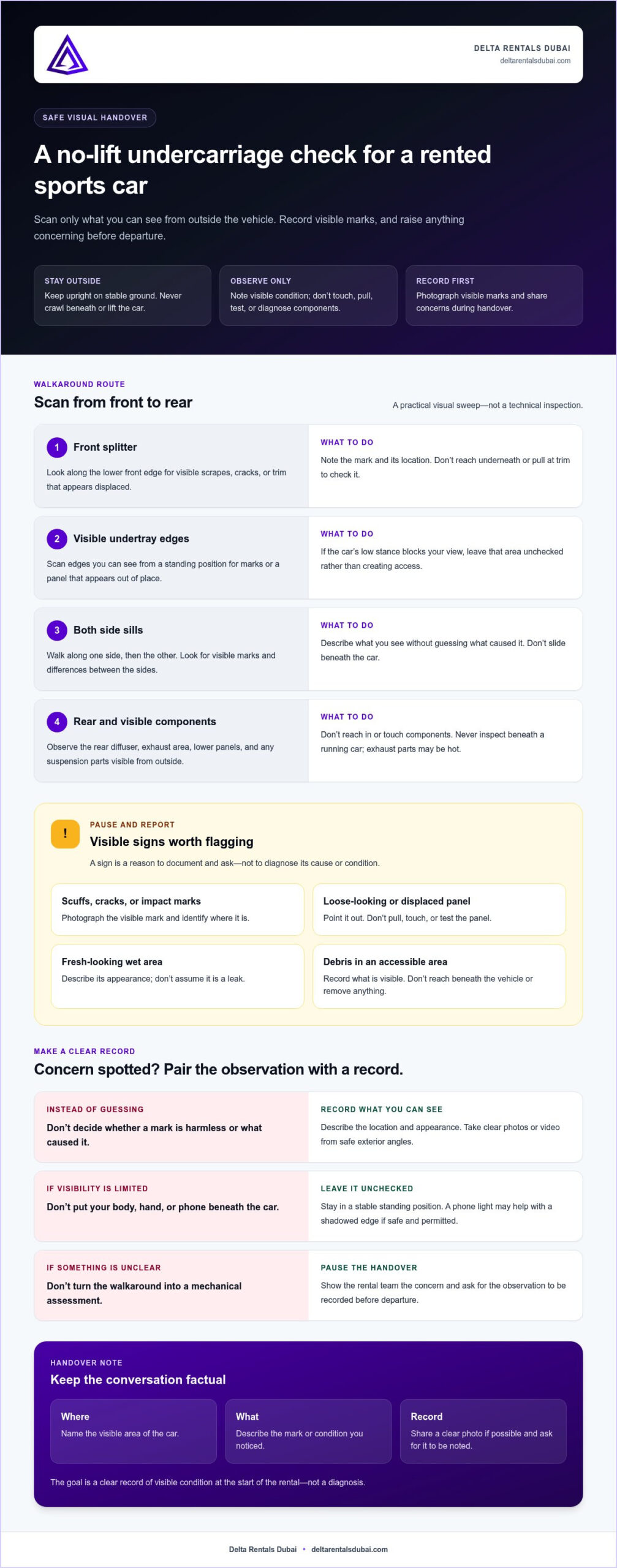
A practical pre-drive undercarriage checklist for renters
A repeatable routine keeps the handover calm and the record clear. Take a few moments before departure to note what’s visible, rather than trying to assess the car mechanically. Whether you’re collecting a Porsche 911 GT3 RS or another sports car, keep the vehicle stationary and use only safe exterior viewpoints.
Follow a repeatable five-step visual routine
- Park safely. Begin only when the car is securely parked and the surrounding area is safe for a walkaround. Keep clear of moving traffic, and don’t inspect beneath a running vehicle.
- Walk around the car. Move around it at a comfortable pace and view accessible lower areas while standing. Don’t kneel beneath, crawl under, jack up, or reposition the vehicle to improve your view.
- Inspect visible zones. Scan the lower front edge, visible panel edges, both sides, and the rear. Note specific observations, such as a scrape near a lower panel or a wet-looking patch, without guessing at the cause.
- Document what you see. Take timestamped photos or a short video before the vehicle moves or you handle any component. Capture a wide view to show the location, then a closer image of the mark. Keep your phone and body outside the space beneath the car.
- Discuss concerns. Show any unclear or significant-looking observation to rental staff and ask for it to be recorded and acknowledged through the handover process before departure.
Make the images useful. Hold the phone steady, include enough surrounding bodywork to identify where a mark is, and avoid relying on a close-up with no location context. If lighting or clearance prevents a clear view, record that limitation instead of guessing. Don’t touch a loose-looking part or try to clean, test, or repair anything.
What to do when the check reveals a concern
Pause before setting off if a visible issue appears significant or you’re unsure whether it could affect safe use. Share the observation and supporting photos with the rental team promptly. If staff identify a safety concern or advise against departure, don’t drive the car. Keep the rental paperwork and any written notes or images together so the recorded condition and handover discussion are easy to refer to.
Keep your description factual: state where the mark is and what it looks like, not who caused it or what repair it needs. This creates a more useful record for both sides. If you’re planning a premium sports car rental, you can discuss a rental through WhatsApp and bring the same clear, considered approach to collection day.
Make the undercarriage check part of a confident rental handover
A calm walkaround and a clear record give you and the rental team a shared reference for the vehicle’s visible condition at collection. The purpose isn’t to decide who caused a mark or diagnose a mechanical issue. It’s to describe what you can see, make sure any concern is discussed, and begin the drive with fewer unanswered questions.
Think of what to inspect on the undercarriage before driving away a rented sports car as part of the handover conversation, not a test you need to pass. A performance car such as the Porsche 911 GT3 RS deserves a composed start, and a concise record helps keep collection practical as well as memorable.
Turn your observations into a clear handover record
Use neutral details: where the mark appears, what it looks like, and whether the area was clearly visible. For example, “scuff on the lower front edge, left side” is more useful than a guess about when or how it happened. Keep the original photos, and note when you raised the concern and who reviewed it. That gives the discussion a clear reference without assigning blame.
If a mark is unclear or could relate to safety, bring it to staff’s attention before departure and allow them to review it. Don’t treat silence as confirmation that an unresolved issue has been addressed. Make sure the concern is acknowledged through the handover process, and keep any related notes with your rental paperwork. A brief, factual exchange is clearer than a long explanation built on assumptions.
Choose a premium rental experience with preparation in mind
Preparation doesn’t take away from the excitement of collecting a high-performance car. It helps you understand the vehicle’s visible condition and gives you a record to refer back to. Delta Rentals Dubai provides premium sports and luxury vehicle rentals, including the Porsche 911 GT3 RS rental experience. Pair the anticipation of the drive with a thoughtful handover: observe, document, discuss, then set off once any concerns have been addressed.
Keep the exchange simple. Share the relevant image, describe the location, and let the rental team review anything uncertain. That small pause can make the transition from collection to driving feel more composed. If you’re considering a premium rental, discuss your rental via WhatsApp.
What to inspect on the undercarriage before driving away a rented sports car
A considered collection sets you up to enjoy the drive with greater peace of mind. Keep your photos and handover notes accessible, and treat any new concern during the rental with the same calm, factual approach. That habit helps you focus on the experience instead of second-guessing what was already visible.
If you’re planning a performance-car experience, Delta Rentals Dubai specializes in premium supercar and luxury vehicle hire, with the Porsche 911 GT3 RS among its rental offerings. Whether you have a specific model in mind or are exploring your options, carry the same confidence into your rental plans that you bring to the handover. A clear understanding of what to inspect on the undercarriage before driving away a rented sports car is a practical first step.
Start a conversation about renting a premium car from Delta Rentals Dubai and take a considered approach to your next drive.
Frequently Asked Questions
Can a rental damage waiver cover undercarriage damage?
It depends on the specific waiver terms, so don’t assume underbody damage is automatically covered or excluded. Review the rental agreement for coverage limits, exclusions, reporting steps, and any conditions that apply after an incident. If damage occurs during your rental, report it promptly through the stated process and keep a copy of the communication. A waiver’s name alone won’t tell you how a particular claim will be handled.
What should I do if a warning light appears after driving over road debris?
Pull over somewhere safe as soon as practical and check the dashboard message or vehicle handbook without putting yourself in danger. Don’t ignore a warning or continue driving if the car feels unusual, a warning indicates a serious problem, or you’re unsure it’s safe to proceed. Contact the rental team and describe the debris, warning, and any change in the car’s behaviour. Follow their instructions, and don’t attempt a roadside repair.
Is it safe to use a phone camera to view beneath a low sports car?
It can help capture an area that’s visible from a safe standing position, but don’t slide your phone or hand beneath the vehicle. Keep the car parked, switch off the engine, and stay clear of traffic or other hazards. A phone camera can document what its lens can safely see; it can’t establish whether a hidden component is damaged. If the angle requires reaching under the car, leave that area for staff to review.
Can rain or darkness make an undercarriage check unreliable?
Yes. Rain can leave surfaces wet or obscure marks, while darkness and glare can hide edges or change how a stain appears. Don’t use a poor view to conclude that an area is clear. Record which parts you couldn’t see well and tell the rental team before setting off. If safe lighting or conditions aren’t available, ask staff to review the area or note the limitation in the handover record.
Should I inspect the undercarriage again when returning a rental car?
A brief return walkaround can help you note any visible change and create a record of the vehicle’s condition at drop-off. Take clear, timestamped photos from safe exterior angles, especially if an incident occurred during the rental. Share any new concern with staff and keep the images with your rental documents. Follow the return instructions in your agreement, since the handover process may specify how to report damage or submit documentation.
What if a visible mark is present but the rental staff disagree about its condition?
Keep the conversation calm and focused on what can be verified. Show the original photo, point out the location, and describe the mark without guessing when it appeared or what caused it. Ask for your observation and the staff review to be recorded through the handover process. Keep copies of relevant messages and documents. If the difference of opinion remains, use the rental agreement’s stated process for raising or following up on a concern.
Does every sports car have the same undercarriage inspection points?
No. Lower-body shapes and the areas visible from outside differ between models, so use a general walkaround rather than assuming every car has identical panels or access points. Check only what’s safely visible, and don’t compare a mark against another vehicle as proof of damage. For a specific model, follow its handover guidance and let rental staff explain any area that isn’t clear from a normal standing view.