
What if the mode that sounds most exciting isn’t the right choice for your drive? Understanding the different driving modes in a Lamborghini starts with knowing that each setting tunes selected vehicle responses, rather than necessarily changing every system. Names such as Strada, Sport and Corsa can be hard to interpret, especially when a model also offers hybrid or terrain-focused settings.
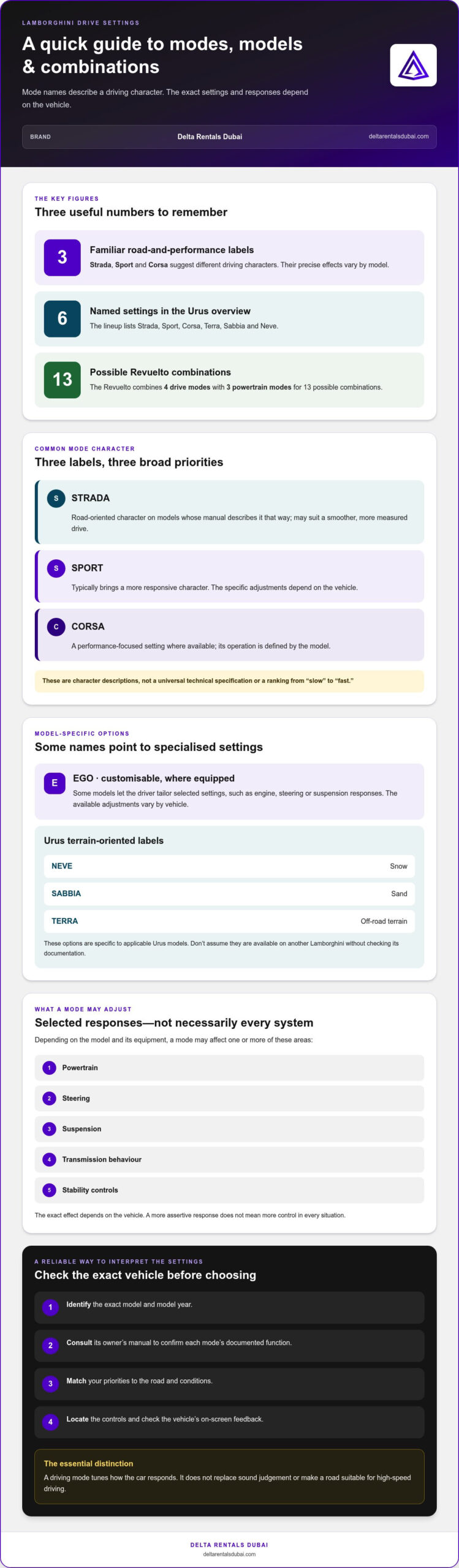
This guide explains what common Lamborghini mode names are designed to do and how to choose a setting based on the model, road conditions and your priorities. You’ll learn why Strada is often the more relaxed choice, how Sport can sharpen the experience, and why Corsa is intended for track-focused driving. Options vary across models: the Revuelto, for example, combines four drive modes with three powertrain modes for 13 possible combinations.
Think of the settings as ways to tailor the drive, not a universal ladder from “slow” to “fast.” Knowing what each one means can help you approach a Lamborghini rental with greater confidence and choose a mode that suits the moment.
Key Takeaways
- Understanding the different driving modes in a Lamborghini starts with recognizing that a mode may adjust selected systems, not every part of the car.
- Use the exact model’s manual to interpret its mode names and understand how its settings are intended to work.
- Match your choice to your priorities and road conditions. A performance-focused setting doesn’t make every road suitable for spirited driving.
- Before changing modes, identify the model, assess conditions, locate the control and check the vehicle’s on-screen feedback.
- A Lamborghini rental lets you experience how a specific model responds across its available settings.
What Do Lamborghini Driving Modes Change?
A Lamborghini driving mode is a coordinated vehicle setting that adjusts selected responses to suit a particular style of driving. Depending on the model and its equipment, adjustments may affect the powertrain, steering, suspension, transmission behaviour or stability controls. The car may feel more relaxed, immediate or focused, but selecting a mode doesn’t change your driving skill or make a road suitable for high-speed driving.
A driving mode tunes how the car responds; it doesn’t replace sound judgement behind the wheel. Keep that distinction in mind as you build your understanding of the different driving modes in a Lamborghini.
How a Lamborghini mode can change the driving feel
One setting may make throttle response feel smoother, while another may deliver a sharper reaction to the same pedal input. Transmission behaviour can also change, influencing how the car selects or shifts gears. Steering may feel lighter or more direct, depending on the mode and vehicle. These are changes in response, not a transformation of the car’s underlying capabilities.
Suspension and stability-control adjustments depend on the vehicle’s equipment and settings. A model with adjustable suspension may alter how it responds over the road, while stability-control changes can influence how the car manages traction. Don’t assume every mode adjusts every system, or that a more assertive response means more control in every situation. The exact effect depends on the model.
Why mode names and functions vary by model
Lamborghini uses model-specific controls and mode line-ups. Where equipped, the ANIMA selector gives the driver access to the available settings, but the options and their effects depend on the model, configuration and model year. A familiar label can suggest a similar driving character across cars without meaning that powertrain, steering, suspension or stability settings are identical.
The Urus illustrates why it’s worth checking the details: its named settings include road-focused and terrain-oriented options. The Lamborghini Urus Driving Modes overview lists Strada, Sport, Corsa, Terra, Sabbia and Neve. That lineup isn’t a template for every Lamborghini, and an identically named mode may work differently on another model.
Before selecting a setting, identify the exact model and model year, then consult its owner’s manual. Match each label to its documented function and locate the relevant controls. This turns unfamiliar names into useful guidance and helps you avoid assumptions based on another Lamborghini’s setup.
Strada, Sport, Corsa, and Other Lamborghini Modes Explained
Mode labels are a useful starting point, not a universal specification. On models whose manuals describe Strada as road-oriented, it’s generally intended for a more composed everyday feel. Sport typically brings a more responsive character, while Corsa is the performance-focused choice where the model offers it. The systems involved and the degree of change depend on the vehicle.
Mode names suggest a driving character, but only the exact vehicle’s manual can confirm what each setting changes.
Strada, Sport, and Corsa: the common mode names
Use the labels to think about your priorities, not to assume one mode is automatically better. Strada may suit a smoother, more measured drive; Sport may appeal when you want sharper responses; Corsa is intended for a more focused experience in models equipped with it. Your road, conditions and comfort behind the wheel matter as much as the name.
Strada: Road-oriented character on models whose manual describes it that way.
Sport: A more responsive character, with specific adjustments varying by vehicle.
Corsa: A performance-focused setting where available, with operation defined by the model.
This is a character guide, not a technical specification. Equipment and calibrations can differ by model and model year, so confirm the precise effects in the manual for the exact car. Don’t assume a label guarantees a particular steering weight, suspension firmness or transmission response across the Lamborghini range.
Ego and specialised modes are model-dependent
Some models provide EGO, a customisable mode that can let the driver tailor selected settings, such as engine, steering or suspension responses. The available adjustments depend on the vehicle. If EGO is present, use the manual and on-screen controls to see what can be changed, rather than assuming it adjusts every system or produces the same setup in every model.
Specialised labels are equally specific. On applicable Urus models, Neve refers to snow, Sabbia to sand and Terra to off-road terrain. These names indicate a setting intended for a particular surface, not permission to take a vehicle onto unsuitable or unsafe ground. Don’t assume these options are available on a Lamborghini Evo Spyder, Revuelto or another model without checking that vehicle’s documentation.
Understanding the different driving modes in a Lamborghini is more practical when you compare documented functions, then choose based on the conditions and experience you want. If you’re considering a Lamborghini rental, you can discuss a Lamborghini rental and experience how a specific car responds.
Which Lamborghini Driving Mode Fits Your Priorities?
Start with the drive you want, then consider the road and conditions. A calm journey, a more engaging response and a track session involve different priorities. No setting is universally best, and a mode name alone can’t tell you whether it suits the moment. Understanding the different driving modes in a Lamborghini means matching the documented behaviour of that specific car to how and where you plan to drive.
Choose a mode by the kind of drive you want
For a relaxed everyday drive, look for the model’s road-oriented setting, if its manual identifies one. If you want a livelier response and conditions are suitable, a more responsive setting may better fit your preference. A track-focused mode belongs in an appropriate track environment, not on a public road simply because it sounds more exciting.
Use this quick decision guide, then check the manual for the exact car:
- Comfort and composure: Choose the documented road-oriented setting when a smoother, more measured character is your priority.
- A more engaging feel: Consider a responsive setting when conditions allow you to drive attentively and smoothly.
- Track-focused driving: Reserve a track-oriented setting for a suitable closed-course environment and follow the vehicle’s guidance.
Conditions can change during a drive. Traffic, visibility, road surface and your comfort behind the wheel all matter. If they call for a calmer approach, choose accordingly, even if another setting promises a sharper character. A more performance-focused mode doesn’t make every road appropriate for that style of driving.
What driving modes do not do
A mode doesn’t replace attentive driving, good judgement or a clear understanding of the car. It can alter selected vehicle responses, but it can’t guarantee extra grip, prevent a loss of control or produce a particular result. Drive within your ability, leave room to respond and adapt to changing conditions.
Nor should you assume every Lamborghini offers the same modes or reacts identically to the same label. Model, model year and configuration can affect the available settings and how driver-assistance or stability systems behave. A setting that suits one car may not be available, or may work differently, in another.
Choose a mode for the conditions and purpose, not its name alone. Before setting off, identify the vehicle, check its manual and understand the selected mode’s documented role. If you’re new to that Lamborghini, begin with a setting suited to the conditions and learn how the car responds before choosing a more engaging option. The right decision supports a composed, attentive drive, not the most extreme experience.
How to Select and Change a Lamborghini Driving Mode
Make mode selection a deliberate part of getting familiar with the car, not a guess made while driving. Controls and available settings depend on the Lamborghini model and model year, so follow the vehicle’s own instructions. Use this routine: identify the car, check its manual, assess the drive, then select a suitable setting.
- Identify the exact vehicle. Note the model and model year, since mode names and functions can differ between versions.
- Check the owner’s manual. Review the available settings, their documented effects and the manufacturer’s instructions for changing modes.
- Assess the conditions. Consider the road surface, weather, traffic and purpose of the drive before choosing a setting.
- Select and verify. Locate the mode control, make the selection as instructed, then confirm the displayed mode before continuing.
A practical checklist before choosing a setting
Pause before setting off. Check that the manual matches the exact car, then consider the conditions you’ll encounter and how comfortable you are with the vehicle. A setting that suits a clear, familiar route may not be appropriate in heavy traffic or on a changing surface. While learning, use smooth, measured inputs and notice how the car responds. Don’t make abrupt changes or treat the mode as a substitute for attention.
Learning the controls without guesswork
Mode controls and dashboard displays vary by model. Find the selector and learn how the selected setting is shown before you drive, using the owner’s manual rather than instructions for another Lamborghini. The display can confirm your choice, but read it while safely stationary. Don’t divert your attention from the road to navigate menus or search for a control.
Follow the manufacturer’s directions on when and how to change modes. Some vehicles may set specific conditions for changing a setting, so don’t assume every mode can be selected in the same way or at any moment. If the display doesn’t show the mode you intended, stay focused on driving and refer to the manual when safe instead of repeatedly experimenting on the move.
Once underway, keep your attention on traffic and adjust your driving to the conditions. A mode changes selected vehicle responses; it doesn’t guarantee grip, safety or a particular outcome. If you’re considering a Lamborghini rental, message us on WhatsApp to discuss renting a Lamborghini and experiencing how a specific car responds.
Experience Lamborghini Driving Modes Through a Rental
Reading about mode names gives you a framework. Driving a specific Lamborghini helps you notice how its documented settings shape the experience. A rental makes the ideas more tangible: you can pay attention to how the car responds in the setting you choose, without treating maximum performance as the goal. Start with the vehicle’s own manual, since controls and mode functions depend on the exact model and model year.
Turn mode knowledge into a more confident drive
Before setting off, review the manual and become familiar with the mode selector and its display. Knowing what the available settings are intended to do can make a first drive feel more approachable, especially if the labels are unfamiliar. Choose a setting that suits the route and conditions, then focus on smooth inputs and the car’s character. Take time to learn rather than chasing the most aggressive response.
Keep the experience measured. Notice how the car reacts to ordinary steering, braking and acceleration, and leave room to adapt as traffic or road conditions change. A setting’s name isn’t a substitute for understanding its purpose, and one model’s behaviour shouldn’t be assumed to match another’s. If you’re new to a Lamborghini, a calm, attentive approach helps you understand the vehicle without pressure to explore every setting.
Explore a Lamborghini rental with Delta Rentals Dubai
Delta Rentals Dubai offers Lamborghini Evo Spyder and Lamborghini Revuelto rentals. These are distinct models, so don’t assume they share the same mode names, controls or responses. Read the manual for the specific car you’re driving and use its instructions to interpret each setting. Explore the Lamborghini rental options to choose the model experience that interests you, while keeping the focus on confident, considered driving.
Understanding the different driving modes in a Lamborghini becomes easier when you connect the labels to the feel of one particular car. Treat each setting as a tool for tailoring selected responses, not as a promise of extra grip or a reason to drive beyond your comfort level. Review the controls before you move, follow the manufacturer’s guidance and let road conditions shape your choices.
If you’d like to explore the experience, discuss a Lamborghini rental with Delta Rentals Dubai and take the next step at your own pace.
Make Your First Lamborghini Drive Your Own
Understanding the different driving modes in a Lamborghini is a strong starting point. Approach the car with curiosity, not pressure. Before setting off, get comfortable with the controls and focus on how the vehicle responds to your inputs. Let the experience build at a pace that feels composed and enjoyable.
A memorable drive isn’t about selecting the most extreme setting. It’s about feeling connected to the car, staying attentive and making choices that suit the moment. Bring that mindset to the wheel, and unfamiliar controls can feel more approachable.
Ready to experience a Lamborghini? Start a conversation about a Lamborghini rental with Delta Rentals Dubai and discover the drive at your own pace.
Frequently Asked Questions
What are the main driving modes in a Lamborghini?
Common Lamborghini mode labels include Strada, Sport and Corsa, but available choices depend on the model and year. Strada is generally intended for road use, Sport for a more responsive feel, and Corsa for a performance-focused drive where offered. These labels are a starting point, not universal specifications. For understanding the different driving modes in a Lamborghini, use the owner’s manual for the exact vehicle.
What is the difference between Strada, Sport, and Corsa?
Strada usually signals a road-oriented character, Sport a more responsive one, and Corsa a performance-focused setting where the model offers it. Their actual effects can differ with each Lamborghini’s equipment and calibration. The response you feel in one model’s Sport setting, for example, may not match another’s. Choose based on the car, conditions and purpose of your drive, not on the assumption that Corsa is always the right choice.
Does every Lamborghini have the same driving modes?
No. Lamborghini mode names and functions can vary by model, configuration and model year. One vehicle may offer a custom setting or options for particular conditions, while another may have a different selection. A generic list can’t confirm what’s fitted to the car you’re driving. Check its owner’s manual and in-car display for the available modes, their descriptions and any model-specific guidance before selecting one.
What does Ego mode do in a Lamborghini?
Ego is a customisation mode on Lamborghini models equipped with it, but the available choices and configurable systems can differ between vehicles. Don’t assume it adjusts the same combination of settings in every car. A control shown under Ego in one model, for instance, may not be available in another. Consult the relevant owner’s manual and in-car information to see exactly which options your Lamborghini allows you to tailor.
Can you change Lamborghini driving modes while driving?
Whether you can change a mode while driving, and how to do so, depends on the specific Lamborghini and its operating instructions. Don’t assume every setting can be selected at any speed or in any situation. Read the owner’s manual for the permitted method and conditions. Keep your attention on the road; if using the controls would distract you, wait until it’s safe to consult the display or instructions.
Does Corsa mode make a Lamborghini faster?
Corsa is generally a performance-oriented setting where offered, but it doesn’t turn the car into a different vehicle or guarantee a particular result. Its effect depends on the model’s systems and configuration, so the name alone doesn’t establish what changes or how the car will respond. Read the vehicle’s manual to understand its function, and choose settings suited to your experience and the conditions rather than assuming Corsa is appropriate for every drive.