

Most drivers assume carbon ceramic brakes exist purely for blistering stopping power, but their true genius lies in sharpening vehicle agility by slashing rotating unsprung mass. If you’ve ever felt intimidated by composite material jargon or puzzled by low-speed brake squeal, you aren’t alone. Masterful driving begins with understanding high performance carbon ceramic brakes, cutting through common paddock myths to reveal why premier supercars demand them.
You already recognize the prestige these massive composite rotors bring to icons like the Porsche 911 GT3 RS and McLaren Artura, but understanding their thermal characteristics is what separates casual observers from skilled pilots. In this complete guide, you’ll discover the physics behind carbon-silicon carbide matrices, learn how shedding wheel-end weight unlocks razor-sharp turn-in response, and master essential temperature management habits. Here is everything you need to command peak braking performance with complete confidence.
Key Takeaways
- Master the science of carbon-silicon carbide matrices to grasp how extreme thermal resilience eliminates brake fade under aggressive driving.
- Discover why understanding high performance carbon ceramic brakes starts with unsprung mass reduction, transforming steering precision and suspension response.
- Uncover the intricate multi-week manufacturing cycle that fuses carbon fibers with molten silicon under vacuum furnaces.
- Learn the mechanical realities of low-speed brake squeal and cold bite, equipping you with essential operating habits for road use.
- See how track-honed machinery like the Porsche 911 GT3 RS pairs carbon composite rotors with active aerodynamics for peerless high-speed control.
What Are Carbon Ceramic Brakes and Why Do Supercars Rely on Them?
Carbon ceramic brakes are advanced friction assemblies engineered by fusing chopped carbon fiber filaments with high-density silicon carbide ceramic. Originally developed for aerospace re-entry shields and aircraft landing gear before proving indispensable in Formula 1 racing, these composite friction discs withstand mechanical loads that easily warp conventional metal components. When evaluating exotic performance machinery, understanding high performance carbon ceramic brakes requires viewing them not as an optional aesthetic badge, but as a mandatory foundation of high-speed vehicle dynamics.
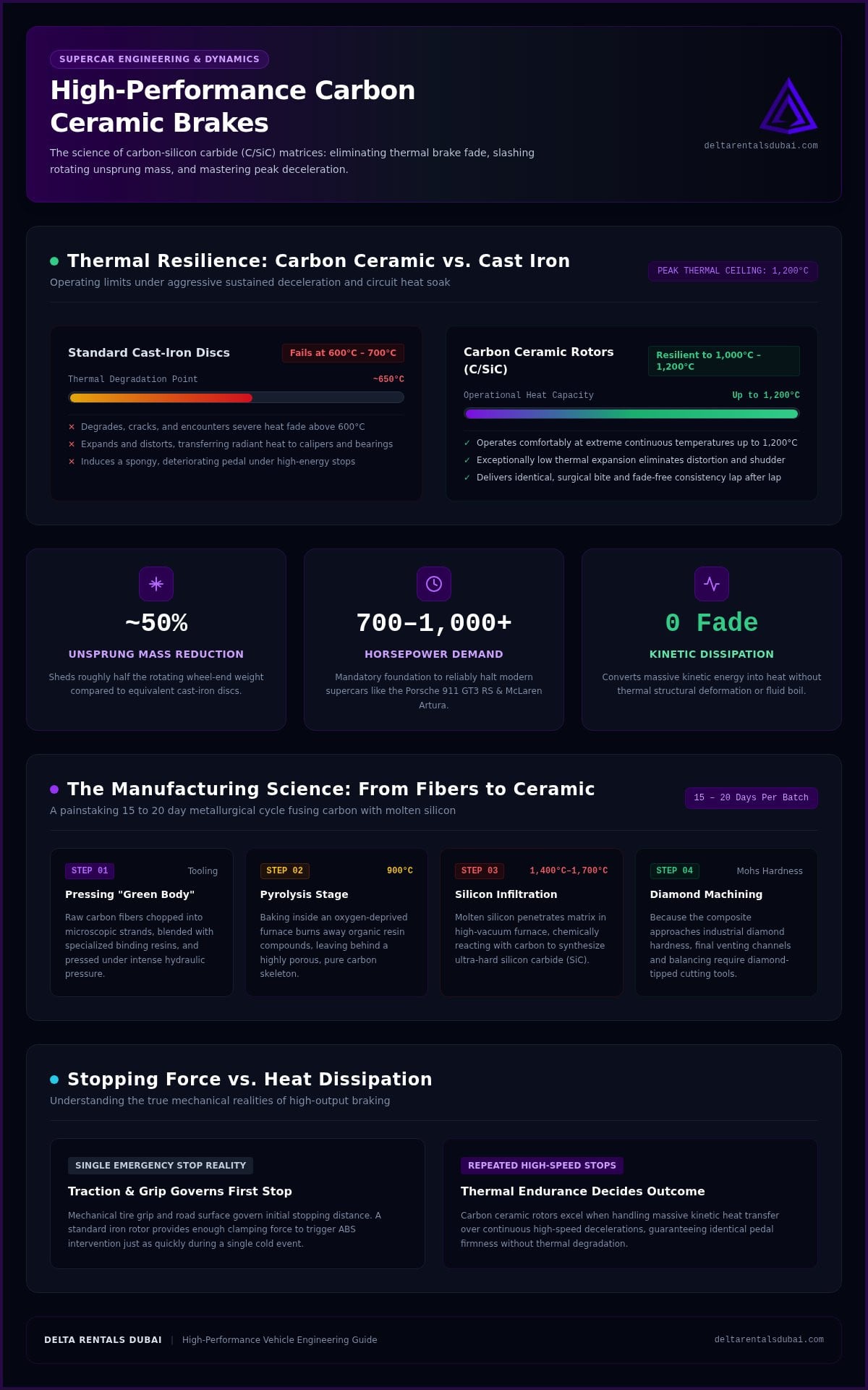
Carbon Ceramic Brake (CCB): A high-performance automotive deceleration system featuring composite carbon-silicon carbide (C/SiC) rotors that resist heat fade up to 1,000°C while shedding roughly half the rotating unsprung weight of equivalent cast-iron discs.
World-class automotive manufacturers specify carbon ceramics on their flagship builds because road-legal power figures now exceed 700 to 1,000 horsepower. Traditional grey cast iron discs simply hit a structural thermal barrier under sustained loads. When repeatedly subjected to high-energy deceleration, iron expands, distorts, and transfers extreme radiant heat directly to calipers and wheel bearings. Composite rotors conquer this bottleneck entirely.
The Evolutionary Leap from Cast Iron to Advanced Composites
Cast-iron brake discs perform reliably under normal street driving. Push them hard on a circuit or during spirited mountain runs, however, and you quickly encounter heat soak. Standard iron begins to degrade, crack, and experience severe brake fade between 600°C and 700°C. In contrast, motorsport engineers turned to carbon-silicon carbide matrices because they operate comfortably at peak temperatures reaching 1,000°C to 1,200°C. Factory platforms adopt these exotic materials to ensure continuous deceleration capacity without thermal distortion or rotor cracking.
Stopping Force vs. Heat Dissipation in High-Speed Driving
A widespread misconception assumes that upgrading to carbon ceramic discs instantly shortens emergency stopping distances during a single stop. In reality, mechanical tire grip and road traction govern that initial deceleration event. A standard iron rotor can generate enough clamping friction to activate ABS intervention just as quickly. The decisive engineering advantage comes from heat dissipation across repeated high-speed stops:
- Kinetic Energy Conversion: Halting a high-output machine converts massive kinetic energy into blistering friction heat that concentrates directly in the rotor disc.
- Fade-Free Consistency: While cast-iron rotors overheat and induce a spongey, deteriorating brake pedal, carbon ceramic assemblies deliver identical bite lap after lap.
- Structural Integrity: The composite matrix exhibits an exceptionally low coefficient of thermal expansion, preventing rotor distortion and steering shudder.
Mastering and understanding high performance carbon ceramic brakes transforms how you pilot high-output machinery. When driving an elite track benchmark from a specialized fleet like Delta Rentals, you gain the confidence that your braking performance remains surgical, consistent, and impervious to thermal exhaustion.
The Engineering Science: How Carbon-Silicon Carbide Rotors Are Manufactured
Unlike standard cast-iron discs poured into sand molds within minutes, crafting a single carbon ceramic rotor is a painstaking metallurgical journey requiring 15 to 20 days per batch. The process begins with raw carbon fibers chopped into microscopic strands and blended thoroughly with specialized binding resins. Technicians load this mixture into precision dies, applying intense hydraulic pressure to press out what engineers call a “green body.”
Once formed, these raw discs undergo extreme thermal processing to lock in their structural strength:
- Pyrolysis (900°C): The green body enters an oxygen-deprived furnace where extreme baking burns away organic resin compounds, leaving behind a porous, pure carbon skeleton.
- Liquid Silicon Infiltration (1,400°C to 1,700°C): In a high-vacuum furnace, molten silicon penetrates the porous matrix, reacting chemically with carbon to synthesize ultra-hard silicon carbide (SiC).
- Diamond Machining: Because the resulting ceramic composite approaches industrial diamonds on the Mohs hardness scale, final balancing and venting channels require specialized diamond-tipped cutting tools.
True fluency in understanding high performance carbon ceramic brakes requires appreciating this atomic transformation. The end result is a component impervious to the mechanical breakdown that ruins conventional metal discs.
The Carbon-Silicon Carbide (C/SiC) Molecular Matrix
The synergy within a C/SiC composite solves a classic materials dilemma: ceramics are incredibly hard but naturally brittle, while carbon fibers boast tremendous tensile strength. By suspending carbon filaments directly within the rigid silicon carbide ceramic, engineers prevent catastrophic crack propagation. The fibers absorb shearing loads while the ceramic shield resists abrasive wear from high-friction pad contact under thousands of pounds of clamping force.
Thermodynamic Thresholds and Resisting Thermal Shock
Thermal stability exceeding 1,000°C allows composite rotors to handle sudden, violent temperature spikes without warping. Cast iron suffers structural stress fractures when transitioning rapidly between ambient air and heavy friction cycles. Carbon ceramic discs shrug off these swings effortlessly. Internal directional cooling vanes cast between the friction faces act as centrifugal air pumps, pulling cold air through the hub and exhausting blistering heat before it can boil hydraulic fluid in the calipers.
Dedicated Caliper Architecture and High-Friction Pad Formulations
Harnessing this ceramic friction face requires dedicated hardware. Automotive engineers pair composite rotors with massive, monobloc aluminum multi-piston calipers to apply uniform pressure across the entire sweep area. Standard organic or semi-metallic brake pads will immediately glaze or disintegrate against a raw silicon carbide surface. Instead, these assemblies require bespoke metallic-ceramic friction formulations designed specifically to generate adhesive friction at elevated temperatures.
Experiencing this motorsport-grade engineering firsthand offers a genuine masterclass in high-speed control. If you’re eager to pilot an exotic machine factory-equipped with pristine composite hardware, connect with our fleet specialists to reserve your seat in a track-bred flagship.
Carbon Ceramic vs. Steel Brakes: Unsprung Mass, Longevity, and Dynamics
Directly comparing composite discs with traditional steel or cast-iron reveals why supercar engineers accept the complexity of ceramic production. The benefits reach far beyond resisting heat. They fundamentally redefine how a chassis reacts to driver inputs. While steel remains a cost-effective benchmark for daily sedans, high-output platforms demand dynamic precision that iron simply cannot deliver.
- Mass Profile: Carbon-silicon carbide discs weigh 40% to 50% less than equivalent cast-iron discs, shedding roughly 4 to 6 kg per wheel corner.
- Thermal Endurance: Composites resist fade up to 1,000°C; cast-iron faces thermal cracking and severe pedal fade between 600°C and 700°C.
- Pedal Modulation: Ceramic setups maintain an unyielding, consistent pedal travel across sustained dynamic driving cycles.
- Rotor Longevity: Road use yields lifespans between 100,000 and 150,000+ miles without developing the deep physical lips or rotor grooves common to metal.
Gaining an authentic grasp of high performance carbon ceramic brakes involves recognizing that their greatest asset often hides behind suspension kinematics rather than sheer stopping torque.
The Physics of Unsprung Weight and Rotational Inertia
Unsprung weight refers to every vehicle component not supported by the suspension springs, including wheels, tires, hubs, and brake assemblies. When you shed rotating unsprung mass from each hub, dampers react instantly to surface imperfections. Reduced gyroscopic resistance lets the front axle track aggressive turn-in commands without hesitation, transforming steering feedback and keeping tire contact patches planted over track curbs.
Wear Lifespans: Street Longevity vs. High-Heat Track Degradation
Under road conditions, carbon ceramic rotors easily last the functional lifespan of the vehicle. Silicon carbide surfaces shrug off road salt, resist surface rust completely, and produce negligible particulate dust. You will never see unsightly rust rings after a rainstorm. Pad life also extends significantly during spirited road outings because smooth ceramic faces minimize mechanical friction gouging.
Sustained track sessions introduce a very different physical reality:
- Thermal Oxidation: Chopped-fiber OEM rotors begin internal oxidation between 420°C and 500°C under extended track punishment, losing core density over 12,000 to 20,000 circuit miles.
- Continuous-Fiber Architecture: Modern 3D continuous-fiber matrices counteract this degradation by enhancing internal thermal conductivity threefold, lowering operating temperatures and allowing multiple surface refurbishments.
- Inspection Standards: Measuring wear requires precision scales to check minimum engraved weight or pulse-induction meters like the Proceq Carboteq, since physical disc thickness changes by less than 200 microns throughout its operational life.
Understanding high performance carbon ceramic brakes requires evaluating these distinct operational profiles, ensuring you extract peerless agility while respecting the mechanical boundaries of the composite structure.
Real-World Driving Dynamics: Operating Nuances Every Driver Must Understand
Piloting a vehicle fitted with track-derived hardware introduces specific sensory characteristics that distinguish composite rotors from ordinary metal discs. For many enthusiasts, understanding high performance carbon ceramic brakes requires unlearning habits formed around cast iron. Beyond the welcome benefit of virtually dust-free braking that keeps intricate forged alloy wheels immaculate, running composite rotors involves distinct friction behaviors that every driver should recognize.
Cold Operating Windows and Pedal Feel Modulation
During early morning starts or extended highway cruising, carbon ceramic rotors operate near ambient temperatures. The initial pedal press can feel firmer or slightly wooden compared to steel. This happens because composite friction relies on an adhesive transfer layer deposited across the rotor face, which grips hardest once friction heat builds. Modern performance platforms employ electronic brake boosters to balance pedal travel automatically, but drivers should always expect a sharper, more responsive bite once the discs reach standard operating temperatures.
Acoustic Resonance: Why High-Performance Brakes Squeal
Low-speed brake squeal frequently alarms unfamiliar drivers, yet it rarely signals mechanical distress. Cast iron possesses internal damping that absorbs vibrational frequencies, whereas rigid carbon-silicon carbide transmits microscopic pad oscillations straight through the wheel hub. Lightly feathering the brake pedal at city speeds creates subtle surface glaze, producing an audible harmonic pitch. Applying firm, decisive pedal pressure sweeps the rotor clean, re-establishing pad transfer and instantly silencing unwanted resonance.
Rotor Surface Health: Inspecting Oxidation and Weight Loss
Evaluating composite brake wear demands specialized inspection protocols. Traditional technicians often reach for micrometers, but rotor thickness changes by less than 200 microns across an entire lifespan. Discs do not groove away; they oxidize internally under sustained high heat. Accurate assessment requires dismounting the clean disc to check its mass against the minimum allowable weight laser-etched onto the rotor hat, measuring material density with a Carboteq pulse-induction meter, or inspecting the circular visual wear indicators recessed into the disc face.
Achieving true command behind the wheel means mastering these operational nuances. To experience track-calibrated braking precision on a flawlessly maintained halo platform, book your elite supercar experience directly on WhatsApp today.
Experiencing Track-Bred Braking Performance in Elite Supercars
Modern supercar engineering does not treat composite braking assemblies as standalone components. Instead, chassis designers integrate carbon rotors directly into real-time active stability ecosystems. When piloting an apex predator like a Porsche 911 GT3 RS rental, understanding high performance carbon ceramic brakes reveals how mechanical friction coordinates seamlessly with computational control to stabilize the entire vehicle under extreme deceleration.
Mid-engine designs from Ferrari and McLaren leverage this immediate stopping power to sharpen corner rotation. By dragging inner rear calipers with microscopic pressure, electronic torque-vectoring tucks the nose into apexes without unsettling chassis balance. Because the composite discs tolerate extreme thermal cycling, these automated micro-interventions occur continuously without cooking the fluid or causing the rear pads to fade.
Integrated Chassis Dynamics and Aerodynamic Deceleration
Approaching a corner at high speeds triggers an orchestra of synchronized hardware:
- Active Aerodynamic Airbraking: Dynamic rear wings tilt vertically in milliseconds, generating massive downforce that pushes the rear tires into the tarmac to stabilize the chassis under braking.
- Bespoke ABS Modulation: Anti-lock software mapped exclusively for composite friction cycles pulses at lightning frequencies, allowing drivers to lean on extreme hydraulic pressures without flat-spotting tires.
- Dynamic Brake Distribution: Electronic brake-force management constantly redistributes clamping force front-to-rear as vehicle weight transfers forward, preserving rear axle composure.
This technical cohesion guarantees that the violent transfer of kinetic energy translates into flat, predictable corner entries.
Accessing Pure Automotive Engineering Through Premier Fleets
Reading about high-end friction matrices provides valuable technical clarity, but the visceral feedback of true motorsport hardware must be felt through your hands and feet. Commanding these thoroughbred systems along wide national highways offers an incomparable driving sensation. The razor-sharp steering response, the lack of nose-heavy inertia, and the unshakable pedal consistency showcase why factory engineers refuse to compromise on braking hardware.
Extracting authentic dynamics depends entirely on vehicle condition. With over 300 five-star verified client reviews evaluating vehicle condition and mechanical integrity, enthusiasts access pristine machinery through Delta Rentals. Every vehicle across our premier fleet undergoes exhaustive multi-point inspections to ensure rotors, multi-piston calipers, and friction pads operate strictly at factory performance thresholds. Mastery behind the wheel begins with understanding high performance carbon ceramic brakes, giving you the precision and confidence needed to pilot automotive masterpieces as their designers intended.
Command the Dynamic Frontier of High-Speed Braking
Uncompromising braking performance does far more than slow a vehicle down; it reshapes the entire driving dynamic. By shedding critical rotating unsprung weight, resisting thermal exhaustion up to 1,000°C, and integrating seamlessly with active aerodynamic systems, composite hardware unlocks the true engineering ceiling of elite machinery. Ultimate driver confidence comes from understanding high performance carbon ceramic brakes and appreciating how their immense thermal stability translates into relentless, fade-free control.
Nothing compares to feeling this motorsport-honed technology respond to your direct inputs on open national routes. Backed by over 300 verified five-star client reviews, our pristine national supercar fleet features factory-specified carbon ceramic systems maintained under flawless mechanical inspection protocols to deliver track-grade stopping power and safety. Ready to command track-engineered braking precision? Connect with Delta Rentals on WhatsApp and elevate your high-performance driving journey today.
Frequently Asked Questions
Do high performance carbon ceramic brakes really last the lifetime of the vehicle?
Yes, under normal road and spirited highway conditions, composite rotors can easily last the operational life of the vehicle, often exceeding 100,000 to 150,000 miles. Their diamond-hard silicon carbide surface resists abrasive grooving. However, track driving exposes the discs to sustained heat beyond 420°C, triggering internal carbon oxidation that gradually reduces density and shortens service life to between 12,000 and 20,000 aggressive circuit miles.
Why do carbon ceramic brakes squeak or make noise during everyday driving?
Squeaking occurs because carbon-silicon carbide is exceptionally rigid and lacks the natural internal damping of cast iron. Light pedal application at low speeds creates micro-vibrations between the pad and disc, translating into an audible high-frequency pitch. This noise is harmless harmonic resonance rather than mechanical failure. A few firm, decisive stops quickly clear microscopic glaze from the rotor surface and silence the squeal.
Can you drive a car with carbon ceramic brakes in cold or wet weather safely?
Yes, you can drive them safely in all weather conditions. When cold, the brake pedal can feel slightly firm or wooden because composite matrices rely on friction heat to achieve optimal pad adhesion. In heavy rain, modern supercars automatically pulse the calipers imperceptibly to sweep water film off the rotor face, ensuring immediate stopping bite the moment you press the pedal.
What is the difference between carbon-carbon brakes and carbon ceramic brakes?
Carbon-carbon brakes use pure carbon fibers suspended in a carbon matrix. Engineered for Formula 1 and aviation, they require blistering temperatures above 300°C to generate any functional friction, making them useless on street roads. Carbon ceramic brakes infuse silicon carbide into the carbon matrix. This vital addition provides high abrasive hardness and immediate friction response from ambient cold starts up to extreme track temperatures.
How do you know when carbon ceramic brake rotors need to be replaced?
Traditional micrometer thickness checks don’t work because carbon ceramic rotors rarely lose physical thickness over time. Instead, technicians verify disc health by removing the rotor and weighing it on a precision scale against the minimum allowable weight stamped on the mounting hat. Specialized electromagnetic tools like the Carboteq gauge also measure internal carbon density loss, while visual surface wear indicators reveal oxidation pitting.
Why don’t all sports cars come standard with carbon ceramic brakes?
Manufacturing complexity and component costs keep carbon ceramics exclusive to halo vehicles. Producing a single batch of carbon-silicon carbide discs requires 15 to 20 days of high-vacuum chemical vapor infiltration and diamond machining. For standard sports cars driven primarily at legal road speeds, conventional cast-iron discs provide reliable performance at a fraction of the manufacturing investment, without the low-speed acoustic quirks of ceramics.
Do carbon ceramic brakes reduce overall stopping distances on road tires?
No, during a single emergency stop from road speeds, stopping distance is determined entirely by tire traction and road surface grip. Cast-iron brakes can trigger ABS just as swiftly. When understanding high performance carbon ceramic brakes, their genuine dynamic value lies in repeated, fade-free deceleration from high speeds and the significant reduction in unsprung mass that sharpens steering agility.