

What if the daily rate that looks like the best deal leaves you with a larger bill after the drive? With high-performance rentals, the mileage allowance and excess-rate wording can matter as much as the headline price. Understanding excess mileage rate tiers on daily high performance rentals means checking how the agreement calculates distance, rather than assuming one surcharge applies to every booking.
Start by finding out whether the mileage allowance applies per day or across the full rental. Then check when excess distance begins and whether it is charged at one rate or through several tiers. These details differ between agreements, so read the terms before planning your route or comparing offers.
This guide explains how to identify the allowance, interpret tiered charges and estimate mileage from your itinerary. You’ll also learn what to compare beyond the daily rate when assessing a high-performance rental, including a Porsche 911 GT3 RS. The written agreement sets the specific terms for each booking.
Key Takeaways
- Identify how the agreement defines the mileage allowance and when excess distance begins.
- Estimate potential overage by comparing your planned distance with the allowance, then applying the written rate tiers.
- Compare allowance, rental duration, units and tier boundaries, not just the advertised daily rate.
- Understanding excess mileage rate tiers on daily high performance rentals helps you assess potential costs before booking.
- Map your expected daily journeys and account for reasonable itinerary changes when choosing a rental duration.
What excess mileage rate tiers mean on daily high-performance rentals
A mileage allowance is the distance included in the rental terms for a stated period. Excess mileage is the distance driven beyond that allowance. If an agreement uses rate tiers, it divides excess distance into contract-defined bands, and each band may have its own charging method. There is no universal schedule for all high-performance rentals.
In plain English: included mileage is the distance covered by your allowance; excess mileage is what you drive beyond it. Check how the agreement defines the allowance, measurement unit, tier boundaries and calculation method. Confirm whether the limit applies per day, across the full rental or over another stated period. Don’t treat these arrangements as interchangeable.
Daily allowance, excess distance, and rate tiers explained
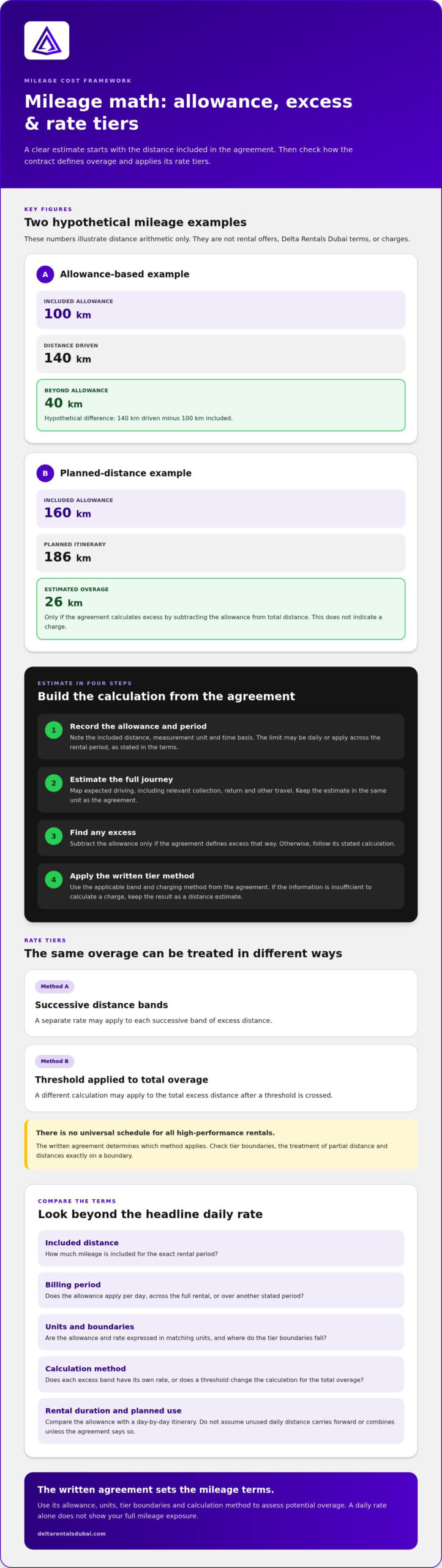
Start with the allowance for the exact rental period. Excess mileage enters the calculation only when the recorded distance exceeds the included amount. Then follow the written tier structure, if one is specified. For example, in a hypothetical illustration only, an allowance of 100 km and a driven distance of 140 km would leave 40 km beyond the allowance. Those figures are for illustration, not a rental offer or Delta Rentals Dubai terms.
Tier boundaries can work in different ways. An agreement might apply one rate to each successive band of excess distance, or use a different calculation for the total overage after a threshold is crossed. The written agreement determines which method applies. Check the units as well: kilometres cannot be compared directly with a limit or rate stated in miles without conversion. General car rental mileage restrictions vary by agreement, so use broad descriptions as background, not as the terms of your booking.
Why high-performance rental terms deserve a close read
Plan your distance around the chosen vehicle and rental duration. A short booking with several planned journeys may use its allowance differently from a longer rental with lighter daily driving. Map your itinerary day by day, then compare the estimate with the allowance stated for that booking. Delta Rentals Dubai offers high-performance rental options, including the Porsche 911 GT3 RS. The mileage terms for a specific vehicle are set out in the written agreement.
The headline daily rate doesn’t show your full mileage exposure. Two offers with similar rates may have different included distances, billing periods or tier boundaries. Compare the written allowance and calculation method alongside the rental duration, then estimate potential overage against your planned use. Understanding excess mileage rate tiers on daily high performance rentals helps you assess the agreement on its terms, rather than relying on the headline price alone.
How to calculate excess mileage on a daily rental
Build your estimate from the written agreement and compare it with the distance you expect to drive. The calculation is straightforward only when the allowance’s time basis and excess-rate method are clear. Treat your result as an estimate until you have applied the booking terms.
Potential excess depends on three inputs: driven distance, the applicable allowance and the rate tier for distance above it. First estimate the relevant distance. Then subtract the allowance if the agreement calls for that calculation, and apply the stated tier method. Don’t use a rate or threshold from another rental.
- Record the allowance and period. Note the distance, unit and time basis in the agreement. The allowance may be daily or apply across the rental period, as specified in the terms.
- Estimate the full journey. Map the planned driving, including relevant collection, return and other travel. Keep the estimate in the same unit as the agreement.
- Find any excess. Subtract the included distance from your estimate only if the agreement defines excess that way. If it specifies a different calculation, follow that wording.
- Apply the stated tier. Use the relevant band and method from the written rate table. If the agreement doesn’t provide enough information to calculate a charge, keep the result as a distance estimate.
A simple method for estimating potential excess mileage
For a clearly labelled hypothetical example, imagine an agreement that includes 160 km for its stated period and a planned itinerary of 186 km. If the contract calculates excess by subtracting the allowance from total driven distance, the estimate is 26 km over. These figures illustrate the arithmetic only. They aren’t Delta Rentals Dubai allowances or rental terms, and they don’t indicate a charge.
Keep a separate estimate for each day if the agreement sets a daily limit. Don’t multiply a daily allowance by the number of rental days unless the contract says the mileage accumulates that way. The ICMA guidance on rental mileage management offers a broader perspective on how clear mileage tracking can help manage rental use.
What to do when a rate table has multiple bands
Read every tier boundary and the method attached to it. A table may apply one rate to all excess distance once a threshold is crossed, or progressive rates to separate portions of the overage. Those approaches can produce different results, so don’t infer the method from the table layout alone. Check the agreement’s wording, including how it treats partial kilometres or miles and distances exactly on a boundary.
Rental duration affects total included distance only when the agreement explains how the allowance applies across multiple days. Don’t assume unused distance from one day carries forward, or that daily limits combine into a trip-wide allowance. Align the vehicle, rental period and itinerary before estimating. A distance forecast based on your plans is more useful than a charge estimate based on assumed terms.
Once you’ve mapped your expected driving, share your rental plans with Delta Rentals Dubai as part of planning a high-performance rental around your intended use. Understanding excess mileage rate tiers on daily high performance rentals means estimating your mileage exposure from the actual agreement, without guessing the allowance or rate.
How to compare excess mileage tiers beyond the daily rental rate
Start a fair comparison with the same planned journey and rental duration for each offer. The advertised daily rate is only one part of the picture. An allowance that fits your itinerary may reduce the chance of excess distance, while different tier wording can change how overage is calculated. Use the written agreement for each figure, and label estimates clearly.
Build a side-by-side comparison using the fields below. Use the same planned distance for each offer so you can compare the terms against one consistent itinerary.
Comparison field | Offer A | Offer B
Daily rate and rental duration | Copy from agreement | Copy from agreement
Allowance and time basis | Distance, unit, and period stated | Distance, unit, and period stated
Planned distance | Your itinerary estimate | Same itinerary estimate
Excess-rate basis | Exact calculation wording | Exact calculation wording
Tier boundaries and method | Each stated boundary and its method | Each stated boundary and its method
Estimated mileage exposure | Apply the agreement to your estimate | Apply the agreement to your estimate
Chat with Delta Rentals Dubai on WhatsApp for assistance with your rental
If a contract doesn’t state a value or method clearly, mark it as unclear rather than filling the gap with an assumption. Keep mileage exposure separate from other agreement terms, such as fuel, delivery, insurance or deposits. Those items may affect the overall rental cost, but they don’t replace the mileage allowance or excess-rate calculation.
Flat excess rates versus contract-defined tier structures
A flat excess rate applies one stated method to the distance beyond the allowance. A tiered structure divides excess distance into contract-defined bands, which may have different rates or calculation methods. Neither format is universal. For the same driven distance, the total may differ if one agreement applies a single rate while another calculates successive bands. Describe each agreement using its exact wording.
The terms that make two mileage offers comparable
Check whether each allowance applies per day, across the booking or over another stated period. Align the units, measurement method, tier boundaries and calculation language before comparing. Put the planned distance and rental duration beside the daily rate, then estimate potential mileage exposure from the written terms. This is the practical foundation of understanding excess mileage rate tiers on daily high performance rentals.
Pay particular attention to tier boundaries. One agreement may explain how it treats a distance exactly on a threshold, while another may describe rounding or partial kilometres differently. Don’t assume either treatment. If your comparison uses a projected itinerary, label it as a planning estimate, not a confirmed charge. This gives you a clearer view of how each offer fits your intended driving without mistaking a low headline rate for the full cost picture.
How to plan daily mileage and reduce surprises
Plan your driving before choosing a rental duration. Start with the journeys you expect to make, then compare your estimate with the allowance and time period in the written terms. Consider how a change of schedule could affect the total distance, especially if you expect to add stops or make extra trips.
Keep your estimate realistic, not artificially exact. Note where your itinerary could change and update the estimate if it does. This helps with understanding excess mileage rate tiers on daily high performance rentals without assuming a particular allowance or charge.
Estimate distance from the itinerary, not guesswork
List each planned stop and driving leg, then total the estimated distance using the same unit as the agreement. Include collection, return or schedule-change driving when it applies to your trip. If you add a stop or change the rental period, revise the estimate and compare it with the written allowance again.
- Map the planned stops and the route between them.
- Add relevant collection and return journeys.
- Note possible itinerary changes, then update the estimate if plans shift.
This gives you a working plan rather than a guess. It also helps you see whether the rental duration fits your intended use, without assuming unused mileage carries over between days.
Review the agreement before collecting the vehicle
Before handover, locate the allowance, its time basis, distance units and any excess-rate tiers. Look for the agreement’s method for recording distance and its treatment of boundaries or partial units. Keep a copy of the written terms so you can compare them with your estimate throughout the rental.
- Check how the mileage allowance applies to your rental period.
- Find the stated tier boundaries and calculation method.
- Record the odometer at handover and return if the agreement uses those readings.
At the start and end of the rental, note the readings in the format the agreement specifies, if applicable. This gives you a reference for comparing recorded distance with your itinerary estimate. Don’t assume a particular tracking or rounding method applies unless it appears in the terms.
For a high-performance rental, a clear plan helps align the vehicle and duration with the journeys ahead. Discuss your intended use with Delta Rentals Dubai as you plan your rental and mileage.
Choose a high-performance rental with mileage terms you understand
The right rental fits your intended drive and has terms you can assess clearly. Before booking, bring together your itinerary, rental duration and the written mileage conditions. This gives you a practical basis for comparing options instead of choosing on the daily rate alone. Delta Rentals Dubai offers high-performance rental options for drivers planning a premium experience in the UAE.
A final mileage-tier checklist before booking
Use this checklist to review the agreement against your plans. Look for the actual wording and units, not assumptions based on another rental or a general description of mileage policies.
- Allowance: Identify the included distance and the exact period it covers.
- Duration: Match the mileage terms to the full rental period and planned daily use.
- Rate structure: Understand how excess distance is assigned to a stated tier and how that tier is calculated.
- Units: Keep the allowance, itinerary estimate and tier boundaries in the same distance unit.
- Total-trip estimate: Compare the planned distance with the agreement and assess potential mileage exposure alongside the daily rate.
Also note the measurement method and any wording about tier boundaries. If a detail is unclear in your comparison, mark it as an assumption rather than treating it as a confirmed term. Keep mileage charges separate from other agreement items so your comparison stays focused on what the mileage clause says.
Make the next step straightforward
Your choice depends on how you plan to use the vehicle, how long you need it and the written mileage terms for that booking. A shorter itinerary may call for a different balance of duration and allowance than a schedule with frequent journeys. Match the rental conversation to your actual plans, not to an assumed universal mileage policy.
Understanding excess mileage rate tiers on daily high performance rentals gives you a practical framework: read the allowance, interpret the calculation and compare your estimate with the trip you expect to make. Bring your intended dates and driving plans into the conversation, especially if your itinerary may change.
To discuss a high-performance rental, share your dates and driving plans with Delta Rentals Dubai on WhatsApp.
Turn your mileage plan into a confident booking
Bring your intended dates and driving plans into the rental conversation. This turns mileage research into a practical decision about the experience you want, guided by the written terms. Understanding excess mileage rate tiers on daily high performance rentals gives you a clearer starting point, while the right fit depends on your plans and the agreement for your booking.
Delta Rentals Dubai specializes in high-performance and luxury rentals, with the Porsche 911 GT3 RS as a priority rental offering. Share what you have in mind and discuss a rental suited to your intended drive, using the written agreement rather than assumed mileage limits or charges.
Discuss your high-performance rental with Delta Rentals Dubai.
Frequently Asked Questions
What does an excess mileage rate tier mean?
An excess mileage rate tier is a contract-defined band that determines how distance beyond the included allowance is charged. A table might divide overage into several bands, but the agreement must explain how each one applies. Check the allowance, unit, boundaries and calculation wording together. There is no single tier structure to assume across daily high-performance rentals, so use the terms for your booking rather than a generic online example.
Is excess mileage charged for every kilometre or mile over the allowance?
It depends on the rental agreement’s calculation method. A contract may apply one stated rate to excess distance or set out several bands with different calculations. Before relying on an estimate, check whether the agreement measures kilometres or miles and how it handles partial units or a distance exactly at a boundary. Don’t assume rounding rules or calculate a charge using another rental’s terms.
How can I estimate whether my trip will exceed the daily mileage allowance?
Compare the allowance with a realistic itinerary, not just the distance between your first and last stops. Include planned return legs and other driving that forms part of your rental use. For example, a day with several separate appointments may cover more distance than a direct outward-and-back journey. Keep the estimate in the contract’s unit and revise it if plans change. The agreement’s tier method is needed to assess any potential overage.
Can unused daily mileage carry over to another rental day?
Rely on carryover only if the written terms expressly allow it. An agreement may define a separate limit for each day, a combined allowance for the booking or another arrangement. Driving less on the first day doesn’t automatically mean you can use that distance on the next. Find the clause that explains the allowance period and carryover treatment. If it’s ambiguous, get the interpretation in writing before planning later journeys around unused distance.
What happens if I return a rental car over its mileage allowance?
The agreement determines how the final distance is recorded and any resulting excess is calculated. Keep a copy of the terms, and note the odometer reading at handover and return if the rental process uses those readings. If your estimate differs from the recorded distance, dated notes can help you review the figures against the contract. Generic online rates may not match your booking, so don’t use them to predict a charge.
Does rental insurance cover excess mileage charges?
Don’t assume insurance covers or cancels mileage charges. These are separate parts of the rental paperwork: review the insurance wording for covered events and the mileage clause for distance-based billing. A policy description about vehicle damage, for example, doesn’t by itself explain how excess distance is treated. Read both sections of the specific agreement before signing. If the wording leaves you uncertain, request a clear written explanation and retain it with your booking documents.
Should I choose a lower daily rate if its mileage allowance is smaller?
Not automatically. Compare offers using the same rental duration and a realistic estimate of your driving, then consider how each agreement handles distance beyond its allowance. A lower daily rate could suit a short, low-distance plan, while a different structure may better fit a longer itinerary. The result depends on the actual terms, not industry averages. Understanding excess mileage rate tiers on daily high performance rentals helps you assess the whole booking against your intended use.