

What if the safest way over a metal road joint isn’t to swerve around it, but to slow down and assess it first? If you’re looking for tips for driving a low clearance supercar in the UAE, it’s natural to worry about a sharp jolt, tyre sidewall damage or a scrape beneath the car. The answer isn’t panic. It’s spotting hazards early and choosing a calm, controlled response.
This guide explains how to assess expansion joints, steep ramps and uneven surfaces before you reach them. You’ll learn when to cross with care, when another route is the smarter choice, and what to do if you suspect the car has made contact. The aim is to protect the tyres and underside while keeping your drive composed.
Whether you’re enjoying a performance car of your own or booking through Delta Rentals Dubai, preparation can make the experience more confident. Look ahead, assess the clearance risk, then decide whether to proceed slowly, stop somewhere safe or turn back.
Key Takeaways
- Learn why the edge, gap or height of a metal expansion joint can matter to low-profile tyres and a car’s underside.
- Use these low-clearance supercar driving tips for UAE roads to spot risky joints, ramps and abrupt transitions early.
- Follow a calm sequence: observe, assess, position safely, cross smoothly, then monitor for warning signs.
- Don’t assume slow speed guarantees protection, or that a quiet crossing means there’s no damage.
- Know when to avoid a route or stop somewhere safe to inspect the car, and use its current documentation for model-specific guidance.
Why metal expansion joints deserve care in a low-clearance supercar
A metal expansion joint connects sections of a road or bridge while allowing for movement, such as expansion and contraction. Its surface may have a gap, raised edge or change in level. Learn more about how metal expansion joints are designed, then assess the surface in front of you. The joint’s actual shape and condition matter more to your car than its name.
A smooth, flush joint may be unremarkable. A damaged, uneven or sharply edged transition deserves more attention because a tyre or low part of the vehicle could meet it abruptly. Contact doesn’t automatically mean damage, but the feature is worth judging before you cross.
What makes a low-profile tyre more exposed?
A tyre’s sidewall is the section between the wheel rim and the road. In a low-profile tyre, that section is relatively short, leaving less tyre material between the rim and an obstacle. Think of a slim band of rubber around the wheel rather than a deep cushion.
If a tyre meets a sharp edge, the contact can be concentrated in a small area. Depending on the edge, tyre condition, pressure, load and the way the wheel meets it, the impact may affect the sidewall or rim. That doesn’t mean damage will happen: a joint isn’t automatically dangerous just because the tyre has a low profile. Follow the vehicle and tyre manufacturer’s guidance over general advice.
Why clearance and tyre protection are separate concerns
Ground clearance is the space between the road and the vehicle’s underside. It’s separate from sidewall height. A tyre can meet a joint while the body clears it, or the tyres can cross while the front lip or another low section comes close to a raised transition.
One road feature can therefore present different risks. A sharp lip may concern the tyre sidewall or wheel rim; a steep change in level may bring the front lip or underside closer to the road. The approach angle, vehicle load and shape of the feature all affect what might make contact. Don’t estimate clearance from appearance or apply one model’s guidance to another.
For low-clearance supercar driving across the UAE, treat each joint as a reason to assess, not a reason to panic. Check the vehicle’s current manual and model-specific instructions for clearance, tyres and operation. This matters especially when driving a performance rental such as a Porsche 911 GT3 RS, whose specifications shouldn’t be guessed from generic supercar advice.
How joints, ramps, and road transitions affect a low-clearance supercar
The shape of a road feature affects how a tyre meets it and how much space remains beneath the vehicle. A flush metal joint may offer a smooth transition. A raised lip can create a sudden step, while a wide gap may leave part of the tyre briefly unsupported. None guarantees damage, but each calls for a different assessment.
Tyre-sidewall exposure is about the wheel meeting an edge; ground-clearance risk is about the vehicle’s underside meeting the road. They’re separate concerns, even when the same joint or ramp presents both. A tyre might cross without the front section clearing a raised transition, or the underside may pass safely while a sharp edge still warrants care around the wheel.
Why the angle and shape of a joint matter
A tyre meeting a sharp lip at an oblique angle may encounter the edge differently from one approaching it more squarely. Where there’s adequate space, clear visibility and no conflict with traffic, a controlled, more direct approach may help avoid striking the edge at a pronounced angle. Don’t steer across lanes or compromise safe positioning to do so. There’s no universal crossing angle: follow the road layout and the vehicle manufacturer’s guidance.
Look beyond the joint itself. Check whether its edges are level with the road, whether the gap is wide or irregular, and whether the surface beyond it rises or falls. A smooth-looking joint can still lead into a sharp change in level; a visible metal strip isn’t automatically a hazard.
Which road features need a slower assessment?
Scan ahead for steep ramps, speed humps, raised entrances, uneven repairs and abrupt transitions between surfaces. These can affect different parts of the car: a hump may challenge the front section as it climbs, while a sharp joint may be more relevant to the tyre and rim. The outcome depends on the feature’s shape and the vehicle’s approach.
Passengers or luggage can change how a vehicle sits, while tyre condition and vehicle setup also matter. Don’t rely on a clearance estimate from another model or assume an unloaded car will behave the same when carrying a load. Use the owner’s manual and model-specific instructions for guidance.
Before committing, make sure you can see the feature clearly and that traffic allows a smooth, lawful path. If visibility is poor, the transition looks severe or a safe alternative route is available, choose caution rather than forcing a crossing. A performance-car drive is more enjoyable when every manoeuvre feels deliberate. If you’re planning one, explore a performance car rental and plan for the road conditions ahead.
Low-profile tyre myths: what careful drivers should and should not assume
Careful driving lowers the chance of a harsh encounter, but it can’t make every road feature safe. A sharp edge, deep gap or abrupt level change may still present a risk, even at low speed. The aim isn’t to treat every joint as dangerous. It’s to judge whether you can cross smoothly and safely, or whether another route makes more sense.
Does crossing slowly eliminate the risk?
Reducing speed can give you more time to assess a feature and maintain control. It doesn’t change the feature’s shape or guarantee that the tyre, wheel or underside will clear it without contact. Avoid sudden braking or swerving, and don’t stop in a live lane or another unsafe position to inspect a road feature.
These tips for driving a low clearance supercar in dubai are about making a considered decision, not forcing a crossing at any cost. If you can’t see the transition clearly or it appears unsuitable for the vehicle, choose a safe alternative where possible.
Can a tyre look fine after an impact?
A visible mark or jolt doesn’t automatically mean the tyre is damaged. The reverse is also true: a quiet, smooth crossing doesn’t prove that the tyre is unharmed. A visual check may reveal an obvious problem, but it can’t confirm the tyre’s internal condition. Watch for pressure loss, a bulge, unusual vibration or a change in handling. If you suspect damage, stop somewhere safe and arrange an inspection by a qualified tyre professional before continuing.
Choose the response that fits the situation:
| Option | Benefit | Limit or caution |
|---|---|---|
| Cautious crossing | May suit a visible, manageable transition when traffic and positioning allow a smooth approach. | Low speed doesn’t remove risk from a sharp edge, gap or unsuitable geometry. |
| Stopping | Allows you to reassess or inspect after a suspected impact. | Only stop where it’s safe. Don’t halt in a traffic lane or exposed position. |
| Rerouting | Avoids a feature you can’t assess or don’t feel the car can clear safely. | Take an alternative only when you can do so safely and lawfully. |
Don’t diagnose damage from appearance alone or dismiss a concern because the car still feels normal. If warning signs appear, prioritise a safe stop and qualified inspection over continuing the drive.
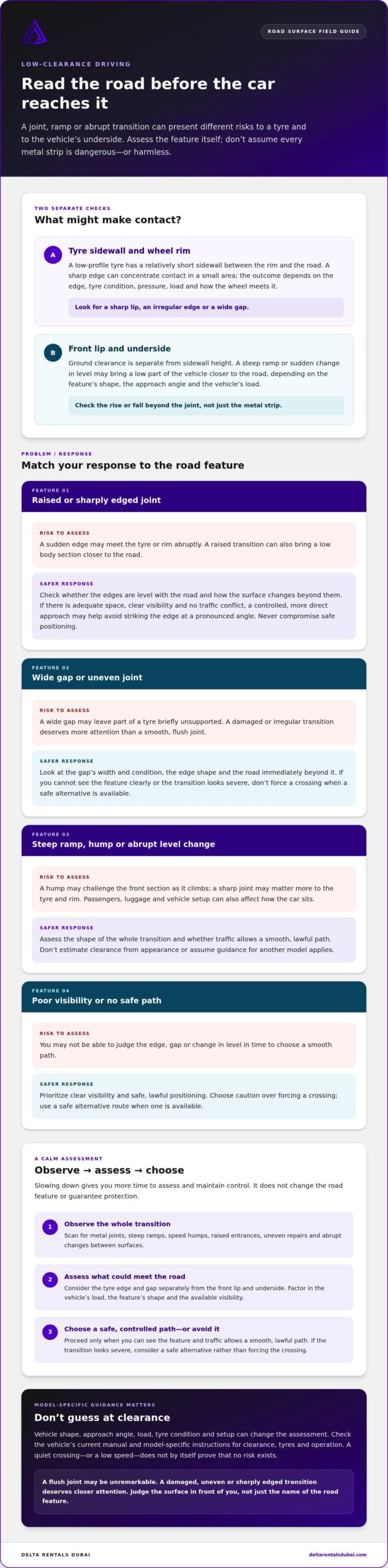
A practical checklist for crossing an expansion joint safely
Use a repeatable routine instead of making a last-second decision. These tips for driving a low clearance supercar in dubai start with traffic awareness: never cross a lane suddenly, move into oncoming traffic or stop where other drivers can’t respond safely.
Quick pre-crossing check: Can you see the joint? Is its shape manageable? Is there a safe, lawful path through? If any answer is no, don’t force it.
- 1. Observe. Scan ahead and identify the joint’s edges, gap, height change and the road surface beyond it. Check visibility, traffic and whether the feature is clear enough to assess.
- 2. Assess. Consider whether the transition looks smooth or abrupt and whether the vehicle’s front section or tyres could meet a raised edge. If you can’t judge the feature safely, plan to stop only in a safe place or take a suitable alternative route.
- 3. Position. Stay in your lane and choose a stable line that doesn’t require sudden steering or braking. Don’t cross into oncoming traffic or make an unsafe lane change to approach at a preferred angle.
- 4. Cross smoothly. If the feature appears manageable and traffic allows, proceed with controlled, steady inputs. Avoid sudden acceleration or sharp manoeuvres. Follow any model-specific crossing guidance in the vehicle’s current manual.
- 5. Monitor. After crossing, pay attention to dashboard warnings, tyre-pressure changes, vibration, pulling or unusual sounds. A smooth crossing doesn’t rule out a problem.
Before crossing: assess the joint and the route
Look for more than the metal strip. A raised edge followed by a steep ramp can present a different concern from a level joint with a clear surface beyond it. Decide early, while you still have room to continue safely, stop at a safe location or reroute. Never brake abruptly or stop in a live lane just to inspect an obstacle.
After crossing: check for warning signs
If you notice pressure loss, vibration, a change in handling, a dashboard alert or an unusual noise, reduce your speed safely and stop somewhere appropriate. Arrange a qualified tyre or vehicle inspection if you suspect damage. Don’t continue at speed or rely only on a quick visual check: appearance can’t confirm a tyre’s internal condition.
Model-specific advice varies. Use the vehicle’s current documentation for tyre, clearance and operating recommendations rather than applying a technique intended for a different car. For a performance-car drive, explore a supercar rental and make preparation part of the experience.
Enjoy a low-clearance performance car with a prepared-driver mindset
Confident driving starts before a road feature appears. Scan ahead, leave room to respond, and keep steering, braking and acceleration smooth. Respect the car’s clearance, and take warning signs seriously rather than assuming a bump was harmless. These habits help make a performance drive composed and enjoyable.
What to consider before driving a performance rental
Before setting off, take time to learn the vehicle’s controls and dimensions. Get comfortable with your seating position, mirrors, visibility and how the car responds to normal inputs. An unfamiliar vehicle can make it harder to judge the front edge or position the car accurately around road features.
Read the current vehicle documentation for model-specific information on tyres, clearance and operation. Follow the rental agreement and applicable road rules, and keep your attention on public-road conditions. Generic advice can’t replace instructions for the specific vehicle you’re driving. If you’re considering the Porsche 911 GT3 RS, explore premium vehicle rental information as part of planning a prepared, responsible drive.
Turn preparation into a more confident drive
Keep the routine simple: look ahead, assess the surface, choose a safe and lawful path, cross only when the feature appears manageable, then monitor how the car feels. Don’t make abrupt corrections to avoid a joint, and don’t let pressure from traffic push you into a manoeuvre that feels unsafe. If you notice a warning, vibration, pressure change, unusual sound or altered handling, stop somewhere safe and take the concern seriously.
A calm approach isn’t about avoiding every imperfect surface. It’s about recognising when a feature is manageable and when another route is wiser. Preparation supports your confidence and focus, so you can enjoy the drive without treating every road transition as a crisis.
If you’re considering a premium performance car rental, discuss a rental through WhatsApp.
Make every performance drive more composed
Metal joints, ramps and uneven transitions call for attention, not alarm. The most useful tips for driving a low clearance supercar in dubai are straightforward: scan ahead, assess the road feature early, keep inputs smooth and choose another route if you can’t judge the risk safely.
Remember that tyre-sidewall concerns and ground-clearance risks are different. A slow, quiet crossing doesn’t guarantee there’s no damage, so pay attention to pressure changes, vibration, warning lights or altered handling. If something feels wrong, stop somewhere safe and arrange a qualified inspection. For model-specific advice, follow the vehicle’s current manual and guidance rather than relying on assumptions.
With responsible preparation, a high-performance drive can feel more confident from the first kilometre. Delta Rentals Dubai specialises in premium and high-performance vehicle rentals, including the Porsche 911 GT3 RS. If you’re considering a premium performance-car rental, discuss a premium performance-car rental with our team. Prepare well, drive thoughtfully and enjoy the experience.
Frequently Asked Questions
Is a low-profile tyre more vulnerable to metal expansion joints?
A low-profile tyre’s shorter sidewall may provide less cushioning between the road and wheel, but that doesn’t mean every expansion joint will cause damage. Risk depends on factors such as tyre condition, vehicle setup, the joint’s shape, speed and the nature of any impact. Follow the vehicle’s guidance. If you notice pressure loss, a bulge, vibration or unusual handling, stop safely and arrange a qualified inspection.
Can I cross an expansion joint diagonally in a low-clearance supercar?
Approach angle can affect how a tyre meets an edge, but crossing diagonally isn’t universally safer. Assess the joint, visibility and traffic before choosing your line. Don’t swerve, make an unsafe lane change or obstruct traffic to change your approach. Keep to a safe road position and follow model-specific guidance. If the joint looks unsuitable or you can’t assess it clearly, choose a safe alternative route.
How should I drive over a metal expansion joint in a supercar?
Scan ahead, assess the joint’s edge and surrounding traffic, then maintain a controlled approach with smooth steering and braking. No technique can promise protection from damage, so don’t force a crossing if the joint looks sharp, raised or difficult to judge. Choose a safe alternative when appropriate. After crossing, watch for warning lights, pressure loss, vibration, unusual sounds or changes in handling.
What happens if a low-profile tyre hits a sharp road edge?
The outcome can range from no apparent issue to visible damage to the tyre or wheel, or damage affecting the vehicle. The impact alone doesn’t confirm what happened, and a normal-looking tyre doesn’t rule out a hidden problem. If the car behaves unusually, stop somewhere safe. Inspect only when it’s safe to do so, and arrange a qualified assessment if you notice warning signs or suspect damage.
Can I tell if my tyre sidewall is damaged just by looking?
A visual check may reveal an obvious cut, bulge or other visible issue, but it can’t reliably rule out internal damage. If you suspect a problem or notice pressure loss, vibration or changed handling, don’t continue at speed. Move to a safe place to stop, then arrange a qualified inspection. Follow the vehicle’s current tyre guidance, and don’t treat a quick visual check as proof that the tyre is safe.
What should I do if my supercar scrapes or strikes an expansion joint?
Stay calm and prioritise safety. Don’t stop where you could put yourself or other road users at risk. Once safely parked, check for dashboard warnings, visible tyre damage, pressure loss, unusual vibration or changes in handling. A scrape or impact doesn’t confirm damage, but warning signs deserve attention. If anything seems unusual, avoid continuing the drive until a qualified professional has assessed the vehicle.