
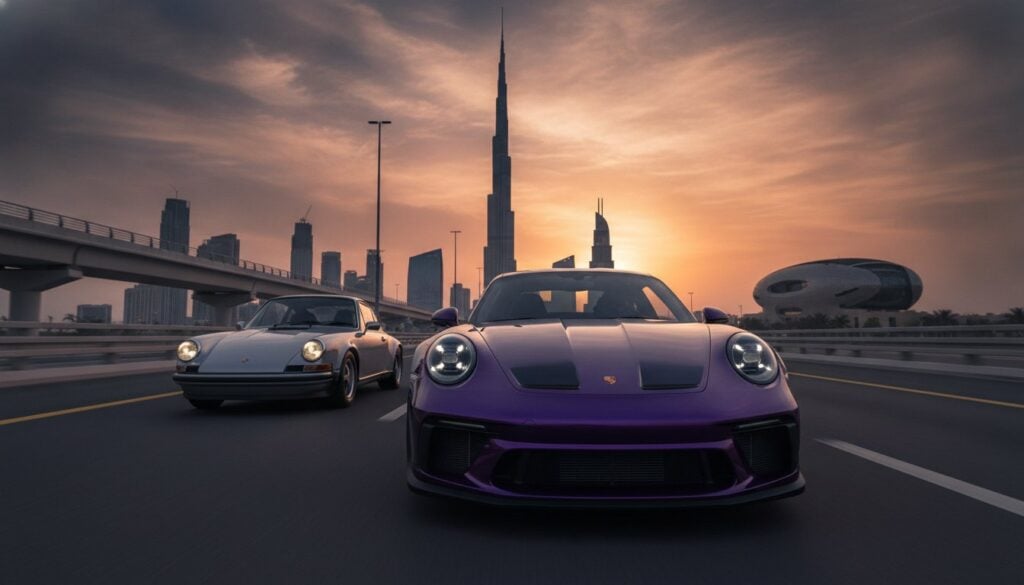
Engineering logic suggests that placing a heavy engine behind the rear axle is a fundamental mistake. Yet, for over sixty years, Porsche has used this “impossible” layout to dominate every racetrack and high-end boulevard on the planet. The history of the Porsche 911 is not just a timeline of car releases; it’s a relentless pursuit of perfecting a single, defiant blueprint. You might feel overwhelmed by the alphabet soup of generation codes like 993, 997, or 992. Perhaps you’re caught in the middle of the heated air-cooled versus water-cooled debate. It’s completely natural to feel lost in the technical jargon of such a storied legacy.
In this article, you’ll discover how a humble 1963 debut transformed into the world’s most versatile high-performance supercar. We promise to demystify the chronological evolution of this icon and highlight the engineering milestones that define its status. You’ll gain a clear understanding of why the rear-engine design works and how decades of motorsport success created the modern GT3 RS. From the early 901 to the cutting-edge tech of today, we’re providing your insider access to a racing legend. Experience how this heritage remains accessible through premium rental options that make an aspirational lifestyle feel straightforward across the UAE.
Key Takeaways
- Trace the 911’s origins from the 1963 Frankfurt Motor Show to the 901 naming dispute that defined its identity.
- Understand how Porsche turned the “impossible” rear-engine layout into a cornering advantage that defies physics.
- Navigate the history of the Porsche 911 by exploring the definitive shift from raw air-cooled power to modern water-cooled innovation.
- Identify the racing DNA that links the classic Carrera RS 2.7 to the extreme performance of the modern GT3 RS.
- Learn how to access this automotive legacy and experience the 911’s prestige on the UAE’s premier highways.
The Birth of an Icon: From the 901 to the First 911
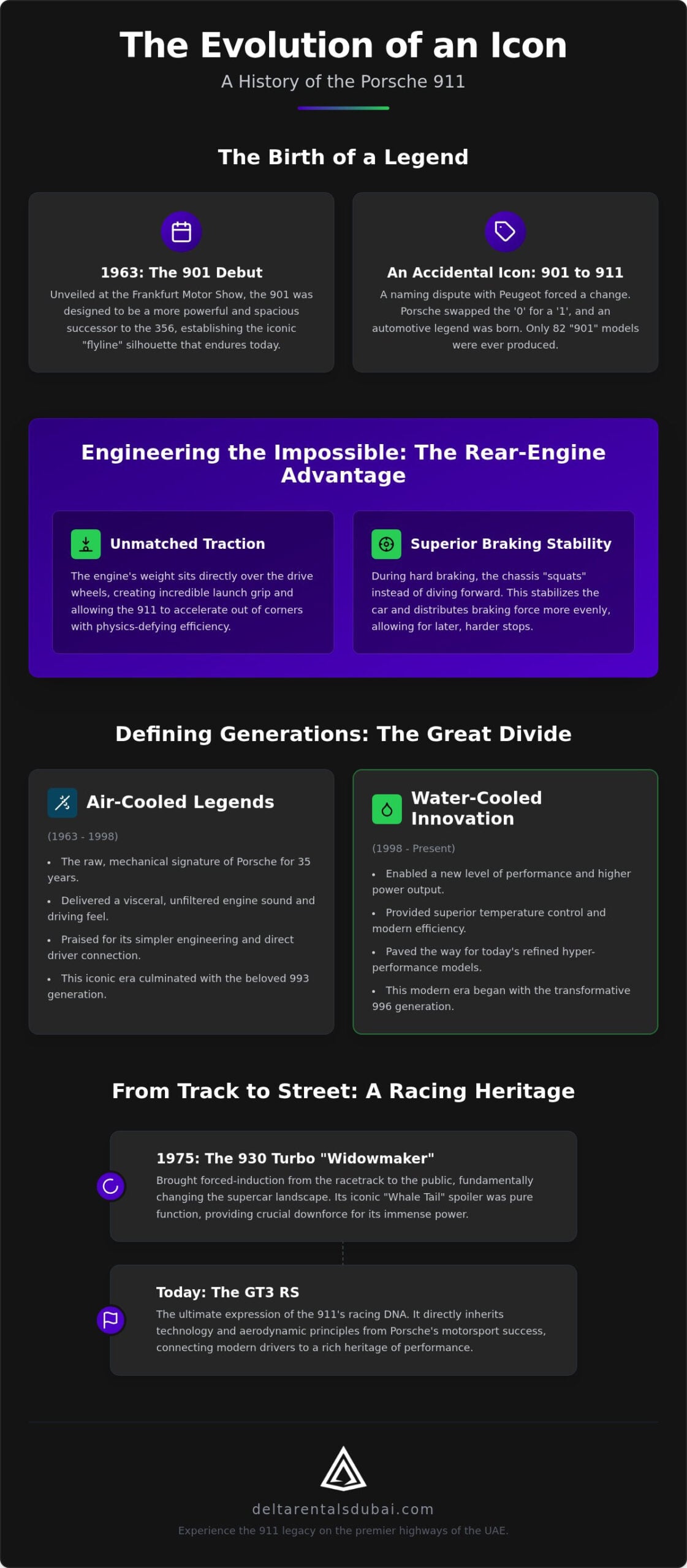
The history of the Porsche 911 began with a significant challenge: how to replace the beloved but aging 356. In 1963, at the Frankfurt Motor Show, the world saw the answer. It was originally unveiled as the 901. Ferdinand Alexander “Butzi” Porsche, grandson of the company founder, envisioned a car that offered more space and power than its predecessor while maintaining a compact footprint. He insisted on a 2+2 layout that allowed for daily practicality without sacrificing performance. This vision created a silhouette so perfect that it remains the benchmark for sports car design sixty years later. While every panel has changed over the decades, the essential “flyline” remains unmistakable.
The Peugeot Naming Dispute
Porsche didn’t choose the number 911 by design; it was a matter of legal necessity. Peugeot held a trademark in France for any three-digit car name with a zero in the middle. To avoid a costly legal battle and ensure they could sell cars in the French market, Porsche simply swapped the zero for a one. Only 82 units were ever produced with the 901 badge, making them some of the most coveted prizes in automotive collecting. You can find deep technical specs on these early variants in this Porsche 911 Wikipedia entry. The 911’s debut stands as the definitive moment the modern sports car was born.
Early Engineering Milestones
The true revolution sat behind the rear axle. Moving away from the 356’s four-cylinder engine, Porsche introduced a 2.0-liter, air-cooled flat-six boxer engine. This layout became the brand’s mechanical signature for the next 35 years. The early engines produced 130 horsepower, a figure that allowed for a top speed of 210 km/h. Engineering a rear-heavy chassis required precise weight management to ensure high-speed stability. Key features of the original engineering included:
- Dry-sump lubrication: This ensured consistent oil flow during hard cornering and high-speed maneuvers.
- Five-speed manual gearbox: A rare luxury at the time that emphasized driver engagement and control.
- Torsion bar suspension: This compact system helped manage the unique weight distribution of a rear-engine car.
This foundation allowed Porsche to build a legacy of reliability and speed. Today, that same spirit lives on in models like the GT3 RS, which you can experience firsthand through premium services at Delta Rentals Dubai. The transition from the 356 to the 911 wasn’t just an upgrade; it was a total reimagining of what a performance vehicle could be.
Engineering the Impossible: The Evolution of Rear-Engine Performance
Critics once argued that placing an engine behind the rear axle defied the laws of physics. They compared the layout to a hammer on the end of a stick, predicting a “pendulum effect” that would make the car impossible to control at high speeds. In the early history of the Porsche 911, this design was seen as a bold gamble. However, Porsche engineers didn’t see a flaw; they saw a hidden opportunity. By leaning into this unconventional blueprint, they developed a car that rewards precision and offers a driving experience unlike anything else on the road. It wasn’t about fixing the layout, but about mastering it.
Traction and Braking Advantages
The 911’s rear-engine bias provides two massive mechanical advantages that mid-engine competitors often struggle to replicate. First, the weight of the engine sits directly over the drive wheels. This creates unmatched launch grip, allowing the car to “dig in” and accelerate with incredible efficiency out of tight corners. Second, during heavy braking, the rear end “squats.” This stabilizes the chassis and distributes braking force more evenly across all four tires. While front-engine cars dive forward, the 911 stays composed, allowing for later and harder braking into every turn. It’s a unique physics-defying trick that has become a hallmark of the 911’s performance DNA.
The Turbo Revolution
In 1975, Porsche fundamentally shifted the supercar landscape by bringing forced induction to the street. The 930 Turbo was born. It was a machine of extremes, combining massive power with the 911’s raw, rear-engine handling. This combination earned it the “Widowmaker” reputation among those who couldn’t respect its power delivery. To manage the immense speed, Porsche introduced the legendary “Whale Tail” spoiler. This wasn’t a mere aesthetic choice; it provided essential downforce to keep the rear planted at triple-digit speeds. This era proved that the history of the Porsche 911 was defined by taming raw energy through functional design.
As technology progressed, electronic stability systems and sophisticated suspension geometry eventually tamed the 911’s aggressive tendencies. Today’s models are as approachable as they are fast, offering confidence-inspiring handling without losing their iconic character. If you’re ready to feel this engineering evolution for yourself, you can reserve a legendary drive and experience the grip of a modern masterpiece. Exploring the fleet at Delta Rentals Dubai is the most straightforward way to step into a legacy of high-performance history.
Defining Generations: Air-Cooled Legends vs. Water-Cooled Innovation
The transition from the 993 to the 996 generation represents the most significant pivot in the history of the Porsche 911. This “Great Divide” saw the brand move away from thirty-five years of air-cooled tradition toward a water-cooled future. While purists initially resisted the change, this evolution was essential for the brand’s survival. It allowed Porsche to meet modern performance demands while keeping the 911 relevant in a changing global market. Understanding these generations is key to appreciating how the car evolved from a quirky sports car into a dominant supercar.
The Air-Cooled Era (1963–1998)
These early generations are defined by a visceral, mechanical connection between driver and machine. The air-cooled engines produced a unique, metallic rasp that no modern exhaust can fully replicate. Collectors today prize the 964 and 993 models for their hand-built quality and compact dimensions. The G-Series, which spanned from 1974 to 1989, remains a favorite for its rugged simplicity and iconic bellows bumpers. The 993 stands as the final masterpiece of this era, blending classic aesthetics with the first truly modern multi-link rear suspension system.
The Water-Cooled Era (1999–Present)
In 1999, the 996 arrived to save the company from financial ruin. It featured the controversial “Fried Egg” headlights and shared internal components with the Boxster to streamline production. Despite the initial backlash from traditionalists, it was a commercial triumph. This shift to water-cooling allowed for four-valve cylinder heads, significantly boosting power while meeting strict global emissions standards. Subsequent generations refined this formula further. The 997 returned to classic round headlights, while the 991 introduced the lightning-fast PDK dual-clutch transmission.
Today, the 992 generation has perfected the balance of the “daily driver supercar.” It’s wider, faster, and more technologically advanced than any predecessor, yet it retains that unmistakable rear-engine soul. You don’t have to be a lifelong collector to appreciate this engineering journey. The current 992 GT3 RS represents the absolute peak of this water-cooled evolution. It’s a track-ready weapon that remains accessible through the elite fleet at Delta Rentals Dubai. Experience the high-status reality of sixty years of development without the barriers of traditional ownership.
The GT3 RS Heritage: How Racing DNA Reshaped the 911
The “RS” badge, standing for Rennsport or “racing sport,” represents the most aggressive chapter in the history of the Porsche 911. This philosophy is straightforward. Strip away everything unnecessary and sharpen every mechanical edge. It’s a pursuit of purity that prioritizes lap times and driver engagement over cabin insulation or soft ride quality. While other manufacturers chase raw horsepower numbers, Porsche uses the RS line to master the relationship between weight, balance, and airflow. This dedication to motorsport has turned a road car into a consistent podium finisher across global endurance series.
The 1973 Carrera RS 2.7 serves as the definitive blueprint for this legacy. It was the first 911 to feature a front and rear spoiler, including the famous “ducktail” that reduced lift at high speeds. By using thinner steel and removing rear seats, Porsche created a machine that was lighter and faster than anything else in its class. This commitment to naturally aspirated engines continues today. While the Turbo models focus on effortless torque, the GT3 RS relies on a high-revving 4.0-liter flat-six that screams to a 9,000 RPM redline. It offers a throttle response that turbochargers simply cannot replicate.
Track-Bred Aerodynamics
Modern engineering has transformed the 911 from a sleek sports car into an aerodynamic weapon. The current 992 GT3 RS features a massive swan-neck rear wing and active aerodynamic flaps that adjust in real-time. This technology, including a Drag Reduction System (DRS), comes directly from Porsche’s GT racing programs. It ensures the car stays glued to the asphalt during high-speed cornering. The GT3 RS is the closest experience to a Le Mans racer available to the public. Every vent and fin serves a cooling or downforce purpose, proving that form always follows function in the RS world.
The Ultimate Performance Benchmark
Porsche uses the Nürburgring Nordschleife as its ultimate yardstick for success. The history of the Porsche 911 is written in the seconds shaved off lap times at the “Green Hell.” The current 992 GT3 RS delivers 525 PS from its 4.0L engine, launching from 0 to 100 km/h in just 3.2 seconds. Achieving these records requires extreme weight reduction. Engineers utilize Carbon Fiber Reinforced Plastic (CFRP) for the doors and roof, magnesium wheels to reduce unsprung mass, and even thinner glass for the windows. You can experience this peak of automotive evolution yourself with a Porsche 911 GT3 RS Rental Dubai. It is the living history of Porsche motorsport, offering the most direct way to feel sixty years of racing heritage under your right foot.
Ready to command the most dominant high-performance supercar on the market? Chat with our concierge team on WhatsApp to secure your booking and join an exclusive community of drivers at Delta Rentals Dubai.
Driving History: Experience the 911 Legacy in the UAE
The history of the Porsche 911 finds its most natural home on the expansive, world-class highways of the UAE. Here, the car is more than a vehicle. It’s a definitive status symbol that commands respect from every lane. The unique environment of the UAE, with its perfectly paved roads and high-speed infrastructure, allows the 911’s engineering to shine exactly as Ferdinand Porsche intended. Whether you’re cruising along the coast or navigating the heart of the city, the 911 offers a blend of performance and prestige that few other supercars can match. It’s a machine built for those who value both engineering perfection and effortless style.
The Modern 911 Experience
Arriving in a Porsche 911 means carrying sixty years of winning pedigree with you. The latest models seamlessly combine this historical soul with 2026-level technology. For instance, the newest iterations of the 911 Turbo S now feature advanced powertrains with dual electric turbochargers, boosting output to a staggering 701 horsepower. This evolution ensures the car remains at the absolute peak of the automotive industry. It’s a high-status experience that feels both classic and futuristic. You can easily Rent a supercar in the UAE to see how this racing DNA handles the local climate with GCC-spec cooling systems and precision handling.
Elite Access with Delta Rentals
Ownership of a high-performance icon like the GT3 RS often involves long waiting lists and complex dealer approvals. Delta Rentals Dubai removes these barriers, offering a direct path to the driver’s seat. You can experience the raw power of the GT3 RS without the long-term commitment or the high maintenance costs of traditional ownership. Our fleet includes the latest Porsche 911 GT3 RS, a model that represents the ultimate culmination of the history of the Porsche 911. We pride ourselves on being the most transparent car rental company in the region, ensuring you get exactly what you expect.
We offer a premium, five-star service tailored for international elites and local enthusiasts alike. With no-deposit options and free delivery, we ensure your transition into a high-status lifestyle is as frictionless as possible. Don’t settle for a standard rental when you can command a racing legend. Book your Porsche experience today and discover why we have over 300 five-star Google reviews. Our team acts as your authoritative concierge, making sure every detail of your drive is handled with professional efficiency. It’s time to stop reading about history and start driving it.
Command Sixty Years of Racing Heritage
The history of the Porsche 911 is a masterclass in relentless refinement. From the early naming disputes of the 1960s to the aerodynamic dominance of the modern GT3 RS, this car has consistently defied expectations. You’ve seen how Porsche transformed an “impossible” rear-engine layout into a global performance benchmark. This journey from raw, air-cooled mechanicals to sophisticated water-cooled power proves that some legends don’t just age; they evolve. Now, the technical specs and historical milestones are ready to be experienced firsthand on the open road.
Delta Rentals Dubai makes it simple to step into this legacy. We remove traditional barriers with no-deposit rental options and an elite national delivery service across the UAE. Our 5-star Google reviewed fleet ensures you receive a vehicle that matches the high-status experience you deserve. Why just read about an icon when you can command its power? Experience the Legacy: Rent a Porsche 911 GT3 RS with Delta Rentals today. Your seat in the ultimate racing legend is waiting.
Frequently Asked Questions
What is the most iconic Porsche 911 model in history?
The 1973 Carrera RS 2.7 is widely considered the most iconic model. It introduced the famous ducktail spoiler and established the “Rennsport” philosophy of extreme weight reduction. This model proved that a practical sports car could dominate the racetrack. It remains the spiritual ancestor of the modern GT3 RS, setting a benchmark for performance that still influences the brand’s design language today.
Why is the Porsche 911 engine in the back?
Placing the engine behind the rear axle was a choice inherited from the Porsche 356. This layout allows for a compact 2+2 seating arrangement, providing more interior space than mid-engine competitors. Mechanically, it puts weight over the drive wheels to improve traction and braking stability. Engineers have spent the entire history of the Porsche 911 perfecting this unique balance to create a car that defies traditional physics while delivering unmatched grip.
What do the Porsche 911 generation numbers (991, 992, etc.) mean?
These numbers are internal chassis codes used to distinguish different eras of the car’s development. For example, the 993 was the last air-cooled version, while the 991 introduced a longer wheelbase for better stability. The current 992 generation represents the most technologically advanced iteration. Understanding these codes helps enthusiasts track the chronological history of the Porsche 911 and identify specific engineering milestones across six decades of elite automotive production.
Is the Porsche 911 a reliable supercar for long-distance driving?
The 911 is famous for being the world’s most reliable supercar. Unlike many fragile competitors, it’s designed to handle daily commutes and long-distance tours with ease. In the UAE, these vehicles come with specific GCC specifications, including reinforced cooling systems to manage high temperatures. This robust engineering makes the 911 a practical choice for crossing the country in total comfort without sacrificing high-performance capabilities.
What is the difference between a Porsche 911 Carrera and a GT3 RS?
The Carrera is designed as a refined, versatile grand tourer for everyday use. In contrast, the GT3 RS is a track-bred weapon stripped of non-essential luxuries. It features a naturally aspirated 4.0-liter engine and aggressive active aerodynamics, such as the massive swan-neck rear wing. While the Carrera offers a balanced road experience, the GT3 RS provides raw, unfiltered racing performance that represents the absolute peak of the model line.
When did Porsche switch from air-cooled to water-cooled engines?
Porsche made the definitive switch with the launch of the 996 generation in 1999. This change was necessary to meet stricter global emissions standards and to allow for more powerful, four-valve engine designs. While the transition was controversial among purists at the time, it saved the company financially. It paved the way for the incredible performance levels seen in today’s turbocharged and high-revving naturally aspirated models.
Can I rent a Porsche 911 GT3 RS in the UAE?
You can easily rent the latest Porsche 911 GT3 RS through Delta Rentals Dubai. We provide a premium, transparent service with no-deposit rental options available for qualified drivers. Our fleet is 5-star Google reviewed, ensuring you receive a meticulously maintained vehicle. We offer elite national delivery across the UAE, allowing you to experience this racing legend without the long-term commitment or dealer allocation hurdles of traditional ownership.
How has the 911’s design changed since 1963?
The 911’s design has followed a philosophy of evolution rather than revolution since its 1963 debut. While the car has grown wider and longer to accommodate modern safety tech and larger engines, the core silhouette remains unchanged. The iconic “flyline” roof profile and round headlights are still present in the latest 992 models. This consistency is why the 911 remains the most recognizable sports car shape in the world today.