

The car you own may not be the car you want to drive every month. Switching from full ownership to monthly high performance car swapping can make room for changing tastes and occasions, while reducing responsibilities that continue whether your car is on the road or parked.
Ownership has clear appeal: you choose one vehicle, keep it as long as you like and know what you’ll be driving. But the real cost goes beyond the purchase or finance payment. Insurance, servicing, depreciation and periods when the car sits unused all belong in the calculation. Monthly access offers a different balance, though the rental charge alone won’t tell you whether it suits your driving life.
This 2026 guide compares the practical trade-offs for drivers in the UAE, so you can weigh ownership against monthly rental without relying on headline prices. You’ll see which costs to compare, how mileage limits, insurance, maintenance and vehicle-change terms can affect the decision, and why access to a different performance car may appeal if your preferences shift. By the end, you’ll have a clearer way to choose between the continuity of ownership and the flexibility of monthly access.
Key Takeaways
- Ownership offers control and continuity; monthly rental provides access for an agreed period, with vehicle changes depending on the arrangement.
- Compare the full ownership picture, including depreciation, insurance and servicing, with rental charges and the contract’s terms.
- Consider how often you drive and whether you prefer one familiar car or different high-performance experiences over time.
- Use a practical checklist to clarify your needs, shortlist models and review commitments before deciding whether switching from full ownership to monthly high performance car swapping fits your life.
- Explore Delta Rentals Dubai’s premium fleet, including the Porsche 911 GT3 RS, McLaren Artura and Ferrari rentals, as an alternative to purchasing.
Full ownership or monthly high-performance car access: what changes?
Ownership gives you control and continuity: one car is yours to use, maintain and personalise. Monthly rental gives you access to a selected vehicle for an agreed period, under the rental contract’s terms. The key difference isn’t simply how you pay. It’s whether you want an ongoing commitment to one vehicle or time-limited access that suits a particular need.
Monthly car swapping means renting different vehicles over time, subject to the arrangements and contract terms for each rental. It doesn’t promise frequent exchanges or a fixed rotation. If you’re considering switching from full ownership to monthly high performance car swapping, treat each vehicle change as something governed by its own agreement, not an automatic feature of renting by the month.
What does monthly high-performance car swapping mean?
A monthly rental gives you use of a selected car for a defined period. You can enjoy a high-performance model without purchasing it, then consider another model for a later period if the rental arrangements allow. That differs from buying, where you acquire the vehicle, and from leasing, which follows its own contractual structure. Monthly rental alone isn’t a guaranteed subscription with scheduled exchanges. The Supercar Wikipedia article offers background on the category, from supercars to hypercars. Your practical decision is which car suits your plans and for how long.
| Consideration | Full ownership | Monthly rental access |
|---|---|---|
| Commitment | Ongoing responsibility for a vehicle you own | Access for the agreed rental period |
| Vehicle choice | Continuity with one car | A selected model; later changes depend on arrangements |
| Day-to-day responsibility | You manage the owner’s obligations | Responsibilities follow the rental contract |
| Flexibility | Personalise and keep the car | Consider a different experience over time |
When does owning a performance car still make sense?
Ownership can be the right fit when you drive frequently, know which model you want and value having it available whenever you need it. Familiarity matters: you get used to the car’s controls, driving feel and setup, and can make it your own over time. For example, a driver who uses the same performance car for regular journeys and planned drives may value consistency more than changing models.
That control comes with continuing obligations, even when the car is parked. Owners remain responsible for costs and tasks such as insurance, servicing, registration and managing the vehicle over time. Personalisation also means committing to one car rather than adapting your choice to each occasion. Compare those responsibilities with the actual rental terms before deciding. Neither route is automatically more convenient or better value for every driver.
The simplest test is your pattern of use. If one familiar car earns its place through frequent, predictable driving, ownership may feel natural. If your preferences or occasions vary, monthly access may offer a more adaptable way to experience different performance cars, without assuming a particular swap schedule.
Compare the full commitment: ownership costs, rental terms, and responsibilities
A fair comparison looks beyond a monthly finance payment or rental charge. Full ownership can tie up capital and bring costs that continue between drives. Rental shifts the calculation to the agreed period and its contract terms, but the headline charge alone doesn’t show what you’ll pay or remain responsible for.
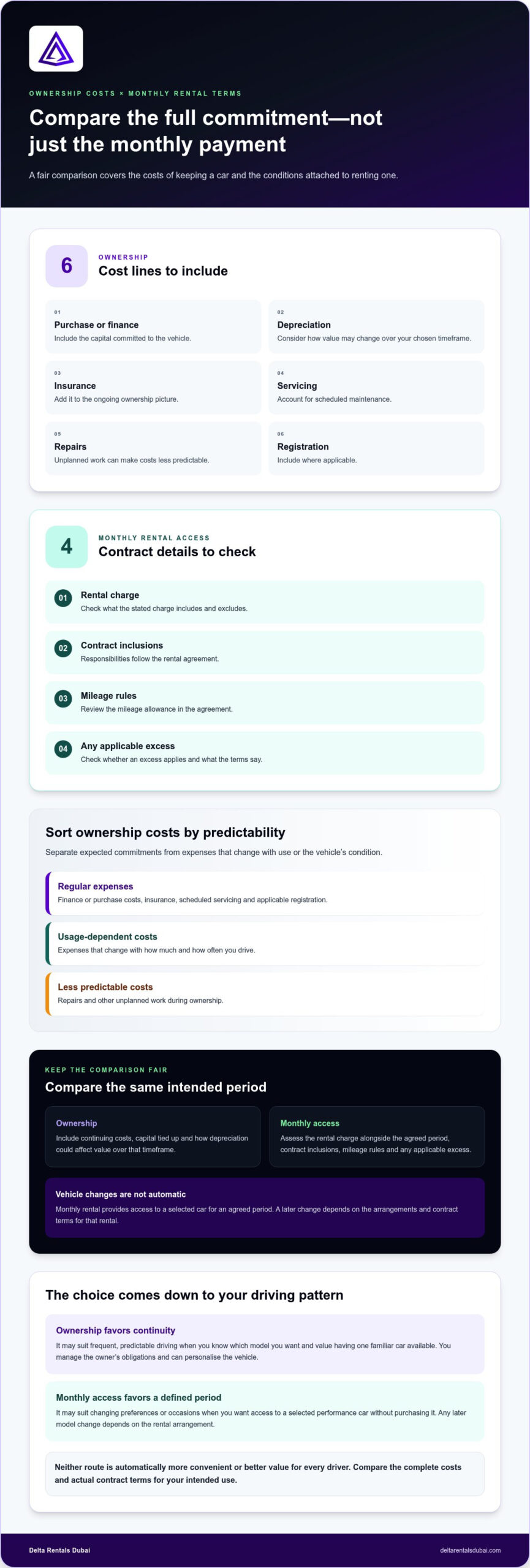
The main cost categories are purchase or finance, depreciation, insurance, servicing, repairs and registration for ownership, compared with rental charges, contract inclusions, mileage rules and any applicable excess for monthly access.
Which ownership expenses belong in the comparison?
Start with the purchase price or finance commitment, and account for capital tied up in the car. Add depreciation, insurance, servicing and registration where applicable. Give repairs their own line: routine maintenance may be planned, while unexpected work can make ownership costs less predictable. The EPA on True Cost of Car Ownership outlines cost categories, though its US context shouldn’t be treated as UAE pricing or guidance.
- Regular expenses: Finance or purchase costs, insurance, scheduled servicing and applicable registration.
- Usage-dependent costs: Expenses that change with how much and how often you drive.
- Less predictable costs: Repairs and other unplanned work during ownership.
For a useful estimate, separate predictable commitments from costs that vary with use or the vehicle’s condition. Then compare the same intended period for ownership and rental. Don’t count the purchase price as if it disappears after one month. Consider how much capital remains committed and how depreciation could affect the vehicle’s value over your chosen timeframe.
Which monthly rental terms should drivers understand?
Read the agreement for the rental period, mileage allowance, insurance provisions and any applicable excess. Identify what the stated rental charge includes and excludes, then note your responsibilities during the rental. Terms can differ between agreements, so don’t assume insurance, servicing or other items are bundled simply because the arrangement is monthly. Use the written contract as the basis for your comparison.
- Period and mileage: Check the rental dates, included distance and how the agreement treats driving beyond its allowance.
- Insurance and excess: Understand the stated cover, your responsibilities and any amount that may apply in a claim.
- Inclusions and exclusions: Record which services or costs the charge covers and which remain yours.
Compare the rental charge plus any costs assigned to you against ownership expenses over the same period and expected use. For example, a driver planning occasional drives should estimate mileage differently from someone expecting regular journeys. Your vehicle, driving pattern and individual agreement all shape the result; there’s no reliable universal total.
If you’re considering switching from full ownership to monthly high performance car swapping, use this checklist before choosing a rental period. The details of monthly high-performance car rental can be considered alongside the driving pattern you’re comparing and the written terms.
Monthly car swapping versus ownership: which approach fits your driving?
The best fit depends on what you want from the car between drives, not just what happens behind the wheel. Ownership can suit a predictable routine built around one favourite model. Rental access may be more appealing if your plans, preferences or occasions change over time. Neither option is automatically less expensive: compare your expected use with the specific rental agreement and the responsibilities you’d keep as an owner.
Think beyond mileage. Do you want the same driving position, controls and character every time, or would you enjoy choosing a different experience for a later period? The Car Subscription Market Analysis discusses subscription services as an access model; it doesn’t establish that every rental includes bundled services or vehicle changes. Let your priorities, rather than a general market trend, guide the decision.
Who benefits most from keeping one performance car?
A single car may suit you if you drive it regularly, value familiarity and want control over your vehicle choice. You can settle into its feel and make personal decisions about how you use or customise it. That continuity has a trade-off: maintenance and other ownership obligations remain yours, including during periods when you drive less than expected.
Who may prefer access to different performance cars?
Rental access can work for drivers whose needs vary by occasion or defined period, or who want to experience different models without purchasing a separate car for occasional use. The model and any later change depend on the rental arrangement, not a guaranteed rotation. For one model-specific example, explore the Porsche 911 GT3 RS guide.
Use this decision matrix to make the trade-offs visible. Rate each point by what matters most in your own driving life:
- Driving frequency: Frequent, predictable use can support keeping one car; occasional or period-specific use may make rental access worth considering.
- Vehicle variety: Choose ownership if one preferred model is enough; consider rental if you’d like different models for different occasions over time.
- Commitment: Decide whether you’re comfortable committing to one vehicle or prefer access for an agreed rental period.
- Responsibility: Consider whether you want ongoing owner duties or prefer responsibilities set out in a rental contract.
For example, a driver who wants the same car for regular journeys may value familiarity more than variety. Someone planning occasional drives around changing preferences may see more appeal in renting a suitable model for a defined period. In either case, compare the expected use and actual agreement details; don’t assume one route always costs less.
Switching from full ownership to monthly high performance car swapping makes most sense when the flexibility to choose a vehicle over time matters more than having one car permanently at hand. If continuity and personal control lead your priorities, ownership may remain the clearer fit.
Make a monthly car decision with this practical checklist
A clear decision starts with your actual driving life, not an idealised estimate. Work through these steps in order to see whether monthly rental access fits your needs better than keeping one car. If you’re considering switching from full ownership to monthly high performance car swapping, be especially precise about how often you’ll drive and what you expect from each rental period.
- Define your use. Estimate how often you’ll drive, the journeys you expect to make and the occasions that matter. Separate regular transport from occasional performance drives. Be honest about time the car may sit unused, and consider whether you need a vehicle consistently or only for specific periods.
- Shortlist models around your priorities. Decide whether performance, comfort, passenger space or presence matters most. A car that suits a special occasion may not be the best fit for everyday needs. Browse the available monthly luxury car rental options as you compare vehicle categories, and treat each model as a choice for a particular purpose rather than assuming one will suit every drive.
- Compare the commitments. Put ownership responsibilities and rental agreement terms side by side for the same expected period and use. For ownership, include the costs and obligations you’d continue to manage. For rental, use the stated charge and contract details, not assumptions about what a monthly arrangement includes. This gives you a more useful comparison than looking at a single headline figure.
- Review the rental terms. Read the actual agreement for its duration, mileage allowance, insurance provisions, applicable excess and permitted drivers. Check payment, delivery and return requirements as written. If you’re considering a different vehicle later, treat that change as subject to agreed arrangements, not an automatic benefit or guaranteed schedule.
- Make the call. Choose ownership if consistent use, one preferred model and personal control carry the most weight. Consider rental if your needs change by occasion or period and you value access without purchasing a vehicle. If the comparison feels close, revisit your driving estimate and contract details before committing.
Keep your notes practical: expected journeys, preferred vehicle category, key contract terms and the responsibilities you’re prepared to take on. That record can reveal whether the flexibility you want is worth more to you than continuity, without assuming either option always costs less.
Rental discussions can focus on your plans and the details that matter in a high-performance car rental.
Explore Delta Rentals’ high-performance fleet as an alternative to ownership
After weighing ownership against rental on your own terms, consider whether access to a premium vehicle for an agreed period better matches your driving plans. Delta Rentals provides premium vehicle rentals across the UAE, including high-performance options such as the Porsche 911 GT3 RS, McLaren Artura and Ferrari models. Rental offers a way to experience a selected vehicle without purchasing it, while leaving the decision about long-term ownership open.
This isn’t a promise of automatic or frequent vehicle changes. The model you choose, rental period and applicable terms are set by the agreement. Use your shortlist and expected driving occasions to focus on the vehicle that fits your plans, then review the actual terms before deciding.
Choose a performance experience that suits the occasion
The Porsche 911 GT3 RS is one high-performance rental option for drivers drawn to a focused sports-car experience. For a contrasting luxury vehicle, the Rolls-Royce Cullinan Black Badge offers a different kind of presence. The right comparison depends on what matters for your drive, whether that’s a performance-car experience or a premium vehicle suited to another occasion. Choose based on your needs rather than assuming one model will suit every journey.
Delta’s premium vehicle rental options also include the McLaren Artura and Ferrari rentals. Treat each as a distinct choice, not a promise that a particular model will be available for every period or that you can exchange vehicles on a set schedule. Your agreement defines the rental period and applicable responsibilities.
Take the next step from ownership comparison to rental
The decision comes back to how you want to access a car. Keep one vehicle if continuity and ongoing personal control are central to your driving life. Choose rental access if a particular model suits a defined period and you’d rather not purchase a car for that experience. Switching from full ownership to monthly high performance car swapping can be worth exploring when your preferred vehicle may change over time, but let the arrangement and contract terms shape your expectations.
Before you decide, have your preferred model or vehicle category, intended rental period and likely use in mind. Then assess the written agreement against your priorities, including its stated mileage, insurance provisions and responsibilities. This keeps the choice practical, without relying on assumed inclusions, savings or vehicle changes.
Rental details and vehicle choices are available through high-performance rental enquiries.
Choose the driving experience that fits your next chapter
Your next step doesn’t have to settle every future car decision. Use a rental period to explore what you genuinely enjoy driving, then decide whether you value one familiar vehicle or the freedom to choose differently over time. The right approach is the one that fits your routine, priorities and appetite for ongoing responsibility.
Delta Rentals’ premium fleet includes Porsche 911 GT3 RS and McLaren Artura rentals, alongside Ferrari options. The business also offers monthly rentals and supercar and luxury car memberships. Treat each as a route to consider, and let your needs and the relevant agreement guide the choice.
If switching from full ownership to monthly high performance car swapping feels like a better match for how you drive, take the next step with a clear idea of your preferred vehicle and rental period. Discuss your high-performance rental options with Delta Rentals. A considered choice can make your next drive feel distinctly your own.
Frequently Asked Questions
Is monthly rental a better alternative to owning a high-performance car?
Monthly rental can be a better fit if you want access to a performance car for a defined period without taking on the purchase commitment. Ownership may suit you more if you drive one preferred car regularly and value having it available at all times. To assess switching from full ownership to monthly high performance car swapping, compare your actual driving pattern and priorities, not just the rental charge against a finance payment.
Can you change high-performance rental cars every month?
Not automatically. Renting for a month doesn’t by itself guarantee that you can exchange cars when the period ends. A change depends on the rental arrangements, the next agreement and the vehicle options for that period. Before planning around a new model, look for written details covering the current rental’s end date and the terms for a subsequent vehicle. Treat swapping as an agreed possibility, not a built-in monthly entitlement.
How much does it cost to own versus rent a performance car monthly?
There’s no single figure that applies to every driver or vehicle. Build an ownership estimate for the period you’re comparing, then set it beside the rental charge and any other amounts stated in the rental agreement. For example, a driver who covers little distance may face a different ownership calculation from someone who drives daily. Use actual figures for your chosen car and expected use, rather than a general market estimate.
What happens if my monthly rental needs change before the agreement ends?
Your options depend on the agreement you accepted. If your plans shift, read its cancellation, extension or amendment terms before assuming you can return the car early or change vehicles. A work schedule change, for instance, might affect how long you need the vehicle, but it doesn’t automatically change the agreed rental period. Keep a copy of the contract and follow its stated process for any requested change.
Is insurance included when renting a high-performance car?
Insurance provisions vary, so don’t assume cover is included in a particular form or that every claim is handled the same way. Read the agreement for the stated coverage, exclusions, driver requirements and any applicable excess. Check how the terms apply to your intended use before driving. For a Delta Rentals vehicle, rely on the specific agreement for the selected vehicle and period rather than a general expectation about premium car rentals.
Can I rent a different performance car for each occasion?
You can choose different rental vehicles for separate occasions if the relevant rental arrangements and vehicle options support those plans. For example, you might prefer a sports car for a personal drive and a luxury SUV for an occasion involving passengers. Each booking is a separate decision, so plan around its own dates and terms. Don’t assume a previous rental includes an automatic exchange or secures a later vehicle.
What should I compare before switching from car ownership to monthly rental?
Compare the same timeframe and likely mileage on both sides. For ownership, use your own finance or purchase figures and records of ongoing expenses; for rental, use the written charge and agreement terms. Also consider how often you need a car, whether you need it for daily transport, and how much flexibility matters. A realistic estimate of your next few months’ driving can make the comparison more useful than an idealised plan.