
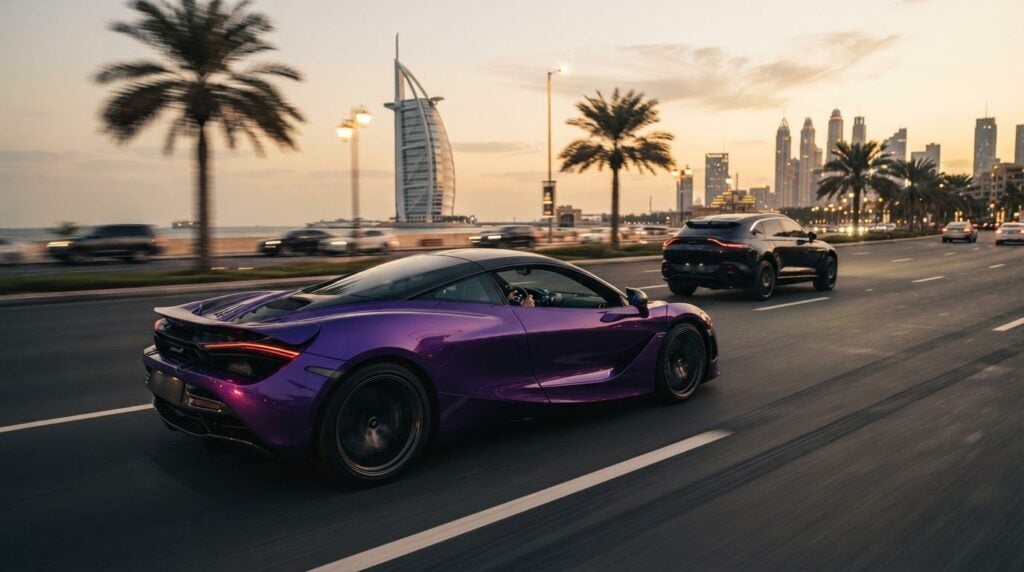
Supercar transmissions aren’t automated convenience features. They’re precision mechanical tools engineered for complete control. Stepping behind the wheel can feel intimidating when cockpits swap traditional stick shifts for sculpted levers and aggressive track software. Mastering supercar transmission types and paddle shifting transforms that initial hesitation into pure driving authority.
You’ve likely felt overwhelmed by engineering acronyms like DCT, PDK, and AMT, or worried about pulling a paddle at the wrong RPM and damaging a high-strung engine. You aren’t alone. Today’s top-tier dual-clutch gearboxes swap ratios in as little as 8 milliseconds, relying on sophisticated electronic logic. You’ll uncover the real mechanics behind dual-clutch, automated manual, and three-pedal systems, alongside the practical techniques required to execute flawless upshifts and downshifts. From mechanical pre-selection quirks to paddle ergonomics across premier marques, this guide hands you the technical clarity to command any exotic transaxle with complete confidence.
Key Takeaways
- Discover how alternating twin-clutch architecture pre-selects gear ratios to execute seamless power delivery without torque interruption.
- Compare core supercar transmission types and paddle shifting systems to see how modern dual-clutch boxes balance track responsiveness with urban refinement.
- Learn the exact paddle-pull timing and chassis drive-mode selections needed to prevent drivetrain strain and maximize acceleration out of every corner.
- Understand the tactical advantages between column-mounted and wheel-mounted paddles, including advanced shortcuts like continuous multi-gear downshifts.
- Identify how distinct transmission calibrations across elite platforms like Porsche, Ferrari, and McLaren shape your hands-on driving experience.
What Are Supercar Transmission Types and Paddle Shifting Mechanisms?
A supercar transmission is engineered to handle brutal torque loads without breaking vehicle composure. Shifting in high-performance environments isn’t just about swapping ratios; it’s about preserving aerodynamic balance and tire traction. The direct relationship between supercar transmission types and paddle shifting defines how efficiently power reaches the asphalt. When gear changes happen in milliseconds, the chassis stays level, mid-corner stability remains undisturbed, and acceleration feels relentless.
Defining the Core Gearbox Technologies
Modern performance engineering divides high-output drivetrains into three primary architectures:
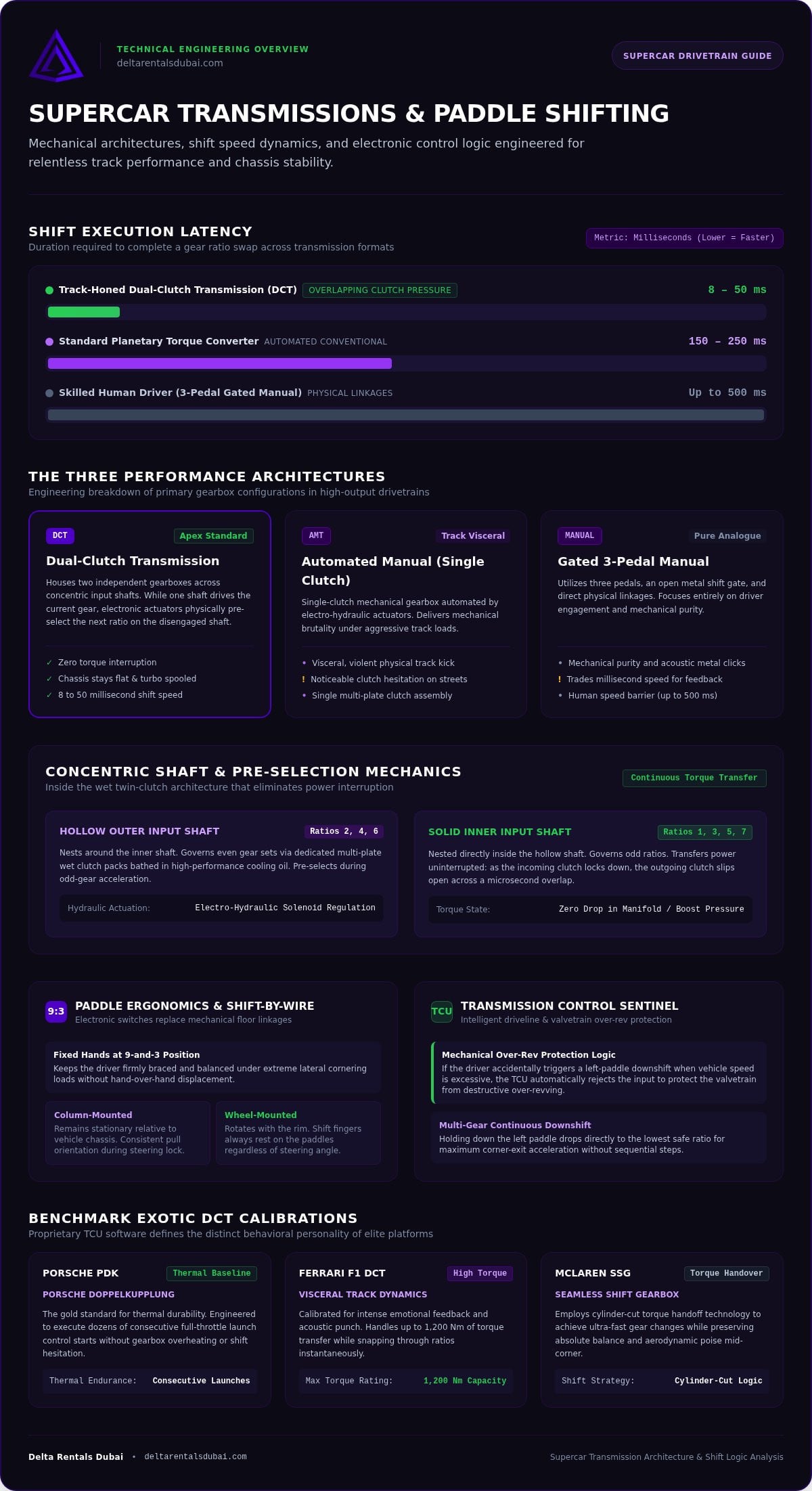
- Dual-Clutch Transmissions (DCT): Contemporary exotics rely heavily on sophisticated dual-clutch transmission architecture. This system houses two independent gearboxes inside one unit, split across concentric input shafts. One shaft controls the odd gears while the other manages the even gears. While you accelerate in second gear, electronic actuators physically pre-select third gear on the disengaged shaft. When you call for an upshift, one clutch disengages as the other simultaneously locks in, transferring drive torque without power interruption.
- Automated Manual Transmissions (AMT): These systems feature a single-clutch mechanical gearbox automated by electro-hydraulic actuators. They produce a visceral, physical kick during aggressive track shifts, though they exhibit noticeable clutch hesitation during casual street driving.
- Gated Manuals: Three-pedal setups utilize physical linkages and an open metal shift gate. They trade millisecond shift speeds for mechanical purity and analogue feedback.
The Mechanical Purpose of Paddle Shifters
Paddle shifters eliminate physical floor linkages in favor of shift-by-wire electronic switches. Mounted either to the steering column or directly to the wheel spokes, they let you command upshifts and downshifts without removing your hands from the 9-and-3 driving position. This tactile setup keeps you firmly planted during heavy lateral cornering loads.
Mastering supercar transmission types and paddle shifting mechanisms requires zero anxiety about mechanical failure. Modern Transmission Control Units (TCUs) act as vigilant electronic sentinels. If you accidentally pull the left downshift paddle while vehicle speed is too high, the TCU rejects the input to protect the valvetrain from over-revving. You get razor-sharp responsiveness backed by comprehensive driveline protection.
How Modern Supercar Dual-Clutch Transmissions Achieve Millisecond Shifts
Shift speed dictates whether an exotic car feels like an untamed rocket or an interrupted surge. While standard planetary automatics take 150 to 250 milliseconds and skilled human drivers take up to 500 milliseconds with a three-pedal manual, track-honed wet DCTs execute gear swaps in a blistering 8 to 50 milliseconds. Studying supercar transmission types and paddle shifting shows that this speed comes down to overlapping clutch pressure rather than raw mechanical force.
The Architecture of Twin-Clutch Systems
A closer look at how dual-clutch transmissions achieve millisecond shifts reveals remarkable packaging. Two concentric input shafts nest inside each other. The hollow outer shaft drives even ratios, while the solid inner shaft spins odd ratios. Electro-hydraulic solenoids regulate fluid flow to multi-plate wet clutch packs bathed in high-performance cooling oil. As the incoming clutch locks down, the outgoing clutch slips open across a microsecond overlap window. Power flows unbroken to the wheels, keeping turbochargers spooled and weight distribution completely flat.
Benchmark Dual-Clutch Implementations: PDK, F1 DCT, and SSG
Each premier manufacturer writes bespoke Transmission Control Unit (TCU) software to define the car’s personality:
- Porsche Doppelkupplung (PDK): The gold standard for thermal durability. You can launch a track-bred GT car dozens of times consecutively without gearbox overheating or shift hesitation.
- Ferrari F1 DCT: Tuned for visceral emotional feedback. It handles up to 1,200 Nm of torque transfer while snapping through ratios with instantaneous acoustic punch.
- McLaren Seamless Shift Gearbox (SSG): Employs cylinder-cut torque handoffs on wide-open throttle, delivering an explosive surge during high-rpm paddle clicks.
Modern hybrid transaxles elevate this architecture even higher. Powertrains like the one found in the McLaren Artura blend electric motor torque straight into the driveline during gear transitions. This eliminates shift shock entirely and allows engineers to delete physical reverse gear mechanisms to save crucial chassis weight. If you want to experience these engineering marvels on open roads, you can reserve an elite supercar rental tailored for pure performance.
Comparing Supercar Transmission Types: DCT vs. Single-Clutch vs. Torque Converter
Selecting the right gearbox architecture comes down to balancing shift velocity against daily refinement. No single layout does everything without compromise. Evaluating supercar transmission types and paddle shifting dynamics requires looking at how each gearbox manages friction, weight, and torque delivery under pressure.
Dual-Clutch Transmission (DCT) Strengths and Limitations
Dual-clutch units dominate modern exotic fleets for good reason. They offer an effortless dual personality. In automatic mode, shifts glide imperceptibly during stop-and-go driving. Switch to manual mode, and the gearbox delivers instantaneous ratio changes on full throttle. The primary trade-off is mechanical mass; housing twin multi-plate clutches and complex hydraulic solenoids adds weight to the rear transaxle. Still, as detailed in any comprehensive guide to using paddle shifters, DCTs remain the ultimate benchmark for tactile driver control without driveline hesitation.
Single-Clutch Automated Manuals: Raw Track Character
Single-clutch automated manual transmissions (AMTs) prioritize minimal weight and motorsport drama over road manners. Found in celebrated track icons and earlier generations of mid-engine exotics, these systems use high-pressure hydraulic actuators to slam a single clutch disc into gear. When driven at ten-tenths, they produce a visceral punch that many purists adore. At low speeds, however, they shudder and hunt. Drivers must consciously lift off the throttle pedal right as they click the upshift paddle to smooth out the transition.
Performance-Tuned Torque Converters in Grand Tourers
Planetary torque-converter automatics have evolved dramatically. Modern high-output grand tourers and flagship performance SUVs frequently utilize reinforced torque converters with rapid lock-up clutches. They excel at smooth low-speed crawling and manage sustained high-speed cruising with supreme cabin refinement. While their 150-millisecond shifts feel remarkably swift, they lack the immediate, razor-edge mechanical bite delivered by a dedicated dual-clutch unit during high-rpm track work.
How to Use Supercar Paddle Shifters: A Driver’s Guide
Operating a high-horsepower machine requires more than clicking tactile levers at random. It demands an appreciation for chassis balance and engine harmonics. Proper technique across different supercar transmission types and paddle shifting interfaces turns raw mechanical speed into composed, repeatable performance.
Column-Mounted vs. Steering-Wheel-Mounted Paddles
Different marques take contrasting approaches to paddle ergonomics:
- Column-Mounted (Ferrari, Lamborghini): Massive carbon levers stay fixed to the steering column. You always know that the right paddle commands upshifts and the left commands downshifts, even while unwinding steering lock past 90 degrees.
- Wheel-Mounted (Porsche, McLaren): The paddles rotate directly with the rim. Keeping your hands anchored firmly at the nine-and-three position guarantees instantaneous fingertip reach through sweeping, high-speed bends.
Precision Downshifting and Corner Entry Balance
Downshifting isn’t just about slowing down; it sets up your corner exit. Always complete heavy braking in a straight line before pulling the left paddle. Modern electronic systems automatically execute lightning-quick throttle blips to match engine RPM to gearbox input speed. Never hammer a downshift mid-corner while loaded under maximum lateral grip, as the sudden shift in engine braking torque can break rear-tire traction.
Common Paddle Shifting Mistakes to Avoid
Fine-tuning your paddle technique separates smooth drivers from erratic ones. Watch out for these three frequent habits:
- Short-shifting turbo platforms: Clicking the upshift paddle too early drops the engine below its boost threshold, creating sluggish lag. Let the rev counter climb into the meat of the torque band.
- Bouncing off the rev limiter: Pull the right paddle roughly 500 RPM before redline. Gearbox shifts take milliseconds, but human reaction time takes longer.
- Overriding during low-speed parking: Let automatic mode handle creeping at single-digit speeds to prevent unnecessary clutch wear and clutch cycling.
Ready to feel that crisp, tactile click for yourself behind the wheel of a track-ready exotic? You can book your next supercar experience directly on WhatsApp with our concierge team today.
Choosing Your Transmission Experience: How to Experience Elite Supercars
Reading about transmission engineering is informative, but pulling a carbon paddle at wide-open throttle delivers an understanding that spec sheets simply cannot match. Exploring various supercar transmission types and paddle shifting setups firsthand reveals how bespoke calibrations shape your driving intensity, transforming an ordinary journey into an unforgettable event.
Match the Transmission to Your Driving Ambition
Every exotic platform brings a distinct mechanical personality to the asphalt:
- Porsche 911 GT3 RS: Experience the benchmark PDK dual-clutch gearbox. It delivers relentless, laser-precise gear swaps that extract maximum pace from a screaming 9,000-RPM naturally aspirated flat-six.
- McLaren Artura: Discover cutting-edge hybrid engineering. Its lightweight eight-speed twin-clutch transaxle pairs with an axial-flux electric motor, filling torque gaps instantly for smooth, continuous forward thrust.
- Ferrari and Lamborghini Lineups: Immerse yourself in pure acoustic drama. Tactile column-mounted paddles command explosive upshifts and sharp throttle blips, letting you harness the vocal fury of mid-mounted V8 and V10 powerplants.
Seamless Access Through Transparent Vehicle Hire
Evaluating these elite gearboxes does not require ownership commitments or steep depreciation costs. Securing seat time in a pristine high-performance vehicle lets you compare track-honed dual-clutch transmissions under real-world conditions with complete confidence.
Through Delta Rentals, you gain direct access to a national fleet of meticulously vetted supercars. Every vehicle undergoes rigorous driveline inspections to ensure clutches, cooling circuits, and electronic actuators perform flawlessly. With straightforward booking terms, no-deposit options across the country, and white-glove customer care, stepping into the cockpit is effortless. Choose your machine, grip the steering wheel, and command engineering excellence with every click of the paddle.
Take Command of Precision Supercar Engineering
Mastering supercar transmission types and paddle shifting unlocks the full capability of modern exotic engineering. Dual-clutch gearboxes swap ratios in mere milliseconds, delivering uninterrupted acceleration while onboard control units safeguard the driveline. Whether you prefer the stationary precision of column-mounted paddles or the fluid agility of wheel-mounted levers, actual seat time turns mechanical theory into second nature.
Experiencing these world-class drivetrains firsthand has never been more straightforward. Delta Rentals provides an extensive national fleet featuring icons like the Porsche 911 GT3 RS and McLaren Artura, backed by over 300 5-star customer ratings nationally. With transparent terms and no security deposit required, stepping into the cockpit is effortless. Reserve your elite supercar with Delta Rentals today, grip the wheel, and discover how exhilarating complete shifting control can be.
Frequently Asked Questions
Can you damage a supercar transmission by shifting incorrectly with paddles?
No, you cannot damage the gearbox during normal driving because modern transmission control units employ strict digital safeguards. If you accidentally pull a downshift paddle while vehicle speed is too high, the electronic brain simply ignores the command. This lockout prevents over-revving and catastrophic engine damage. Upshifts won’t engage if vehicle speed drops too low, ensuring the mechanical driveline stays fully protected against driver error.
What is the difference between column-mounted and wheel-mounted paddle shifters?
Column-mounted paddles remain stationary on the steering column, while wheel-mounted paddles rotate directly with the steering wheel rim. Ferrari and Lamborghini favor column-mounted designs, giving drivers a fixed spatial reference point during aggressive cornering. Porsche and McLaren mount paddles to the wheel, allowing fingertip actuation without adjusting your hand position on sweeping bends. Understanding these supercar transmission types and paddle shifting variations helps you adapt quickly to any cockpit layout.
Is a dual-clutch transmission faster than a professional driver in a manual?
Yes, modern dual-clutch gearboxes shift substantially faster than any human driver can physically manage. A seasoned professional shifting a traditional three-pedal manual takes between 250 and 500 milliseconds to depress the clutch, slot the lever, and re-engage drive. In contrast, high-performance wet DCTs execute complete gear changes in just 8 to 50 milliseconds without cutting engine torque, resulting in superior acceleration times and uninterrupted longitudinal stability.
Do you need to lift off the throttle when pulling an upshift paddle?
No, you should keep your foot firmly planted on the throttle pedal when executing upshifts in a dual-clutch supercar. Unlike older single-clutch automated units that required a brief throttle lift to smooth shifts, modern dual-clutch systems are engineered to shift under continuous full load. Lifting off the throttle interrupts turbo boost and confuses the transmission control software, which slows down the shift and disrupts vehicle momentum.
Why do modern supercars no longer come with traditional manual stick shifts?
Manufacturers phased out manual transmissions because human reaction times cannot match the speed, emission targets, and extreme power levels of modern supercars. Current exotic engines produce massive horsepower and instant torque that can easily shred conventional clutch friction plates under aggressive launches. Additionally, integrated active aerodynamics, stability control, and hybrid torque-fill systems require millisecond driveline integration that only computerized dual-clutch boxes can deliver.
Can you drive a paddle-shifted supercar in fully automatic mode?
Yes, virtually all modern paddle-shifted exotics feature a fully automatic drive mode. When exploring different supercar transmission types and paddle shifting options, you don’t have to shift manually at all times. Pressing the automatic selector button prompts the onboard computer to handle all upshifts and downshifts seamlessly. This setup lets you navigate congested traffic with the calm comfort of an executive sedan before toggling manual mode on open roads.
What causes the loud exhaust crackle or pop when shifting gears in a supercar?
The distinctive acoustic crackle or bang during high-rpm upshifts results from deliberate ignition cuts executed by the engine management software. To protect internal clutch packs and speed up gear engagement, the engine momentarily cuts spark or retards ignition timing. A tiny amount of unburnt fuel vapor escapes directly into the glowing-hot exhaust manifold, igniting instantly to produce that signature track-inspired sonic crackle.