

What if the lift that protects your supercar’s front splitter still isn’t enough to clear a speed bump safely? When using supercar front axle lift for dubai speed bumps, treat it as temporary extra clearance, not permission to approach quickly or ignore the obstacle’s shape. A low splitter can scrape, and unfamiliar controls can make an ordinary road feature feel stressful.
This guide explains what a front-axle lift can and can’t do, when to raise and lower it, and how it differs from electronic damper adjustment. You’ll also find a practical approach for assessing speed bumps and uneven surfaces, so you can make a more informed decision instead of relying on the lift alone.
Equipment and controls vary by vehicle, and a lift isn’t confirmed on every rental. Before driving, ask whether your specific car has one and request instructions for its system. Delta Rentals Dubai offers a Porsche 911 GT3 RS rental, but confirm the equipment and operating procedure for the individual vehicle before setting off.
Key Takeaways
- Learn why low front splitters are vulnerable when road height changes abruptly, and what extra clearance may help with.
- Understand the difference between a front-axle lift and electronic damper tuning before choosing a setting.
- When using supercar front axle lift for dubai speed bumps, follow the vehicle manual and account for current traffic conditions.
- Recognise that a lift can’t guarantee clearance if the bump is steep, the approach is unsuitable, or speed is excessive.
- Before driving a rental, confirm the exact vehicle’s lift fitment, control location, and operating instructions with the rental team.
Why a Supercar Front-Axle Lift Helps at Speed Bumps
A front-axle lift temporarily raises the front end of a vehicle when the feature is fitted. The added clearance may help a low nose pass over some raised surfaces, including certain speed bumps. It is a useful aid, not a guarantee against damage.
That distinction matters when using supercar front axle lift for dubai speed bumps. The lift may create more room for the front splitter, but the bump’s profile, the car’s approach and the system’s limits all affect whether there is enough clearance.
What does a front-axle lift actually raise?
When activated, the system raises the vehicle’s front end to increase clearance at the nose. The amount of lift, activation conditions and control location depend on the vehicle. Fitment can also vary by specification, so don’t assume a particular model or rental car has the feature.
Check the owner’s manual for the correct procedure. If you’re renting, ask the provider to confirm whether the specific vehicle is equipped, where the control is and how the system works. Don’t rely on a button’s appearance or instructions for a different car.
Why can speed bumps challenge low-clearance cars?
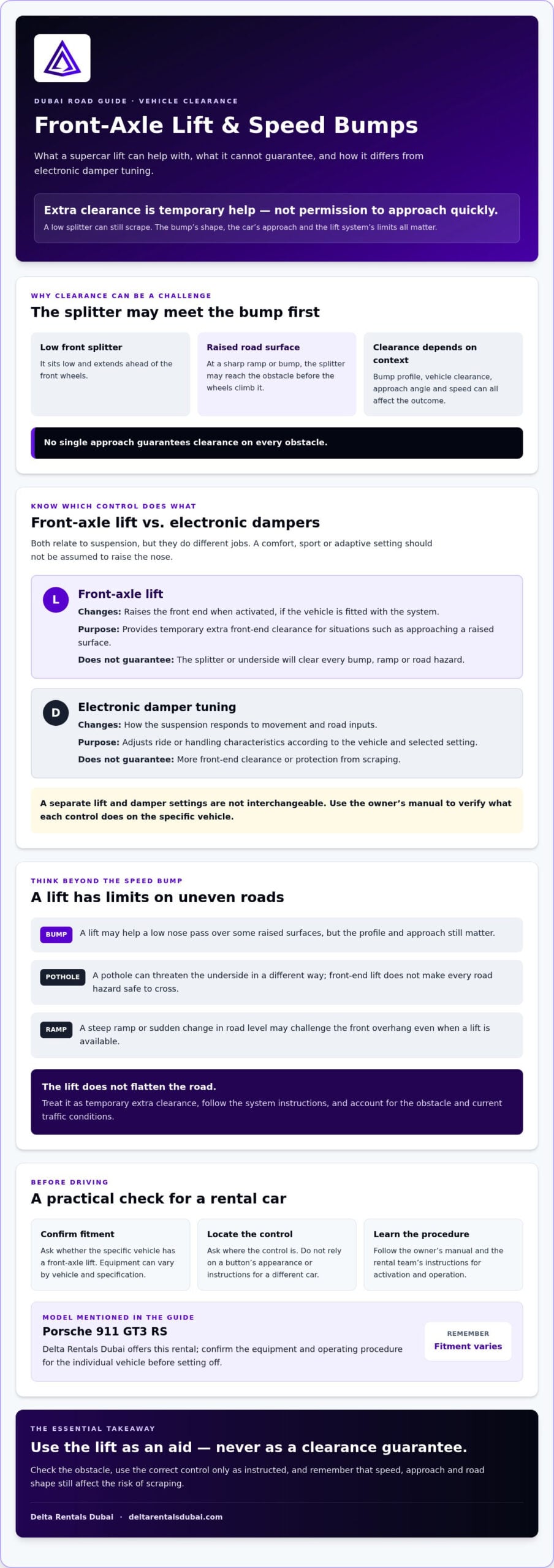
A front splitter sits low and extends ahead of the front wheels. At a sharp ramp or raised surface, the splitter may reach the obstacle before the wheels climb it. The risk depends on the bump’s profile, the car’s clearance, and the angle and speed of approach. No single approach guarantees clearance on every obstacle.
Speed bumps aren’t the only concern. A pothole can threaten the underside in a different way, while a steep ramp or sudden change in road level may challenge the front overhang. A front lift provides temporary front-end clearance when used as instructed; it doesn’t flatten the road or make every hazard safe to cross.
For background on suspension systems that actively adjust a vehicle’s response, see this overview of Active suspension. The practical point is to learn what your car’s specific lift changes rather than assume every suspension control raises the front end.
Front-Axle Lift vs Electronic Damper Tuning: What Changes?
These controls can both relate to suspension, but they do different jobs. A lift changes front-end clearance when activated. Electronic damper tuning changes how the suspension responds to movement and road inputs. Don’t assume a comfort, sport or adaptive setting raises the nose unless the vehicle’s documentation says it does.
In short: A front-axle lift temporarily changes clearance; damper tuning adjusts suspension response. Neither setting guarantees safe passage over every obstacle.
System: Front-axle lift. What it changes: Raises the front end when activated, if fitted. Intended use: Provide temporary extra clearance in situations such as approaching a raised surface. What it can’t guarantee: That the splitter or underside will clear every bump, ramp or road hazard.
System: Electronic damper tuning. What it changes: The suspension’s response to movement and road inputs. Intended use: Adjust ride or handling characteristics according to the vehicle’s design and selected setting. What it can’t guarantee: More front-end clearance or protection from scraping.
How does electronic damper tuning affect ride comfort?
Dampers control how suspension movement is resisted as the car responds to bumps, dips and body movement. A vehicle may offer comfort-oriented or firmer settings, but mode names and their effects vary by model. These settings may change how the car feels over a road surface without changing the distance between the front splitter and the ground.
Don’t select a softer or firmer setting expecting it to lift the nose. Check the owner’s manual for each control’s function. Whether a setting also changes ride height is specific to the vehicle and should be verified in its documentation.
When is a lift system different from a suspension mode?
Think about what each control does at a bump. Damper tuning affects how the suspension responds as the wheels travel over it. A separate lift system, if fitted, temporarily increases front-end clearance before the approach. Some vehicles may have both, but their controls and operation aren’t interchangeable. Follow the manual and don’t experiment while moving through traffic.
When using supercar front axle lift for dubai speed bumps, identify the correct control before you need it, then use it only as the vehicle instructions permit. If you’re considering a rental, ask the team to confirm the specific car’s equipment and controls. You can ask about rental vehicle equipment before driving.
What a Front-Axle Lift Can, and Cannot, Do for a Speed Bump
A front-axle lift can provide useful extra clearance when a low nose approaches a raised surface. If the vehicle has the feature and it’s operated as instructed, it may reduce the chance of the front splitter contacting a suitable obstacle. It doesn’t make every bump safe to cross.
A lift adds clearance temporarily, but it doesn’t change every part of the car. The system may raise the front end while other low points remain close to the road. Its benefit depends on the car’s dimensions, the obstacle’s profile, the vehicle’s load and the lift’s operating conditions.
Which situations may benefit from raising the front axle?
Extra front-end clearance may help when a low obstacle or abrupt transition brings the nose close to the surface. Consider a raised entrance, for example. If the car has a lift, assess the transition and use the feature according to the manual before proceeding.
A lift isn’t automatically suitable for every ramp, speed bump or uneven surface. A steep slope, unusual bump profile or limited visibility may call for a different decision, including choosing another route when safe and practical. Assess the obstacle first and follow the specific vehicle instructions rather than assuming the lift works the same way in every car.
What risks remain even when the lift is active?
Clearance is still limited. A raised front end may not protect the splitter or underside if an obstacle is too high or sharply edged, or if the approach brings a low point into contact. Excessive speed also leaves less time to assess the surface and respond smoothly. The lift can’t compensate for insufficient clearance.
A front lift addresses the front end, not every low point beneath the vehicle. Load can affect clearance, and uneven ground may bring parts of the car closer to the surface. A pothole presents a different hazard from a raised speed bump, so don’t treat the lift as general protection for the underbody.
If you can’t judge the bump’s shape or whether the car will clear it, don’t commit to the approach. Reassess from a safe position without obstructing traffic, and follow the manual. The key when using supercar front axle lift for dubai speed bumps is to treat the lift as assistance, not certainty.
For a rental, confirm the specific vehicle’s lift equipment and operating instructions with the rental team before setting off. You can ask about vehicle equipment ahead of your drive.
How to Approach a Speed Bump in a Supercar
Keep the process calm and deliberate. The vehicle manual takes priority because lift controls, activation conditions and automatic lowering behaviour differ by model. Don’t assume the system will engage on its own, and never search for a control while distracted or moving through traffic.
- Identify the bump. Look ahead to assess its height, shape and position. Check visibility and surrounding traffic before deciding how to proceed.
- Reduce speed smoothly. Slow down in good time, taking account of road conditions and allowing other road users to move safely.
- Use the lift as instructed. If the car has a front-axle lift, activate it at the point and in the manner specified in the manual. Check the displayed status if the vehicle provides one.
- Cross carefully. Keep a controlled pace and watch the obstacle as you move over it. Don’t assume the lift makes the bump safe or follow a universal angled-crossing rule.
- Lower the lift when permitted. Follow the manual’s instructions and check whether the system has lowered or must be reset manually.
When should you activate and lower the lift?
Activation timing isn’t universal. Systems may have different operating conditions or automatic behaviour. Before setting off, confirm how your specific car works. Then follow its instructions and lift-status display rather than relying on memory from another vehicle. Lower the system only when the manual says it’s appropriate and traffic conditions allow you to operate the control safely.
How should you cross without rushing?
Assess the obstacle first, then proceed slowly and smoothly if it appears manageable. There’s no single crossing angle that suits every bump, car or traffic situation. Prioritise a clear view, safe road positioning and the manufacturer’s guidance. If the bump looks too steep or you can’t judge clearance, don’t commit; choose a safe alternative route where possible.
Quick checklist: Pause. Check. Lift. Cross. Reset.
- Pause: Make sure you can assess the bump without creating a traffic hazard.
- Check: Review the obstacle, the manual’s instructions and the lift-status display.
- Lift: Activate the feature only as the vehicle’s instructions allow.
- Cross: Move carefully and be ready to stop if conditions change.
- Reset: Lower or return the system to its normal setting when permitted.
This routine makes using supercar front axle lift for dubai speed bumps more considered, but it can’t guarantee clearance. Before a rental drive, ask the team to explain the exact vehicle’s lift controls and operation. Ask about rental vehicle equipment before you set off.
Before Renting a Supercar, Confirm Its Lift Equipment
Don’t choose a rental based on its model name alone. Equipment can vary between individual vehicles, and a front-axle lift isn’t confirmed just because a car is known for performance or has appeared with that feature in other specifications. Verify the exact vehicle and its equipment with the rental team before driving.
This check is useful if your planned route includes speed bumps, steep entrances or uneven surfaces. A Porsche 911 GT3 RS rental is one of Delta Rentals Dubai’s offerings, but the supplied vehicle information doesn’t confirm front-axle lift fitment on a particular car. For context on the model, see the Porsche 911 GT3 RS rental information.
Which questions should you ask about the rental car?
Ask specific questions and get answers before setting off. A clear handover helps you understand the car without trying to work out unfamiliar controls on the road.
- Is this exact vehicle fitted with a front-axle lift, and is it operational? Confirm the actual car assigned to you, not just the model range.
- Where is the control, and what does the status indicator show? Ask for a brief demonstration while the car is stationary, if appropriate.
- How should the lift be activated and lowered? Request the vehicle-specific operating instructions, including any conditions or limitations.
- What rental guidance applies? Review instructions for safe operation and how to report any damage or warning message.
If the car doesn’t have a lift, or its status is uncertain, don’t assume another control will provide extra clearance. Use the vehicle’s manual and rental guidance, and drive according to road and traffic conditions.
How does lift equipment fit into choosing a supercar?
Lift availability is one factor in choosing a suitable car, not a substitute for careful driving. Consider the vehicle’s clearance, your intended routes and your comfort with its controls. Other practical factors can also help you compare cars for everyday road use, so don’t let the lift alone decide which supercar suits your plans.
If you’re researching using supercar front axle lift for dubai speed bumps, include equipment confirmation in your rental questions. Ask the team about the specific vehicle’s lift fitment and operating instructions before driving. Message Delta to ask about vehicle details.
Drive With Confidence by Checking First
A front-axle lift can offer temporary extra clearance, but it can’t guarantee that a splitter or underbody will clear every speed bump. Damper settings aren’t automatically lift controls, either. Follow the vehicle manual, approach obstacles slowly, and confirm the exact car’s equipment and operating instructions before driving.
Preparation makes using supercar front axle lift for dubai speed bumps more straightforward: know what the feature does, use it only as instructed, and reassess whenever clearance is uncertain. Delta Rentals Dubai offers a Porsche 911 GT3 RS rental alongside other premium high-performance and luxury vehicles, but lift fitment must be confirmed for the specific car.
Message Delta Rentals Dubai to confirm vehicle equipment before choosing your drive. A quick check helps you understand the car’s controls and equipment before setting off.
Frequently Asked Questions
What does a front-axle lift do on a supercar?
A front-axle lift temporarily raises the vehicle’s front end, if the car is equipped with the system. This adds some clearance at the front, which may help when approaching certain raised surfaces. It doesn’t raise every low point under the car or guarantee that the splitter will clear an obstacle. The lift’s height, controls and operating conditions vary by vehicle, so check the owner’s manual.
Can a front-axle lift prevent a supercar from scraping a speed bump?
No, it can’t guarantee that a supercar won’t scrape. A lift may provide useful temporary clearance, but the bump’s shape, the car’s dimensions, its load and the approach all matter. Excessive speed or a steep transition can still create a risk of contact, and other parts of the underbody may remain low. Slow down, assess the obstacle and don’t proceed if you can’t judge whether the car will clear it.
How should you use a front-axle lift when approaching a speed bump?
Identify the bump and check that traffic conditions allow you to respond safely. Reduce speed, then activate the lift only as the vehicle manual instructs. Check the displayed status if available. Cross carefully without assuming the lift removes all risk. Don’t search for controls while distracted or moving through traffic. For using supercar front axle lift for dubai speed bumps, rely on the specific car’s instructions rather than a generic procedure.
Is front-axle lift the same as electronic damper adjustment?
No. A front-axle lift temporarily raises the front end to add clearance when activated, if fitted. Electronic damper adjustment changes how the suspension responds to movement and road inputs; it doesn’t necessarily change ride height. Comfort, sport and adaptive modes differ between vehicles, so don’t assume a setting raises the axle. Check the manual to confirm exactly what each control does on the car you’re driving.
Does every Porsche 911 GT3 RS have a front-axle lift?
No, don’t assume every Porsche 911 GT3 RS has one. The 2026 Porsche 911 GT3 is identified as having front-axle lift available as a factory option, but an available option isn’t standard fitment on every car. Rental equipment can vary by individual vehicle as well. Confirm whether the exact car has an operational lift, and ask for its control location and operating instructions before driving.
When should you lower a supercar’s front-axle lift after a speed bump?
Lower the lift when the vehicle manual says it’s appropriate, and only when you can operate the control safely. The correct timing and whether the system lowers automatically vary by vehicle. Check the lift-status display, if the car has one, rather than assuming the system has reset. If you’re driving a rental, ask the provider to explain the specific car’s lowering procedure before setting off.