
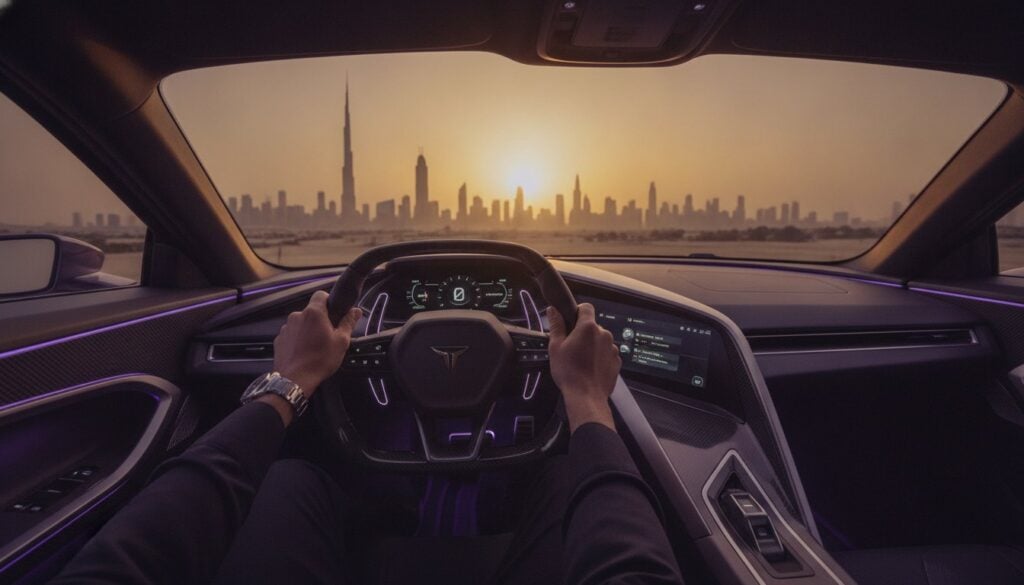
The greatest barrier to mastering a 900-horsepower machine isn’t the engine’s raw power; it’s the driver’s own hesitation. You’ve likely felt that sharp spike of anxiety when eyeing a low-slung carbon fiber splitter or a cockpit filled with intimidating toggles. It’s completely natural to fear losing control of a high-performance vehicle or becoming the next viral ‘YouTube fail’ at a busy intersection. This guide delivers the essential supercar driving tips for beginners to ensure you command elite performance with absolute confidence, turning that initial nervousness into effortless prestige.
At Delta Rentals Dubai, we understand that the transition from a standard luxury sedan to a track-bred beast requires a specific mindset. You deserve the status of the drive without the stress of a mechanical mishap. We are going to break down how to navigate complex drive modes, master paddle shifters, and handle visibility limitations like a professional. By the end of this article, you’ll be ready to handle everything from a Porsche 911 GT3 RS to the latest hybrid powertrains with precision and poise. Let’s ensure your transition into the driver’s seat is as seamless as the car’s gear changes.
Key Takeaways
- Master the “PalmerSport” seating method to gain maximum leverage over the pedals and ensure your wrists have the perfect range of motion for elite steering control.
- Follow these supercar driving tips for beginners to navigate the immediate torque of hybrid models like the McLaren Artura without losing composure.
- Apply “String Theory” to your driving dynamics to connect steering and pedal inputs, ensuring every movement is fluid rather than jerky.
- Navigate urban environments with confidence by mastering the “Invisibility Paradox” and maintaining a three-second safety gap to account for high-speed stopping distances.
- Learn how to conduct a professional pre-drive walkthrough with your concierge to feel completely at home in the cockpit before you even start the engine.
Understanding the Machine: Power, Torque, and Respect
A supercar isn’t just a faster version of a standard vehicle; it’s an entirely different category of physics. Most daily drivers are engineered for fuel economy and predictable safety. In contrast, an elite machine is built for extreme efficiency in motion. This means every pound of the car’s weight is pushed by significantly more horsepower, making the vehicle react to your inputs with startling speed. At Delta Rentals Dubai, we believe the most vital supercar driving tips for beginners start with respecting this sensitivity. Engine placement also dictates how the car behaves under pressure. While your typical commuter car likely has the engine over the front wheels, many high-performance models place it in the middle or rear to optimize balance and grip.
Engine Layouts and Handling Characteristics
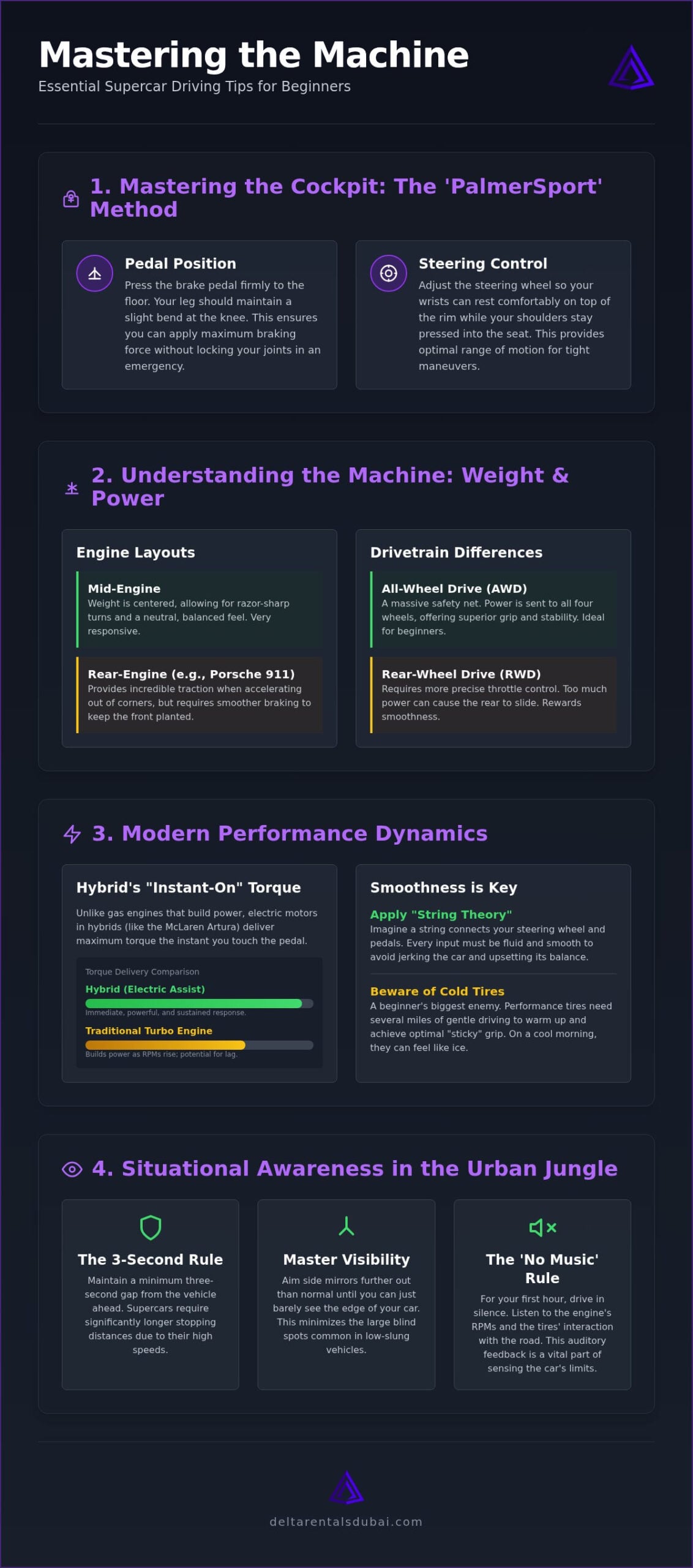
Weight distribution is the secret to cornering stability. In a mid-engine car, the weight is centered between the axles, allowing for razor-sharp turns and a neutral feel. A rear-engine icon like the Porsche 911 places the weight over the back wheels. This provides incredible traction when accelerating out of a corner but requires a steadier hand and smoother braking during entry to keep the nose planted. You should also understand the difference between All-Wheel Drive (AWD) and Rear-Wheel Drive (RWD) power delivery. AWD systems offer a massive safety net by distributing power to all four wheels, which is ideal for beginners. RWD requires more precise throttle control to avoid the rear end stepping out unexpectedly.
Stop thinking about “driving” and start “commanding” a precision instrument. This psychological shift is crucial for your safety and enjoyment. You aren’t just a passenger in the cockpit; you are the final component of a complex mechanical system. Before you attempt to push any limits, remember that cold tires are a beginner’s biggest enemy. High-performance rubber is designed to be “sticky,” but it only reaches that state once it’s warm. On a cool morning, even the most advanced supercar can feel like it’s on ice if you don’t give the tires several miles to reach their optimal operating temperature.
Modern Hybrid Performance in 2026
The 2026 automotive landscape is dominated by hybrid technology. Models like the McLaren Artura use electric motors to provide “instant-on” torque that can catch a novice driver off guard. Unlike traditional engines that need to “rev up” to find their power, electric assistance is available the moment your foot touches the pedal. Mastering the transition between silent electric cruising and the raw power of the internal combustion engine is a core skill for the modern enthusiast. Torque fill in the McLaren Artura uses the electric motor to eliminate the momentary lag of the turbochargers, providing a seamless and relentless surge of acceleration across the entire power band. Understanding this technology is a key part of supercar driving tips for beginners because it changes how you anticipate the car’s response in traffic or on open stretches of road.
Mastering the Cockpit: Ergonomics for Elite Control
Your interaction with the car starts long before the engine fires. Effective supercar driving tips for beginners prioritize the physical connection between your body and the controls. If you’re sitting too far back, you lose the leverage needed for emergency braking. If you’re too close, your range of motion is restricted. Command requires a precise balance of comfort and tactical positioning.
Use the ‘PalmerSport’ method to find your baseline. Press the brake pedal firmly to the floor; your leg should still have a slight bend at the knee. This ensures you can apply maximum force during high-speed deceleration without locking your joints. Next, adjust the steering wheel so your wrists can rest comfortably over the top of the rim while your shoulders remain pinned to the seat back. This positioning guarantees you can cross your arms during tight maneuvers without losing your grip or your composure.
Visibility is a common pain point for first-time drivers. Supercars are notoriously low, and traditional mirror setups often leave massive blind spots. Aim your side mirrors further out than you would in a standard SUV. You should barely see the edge of your own car’s rear haunches. Finally, follow the ‘No Music’ rule. Silence the infotainment system for your first hour of driving. You need to hear the engine’s RPMs and the tires’ interaction with the road. This auditory feedback is a vital part of supercar driving tips for beginners, allowing you to sense the car’s limits through sound rather than just the speedometer.
The Perfect Driving Position
Achieving elite control requires a modular approach to your setup. Follow these three steps to optimize your command center:
- Step 1: Adjust seat height. Position yourself low to lower the center of gravity, but ensure you can still see the top of the front fenders to judge car width accurately.
- Step 2: Set the distance. Your knees must remain slightly bent even when the pedals are fully depressed to maintain muscular control.
- Step 3: Elbow angle. Position the steering wheel so your elbows are at a relaxed 90-degree angle. This prevents fatigue and provides the best leverage for quick steering corrections.
Navigating the Interface and Drive Modes
Modern cockpits are designed for high-speed efficiency, but they can be intimidating. Locate the ‘Nose Lift’ button immediately. This essential system raises the front suspension to clear speed bumps and steep driveways. Activate it early; waiting until you reach the incline is often too late to prevent a costly scrape. If you’re feeling overwhelmed by the digital interface, ask a concierge for a personalized walkthrough of your specific model’s controls.
Most elite models feature a drive mode dial, such as the Ferrari Manettino. Resist the urge to toggle into ‘Track’ or ‘Race’ settings immediately. Start in ‘Wet’ or ‘Comfort’ modes. These settings keep the electronic stability controls at maximum alert while you acclimate to the throttle’s sensitivity. Regarding the gearbox, leave it in ‘Auto’ for your initial city transit. Once you reach an open road, use the paddle shifters to downshift before corners. It’s the most rewarding way to experience the car’s mechanical soul while maintaining total control over the power delivery.
Smoothness Over Speed: Advanced Driving Dynamics
Speed is a byproduct of precision. For those seeking supercar driving tips for beginners, the most important lesson is that jerky movements lead to instability. Master the ‘String Theory’ of driving. Imagine an invisible string connecting the bottom of your steering wheel to your big toe. When the wheel is straight, you can pull the string taut by flooring the accelerator. As you turn the wheel, the string slackens, forcing you to ease off the pedals. This mental model prevents the tires from being overwhelmed by simultaneous steering and power demands.
Progressive braking is equally vital. Supercar brakes, especially high-performance systems found in the Ferrari SF90, require significantly more initial pressure than a standard sedan. Don’t stab at the pedal. Squeeze it firmly to settle the nose of the car, then gradually bleed off the pressure as you enter the turn. This technique keeps the vehicle balanced and prevents the anti-lock braking system from intervening unnecessarily. Maintaining this composure is what separates a prestigious driving experience from a chaotic one.
Manage your lane position with extra care. Elite machines are often much wider than they appear from the cockpit. A Lamborghini Revuelto, for instance, has a substantial footprint that can feel tight on narrow city streets. Position yourself slightly further toward the center of the lane than you think is necessary. Use the front fenders as your guide. If you can see the lane markings in your side mirrors, you have successfully accounted for the car’s aggressive width.
Throttle Management and Traction
Traction is a finite resource. Use the ‘Roll-on’ technique when exiting a corner. Gradually increase throttle pressure only as you begin to straighten the steering wheel. Flooring the accelerator while the wheels are still turned is a guaranteed way to trigger traction control or, worse, induce a spin. At higher speeds, remember that aerodynamics play a massive role. The active wings on a Porsche 911 GT3 RS generate incredible downforce, pushing the car into the tarmac. This means the car actually becomes more stable as your speed increases, provided your inputs remain smooth and deliberate.
Braking with Carbon Ceramics
Most modern supercars utilize carbon-ceramic brakes for their fade-resistant properties. These feel different than the steel brakes on your daily driver. They can feel “wooden” or less responsive when they are cold. Give yourself several miles of light braking to bring them up to operating temperature. Once warm, they offer incredible stopping power and a very specific “bite.” Keep your left foot firmly on the dead pedal to brace your body during cornering. Beginners should strictly avoid left-foot braking on public roads, as a lack of muscle memory in that foot often results in accidental, violent stops that can surprise following traffic.
Situational Awareness: Navigating the National Landscape
Operating a high-performance vehicle requires a higher level of environmental scanning than your daily commute. You are experiencing the ‘Invisibility Paradox.’ While your car is loud and visually striking, its low profile places it below the standard sightline of most SUV and truck drivers. Never assume other motorists see you. One of the most critical supercar driving tips for beginners is to drive defensively by assuming you are invisible to surrounding traffic. Always signal early and give other drivers plenty of space to react to your presence.
Maintain a strict three-second gap between you and the vehicle ahead. Supercars possess incredible braking power, but your reaction time remains human. At the high speeds these machines reach effortlessly, stopping distances expand rapidly. In 2026, automated traffic enforcement is more prevalent than ever. Speed and red-light cameras are increasingly common in construction and school zones. Avoid the temptation to show off; a single lapse in focus can lead to significant penalties. Remember that supercar insurance deductibles often range from $5,000 to $15,000; caution is a very practical investment in your peace of mind.
You will attract attention. Car-spotters and pedestrians with cameras are part of the elite driving experience. Stay focused on the road ahead rather than the lenses pointed at you. If you feel overwhelmed by the attention or the vehicle’s mechanics, contact our concierge team to book a guided session. We ensure you feel like a master of the road, not a target for social media fails.
Visibility and Blind Spots
Mid-engine designs offer superior balance but sacrifice rear visibility. Use your reverse camera and parking sensors as your primary navigation tools for low-speed maneuvers. The ‘shoulder check’ is challenging when looking through a narrow engine cover. Always verify your path twice before changing lanes. Be prepared for erratic behavior from other drivers. Motorists often speed up or drift toward you just to get a better look at the car. Anticipate these movements and keep yourself in clear pockets of space to avoid unnecessary risks.
Electronic Aids and Safety Systems
Your car is equipped with sophisticated safety nets. Electronic Stability Control (ESC) and Traction Control are your best friends. ESC manages the car’s overall direction, while Traction Control prevents the wheels from spinning under power. Never turn these systems off. Even professional drivers rely on them on public roads to manage unpredictable surfaces. Launch Control is a thrilling feature, but it should almost never be used on public streets. It puts immense strain on the drivetrain and can be unpredictable on un-prepped tarmac. For most driving, ‘Comfort’ mode is actually the fastest and safest choice. It allows the suspension to absorb road imperfections, keeping the tires in constant contact with the ground for maximum grip. This is a vital part of supercar driving tips for beginners that ensures a smooth and prestigious journey.
The Delta Experience: Renting Your First Supercar
The final step in mastering supercar driving tips for beginners is the actual transition into the driver’s seat. At Delta Rentals Dubai, we prioritize a frictionless handover to ensure you feel like an expert before you even leave our lot. Your concierge is your primary resource and a bold facilitator of your high-status experience. Don’t rush the walkthrough. Ask questions about the specific quirks of your chosen model. Our ‘No Deposit’ model is specifically designed to remove the traditional friction of luxury rentals, allowing you to focus entirely on the precision of the machine without unnecessary financial anxiety.
Transitioning from a Luxury SUV to a supercar requires a recalibration of your senses. You’ll sit much lower to the ground, and the steering will feel significantly more immediate. This change in perspective is exhilarating, but it demands the respect for power we discussed in earlier sections. By following our structured handover process, you ensure that your first hour on the road is spent enjoying the prestige of the drive rather than fumbling with unfamiliar controls.
The Handover Checklist
A successful drive starts with a comprehensive physical walkthrough. Follow this protocol with your concierge to ensure total confidence:
- Fueling Protocol: Verify the location of the fuel cap and confirm the correct grade. High-performance engines require Super 98 (98 Octane) to maintain their elite power delivery.
- Suspension Management: Test the nose-lift system while stationary. Understanding the timing of this system is essential for protecting the car’s low-slung bodywork during transit.
- Operational Security: Confirm your insurance coverage details and emergency contact procedures. Knowing you have 5-star Google reviewed support behind you allows for a stress-free journey.
Selecting Your Vehicle
Choosing the right car is as important as your driving technique. For those seeking incredible mechanical feedback and a track-bred pedigree, the Porsche 911 GT3 RS is an unmatched starting point. It communicates its limits with absolute clarity, making it an excellent platform for applying supercar driving tips for beginners. The car’s aerodynamics and precision steering offer a reassuring sense of stability even for novices.
If you prefer to explore modern hybrid performance, the McLaren Artura provides a sophisticated and approachable entry into the world of instant torque. For drivers who prioritize commanding presence and ultra-luxury over raw track capability, a Rolls Royce Rental provides a prestigious alternative. It delivers a high-status experience focused on supreme comfort and effortless power. Whatever your preference, we are here to ensure your transition into the elite driving world is seamless. Book your elite driving experience with Delta Rentals Dubai today.
Secure Your Seat in the Future of Performance
Mastering an elite vehicle is a journey that begins with technical respect and ends with the confidence of total control. You now have the tactical knowledge to manage instant hybrid torque, optimize your cockpit ergonomics, and apply “String Theory” to every maneuver. These supercar driving tips for beginners ensure your first experience behind the wheel is characterized by prestige rather than stress, allowing you to focus on the pure exhilaration of the drive.
At Delta Rentals, we make this aspirational lifestyle attainable through our exclusive 2026 fleet, featuring high-performance icons like the Porsche 911 GT3 RS. Our 5-star Google reviewed service and unique no-deposit model remove the traditional barriers to luxury hire, providing you with a seamless transition into a world of superior quality and effortless power. We pride ourselves on being the authoritative partner for your high-status journey.
Drive your dream supercar with Delta Rentals Dubai. The road is open and the keys are ready; step into the cockpit and command your destiny with precision today.
Frequently Asked Questions
Do I need a special license to drive a supercar in the UAE?
You don’t need a specialized racing license to command an elite machine in the UAE. A standard, valid driving license from your home country or a UAE license is sufficient for most models. Visitors from specific regions may require an International Driving Permit. Always ensure you meet the minimum age requirement, which is typically 25 for high-performance rentals in our 2026 fleet.
Is it difficult to drive a supercar with a paddle-shift gearbox?
Transitioning to a paddle-shift gearbox is remarkably straightforward. Most modern supercars feature a highly intelligent automatic mode that handles gear changes seamlessly. If you choose to use the paddles, remember that the right paddle upshifts and the left paddle downshifts. It’s a tactile experience that quickly becomes second nature, allowing you to focus entirely on the road ahead.
What happens if I accidentally turn off traction control?
Turning off traction control is a significant risk for non-professional drivers. These systems are designed to manage immense power delivery and keep the vehicle stable on unpredictable surfaces. If accidentally deactivated, pull over safely and re-engage the system immediately. Operating without these electronic safety nets often leads to the “YouTube fails” every beginner wants to avoid.
How do I handle speed bumps in a low-clearance supercar?
Approach speed bumps at an angle and utilize the integrated nose-lift system. This technology raises the front suspension by several centimeters, providing the necessary clearance to protect the carbon fiber bodywork. Mastering this system is one of the most practical supercar driving tips for beginners. Activate the lift well before you reach the obstacle to ensure the car is fully raised.
Can I drive a supercar in the rain safely?
You can drive a supercar in the rain safely by selecting “Wet” or “Weather” mode on the drive selector. These settings optimize the traction control and soften the throttle response to prevent wheel spin. Increase your following distance to at least five seconds. High-performance tires are designed for maximum grip, but standing water requires a conservative approach to avoid aquaplaning.
What is the best supercar for a beginner to rent first?
The Porsche 911 GT3 RS is an ideal starting point for applying supercar driving tips for beginners because it offers incredible mechanical transparency. It communicates its limits clearly, making it very approachable on public roads. Alternatively, the McLaren Artura provides a smooth entry into modern hybrid performance, offering a perfect blend of cutting-edge technology and driver-focused ergonomics.
Should I use ‘Sport’ or ‘Race’ mode on my first drive?
Stick to ‘Comfort’ or ‘Sport’ mode for your initial journey. ‘Race’ or ‘Track’ modes sharpen the throttle response and stiffen the suspension to levels that are potentially unpredictable on public streets. These aggressive settings also reduce the intervention of safety systems. Master the car’s baseline dynamics in a more forgiving mode before exploring higher performance levels.
What should I do if the engine temperature starts to rise?
If the engine temperature gauge climbs into the red, pull over immediately and allow the car to idle. High-performance engines generate significant heat, especially in urban traffic. Check for any obvious obstructions to the air intakes. If the temperature doesn’t drop within a minute, turn off the engine and contact your concierge for assistance. Never attempt to open the coolant cap while the engine is hot.