

Luxury features can sound impressive on a specification sheet, but their value is measured on the drive. With Rolls Royce Cullinan rental features explained in practical terms, it’s easier to identify which details shape passenger comfort, which driver-assistance tools can support awareness, and what those tools can’t do.
An ultra-luxury SUV should feel considered from the driver’s seat as well as the passenger cabin. But a feature’s name doesn’t explain how it works or whether it suits your journey. This guide breaks down the Cullinan’s comfort and assistance features, including how thermal night vision, where fitted, detects heat rather than extending the reach of headlights or working like a conventional camera. It also explains why these systems support an attentive driver rather than replace one.
Use these explanations to set your priorities, whether that means a composed ride, added awareness after dark, or getting comfortable with the vehicle’s controls. Delta Rentals Dubai offers the Rolls-Royce Cullinan Black Badge for rental, giving you a way to experience the SUV with your priorities in mind.
Key Takeaways
- Rolls Royce Cullinan rental features explained in practical terms help you focus on the comfort, visibility and control that matter for your journey.
- Thermal night vision detects heat differences. It doesn’t illuminate the road like headlights or drive the vehicle for you.
- Weather, obstructions and system design can affect what night-vision imagery shows, so stay attentive behind the wheel.
- Before driving, define your priorities, learn the relevant controls and understand the limits of any assistance features.
- Use what you learn to make a considered decision about experiencing a Rolls-Royce Cullinan Black Badge rental.
Rolls-Royce Cullinan rental features: what shapes the experience?
The Rolls-Royce Cullinan is a luxury SUV designed to pair passenger comfort with the flexibility of an SUV. For renters, features matter most in three practical areas: how relaxed the cabin feels, how clearly the driver can see, and how confidently the vehicle can be controlled. Rather than focusing on a long feature list, consider which functions relate to the drive you have planned.
Self-levelling air suspension is a model feature associated with the Cullinan, designed to help soften the effect of road imperfections for passengers. Rolls-Royce describes its smooth ride as a “Magic Carpet Ride.” This describes the intended benefit, not a promise that every surface will feel the same. Road conditions and the specific vehicle also affect ride comfort, so assess the experience as a whole rather than relying on a slogan.
A vehicle feature is useful when you understand its purpose, how it may help on your journey, and where its limits begin. Apply that test to comfort, visibility and driver assistance. A feature’s presence alone doesn’t show how intuitive it is to use or whether it will make a noticeable difference on your route.
Separate general model information from the equipment of a particular rental. Model year, trim and vehicle configuration can affect which features are fitted. The Rolls-Royce Cullinan Wikipedia page offers a general model overview, but it doesn’t establish the equipment of an individual vehicle. For your rental, focus on the controls and functions in the vehicle you’ll drive.
Which Cullinan features matter most to a renter?
Start with the experience you want. For comfort, consider how the suspension is intended to manage uneven surfaces. For visibility, understand what the vehicle’s lighting or camera aids show. For confident control, learn the purpose of any driver-assistance functions before setting off. Equipment can vary by model year, trim and configuration, so don’t treat a general feature list as a vehicle-specific specification.
How to read a luxury vehicle feature list
Translate each label into a real task. A camera presents an image, while an assistance system may alert the driver or support a particular function. Neither removes the need to look, judge conditions and remain in control. Assess each feature against your route, passengers and driving preferences, not its name alone. For a related rental perspective, explore Rolls-Royce Cullinan Black Badge rental options from Delta Rentals Dubai.
How does thermal night vision work in a luxury touring vehicle?
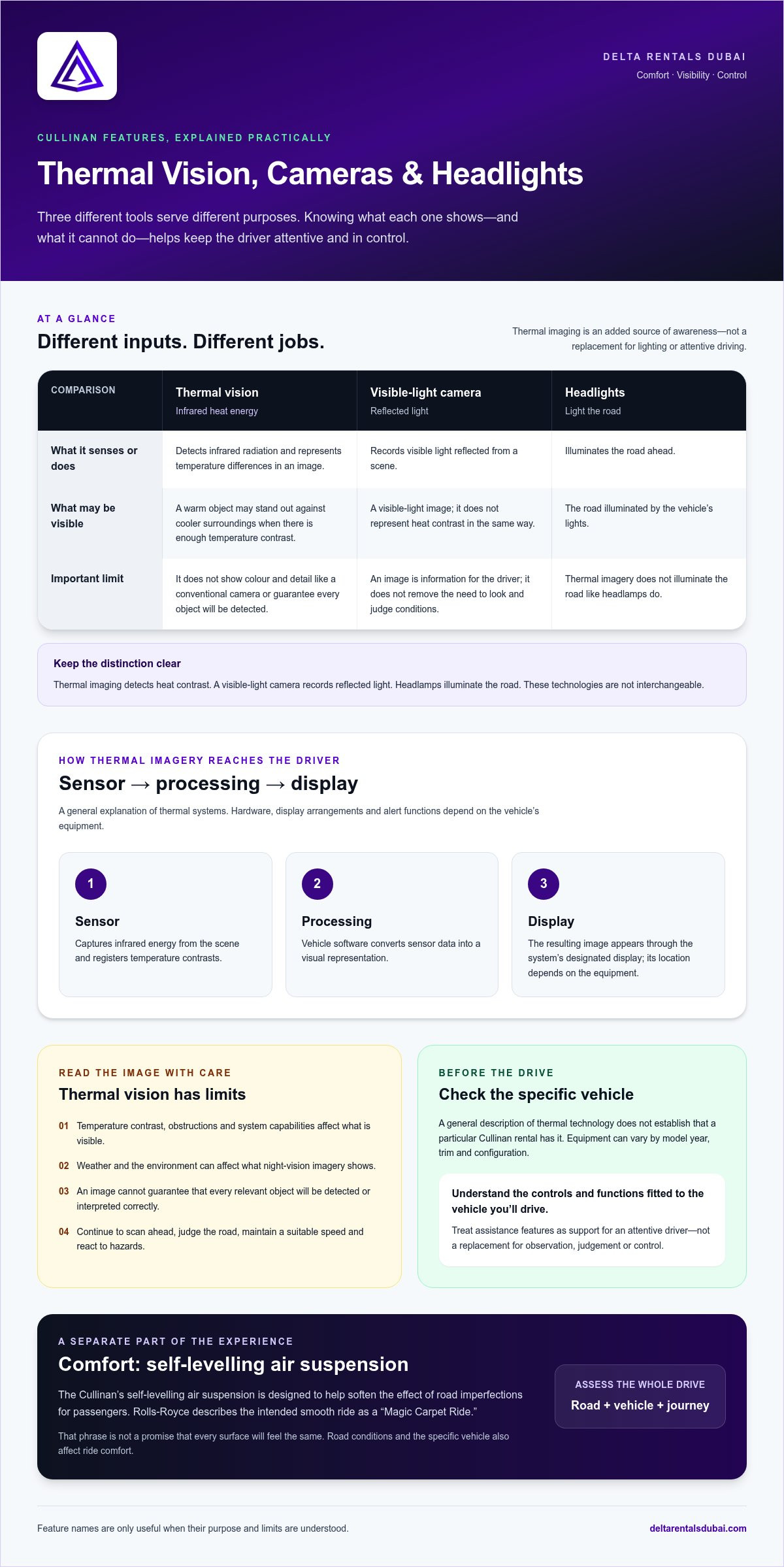
Thermal night vision works differently from headlights and ordinary cameras. Instead of lighting the road or recording visible light, a thermal sensor detects infrared radiation, the heat energy objects emit. It represents temperature differences in an image, which may help a driver notice a warm object against a cooler background. What appears depends on the environment and the system’s design.
That distinction matters when reading about Rolls Royce Cullinan rental features explained: a general description of thermal technology doesn’t establish that a particular rental has it. Vehicle equipment can depend on model year and configuration. Rolls-Royce’s official Cullinan features page provides manufacturer context about the model, but an individual vehicle’s specification is what determines its equipment.
What does a thermal camera detect?
Objects emit infrared energy according to their temperature. A thermal camera senses that energy and represents temperature differences as contrasts in an image. It doesn’t show colour and detail in the same way as a conventional visible-light camera. A person, animal or recently warmed object may stand out against cooler surroundings, but this isn’t guaranteed. Temperature contrast, obstructions and the system’s capabilities all affect what’s visible.
Thermal imaging detects heat contrast; a visible-light camera records reflected light, while headlamps illuminate the road. These technologies serve different purposes. Thermal imagery doesn’t replace lighting, provide a complete picture of the road or remove the need to scan ahead and respond to conditions.
How does thermal imagery reach the driver?
A typical system turns sensed heat into an image through a simple sequence. Hardware and display arrangements vary, so this is a general explanation rather than a claim about a specific Cullinan rental.
- Sensor: A thermal sensor captures infrared energy from the scene and registers temperature contrasts.
- Processing: Vehicle software converts the sensor data into a visual representation. The system determines how that information appears.
- Display: The resulting image is shown through the system’s designated display. Its location and any alert functions depend on the vehicle’s equipment.
Think of the image as an additional source of awareness, not a substitute for headlights, mirrors or attentive driving. You still need to judge the road, maintain a suitable speed and react to hazards. A system can present information, but it can’t guarantee that every relevant object will be detected or interpreted correctly.
Understanding that distinction helps you assess the technology as part of the overall rental experience, rather than treating a feature name as a promise. To explore a Rolls-Royce Cullinan Black Badge rental, consider which comfort and driving features matter most to you.
What can Cullinan night vision do, and what should renters not assume?
Thermal night vision is a driver aid, not autonomous obstacle avoidance. It may present heat-related information that isn’t obvious in ordinary visible-light conditions, but it doesn’t steer around hazards, guarantee detection or take responsibility for the drive. Equipment depends on the particular vehicle and its configuration, so don’t assume every Cullinan has thermal night vision.
Think of the image as one input, not a verdict. A warm shape on a display may deserve attention, but the driver must interpret it in context and respond to the actual road. Weather, obstructions, surrounding temperatures, road conditions and system design can all affect the imagery. Heavy rain or fog, for example, can make the driving environment harder to assess, while an object blocked from the sensor’s view may not appear as expected.
Thermal night vision versus headlights and standard cameras
These systems sense different things. Headlamps cast visible light onto the road. A conventional camera records visible light reflected from objects, so darkness and lighting conditions affect what it captures. Thermal imaging detects infrared energy and displays temperature contrasts instead. These functions can complement one another, but they aren’t interchangeable: thermal imagery isn’t a complete road view, and it doesn’t replace headlights, mirrors or direct observation.
| General technology principle | Limits and Cullinan-specific caution |
|---|---|
| Thermal imaging can show heat contrast between objects and their surroundings. | It doesn’t guarantee detection or identify every object correctly. Don’t assume a particular Cullinan rental has this system without vehicle-specific specification. |
| Headlamps illuminate the route; visible-light cameras show reflected light. | Neither function is the same as thermal sensing, and none provides a complete substitute for attentive driving. |
Why driver attention remains essential
A display can only show information captured and processed within the system’s capabilities. Its field of view may not cover every direction, and an image can be difficult to interpret quickly, especially when the scene is unfamiliar or visibility is reduced. Continue scanning the road and surroundings rather than focusing too long on a screen.
Follow road rules, maintain attention and use lighting and mirrors as intended. Never treat a thermal display as permission to drive faster or rely on the system to prevent a collision. The practical takeaway from Rolls Royce Cullinan rental features explained is straightforward: understand what a feature is designed to support, then respect what it can’t promise. For a specific rental, use the equipment information for that vehicle rather than general descriptions of the model or thermal technology.
How should renters assess Cullinan features before a drive?
Start with your journey, not the feature list. A longer drive, a trip with passengers and a short visit can call for different priorities. Comfort, visibility and assistance technology may all matter, but only features present in the specific vehicle can shape your experience. The goal is to identify what’s relevant and feel composed before setting off.
Match features to the journey you have in mind
Think about the drive and who’s travelling with you. For a longer route, ride comfort and visibility may be priorities; if you’re travelling with passengers, consider the cabin experience you want. Treat these as questions about your needs, not assumptions about equipment. Features and cabin details can vary by model year and configuration, so a general Cullinan description doesn’t establish what’s in a particular rental. A useful Rolls-Royce rental guide can also help you think through the wider experience beyond individual features.
Use this sequence to focus your assessment:
- Define the journey. Consider its length, driving conditions and whether you’ll travel alone or with passengers.
- Identify your priorities. Decide whether comfort, visibility, ease of control or cabin experience matters most to you.
- Understand relevant controls. Before driving, get oriented with the controls and displays that are actually present in the vehicle.
- Review assistance features. Learn what each system is designed to do, and remember that it supports rather than replaces your judgment.
- Drive attentively. Keep your focus on the road and surroundings, using vehicle technology as a supplement.
Get oriented before setting off
Take a calm moment to locate and understand the relevant controls and displays before moving. Follow the vehicle-specific explanations rather than relying on a feature description for another model year or configuration. If a display or assistance function is unfamiliar, learn its purpose and limits while stationary. This preparation helps you avoid interpreting a new system while also managing the drive.
Keep this quick checklist in mind:
- Journey: Can you describe the kind of drive you’re preparing for?
- Controls: Do you understand the functions you expect to use?
- Assistance: Do you know what each relevant feature supports, and what it doesn’t do?
- Attention: Are you ready to make driving decisions based on the road, not just a display?
The Rolls Royce Cullinan rental features explained in this guide are most useful when matched to your priorities, rather than counted as a list of impressive names. If a Rolls-Royce Cullinan Black Badge rental suits the experience you have in mind, message Delta Rentals Dubai on WhatsApp about your rental.
Experience Cullinan Black Badge features through a considered rental
A luxury rental feels more rewarding when the vehicle suits the experience you want. Weigh comfort, technology and your driving priorities together, rather than choosing by feature names alone. The useful question isn’t how long the equipment list is. It’s whether the vehicle and its features fit your plans and help you feel prepared behind the wheel.
Why the Cullinan Black Badge suits an ultra-luxury rental brief
Delta Rentals Dubai offers the Rolls-Royce Cullinan Black Badge as a luxury-SUV rental. It combines the presence of an SUV with the Rolls-Royce name, making it an option for renters seeking an elevated vehicle experience. Equipment can differ by vehicle configuration, so base your expectations on the vehicle itself. When comparing rental options, consider whether space, cabin experience, technology or the character of an SUV matters most to you.
Think about the drive you want, the passengers joining you and how familiar you want to be with in-car technology. A feature that sounds impressive in a general description may be less relevant to your plans than a comfortable cabin or controls you understand easily. A driver-assistance system is useful only when you know its purpose and limits. Make your rental choice around the experience, not assumptions about equipment.
Turn feature knowledge into a rental enquiry
Use your feature knowledge to describe what matters to you: a composed, comfortable journey, an engaging cabin experience or a confident introduction to an ultra-luxury SUV. These priorities give your enquiry a clear focus without relying on claims about equipment that may not apply to the specific vehicle. Before setting off, take time to understand the controls and assistance functions in the vehicle you’re driving.
That is the practical value of Rolls Royce Cullinan rental features explained: you can separate a feature’s intended purpose from its real use, then choose with greater confidence. Delta Rentals Dubai’s Cullinan Black Badge rental offers a way to experience this luxury SUV while keeping your preferences at the centre of the decision.
To take the next step, send Delta Rentals Dubai a WhatsApp message and share the kind of experience you have in mind. This gives your Cullinan Black Badge rental enquiry a clear focus.
Make your next drive a considered choice
A considered luxury rental decision starts with the experience you want, not a checklist of impressive-sounding technology. Use what you’ve learned from Rolls Royce Cullinan rental features explained to identify your priorities, then shape your enquiry around them. Whether comfort, cabin experience or familiarity behind the wheel matters most, a clear brief helps you choose with purpose.
Delta Rentals Dubai serves customers across the United Arab Emirates, with the Rolls-Royce Cullinan Black Badge among its rental offerings. Share what kind of drive you have in mind and what matters to you. Focus on the experience you want, while treating each vehicle’s equipment as specific to that vehicle.
Ready to take the next step? Enquire about a Rolls-Royce Cullinan Black Badge rental on WhatsApp and start planning an experience that fits your priorities.
Frequently Asked Questions
How does a thermal camera work in a luxury vehicle?
A thermal camera turns differences in infrared energy into a visual image. Warmer objects may contrast with cooler surroundings, but the result isn’t a normal colour photograph and doesn’t necessarily identify an object. An unusual shape on the screen may prompt a closer look, not an assumption about what it is. Image appearance and usefulness depend on the sensor, processing and conditions around the vehicle.
Is thermal night vision the same as a standard night-vision camera?
No. Thermal imaging senses infrared energy associated with heat, while a conventional low-light camera captures visible light or, in some designs, near-infrared light reflected from objects. That difference affects the image each system produces. A camera image may show familiar visual detail when enough light is available; a thermal image emphasizes temperature contrast instead. Neither should be treated as a complete substitute for the driver’s view of the road.
Does every Rolls-Royce Cullinan have thermal night vision?
No. Don’t assume thermal night vision is installed in every Cullinan. Equipment may differ by model year and vehicle configuration, so general descriptions of the model don’t establish what a particular rental includes. Use the specification for the actual vehicle rather than relying on a feature list written for another version. This matters especially if a specific technology is central to your decision.
Can thermal night vision replace headlights when driving at night?
No. Thermal night vision doesn’t illuminate the road, so it can’t replace headlights. It presents information based on heat contrast, while headlamps light the route so the driver can see the driving environment. Treat a thermal image as a possible extra reference, not permission to drive without normal lighting or attention. Continue to use the vehicle’s lighting appropriately and make decisions based on the road ahead.
What is the difference between thermal imaging and a head-up display?
Thermal imaging is a way of sensing and representing heat contrast. A head-up display is a way of presenting selected information in the driver’s field of view. One describes how information may be captured; the other describes where information may be shown. They are not interchangeable, and vehicles can use different display arrangements. Don’t assume a particular display or thermal system is fitted without vehicle-specific equipment details.
Are Cullinan driver-assistance features a substitute for careful driving?
No. Driver-assistance features support particular tasks; they don’t take over the driver’s responsibility. Their capabilities and limits vary, and conditions can affect how they respond. For instance, treat a warning as information to assess, not proof that the system has detected every hazard. Stay focused on traffic, road conditions and your surroundings, and follow the vehicle’s instructions for any assistance feature you use.
What should I understand before renting a Rolls-Royce Cullinan?
Before driving, understand the journey you have in mind, the vehicle’s main controls and the purpose of any assistance features you expect to use. Make sure you can operate essential functions without searching through unfamiliar menus while moving. The Rolls Royce Cullinan rental features explained in this guide are a starting point, while the vehicle’s own equipment information is the practical reference. Review the rental terms and driving requirements before setting off.