

A polished yacht and attentive service can set the mood, but neither proves a charter is ready to sail. A proper safety checklist for a private yacht rental helps you look beyond reassuring claims and focus on what you can ask about before you book or board.
It’s reasonable to want clear answers about the captain, vessel documents, emergency procedures and changing weather. Asking about safety is a practical way to set expectations and help everyone feel prepared.
Use this guide to prepare questions about the captain and vessel, understand what to look for in a passenger safety briefing, and share needs that may affect your group. Review it before confirming your charter and again before departure. Delta Rentals Dubai offers luxury yacht rentals, and clear communication helps you prepare for your time on the water.
Key Takeaways
- Use the safety checklist for private yacht rental dubai to prepare focused questions before confirming your charter.
- Ask about captain credentials and vessel documents separately, since they relate to different things.
- Turn broad claims such as “licensed” or “insured” into questions about the relevant information and its scope.
- Before departure, listen for clear guidance on lifejackets, emergency routes and how the crew will communicate instructions.
- Share passenger needs in advance and attend the safety briefing so your group knows what to expect on board.
Why a Private Yacht Rental Safety Checklist Matters Before Departure
A few clear questions before departure can make a luxury charter feel more relaxed. The aim isn’t to inspect the yacht yourself or challenge the crew. It’s to understand how the charter is prepared, what information is available and what guests should do if plans change. A practical safety checklist for private yacht rental dubai turns vague reassurance into a focused conversation.
Separate broad promises from details you can understand or review. “Fully safe” doesn’t explain the briefing, emergency communication or documents relevant to the vessel and operation. Ask courteously: “Could you explain what safety briefing we’ll receive?” or “Which vessel documents can passengers review?” Direct questions help set expectations without disrupting the experience.
What a passenger-focused safety check can establish
Different checks provide different kinds of reassurance. Documents can clarify how a vessel or operation is represented; a briefing explains what guests should do; and the crew can show where relevant equipment is and how instructions will be given. None replaces professional oversight, and one document cannot establish every aspect of readiness. Look for a clear, consistent picture rather than relying on a certificate or a polished claim alone.
- Documentation: Ask what the available paperwork covers and whether it applies to this vessel and charter.
- Briefing: Listen for practical instructions on emergency communication and what passengers should do.
- Preparedness: Ask where relevant safety equipment is and how guests should respond if it is needed.
If a detail is unclear, ask before departure and give the crew time to answer. “What does this document cover?” is more useful than assuming a label such as “licensed” or “insured” answers every question. The International Convention for the Safety of Life at Sea (SOLAS) offers background on international maritime safety standards, but it doesn’t establish which requirements apply to a particular charter. Confirm regulatory questions through current UAE maritime authorities.
What a checklist cannot guarantee
Conditions at sea can change, even when a charter is well prepared. A guest checklist helps you understand the information presented and follow the crew’s guidance; it cannot guarantee a risk-free trip, certify a vessel or replace a technical inspection. It is not legal advice, either. Applicable documents and requirements may depend on the vessel and its operation, so don’t treat a general online list as a definitive ruling.
Use the checklist to identify questions, not to make technical judgments. If weather or another changing condition affects the departure plan, listen to the crew’s explanation and instructions. For regulatory interpretation, consult current guidance from the relevant UAE authority. Informed guests, professional oversight and clear expectations all play a part in preparing for a charter.
How to Verify the Captain, Vessel Documents and Insurance
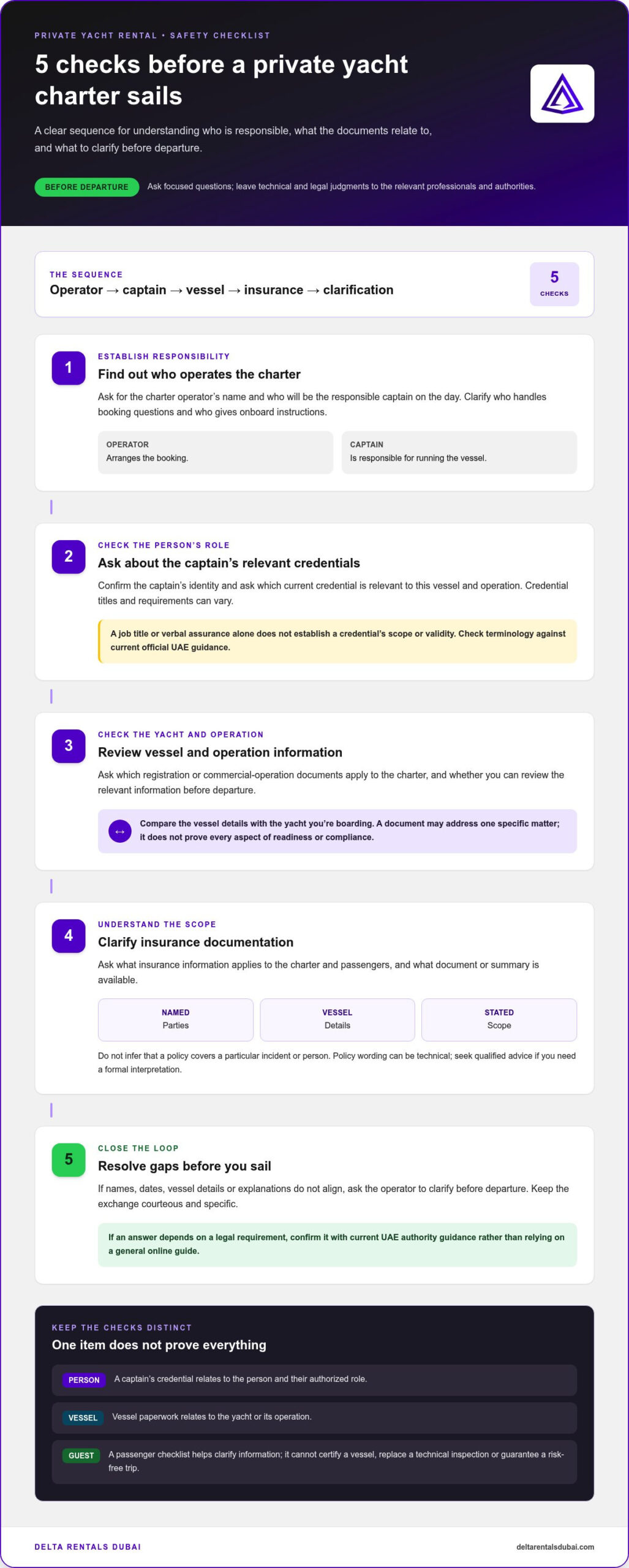
Review these details in sequence. The aim is to understand who is responsible for the charter and what information relates to the vessel and passengers, not to make a technical or legal judgment yourself. Document names, credentials and requirements can depend on the vessel and operation. For questions about current rules, refer to the relevant UAE maritime authority.
- Establish who operates the charter. Ask for the charter operator’s name and who will be the responsible captain on the day. Clarify who handles booking questions and who gives onboard instructions. The operator arranges the booking, while the captain is responsible for running the vessel.
- Ask about the captain’s relevant credentials. Confirm the captain’s identity and ask which current credential is relevant to this vessel and operation. Credential titles and requirements can vary. Check the terminology against current official UAE guidance; a job title or verbal assurance alone doesn’t establish a credential’s scope or validity.
- Review vessel and operation information. Ask which registration or commercial-operation documents apply to the charter, and whether you can review the relevant information before departure. Compare the vessel details with the yacht you’re boarding. A document may address one specific matter, so don’t treat it as proof of every aspect of readiness or compliance.
- Clarify insurance documentation. Ask what insurance information applies to the charter and passengers, and what document or summary is available. Note the named parties, vessel details and stated scope, but don’t infer that a policy covers a particular incident or person. Policy wording can be technical; ask questions and seek qualified advice if you need a formal interpretation.
- Resolve gaps before you sail. If names, dates, vessel details or explanations don’t align, ask the operator to clarify before departure. Keep the exchange courteous and specific. If the answer depends on a legal requirement, confirm it with current UAE authority guidance rather than relying on a general online guide.
Keep captain credentials separate from vessel documents
A captain’s credential relates to the person and their authorized role; vessel paperwork relates to the yacht or its operation. One does not automatically establish the other. Ask what each item is intended to show and whether it relates to your charter. For an example of how a safety check can prompt equipment review and discussion, see the Vessel Safety Check (VSC). It’s a reference, not a UAE regulatory standard.
Ask about insurance without guessing what it covers
“Insured” alone doesn’t tell a passenger which policy applies or what its terms mean. Ask which insurance information concerns the charter, whether passengers are addressed in the documentation, and whom to approach if an explanation is unclear. Don’t assume a certificate proves comprehensive protection. Read any supplied summary carefully and seek qualified advice if you need a formal interpretation.
Use this part of your safety checklist for private yacht rental dubai to organize questions before boarding. To plan a charter with Delta Rentals Dubai, discuss a private yacht rental and share any preparation questions.
How to Assess Safety Claims and Charter Readiness
Promotional language can sound reassuring, but it doesn’t show exactly what has been checked. Treat broad claims as prompts for useful detail, not as reasons for suspicion. The goal is to understand how the charter is prepared and what the crew can explain, without trying to certify the yacht yourself.
Use this comparison to turn common assurances into specific questions. The relevant evidence can vary by vessel and operation, so ask what applies to your charter.
| Broad assurance | Useful evidence or explanation | Clear follow-up question |
|---|---|---|
| “The captain is licensed” | The relevant current credential and how it relates to this role | “Could you explain which credential applies to the captain’s role on this charter?” |
| “The yacht is insured” | Insurance information identifying what applies to the vessel or charter, and how passenger questions are addressed | “What insurance document or summary relates to this booking and its passengers?” |
| “The yacht is ready” | A clear account of preparations and the passenger safety briefing | “What should guests know about the briefing and onboard safety equipment?” |
| “The operation is compliant” | A plain-language explanation of the relevant documents or process | “Which requirement or document does that refer to?” |
Turn broad assurances into specific questions
Ask neutrally and give the operator room to explain. If “licensed” or “insured” feels too broad, ask what the word refers to and whether supporting information is available. For unfamiliar terms, request a plain-language explanation. A useful response should make the claim’s scope clearer; a label alone doesn’t prove every safety or legal matter.
Regulatory and technical meanings can depend on the vessel and operation. The International Maritime Organization (IMO) provides background on international maritime affairs, but its general information isn’t a ruling on an individual charter. Check current UAE authority guidance when you need to interpret a legal requirement.
Assess readiness without attempting an inspection
As a passenger, notice whether safety information and equipment are presented clearly and whether the crew can explain the briefing. These observations can help you follow instructions, but they don’t certify the vessel’s condition or prove compliance. If something appears unclear or concerning, raise it with the operator before boarding instead of making a technical judgment yourself.
Keep your notes focused on what you’ve been told, what information you’ve seen and what remains unclear. That makes it easier to resolve questions without turning preparation into a confrontation. Treat each answer in your safety checklist for private yacht rental dubai as one part of the overall picture, not a standalone guarantee.
If you’re planning a private yacht charter, you can discuss your yacht rental plans and share preparation questions in advance.
What to Check Before Boarding and During the Safety Briefing
Use the time before departure to get oriented, not to conduct your own inspection. A clear briefing helps every guest understand where to go, how to alert the crew and whose instructions to follow if conditions change. Layouts and procedures vary by vessel, so ask the crew to show you what applies on this yacht rather than assuming a standard arrangement.
The essential passenger safety briefing
Listen first, then ask a focused question if something is unclear. Before the yacht gets underway, make sure the essentials have been covered:
- Identify the crew contact. Know whom to alert and how to get their attention from the areas where guests will spend time.
- Locate lifejackets. Ask where they’re stored, how to put them on and which ones are suitable for each passenger, including children. Find out before an emergency.
- Understand the routes. Ask the crew to point out the available ways to move between guest areas and reach an appropriate safe location if instructed. Follow the vessel-specific directions.
- Learn the communication procedure. Find out what to do if someone feels unwell, notices a concern or can’t understand an instruction. Confirm how the crew will give directions if plans change.
- Follow onboard instructions. Pay attention to where guests may sit or move while underway, and what the crew expects during an emergency or a change in conditions.
If you missed a direction, ask the crew to repeat it before departure. The briefing is there to make instructions clear, not to test your nautical knowledge.
Passenger needs, weather and changing conditions
Share relevant needs before boarding, ideally while planning the charter. Mention mobility limitations, health concerns that could affect the trip, assistance needed when moving around, or child-safety considerations. Share only the personal detail needed to explain what support may be useful.
Weather and route decisions belong to the captain’s operational judgment. Conditions can change, and the captain may adjust the plan or give new instructions. There’s no single wind or wave threshold guests should apply themselves. Ask how updates will be communicated, then follow the captain and crew rather than relying on a forecast alone.
Keep this part of your safety checklist for private yacht rental dubai ready on your phone: passenger needs shared, lifejackets and routes identified, crew contact understood, and briefing instructions heard. Raise unclear or concerning points with the crew before departure. Discuss your private yacht rental and share passenger preparation needs ahead of your charter.
Use the Checklist to Plan a Confident Private Yacht Charter
Good preparation follows a simple sequence: clarify who operates the charter, review relevant information, share passenger needs and attend the onboard briefing. You’re not expected to inspect the yacht or interpret technical paperwork. Aim to understand the arrangements, know what to expect and give the crew useful information before departure.
Keep the conversation calm and specific. Instead of challenging a broad assurance, ask what it refers to and request a plain-language explanation. This helps identify unanswered questions without making the exchange adversarial. Decisions about the vessel and its operation remain with the responsible professionals.
Prepare your questions before confirming
Save a short list on your phone or with your booking notes. Group questions by topic so you can cover the essentials and review the answers before departure:
- Captain: Who is the responsible captain, and what current credential is relevant to this role?
- Vessel documentation: What registration or operating documents apply to this yacht and charter, and what information can guests review?
- Insurance: What insurance information relates to the booking and passengers, and who can explain the policy wording?
- Onboard briefing: Where are lifejackets and emergency routes, how do guests contact the crew, and what instructions should everyone follow?
Keep important arrangements accessible to the lead guest and anyone coordinating the group. Note terms you want clarified, but don’t treat a document or verbal explanation as a substitute for current official guidance on a regulatory question. Share accessibility, health or child-safety needs before boarding so the crew can take them into account during the briefing.
Make the charter experience feel effortless
Preparation shouldn’t dominate the day. Once key questions are answered, let the crew guide the experience: arrive ready to listen, follow the briefing and pay attention to updates from the captain. If the route or plan changes, ask for a concise explanation and follow operational instructions. Clear expectations help guests settle in and enjoy their time on board.
Delta Rentals Dubai offers luxury yacht rentals as part of its luxury experiences in the UAE. Use this safety checklist for private yacht rental dubai to prepare for a considered charter, not to seek a promise of risk-free sailing. Clear communication, informed expectations and professional oversight all contribute to a well-prepared experience.
Ready to plan a private yacht rental? Discuss your yacht rental with Delta Rentals Dubai.
Make Your Next Charter a Confident One
Let preparation be the quiet part of a memorable day on the water. Before booking, choose one person in your group to keep key answers and arrangements together. That way, everyone knows where to turn and can avoid relying on assumptions.
Keep the safety checklist for private yacht rental dubai as a practical planning tool, not a promise that conditions can’t change. Confidence comes from clear communication, professional guidance and being ready to follow instructions on board.
Delta Rentals Dubai offers luxury yacht rentals. Discuss your private yacht rental with our team to start planning your charter.
Frequently Asked Questions
What documents should I check before a private yacht charter?
Ask which vessel registration and commercial-operation documents apply, and request information about the captain’s relevant credential and insurance connected to your booking. Check that names and vessel details are consistent across the information you receive. Keep your booking confirmation accessible so you can compare the agreed charter details with the arrangements on the day. Document names and requirements can vary; confirm legal questions with current UAE maritime authorities.
How can I verify a yacht captain’s qualifications in the UAE?
Ask for the responsible captain’s name and the current credential relevant to their role, then check its terminology and verification process with the appropriate UAE maritime authority. A job title or general statement that a captain is “licensed” doesn’t tell you the credential’s scope or whether it applies to the operation. If the details are unclear, ask the operator for a plain-language explanation before departure.
Is a private yacht charter insured for its passengers?
Don’t assume passenger coverage from the word “insured” alone. Ask what policy information applies to the charter, whether passengers are addressed, and where you can review the relevant terms. Coverage depends on the policy wording, including its scope and exclusions. If you need to know whether a particular situation or person is covered, request clarification from the responsible operator or insurer, and seek qualified advice rather than relying on a verbal summary.
Can I ask to see vessel safety documents before boarding?
Yes. Ask which vessel or operating documents relate to your charter and whether relevant information can be shared before boarding. You can also ask for the vessel’s name or identifying details to compare with the yacht presented on the day. A document can answer a specific question, but it isn’t a passenger inspection or proof of every safety measure. Use current official guidance for regulatory interpretation.
What safety equipment should guests be shown on a yacht?
Ask the crew to point out lifejackets and explain how to use the ones intended for your group. Guests should also learn where relevant first-aid supplies and fire extinguishers are located, and how to contact the crew in an emergency. Equipment and its placement differ by vessel, so follow the crew’s demonstration rather than searching independently. If travelling with children, ask which lifejackets are appropriate for them.
What should I do if the safety briefing is unclear?
Ask the crew to repeat or demonstrate the instruction before the yacht departs. Be specific: “Could you show me how to alert you from this area?” or “Which route should we use if you direct us to move?” If a critical direction remains unclear, tell the responsible crew member or captain and pause your preparations until you understand what to do. Clear instructions help the whole group respond calmly.
What happens if weather conditions change during a yacht charter?
The captain may adjust the route, timing or operation in response to changing conditions. Follow the crew’s updated instructions, and ask for a brief explanation if you’re unsure what has changed. Don’t rely on an earlier forecast or pressure the captain to continue with the original plan. Conditions and decisions depend on the vessel and circumstances, so there isn’t one wind or wave threshold for every charter.