

When ambient temperatures reach 35°C, highway asphalt routinely surges past 65°C. At that extreme threshold, maintaining premium vehicle tire grip in hot climates shifts from a routine driving consideration into a vital engineering discipline.
If you’ve ever felt your steering turn greasy during high-speed cruising or watched tire pressures spike dramatically on the highway, you know the frustration. Pushing a high-horsepower vehicle across sun-baked road networks naturally triggers concerns about rapid tread wear, unexpected traction loss, and thermal over-pressurization. You deserve unwavering stability and predictable feedback from your machine, regardless of external heat.
You don’t have to compromise precision when temperatures peak. Discover the critical science of high-performance tire traction on scorching asphalt to preserve vehicle safety, razor-sharp handling, and tire longevity. We examine how ultra-high-performance compounds behave under thermal stress, outline practical cold-pressure protocols, and detail how to command high-performance vehicles across demanding arid environments with effortless confidence.
Key Takeaways
- Master the mechanics of contact patch adhesion to optimize premium vehicle tire grip in hot climates when asphalt temperatures cross critical thresholds.
- Understand the thermodynamic forces behind internal pressure spikes and why bleeding hot tires compromises high-speed structural integrity.
- Identify why dedicated ultra-high-performance summer compounds remain essential for stability, whereas all-season alternatives degrade rapidly under severe heat.
- Apply practical cold-setting protocols and dry nitrogen inflation to eliminate moisture-induced pressure volatility before high-speed journeys.
- Adopt elite fleet maintenance standards by tracking compound heat cycles rather than relying solely on traditional tread depth measurements.
What Controls Premium Vehicle Tire Grip in Hot Climates?
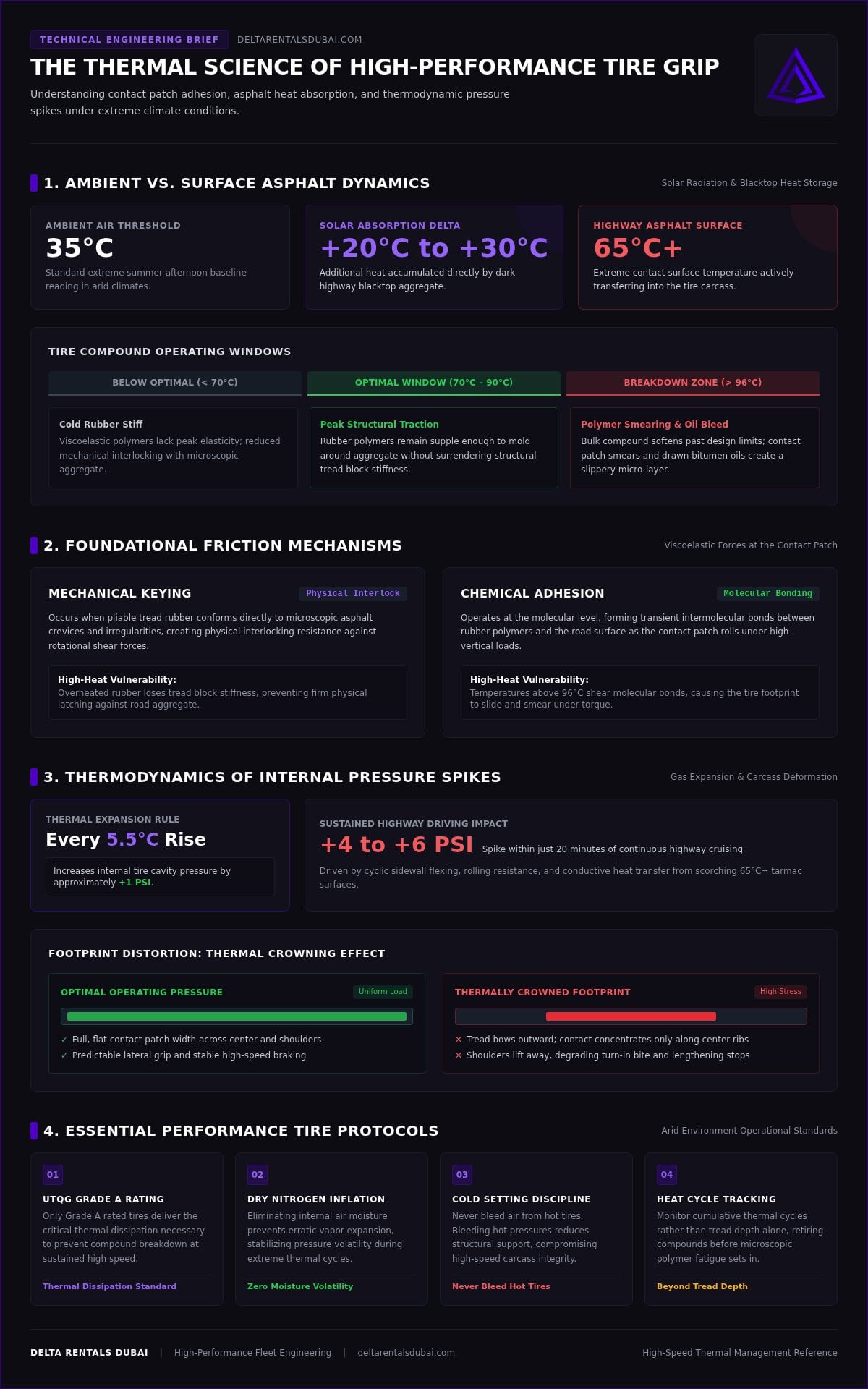
Tire grip relies on two foundational mechanisms: mechanical keying and chemical adhesion. Mechanical keying occurs when pliable tread rubber conforms to microscopic asphalt crevices, interlocking the tire with the pavement. Chemical adhesion operates at the molecular level, forming transient intermolecular bonds between rubber polymers and the road surface.
Balancing both forces dictates premium vehicle tire grip in hot climates, especially when high horsepower enters the equation. Pushing massive torque through the driven wheels generates severe shear stress. The tire contact patch must simultaneously handle relentless rotational friction and searing pavement heat. While standard road tires function predictably under moderate conditions, aggressive heat transfer changes rubber dynamics entirely.
The Physics of Chemical Adhesion and Molecular Softening
Tire rubber is viscoelastic, behaving partially like an elastic solid and partially like a viscous liquid. Premium road compounds operate best within a targeted thermal window between 70°C and 90°C. Within this zone, rubber polymers stay supple enough to mold around aggregate without surrendering structural stiffness.
Crossing this thermal boundary compromises grip. When bulk compound temperatures exceed 96°C, polymers soften past their design limits, causing the contact patch to smear rather than bite. High road heat also draws underlying bitumen oils to the surface, creating an invisible, slippery micro-layer. Under Uniform Tire Quality Grading standards, only Grade A rated tires offer the thermal dissipation necessary to resist catastrophic compound breakdown at sustained speed.
How Extreme Asphalt Temperatures Exceed Compound Tolerances
Dark asphalt acts as a massive thermal reservoir. Because blacktop absorbs immense solar radiation, surface temperatures routinely measure 20°C to 30°C higher than ambient air readings. A warm 35°C afternoon easily yields tarmac temperatures above 65°C.
This intense baseline leaves negligible thermal headroom for spirited driving. High-downforce sports cars generate exceptional vertical load, forcing the tire carcass to flex continuously. That internal deformation generates rapid kinetic heat. Once the tire exceeds its optimal operating range, drivers experience a greasy, detached sensation at the steering wheel, accompanied by sluggish turn-in response and extended braking distances. Preserving premium vehicle tire grip in hot climates demands active awareness of these mechanical limits before heat-induced sliding takes over.
Thermodynamics of High-Performance Tires: Pressure, Heat, and Load
Every closed tire cavity functions as a thermodynamic chamber governed by gas expansion physics. As heat transfers inward from searing road surfaces, gas molecules accelerate, driving internal pressure upward. When high vehicle mass and extreme torque enter the equation, managing pressure expansion becomes the primary factor in sustaining premium vehicle tire grip in hot climates.
Continuous carcass deformation generates intense kinetic friction. At sustained highway velocities, cyclic sidewall flexing and rolling resistance create internal heat faster than the tire can dissipate it. Without disciplined thermal management, internal pressures spiral far above manufacturer specifications.
Pressure Expansion Mechanics: Calculating the Thermal Spike
Internal tire pressure scales predictably with heat. For every 5.5°C increase in cavity temperature, pressure climbs by roughly 1 PSI. Setting a baseline cold pressure inside a shaded facility provides no shield once the car rolls onto hot blacktop. Twenty minutes of highway cruising routinely adds 4 to 6 PSI from carcass flexing alone.
Thermal over-pressurization crowns the tire. The tread bows outward, concentrating the vehicle’s footprint along the center ribs while lifting the shoulders away from the pavement. This distortion sharply shrinks the contact patch, degrading lateral cornering grip and lengthening braking distances.
Sidewall Deflection and Structural Heat Buildup
Vehicle mass directly magnifies thermal stress. Heavy grand tourers and full-size performance platforms exert massive loads on tire carcasses during high-speed transitions. Understanding these load dynamics is standard practice when choosing luxury SUV rentals engineered for severe conditions, where heavier chassis demand precise load-rated tires.
Supercar alignment profiles complicate this balance. Aggressive factory negative camber concentrates continuous vertical and lateral loads onto the inner shoulder. This localized contact zone absorbs blistering thermal stress, accelerating carcass fatigue while the outer shoulder remains comparatively cool.
Tire Blistering and Delamination Risks at Sustained Speeds
Thermal accumulation degrades tire safety from the inside out. Ambient shop air often introduces trace moisture into the carcass during inflation. Under prolonged high-speed friction, that moisture vaporizes into steam, creating localized hot spots and pressure surges.
Severe thermal stress can cause tread rubber to blister and peel away from the steel belts. Reviewing NHTSA tire safety standards and temperature grading reinforces why sustained speeds in hot climates require strict thermal cool-down intervals. If you want seamless access to meticulously inspected exotics prepared for these harsh thermal demands, you can connect with a performance concierge to ensure every tire cold-setting matches national driving conditions.
Comparing Tire Compounds for Blistering Highway and Track Driving
All-season compounds fail rapidly under sustained desert heat. Designed to stay flexible near freezing temperatures, their softer rubber matrices turn pliable and greasy once road surfaces exceed 60°C. Tread blocks flex excessively, shearing away under acceleration and dramatically lengthening stopping distances. Choosing the right compound architecture is the only way to preserve premium vehicle tire grip in hot climates.
High-performance driving demands specialized polymer chemistry. Ultra-High-Performance (UHP) summer rubber and track-focused semi-slicks use distinctly formulated resins. Each compound balances thermal endurance, traction limits, and carcass stability differently.
| Compound Category | Optimal Bulk Temp Window | Traction Characteristics | Heat Cycle Durability |
|---|---|---|---|
| All-Season Touring | 10°C to 45°C | Greasy slip above 50°C; severe tread squirm | Rapid degradation; premature tread reversion |
| Max-Performance UHP Summer | 70°C to 90°C | Predictable adhesion; sharp steering response | Robust resistance to repeated thermal cycles |
| Track Semi-Slick (R-Compound) | 80°C to 105°C | Extreme mechanical grip; sudden break of traction when hot | Very low; heat cycles harden rubber prematurely |
Ultra-High-Performance (UHP) Street Tires: The Desert Standard
UHP summer tires like the Michelin Pilot Sport S 5 or Continental SportContact 7 represent the benchmark for arid highway cruising. Their tread formulations blend synthetic solution-SBR with dense silica networks to maintain high glass transition thresholds. These tires dissipate thermal spikes effortlessly during rapid cross-country transits.
Rigid tread blocks resist squirm under sudden deceleration, keeping braking distances short. Following established USTMA tire care and inflation protocols ensures these performance structures do not exceed their pressure thresholds. Even ultra-luxury flagships like the Rolls-Royce Cullinan Black Badge rely on high-load UHP rubber to preserve silent cruising composure and structural resilience against searing asphalt.
Track-Grade Semi-Slick Rubber: Peak Adhesion vs. Overheating
Semi-slick track tires, such as the Pirelli P Zero Trofeo RS and Michelin Pilot Sport Cup 2 R, offer peerless grip on prepped circuits. Their minimal tread pattern expands the footprint to maximize chemical bonding with the tarmac. However, that ultra-soft formulation presents serious compromises on open desert highways.
Without constant cooling air or active management, sustained high-speed driving on burning pavement overheats the compound beyond 105°C. The rubber grains rapidly, shedding its cohesive strength and producing sudden understeer. Purpose-built machinery like the Porsche 911 GT3 RS leverages this track rubber brilliantly on circuit surfaces, but sustained highway journeys demand close telemetry monitoring to avoid blistering the shoulders. For everyday driving, UHP street tires deliver far more predictable premium vehicle tire grip in hot climates.
Essential Protocols to Maximize Hot-Weather Traction and Safety
Sustaining vehicle composure on sun-baked tarmac requires systematic operational discipline. High ambient temperatures shrink your margin for error, making proactive maintenance critical. By following rigorous pre-drive protocols and observing vehicle feedback, you safeguard your tires against thermal failure while ensuring dependable premium vehicle tire grip in hot climates.
Executing five proven steps guarantees optimal performance:
- Verify cold baseline pressures: Always calibrate in shaded environments before driving.
- Incorporate dry nitrogen: Purge moisture to stabilize internal cavity expansion.
- Monitor real-time telemetry: Track digital TPMS displays for irregular temperature spikes.
- Refine steering technique: Apply smooth inputs to prevent destructive tread scrubbing.
- Perform visual inspections: Check for shoulder feathering, heat checking, and carcass deformation.
Cold Calibration and Nitrogen Inflation Advantages
Check baseline tire pressure only after the vehicle has rested in the shade for at least three hours. Morning calibration provides the truest baseline reading. Inflating tires with dry nitrogen purges ambient water vapor entirely. Moisture expands erratically under high heat, whereas dry gas expands at a steady, predictable rate.
Never bleed air pressure from hot tires. A midday pressure rise is an engineered reaction to highway driving. Venting air from a hot tire drops the cold resting pressure below the factory placard threshold, accelerating carcass flexing and blowout risks once the tire cools.
Active Cockpit Telemetry and Heat Management
Modern supercar displays provide real-time pressure and temperature readouts for each corner. Keep this display visible during sustained highway driving. An axle variance exceeding 4 PSI indicates localized friction or heat buildup from mechanical misalignment.
Manage operating temperatures using smooth decelerations. Gradual braking allows airflow to cool wheel assemblies naturally. In contrast, violent threshold stops transfer intense brake rotor heat into the wheel rims, heating internal tire air from the inside out.
Recognizing Surface Greasing and Dynamic Driving Adjustments
When tread rubber exceeds its optimal thermal threshold, steering feedback becomes light and unresponsive. This greasy sensation signals that chemical adhesion is collapsing. Aggressive steering inputs under these conditions scrub the outer shoulders against hot aggregate, stripping tread depth rapidly.
Smooth, measured steering inputs preserve the tire contact patch and restore predictable premium vehicle tire grip in hot climates. Combine progressive driving habits with daily visual checks for shoulder feathering and heat-induced surface cracking. For expert vehicle setup advice or to reserve high-performance vehicles prepped for severe thermal conditions, reach out directly to the Delta Rentals Dubai concierge via WhatsApp.
How Elite Performance Fleets Maintain Uncompromising Tire Standards
Operating high-horsepower machinery across blistering road networks leaves zero margin for mechanical compromise. Professional fleet maintenance serves as the definitive benchmark for hot-weather performance safety, replacing casual ownership habits with strict engineering protocols. Sustaining optimal premium vehicle tire grip in hot climates requires continuous oversight, specialized equipment, and uncompromising retirement criteria for every contact patch.
Top-tier operators never evaluate tires purely by remaining tread depth. Repeated exposure to extreme surface heat hardens tread polymers through continuous heat cycles, degrading chemical grip long before grooves wear smooth. Professional teams retire tires based on operational hours and thermal exposure, ensuring vehicles retain full dynamic capabilities at speeds exceeding 300 km/h.
The Pre-Delivery Multi-Point Inspection Routine
Before any prestige vehicle departs the staging bay, technicians conduct rigorous computerized inspections. Technicians check inner and outer sidewalls for structural blistering, evaluate bead seating, and measure tread across three distinct lateral zones using digital depth gauges.
Wheel geometry receives equal scrutiny. Laser alignment racks confirm that toe and negative camber match factory tolerances precisely, preventing heat from concentrating on vulnerable inner tire shoulders. Every high-performance model, including track-focused thoroughbreds like the Ferrari SF90 and McLaren Artura, rolls out with factory-homologated, Grade A heat-rated OEM fitments calibrated to exact cold specifications.
Experiencing Flawless Performance with Complete Peace of Mind
Behind the wheel of an exotic, confidence stems directly from vehicle preparation. Knowing that your tire contact patch has been inspected, pressure-calibrated, and balanced for severe thermal stress allows you to experience peerless acceleration and handling without hesitation. Backed by over 300 five-star verified client reviews reflecting elite vehicle reliability, professional preparation removes all driving guesswork.
Selecting an immaculately maintained machine ensures you enjoy maximum premium vehicle tire grip in hot climates from the first throttle input. Review our curated collection at Delta Rentals to choose from an elite national fleet of prestige supercars and luxury SUVs. When you are ready to secure a vehicle prepped to the highest thermal safety standards, reach out via WhatsApp to book your precision vehicle with our dedicated concierge team.
Master the Heat With Uncompromising Performance Standards
Sustaining premium vehicle tire grip in hot climates comes down to active thermal discipline. When you calibrate baseline pressures in the shade, track live cockpit telemetry, and rely on dedicated ultra-high-performance compounds, extreme asphalt isn’t an obstacle. You protect the tire contact patch, prevent greasy traction loss, and unlock the full dynamic potential of your machine.
Experience that engineering precision firsthand. Backed by over 300 five-star verified client reviews on Google, we subject every vehicle to a strict multi-point tire and mechanical inspection prior to every client handover. Step behind the wheel of an elite collection of factory-maintained supercars and ultra-luxury SUVs prepared specifically for demanding thermal conditions. Chat with our VIP concierge on WhatsApp to reserve your perfectly prepped supercar and enjoy absolute peace of mind at speed.
Frequently Asked Questions
How much does tire pressure increase when driving on hot asphalt in summer?
Expect an internal pressure increase of 4 to 6 PSI during standard highway cruising on sun-baked asphalt. Tire cavity air expands predictably by roughly 1 PSI for every 5.5°C rise in temperature. When radiant road heat exceeding 60°C combines with continuous carcass flexing, internal pressure climbs swiftly. Modern performance TPMS readouts reflect this normal thermodynamic expansion within twenty to thirty minutes of continuous operation.
Can high road temperatures cause high-performance car tires to blow out?
Yes, extreme road heat can trigger catastrophic structural failure if tires are underinflated or neglected. Underinflation causes excessive sidewall deflection, generating severe internal carcass friction. Combined with surface temperatures over 60°C, this friction heats the internal belt package past safe thresholds, accelerating ply separation and rapid delamination. Maintaining correct cold placard pressure prevents excessive flexing and eliminates the primary catalyst for high-speed tire failure.
Why do tires feel slippery or greasy after aggressive driving in hot weather?
Tires turn greasy when the outer tread compound exceeds its optimal operating window, typically above 96°C for standard performance rubber. At this threshold, viscoelastic polymers soften excessively, losing shear resistance and smearing across aggregate rather than interlocking with it. Sustaining premium vehicle tire grip in hot climates requires smooth steering inputs and brief cooling intervals to bring surface temperatures back into their ideal adhesive range.
Is nitrogen tire inflation genuinely beneficial for sports cars in arid climates?
Nitrogen inflation delivers tangible benefits by eliminating moisture from inside the tire cavity. Standard compressed air contains ambient humidity, which vaporizes at high temperatures and creates erratic pressure spikes. Because pure dry nitrogen expands linearly according to gas laws, it provides predictable pressure curves during hard driving. This thermal stability protects contact patch geometry and ensures consistent vehicle balance across scorching highway transits.
Should I lower my tire pressure below recommended specs before driving in extreme heat?
Never drop tire pressure below factory placard recommendations before driving. Lowering baseline pressure increases sidewall deflection and rolling resistance, generating dangerous internal friction that accelerates heat buildup rather than preventing it. You shouldn’t second-guess manufacturer cold inflation specs, which already factor in thermodynamic expansion. Always set pressures to exact factory cold figures in shaded conditions before departure.
What tire tread compound is best suited for extreme heat environments?
Ultra-High-Performance (UHP) summer compounds engineered with synthetic solution-SBR and dense silica matrices offer the highest durability and grip. These formulations deliver elevated glass transition temperatures, resisting polymer breakdown on tarmac exceeding 65°C. While semi-slick motorsport rubber provides exceptional initial traction, dedicated UHP street tires deliver the most dependable premium vehicle tire grip in hot climates without premature blistering or accelerated compound graining.
How often should I inspect the tires on an exotic vehicle during summer?
Inspect high-performance tires before every journey during high-temperature months. Perform a visual check for inner-shoulder wear, foreign debris, and surface heat cracking while the rubber is cool. Verify baseline pressures with a calibrated gauge if the car has rested for over three hours. Routine pre-drive checks catch heat-induced abnormalities early, ensuring pristine structural integrity and predictable high-speed handling across national road networks.