

What happens after you pull a paddle to request a lower gear? This educational guide to paddle shift rev matching downshifts on performance cars explains how the transmission may respond, so you can understand the shift instead of guessing. A paddle sends a request, but the car’s controls determine whether and when the gear change happens.
It’s natural to wonder whether a downshift will unsettle the car, push engine speed too high or work just like heel-and-toe. The answer depends on the vehicle’s transmission and controls. In many performance cars, the system coordinates the shift and may briefly raise engine speed to bring it closer to what the lower gear requires. That assistance has limits. It doesn’t replace your judgement about speed, gear choice, grip or conditions.
This guide walks through the downshift sequence, compares automatic rev matching with heel-and-toe and explains why a paddle request may be delayed or refused. It also covers how to build familiarity in a suitable closed-course setting. Start with the owner’s manual, follow an instructor’s guidance and progress gradually.
Key Takeaways
- Learn how a paddle request, shift authorisation and engine-speed adjustment can work together during a downshift.
- Understand what automatic rev matching may assist with, and why it can’t replace your judgement about speed or gear choice.
- Distinguish an automated throttle blip from the driver-operated heel-and-toe technique.
- Before practising, check the owner’s manual and vehicle controls, then build familiarity gradually in a suitable closed-course setting with instructor guidance.
- Verify the transmission and paddle functions for the specific vehicle model year, because features can vary between cars.
What Is Rev Matching in a Paddle-Shift Downshift?
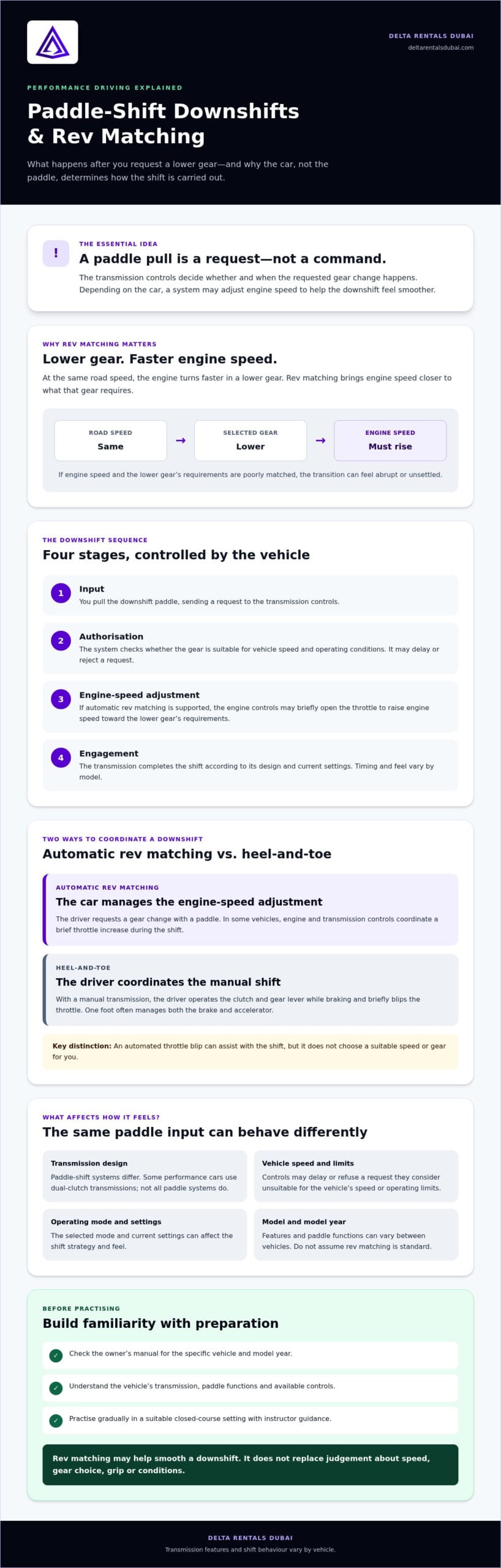
Rev matching brings engine speed closer to the speed required by a lower gear. At a given road speed, selecting a lower gear makes the engine turn faster relative to the wheels. If engine speed and the lower gear’s requirements are poorly matched, the transition can feel abrupt. Depending on the vehicle, its controls may adjust engine speed during the shift to help smooth the change.
Rev matching is the process of bringing engine speed closer to what a lower gear requires, although vehicles manage that process differently. Pulling a paddle starts a request, not necessarily an immediate shift. The transmission’s control system may accept, delay or refuse the request based on factors such as vehicle speed and engine operating limits.
What changes when you select a lower gear?
At the same road speed, the engine turns faster in a lower gear than in a higher gear. Think of a bicycle: in a lower gear, the pedals turn more quickly for the same wheel speed. A car’s transmission creates a similar relationship between the wheels and the engine.
Simple example: If you’re travelling steadily in a higher gear and request the next lower gear, the engine will need to turn faster to keep pace with the wheels. The exact engine speed depends on the car, its gear ratios and road speed, so there’s no universal RPM target. If engine speed changes sharply, the car may lurch or the shift may feel unsettled. Matching speeds can reduce that jolt, but it doesn’t make every downshift suitable for the situation.
What do the shift paddles actually control?
A paddle sends a gear-change request to the transmission controls. What happens next depends on the vehicle’s transmission design, selected operating mode and current conditions. The paddle doesn’t directly set engine speed, and pulling it doesn’t guarantee that the requested gear will engage. In vehicles with electronic rev matching, the system may coordinate the shift with a brief throttle increase.
Some performance cars use dual-clutch transmissions, with separate clutches for odd and even gears. This design can allow the next gear to be prepared in advance, but paddle-shift systems aren’t all dual-clutch units. For background on that transmission design, see How Dual-Clutch Transmissions Work. The useful distinction is that your input requests a change, while the car’s controls determine how and when it happens.
How Performance Cars Rev-Match During Paddle-Shift Downshifts
A paddle downshift involves more than changing gears. In a vehicle with automatic rev matching, the engine and transmission controls coordinate the request so engine speed can rise towards what the lower gear requires. The exact sequence and strategy depend on the car. The driver requests a shift; the vehicle’s control systems decide how to carry it out.
A typical electronically managed downshift may follow these steps:
- Input: You pull the downshift paddle, sending a request to the transmission controls.
- Authorisation: The system checks whether the selected gear is suitable for the vehicle’s speed and operating conditions. It may delay or reject a request it considers unsuitable.
- Engine-speed adjustment: If the vehicle supports automatic rev matching, engine controls may briefly open the throttle to raise engine speed towards the lower gear’s requirements.
- Engagement: The transmission completes the shift according to its design and current settings. Timing and feel vary by model.
Automatic rev matching and transmission control
The engine control unit manages engine functions, while the transmission controls oversee gear selection. In some cars, these systems coordinate a brief throttle increase with a downshift. Other cars use a different shift strategy or don’t offer automatic rev matching. Modes and feature names vary, too. Check the owner’s manual for the specific model and year rather than assuming a setting or capability is standard.
For a driver-focused explanation of the underlying idea, see What Is Rev-Matching. Automatic systems perform the engine-speed adjustment electronically, but they don’t remove the need to choose a suitable gear and speed.
Paddle shifting compared with heel-and-toe downshifting
With a manual transmission, heel-and-toe is a driver technique. While braking, the driver operates the clutch and gear lever and briefly blips the throttle, often using one foot to manage both the brake and accelerator. With paddle shifting, the driver requests a gear change using a paddle, and the car may manage the shift and throttle coordination. Both approaches address engine-speed compatibility, but use different controls. Heel-and-toe isn’t required in every paddle-shift car.
This guide provides general context, not instructions for every vehicle. If you’re considering a performance-car rental, you can ask about available rental options, then verify the specific vehicle’s transmission and paddle functions before driving.
Why a Paddle-Shift Downshift May Feel Smooth, or Abrupt
A paddle downshift can feel crisp, pause briefly or fail to engage. That response isn’t automatically a sign of a problem. Road speed, the requested gear, engine operating range, selected driving mode and the vehicle’s calibration can all affect what the transmission allows and how the shift feels.
| What you notice | Possible explanation |
|---|---|
| Smooth shift | The requested gear is suitable for the current conditions, and the transmission coordinates the change with engine speed. |
| Delayed shift | The system may be checking the request, managing another shift, or responding to the selected mode and operating conditions. |
| Refused shift | The requested gear may be outside the vehicle’s permitted operating range, so the system prevents or limits the change. |
Why might the car delay or reject a downshift?
A lower gear at the car’s current speed could demand an engine speed the vehicle’s controls won’t permit. The system may therefore hold the existing gear, delay the change or reject the request. Thresholds and responses vary by model, year and mode. One delayed shift alone doesn’t diagnose a fault. Check the owner’s manual for the vehicle-specific explanation, and consult qualified service personnel if the behaviour persists or warning indicators appear.
What affects shift smoothness and vehicle balance?
Gear choice is only part of the experience. A sudden downshift can increase engine braking and change how the car decelerates. If that change is abrupt, it may unsettle the vehicle, particularly when you’re also braking or turning. Even a smooth shift can be unsuitable for the situation.
Surface conditions matter as well. A rough, wet or otherwise low-grip road can leave less margin for abrupt changes. A downshift during cornering can add another demand while the car is already changing direction. Don’t experiment with unfamiliar gears on public roads. Learn the vehicle’s controls and guidance first, and reserve practice for a suitable closed-course environment.
As background, a synchronized downshift rev-matching system describes technology that helps coordinate engine speed with a downshift. Rev matching can’t make every gear choice appropriate, remove the effects of speed and conditions, or guarantee a risk-free shift. Follow the specific vehicle’s instructions and respect its limits.
How to Practise Paddle-Shift Downshifts Safely
Build familiarity before adding speed or complexity. Practise only in a suitable closed-course environment, with instructor guidance and within the venue’s rules and the vehicle’s limits. Practise technique on a closed course, not public roads. A controlled setting gives you room to learn the car’s responses without treating traffic as a test environment.
A beginner’s closed-course practice sequence
Keep the first exercises simple. Before moving, read the owner’s manual, locate the vehicle’s controls and follow the instructor’s direction. Then progress gradually:
- 1. Get familiar while stationary. Locate the paddles and check how the selected gear and driving mode appear on the display. Confirm how the vehicle indicates a shift request or completed change.
- 2. Review the car’s limits. Use the owner’s manual to understand paddle-shift operation, warnings and gear-selection restrictions. Ask the instructor to clarify anything unfamiliar.
- 3. Begin with basic, straight-line inputs. On a suitable course, follow an instructor-approved exercise at a manageable pace. Focus on deliberate paddle use and awareness, not on producing a dramatic sound or rapid shift.
- 4. Add complexity only with guidance. Introduce braking or cornering only if the instructor approves and the exercise, vehicle and course conditions are appropriate.
- 5. Pause when a response surprises you. Don’t immediately repeat an unexpected or refused shift. Stop the exercise when safe, then review the manual and ask the instructor what the vehicle may have been communicating.
Common mistakes to avoid while learning
Don’t request a lower gear without understanding the vehicle’s speed-related limits. Rev matching can help coordinate engine speed, but it doesn’t make an unsuitable gear choice safe. The permitted response differs between vehicles, so don’t rely on rules of thumb from another model.
Keep your attention on vehicle control and your surroundings, not fixed on the tachometer. Check the display only as appropriate for the exercise and the instructor’s guidance. Don’t test performance techniques or chase engine sounds on public roads. Traffic, road surfaces and changing conditions leave no place for experimentation.
This guide can help you prepare, but it can’t replace model-specific instructions or supervised practice. If you’re considering a performance-car rental, contact Delta Rentals Dubai to ask about rental options and verify the specific vehicle’s transmission and controls before driving.
Experience Paddle-Shift Performance with the Right Preparation
The key lesson is simple: understand the vehicle, use its paddles deliberately and respect the limits set by its controls. A familiar badge or model name isn’t enough to confirm how a particular car shifts. Transmission equipment and features can vary by model year, so check the exact vehicle before driving.
What to confirm before driving an unfamiliar performance car
Take a moment to establish what the car can and can’t do. Review its owner’s guidance and ask the rental provider to explain any controls or functions you don’t recognise. Confirm the rental terms and any applicable driving requirements directly with the provider.
- Transmission: Ask which transmission is fitted to the specific vehicle.
- Paddles and modes: Confirm how to request shifts, how the selected gear appears on the display and which operating modes affect shift behaviour.
- Rev matching: Ask whether the car has automatic rev matching and how the feature behaves in that model year. Don’t assume the paddle automatically blips the throttle.
- Driving guidance: Read the owner’s instructions and ask for a clear explanation of the controls before setting off.
- Rental terms: Check the provider’s terms and any driving requirements that apply to your rental.
This preparation helps you understand how the transmission responds without treating the paddles as a reason to push beyond your familiarity or the car’s limits. The principles in this educational guide to paddle shift rev matching downshifts on performance cars are general. The owner’s guidance and the specific vehicle’s behaviour should lead.
Take the next step from learning to experience
Delta Rentals Dubai offers a Porsche 911 GT3 RS rental as one way to experience a performance car. That doesn’t confirm the transmission, paddle system or rev-matching feature of a particular vehicle. Verify its model year and equipment directly before making plans, and approach the drive with the same deliberate preparation covered here.
For questions about the vehicle, message Delta Rentals Dubai on WhatsApp to ask about rental options and confirm the specific car’s features.
Drive with Understanding, Then Explore Performance
A paddle downshift begins with your request, but the vehicle’s controls determine whether and how the shift happens. Rev matching may bring engine speed closer to what the lower gear requires, yet it can’t make every gear choice suitable or remove the need for sound judgement. Features vary, so check the owner’s manual and confirm the transmission and shift functions for the specific model year.
The safest way to build skill is gradually, with instructor guidance in a suitable closed-course setting. Keep your attention on vehicle control, respect the car’s limits and don’t use public roads to test performance techniques. This guide provides a foundation for understanding, not a substitute for vehicle-specific guidance.
Ready to explore a performance car with the right preparation? Delta Rentals Dubai offers a Porsche 911 GT3 RS rental and specialises in premium performance and luxury vehicles. Confirm the specific car’s equipment and rental details before driving. Ask about the Porsche 911 GT3 RS rental, then plan your next step with care.
Frequently Asked Questions
What is rev matching when downshifting with paddles?
Rev matching brings engine speed closer to what a lower gear requires at the car’s current speed. A lower gear makes the engine turn faster relative to the wheels, and a sudden mismatch can make a shift feel abrupt. If the vehicle has automatic rev matching, its controls may raise engine speed during the shift. The method varies by car, so check the owner’s manual for model-specific guidance.
Do paddle shifters automatically rev match?
Not always. Paddle shifters send gear-change requests, but automatic rev matching is a separate capability that depends on the vehicle’s transmission and control systems. Some cars coordinate a brief throttle increase during a downshift; others may shift without that feature. Don’t assume a paddle will blip the throttle just because the vehicle allows manual gear selection. Confirm the specific model year’s functions in the owner’s manual.
How do you downshift smoothly using paddle shifters?
Use the owner’s manual to learn the car’s shift controls and gear limits, then make deliberate requests instead of pulling the paddle repeatedly. Select a lower gear only when it’s appropriate for your speed and the vehicle’s operating range. This educational guide to paddle shift rev matching downshifts on performance cars offers general context, not a universal technique. Build familiarity in an instructor-guided, suitable closed-course setting before attempting more complex inputs.
Can you downshift with paddles while cornering?
Some vehicles may allow a paddle downshift while cornering, but that doesn’t make it suitable in every situation. A downshift can change engine braking and affect how the car responds while turning. The result depends on the vehicle, gear choice, speed and road conditions. Don’t experiment with unfamiliar shifts on public roads or mid-corner. Learn the vehicle’s guidance first and practise only under instructor supervision in a suitable closed-course setting.
Why won’t my car accept a paddle-shift downshift?
The requested gear may not be suitable for the car’s current speed or engine operating range, so its controls can delay or reject the shift. The selected mode or another shift in progress may also affect the response. One refused request doesn’t necessarily mean there’s a fault. Check the owner’s manual for the model-specific explanation. If the behaviour keeps happening or a warning appears, seek advice from qualified service personnel.
Do paddle-shift cars need heel-and-toe downshifting?
Usually, no. Heel-and-toe is a manual driving technique that combines braking, clutch operation, gear selection and a throttle blip. In a paddle-shift car, the transmission manages gear changes through its controls, and some vehicles also provide automatic rev matching. Features vary, so don’t assume every paddle-shift car matches engine speed automatically. Check the owner’s manual to understand what the system does and whether any driver input is required.
Is it safe to practise rev-matching downshifts on public roads?
No. Public roads aren’t an appropriate place to test performance techniques because traffic, road surfaces and changing conditions leave little room for experimentation. Learn the vehicle’s controls from its owner’s manual, then practise progressively with instructor guidance in a suitable closed-course environment. Keep early exercises simple and follow the instructor’s directions, venue rules and vehicle limits. Prioritise awareness and control over shift speed, engine sound or dramatic results.