

What if the safest move at an automated barrier gate is to wait rather than inch forward? For a low-slung performance car, an open gate doesn’t guarantee a clear path. A steep ramp, raised threshold, or awkward approach can put a front splitter or underbody at risk. Navigating automated barrier gates in low slung performance vehicles takes more than watching the arm rise. It calls for a careful look at the entrance and a plan before you commit.
It’s natural to feel pressure when traffic is waiting behind you, especially if the gate hesitates or your car isn’t detected straight away. Rushing, however, can turn a routine entry into a scrape. Give yourself time to pause, assess the angles, and choose another route if the clearance looks uncertain.
This guide explains how to assess the approach, position your car, pass through at a controlled pace, and exit without unnecessary risk. Whether you’re driving your own vehicle or a performance car such as a Porsche 911 GT3 RS, you’ll have a practical sequence to follow and know when patience is the smarter choice.
Key Takeaways
- Learn how ground clearance and approach angle affect whether a ramp, crest, or threshold is safe to cross.
- Understand why moving slowly helps you stay in control but can’t make up for insufficient clearance.
- Use a simple routine to observe the entrance, position the car, proceed carefully, and reassess as you go.
- Recognise the difference between underbody contact and a barrier arm or kerb hazard before committing.
- Apply these principles to navigating automated barrier gates in low slung performance vehicles, and choose another entrance when the path isn’t clear.
Why navigating automated barrier gates in low-slung performance vehicles needs care
A low-slung performance vehicle sits close to the road, often with front bodywork that extends near the ground. That combination can make an entrance more demanding than it first appears. The risk isn’t limited to a steep ramp: an uneven join, raised threshold, abrupt dip, or sudden change in slope can bring the car’s body or underside into contact with the surface.
Ground clearance is the space between the road and the vehicle’s lowest point. Approach angle describes how steep an incline the front of the vehicle can meet before its lower bodywork risks touching the ground. In short, clearance describes the gap beneath the car, while approach angle describes how it meets a slope. Approach and departure angles are useful concepts for understanding why a car may clear a flat surface but struggle at a sharp transition.
The gate arm and the driveway are separate considerations. An arm lifting clear tells you about the barrier, not whether the ramp, lip, or road surface provides enough clearance for your car. That distinction is central to navigating automated barrier gates in low slung performance vehicles. Look beyond the opening and assess the path beneath your wheels and bodywork.
Which parts of a low car are most exposed?
Depending on the vehicle, potential contact points include the front splitter, lower bumper, side skirts, and components beneath the car. Their position and vulnerability vary, so another sports car’s experience may not predict yours. A surface can look smooth yet change slope quickly. When the front wheels begin climbing while the nose is still low, the transition may bring bodywork closer to the ground. Inspect the shape of the incline, not just its finish.
Why a gate entrance can be harder than it looks
A short ramp or raised lip can create a sharper transition than a longer, gradual incline. Before entering, check for signs, changes in paving or level, and enough space to approach without clipping a kerb or being forced into an awkward angle. If the surface disappears from view or the clearance looks uncertain, pause where it’s safe. An open barrier is not proof that the route is suitable.
How approach angle and ground clearance affect barrier-gate entry
Ground clearance is the space beneath your vehicle; approach angle describes how steep a rise its front can meet before the lower bodywork risks touching the surface. A car’s shape and an entrance’s slope work together: even adequate clearance on level ground may not protect the front end at a sharp transition.
A ramp can look modest yet include a raised lip at its base, a dip midway, or a crest where the incline changes suddenly. As the front wheels climb, the nose may still be close to the lower section of the driveway. At a crest, the underside can become vulnerable; in a dip, the front or rear bodywork may meet the ground. Slow driving gives you more control, but it can’t create clearance that the car doesn’t have.
Read the entrance before the vehicle reaches the barrier
Pause where you can assess the approach safely. Look for steep ramps, raised edges, drainage channels, uneven paving, and changes in slope. Check that there’s room to follow a smooth line without crossing a kerb, encroaching on oncoming traffic, or blocking the entrance while you assess it. Don’t assume an opening is suitable because the barrier arm is high or because another vehicle crossed without trouble. Its shape, weight, and clearance may differ from yours.
Keep a clear view of the path ahead and move only when you can judge the transition. Avoid sudden acceleration or steering corrections near a lip. Smooth, measured movement helps you stay composed and respond to the surface in front of you. If you can’t see a suitable route, wait in a safe position or choose another entrance.
When positioning diagonally may help
If the entrance is wide and unobstructed, a gentle diagonal approach can let one front wheel meet a slope change before the other. That may reduce how abruptly both sides of the car rise together. Keep the angle gradual and your speed controlled; don’t swing across a lane or turn sharply to force a line. If there’s traffic, a nearby kerb, a post, or limited room, avoid attempting a diagonal manoeuvre.
Keep people clear of the moving barrier and wait until the arm is fully open before proceeding. The key to navigating automated barrier gates in low slung performance vehicles is to assess the whole entrance, not just the opening. If you’re interested in experiencing a performance car such as the Porsche 911 GT3 RS, explore a Porsche 911 GT3 RS rental and plan your route with care.
Low-slung performance cars at barrier gates: common risks and misconceptions
Moving slowly helps you stay in control, but it can’t create clearance your car doesn’t have. A low car may still scrape if its front bodywork meets a sharp ramp or its underside crosses a crest with too little space. Crawling forward gives you more time to respond; it doesn’t change the vehicle’s shape or the entrance geometry.
It helps to separate two risks. Underbody contact can happen where the road rises, dips, or changes slope beneath the car. Barrier-arm or kerb contact involves an obstacle beside or above the route. Each calls for a different assessment: check the pavement and transitions for underside risk, then judge the arm’s movement and the available width around the vehicle.
Does crawling forward guarantee the car will clear?
No. A low speed can make a manoeuvre more measured, but it won’t prevent contact if the car’s front end, middle, or rear cannot clear the surface. Parking-structure design accounts for how a vehicle’s shape interacts with ramps and transitions. The parking structure design principles discussed by PDHonline include vehicle break-over, a useful reminder that a car’s position on a slope affects clearance beneath it.
If the route looks too steep, has an abrupt lip, or is difficult to judge from the driver’s seat, stop before committing, provided you can do so safely. Don’t use acceleration to push through uncertainty, and don’t assume a particular steering angle or speed will make every entrance passable. If you can’t see a clear path, choose another suitable entrance or parking option.
What should drivers know about sensors and barrier arms?
Parking sensors and cameras can help reveal nearby obstacles, but they aren’t reliable detectors of the space beneath the car. Their view may not show a low splitter or the point where the underbody meets a ramp. Use them as supporting aids, not as proof that the surface is clear. A sensor warning also doesn’t tell you whether a barrier arm has completed its movement.
Follow the gate’s signals and wait until the arm is fully open before proceeding. Never pass beneath a moving arm, and don’t treat another driver’s path as proof of safe clearance: their vehicle and line of travel may be different. Careful judgement is central to navigating automated barrier gates in low slung performance vehicles, especially when the entrance is unfamiliar or visibility is limited.
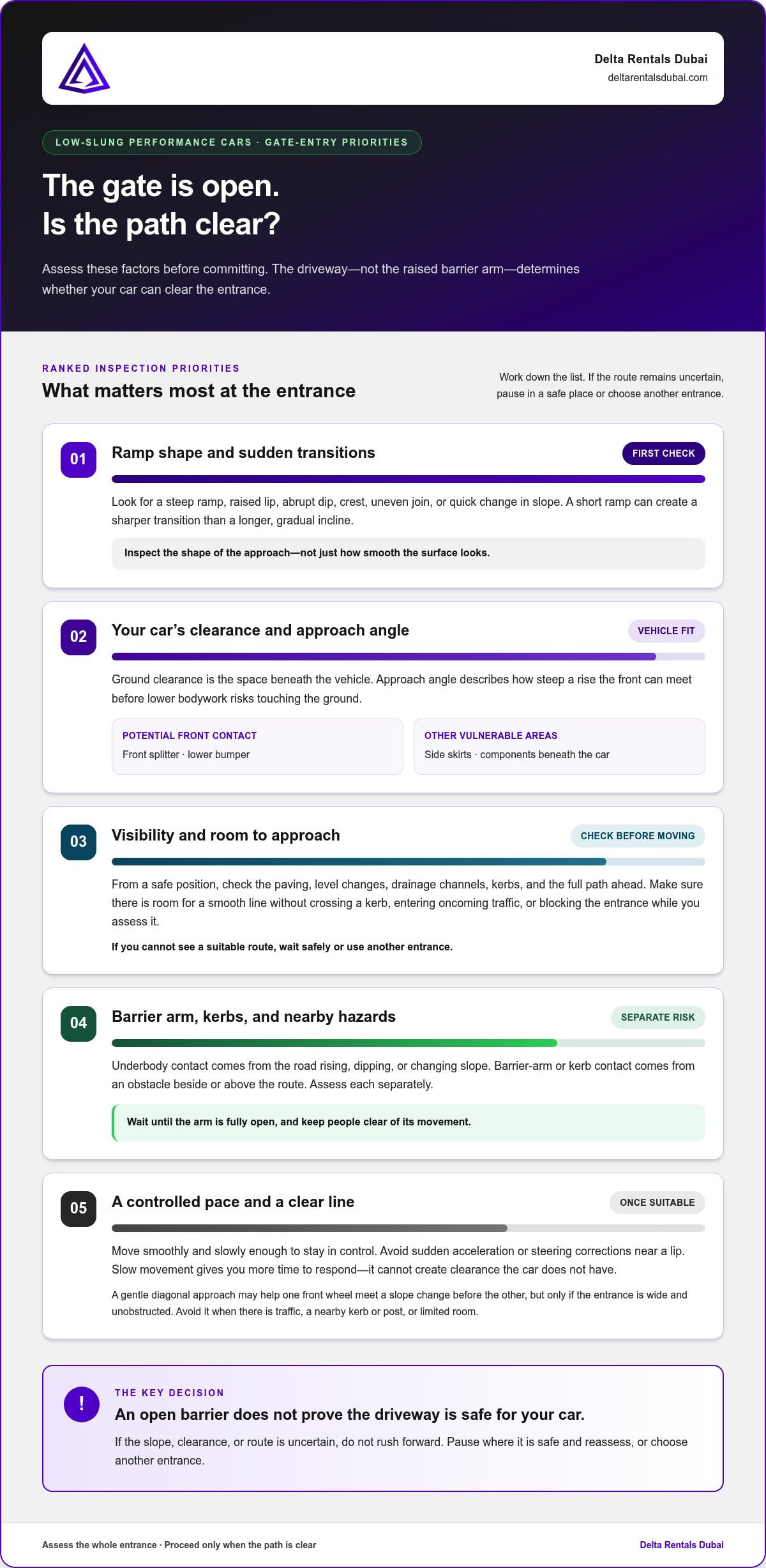
How to navigate an automated barrier gate in a low car, step by step
A short routine makes navigating automated barrier gates in low slung performance vehicles more composed and deliberate. Don’t let a queue behind you rush the decision. If you can’t judge the surface, gate movement, or traffic safely, wait in a safe place or choose another route.
Remember: observe, assess, position, proceed, reassess.
- Observe. Pause where you won’t block traffic. From the driver’s seat, check the gate instructions, the flow of vehicles, the road surface, and the space available beyond the opening.
- Assess. Look for a raised lip, drainage channel, steep ramp, uneven paving, or sharp change in slope. Decide whether you can see a smooth route across it. If the path is unclear, don’t commit.
- Position. Line up with the opening while leaving room from kerbs, posts, and the barrier mechanism. Keep the vehicle straight where practical. Use a gentle angle only if the entrance is wide, visible, and clear.
- Proceed slowly. Wait for the barrier to open fully, then cross with steady throttle and smooth steering. Avoid abrupt acceleration, braking, or corrections, and don’t stop on a threshold or ramp crest if you can safely keep moving.
- Reassess. Once fully clear of the gate and transition, check your position and listen for unusual contact sounds. If you hear or feel something concerning, stop in a safe place rather than continuing under pressure.
Before entering: assess, signal, and create space
Make your decision before reaching the ramp. Check for instructions and approaching traffic, then identify where the car will travel through the opening and what lies immediately beyond it. Choose a smooth line only when you have clear visibility and enough room to follow it without crossing a kerb or interfering with other vehicles. If you need more time, remain safely out of the way instead of creeping forward into a position that limits your options.
While crossing and after the barrier opens
Keep your attention on the car’s path and the barrier, not just the parking sensors or camera display. These aids can help, but they may not show the exact clearance beneath low bodywork. Don’t pass under a moving arm. Once the car is beyond the ramp and barrier, reassess before turning or stopping; avoid pausing where the surface changes slope.
Thoughtful positioning matters in a performance car such as the Porsche 911 GT3 RS. If you’d like to experience one, enquire about a Porsche 911 GT3 RS rental and bring the same calm approach to unfamiliar entrances.
Preparing a performance car for automated gates and unfamiliar entrances
Preparation starts before you reach the gate. Give yourself time to understand how the car responds, where its front corners sit, and what you can and can’t see from the driver’s seat. These details matter in any low-clearance performance car, whether it’s your own vehicle or a rental. Getting comfortable with the car before setting off helps you make better decisions later, when an unfamiliar entrance leaves little room to adjust.
What to learn before driving a performance car
Before setting off, adjust the seat and mirrors, locate the key controls, and get a feel for the car’s turning response at low speed. Pay attention to the front end and lower bodywork, which may be harder to judge from inside than a conventional car. Don’t assume your usual reference points or manoeuvring habits will transfer perfectly to a different vehicle.
If a planned route includes a steep car-park entrance or a tight access ramp, consult the manufacturer’s guidance for verified vehicle dimensions. Use that information alongside what you can see at the site; dimensions alone can’t tell you the shape or condition of a particular threshold. There’s no single line or technique that suits every car and entrance.
Drivers interested in getting familiar with a performance car can explore the Porsche 911 GT3 RS rental. Take time to understand the vehicle before approaching unfamiliar access points, rather than making your first careful assessment under pressure at a barrier.
When the safest choice is to pause or reroute
If the entrance looks steep, visibility is poor, or traffic leaves no safe space to assess the approach, stop where it’s safe. Don’t let a queue behind you turn uncertainty into a rushed manoeuvre. Look for another suitable entrance or parking option if the route remains unclear. Choosing not to risk a questionable path is sound judgement, not a failure of skill.
That principle is central to navigating automated barrier gates in low slung performance vehicles: preparation helps, but it doesn’t make every entrance suitable. Reassess if the gate behaves unexpectedly, the surface is difficult to judge, or your view of the route changes. Proceed only when you can do so with control and a clear path.
If you’d like to experience a performance car, message us on WhatsApp about a performance-car rental.
Make every gate approach a considered one
A confident entry starts before the barrier: assess the ramp, threshold, and available space, then choose a line that keeps the car controlled. Remember that moving slowly gives you time to respond, but it can’t make up for limited ground clearance or a sharp change in slope. If visibility, traffic, or the path itself leaves you uncertain, pause safely and choose another suitable route.
That simple decision-making sequence is the key to navigating automated barrier gates in low slung performance vehicles. Learn your car’s visibility and turning response before taking unfamiliar routes, and don’t let pressure from waiting traffic rush your judgement. A little patience can protect both the car and your peace of mind.
If you’d like to experience a performance car that rewards thoughtful manoeuvring, Delta Rentals Dubai offers Porsche 911 GT3 RS rental. Explore a performance-car rental with our team. Take your time, trust what you can see, and make the safe choice with confidence.
Frequently Asked Questions
Can a low-slung performance car pass through an automated barrier gate safely?
Yes, if the vehicle has sufficient clearance for the entrance and the route is clear. Assess the ramp, threshold, slope changes, kerbs, and space around the gate before committing. The barrier opening itself doesn’t indicate whether the road surface is suitable. Vehicle shape and entrance geometry vary, so there’s no universal yes or no. For navigating automated barrier gates in low slung performance vehicles, base your decision on the specific car and entrance.
Is it safer to approach a steep barrier-gate ramp diagonally?
A gentle diagonal can help one front wheel meet a slope transition before the other, but it isn’t automatically safer. Use this approach only if you have enough space, a clear view, and no traffic or nearby obstacles in your path. Avoid sharp steering inputs or crossing kerbs to create an angle. If the entrance is narrow or the route is unclear, don’t force a diagonal manoeuvre. Pause safely or choose another suitable entrance.
How do I know if my car has enough ground clearance for a parking entrance?
Check the vehicle manufacturer’s guidance for verified dimensions, then compare what you know with the entrance’s visible shape. Ground clearance alone doesn’t tell the whole story: a raised lip, steep incline, dip, or crest can bring bodywork closer to the road. From a safe position, look at the full route and consider your car’s front and underside. If you can’t confidently judge the transition, don’t assume it will clear.
What happens if the underbody touches the road while crossing a gate?
Contact may cause a scrape or damage, but the outcome depends on the vehicle, the contact point, and the surface. If you hear or feel an impact, stop in a safe place as soon as possible and check for visible signs of damage without putting yourself in traffic or near the gate. Don’t continue if something appears loose, damaged, or unusual. Avoid repeating the manoeuvre to test whether the car will clear.
Can parking sensors detect whether a low car will scrape a ramp?
Don’t rely on parking sensors to determine underbody clearance. They may help identify nearby obstacles, but they might not show a low front splitter, the underside of the vehicle, or the point where a ramp changes slope. A camera can also leave parts of the route outside its view. Use these systems as supporting aids, then assess the surface and your line directly from a safe position.
Should I drive slowly or stop before an unfamiliar barrier gate?
Stop first where it’s safe and won’t block traffic, then inspect the entrance and follow its instructions. If the path looks clear and suitable for your car, proceed at a controlled pace with smooth steering and throttle. Slow movement gives you more time to respond, but it can’t create missing clearance. If you can’t judge the ramp, gate movement, or traffic safely, wait or choose another route.
What should I do if the gate opens but the entrance looks too steep?
Don’t enter just because the barrier has opened. The arm’s movement doesn’t confirm that your car can clear the ramp, threshold, or slope. Wait in a safe position, make sure you’re not obstructing traffic, and reassess the route. If the entrance still looks too steep or you can’t see a safe path, choose another suitable entrance or parking option. A calm decision to reroute is better than a rushed attempt.