

A faint scrape on a rental car can raise a surprisingly big question: should you contact the police, notify the rental company, or both? The right first step in official police report filing for minor car park blemishes on rental vehicles is not to guess who caused the mark. It is to create a clear, timely record of what you found.
It is understandable to worry that a small blemish could become a problem at return, especially if you are unsure whether it counts as damage. A police report, a rental-company notification, and an insurance report are separate records, and one does not automatically replace another. Requirements can depend on the circumstances, current UAE guidance, and your rental agreement, so do not assume a report is always required or never needed.
This guide explains how to respond calmly: what to photograph and note, when to contact the rental company, and how to check whether an official police report is appropriate. It also covers how to keep your documentation organized from discovery through return, without speculating about fault or making unsupported legal or insurance assumptions. Clear records make for a more confident rental experience, whether you are driving a premium vehicle now or planning a future booking.
Key Takeaways
- Start with safety, then record what you can observe without assuming how the blemish occurred or who is responsible.
- Understand what an official police report can record and why it does not replace notifying the rental company or insurer.
- For official police report filing for minor car park blemishes on rental vehicles, follow current official guidance and your rental agreement instead of assuming a report is always required or unnecessary.
- Keep a clear visual record with wide and close-up photos, surrounding context, and original, unedited image files.
- Store your photos, rental agreement, report reference, and messages together. At return, compare the vehicle’s condition with the inspection notes.
Rental Car Blemishes: What to Do Before Reporting
Put safety first. If the vehicle is in an unsafe position or anyone may be injured, prioritize safety and follow appropriate official guidance. Before cleaning or trying to repair a mark, document it. Start with what you know: where the car is, when you noticed the mark, and what it looks like.
A blemish is a visible mark, such as a light scuff or scrape. Its appearance alone cannot tell you when it happened, what caused it, or whether an official report is appropriate. A mark found on a parked vehicle is different from damage involving another vehicle, a person, or property. Reporting steps may depend on the circumstances, official guidance, rental terms, and insurer requirements. For official police report filing for minor car park blemishes on rental vehicles, do not assume that a small mark automatically requires a report or can be ignored.
Is a small scrape different from a traffic incident?
It can be, but the mark itself will not establish the difference. A superficial scuff noticed while the car was stationary may have no known connection to a collision. Damage linked to contact with another vehicle, a person, or property may involve different circumstances and reporting considerations. If another party may be involved, or you are unsure what happened, consult current official guidance rather than deciding from appearance alone. An incident report records information about an event. Recording a mark does not, by itself, prove how it happened.
What should a renter do first?
Make a factual record before anything changes. Note when and where you noticed the mark, then describe only what you observed. For example: “Light scrape on the left rear door, noticed in the car park after parking.” Do not guess when it appeared or assign responsibility.
- Photograph the mark close up, then take wider views that show its position on the vehicle.
- Keep the original images. Do not clean, edit, or alter the area before documenting it.
- Notify the rental company promptly using the contact method in your rental terms. Save your message and any reply.
Documenting a mark records what you found; it does not establish who caused it. Keep those questions separate. A police report, rental-company notice, and insurer record serve different purposes. Follow current official guidance and the relevant rental and insurance requirements rather than treating one record as a substitute for another.
What an official police report can document, and what it cannot decide
An official police report can create a formal record of circumstances reported to the authorities. Depending on the incident and reporting process, it may include details such as when and where an event occurred and the accounts provided. It is not automatically a finding of fault or a decision about who is responsible for a vehicle mark.
That distinction matters for official police report filing for minor car park blemishes on rental vehicles. A report may document what you reported, but it does not replace the notification process in your rental agreement or determine how an insurer will assess a claim. Keep your account factual. Filing a report does not guarantee a particular damage or insurance outcome.
Which records serve different purposes?
Think of the records as complementary, not interchangeable. A police record documents information reported to authorities. The rental agreement and handover notes describe the vehicle’s recorded condition and set out the rental terms. Insurer documentation supports the insurer’s separate review under the applicable cover.
A report records circumstances, photographs show condition, and the rental agreement sets out the rental terms; none alone decides responsibility. Consistent timestamps, original photographs, and written messages can make your account easier to follow. Keep copies together, without assuming any single item guarantees a particular decision.
When should official reporting guidance be checked?
Reporting routes and criteria can depend on the incident details. Check the relevant official UAE police channel for current filing steps and guidance. Seek prompt official direction if another party may be involved, anyone is injured, accounts differ, or the damage appears significant. Do not rely on a generic online explanation to establish a UAE reporting requirement.
Rental-company procedures are separate from official reporting, and insurer documentation has its own requirements. Follow the instructions in your rental agreement and applicable insurance terms alongside current official guidance. Keep each communication and reference with your records so the separate steps remain clear.
For a future booking, review the rental terms and vehicle-condition documentation before collection. Explore a premium car rental while keeping this incident guidance separate from your booking decision.
Police report, rental-company notice, or insurer record: which step comes first?
There is no single sequence for every mark or incident. First address any immediate safety risk. If the circumstances may involve an injury, collision, another party, or significant damage, follow relevant official guidance promptly. Then notify the rental company using the method in your signed agreement and check current official guidance. Contact your insurer as required by your cover. A minor appearance alone does not prove that reporting is unnecessary.
For official police report filing for minor car park blemishes on rental vehicles, treat each record as a separate step with its own purpose. The rental agreement’s instructions and current official requirements take precedence over generic online advice.
| Record or step | Purpose and who to contact | Evidence to retain |
|---|---|---|
| Official police report | Use the relevant official police channel when reporting applies under current guidance. Check the appropriate channel for the circumstances. | Report reference or copy, photographs, and the factual details you submitted. |
| Rental-company notice | Tell the rental company about the mark using the contact method and instructions in your signed rental agreement. | Your message, the company’s response, relevant agreement terms, and vehicle-condition notes. |
| Insurer record | Follow the notification and documentation requirements of the applicable insurance cover. | Claim or contact references, correspondence, photographs, and any requested supporting records. |
How do the steps fit together?
Keep the process orderly. Make the area safe and avoid worsening the damage. Notify the rental company promptly as directed by your agreement, then check current official guidance to determine whether and how to report the circumstances. Follow your insurer’s process separately. If safety concerns or the incident itself call for immediate official assistance, prioritize that guidance rather than waiting to complete routine rental or insurance notifications. The exact sequence can depend on the situation and applicable terms.
Can you report a blemish without admitting fault?
Yes. Cooperate with documentation, but stick to what you observed. You might state, “I noticed a light scrape on the rear door while the vehicle was parked,” if that accurately describes what you know. Do not guess when it appeared, identify a cause you did not witness, or make unsupported statements about responsibility. A factual account is not the same as deciding liability.
Save copies of each report, photograph, message, and response, along with dates and times. Keep your wording consistent, and distinguish direct observations from anything you are unsure about. No single record guarantees a particular damage assessment or insurance decision. Together, clear records can keep the account organized from discovery through return.
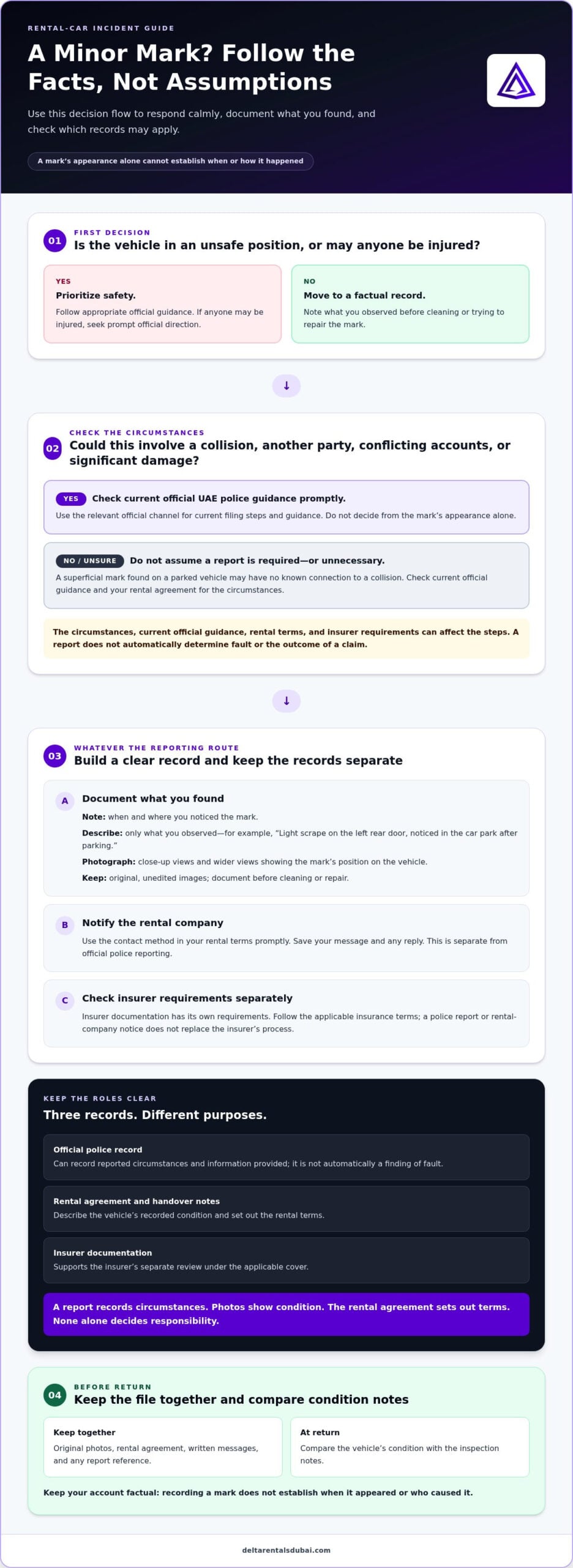
How to document a minor rental-car blemish step by step
A tidy record makes it easier to explain what you noticed and when. Follow this sequence, keeping your notes factual. For official police report filing for minor car park blemishes on rental vehicles, preserve the original evidence and follow the instructions that apply to your circumstances and rental terms.
- Step 1: Make the situation safe. If you are driving, stop somewhere safe. Check for immediate hazards and avoid moving or handling anything that could worsen damage or affect evidence.
- Step 2: Observe before touching. Note the blemish’s position, shape, and visible condition. Look at the surrounding panel for other marks, but do not infer when or how anything happened.
- Step 3: Photograph the context. In good light, take a view of the whole vehicle, a wider image showing the affected panel, and close-ups of the mark. Include nearby marks so the images show context. Keep the original files and do not edit or filter them.
- Step 4: Write down the details. Record when you noticed the mark, its location, what you were doing or observed, and any relevant circumstances. If the exact time or cause is unknown, say so rather than guessing.
- Step 5: Check the agreement and notify the rental company. Use the contact method set out in your rental terms. Describe only what you observed, share relevant images, and request written acknowledgement of your notification. Follow any instructions before cleaning, polishing, repairing, or otherwise altering the area.
- Step 6: Keep the record together. Save your message, the company’s response, any reference numbers, photographs, notes, rental agreement, and any official report record in one place. If you contact an insurer, keep that correspondence with the same file.
What photographs and notes should you keep?
Capture the whole vehicle, the affected panel, and close-up views in clear light. Include enough surrounding area to show where the blemish sits, and capture nearby marks for context. Preserve the original photo files, and note dates, times, location descriptions, and circumstances as accurately as you can. Do not remove evidence or attempt a repair before following the rental company’s instructions.
How should you notify the rental company?
Keep the notification brief and neutral. For example: “I noticed a light scrape on the left rear door while the vehicle was parked. I’ve attached photos taken when I found it.” Send it through the route specified in your rental agreement, then save the exchange and any reference number with your rental documents.
Before return, keep the original photos, observation notes, rental agreement, notification and reply, and any report or reference number.
For a future booking, consider your next luxury car rental with clear vehicle documentation in mind.
Close the record before return, and plan your next rental with confidence
Before handing back the vehicle, bring your records together so you can refer to them during the return process. Keep any official report reference, original photographs, rental agreement, condition notes, and messages with the rental company in one folder. An organized file can help you explain the timeline, but it does not guarantee that a charge will be waived, determine fault, or settle an insurance decision. Those outcomes depend on the relevant assessment and terms.
What should you check at vehicle return?
Follow the return process in your rental agreement. Review the inspection record and compare its description with your photographs and earlier notes. If you disagree with an entry, explain the specific point calmly and factually before acknowledging the record. Identify the mark or location you mean rather than making assumptions about when it appeared.
Keep copies of relevant condition notes, return documentation, messages, and any incident or report references. Save any related request and response with your existing file. Do not assume that a police report or earlier notification guarantees a particular return decision.
How can renters reduce uncertainty on a future booking?
Before collecting another vehicle, read the terms covering vehicle condition, damage notification, and incident reporting. During handover, inspect the car in good light, photograph any existing marks, and make sure they are recorded on the condition document. Retain a copy of that completed record alongside your rental agreement.
The same careful approach supports official police report filing for minor car park blemishes on rental vehicles: keep records factual, complete, and consistent, and follow the instructions that apply to the rental and circumstances.
For future planning, explore Delta Rentals Dubai rental options and review the rental terms before booking. If you are considering a premium vehicle, view the WhatsApp rental enquiry option.
Keep Your Next Rental Clear and Confident
A minor mark calls for a measured response, not a guess. Photograph what you find, record the circumstances in neutral language, and notify the rental company through the method in your agreement. Police reporting and insurer documentation serve separate purposes, so follow applicable official guidance and rental terms rather than assuming appearance alone settles whether to report.
For official police report filing for minor car park blemishes on rental vehicles, keep your photos, agreement, messages, and any report reference together through return. These records preserve a clear account, but they do not automatically determine responsibility or an insurance outcome.
For a future rental, review the vehicle-condition and incident-notification terms before collection, then document any pre-existing marks at handover. Delta Rentals Dubai offers premium and luxury vehicle rentals across the United Arab Emirates, including models such as the Porsche 911 GT3 RS and Rolls Royce Cullinan Black Badge. Enquire about your next premium rental and plan your next drive.
Frequently Asked Questions
Do I need an official police report for a minor scratch on a rental car?
Not automatically. Whether official police report filing for minor car park blemishes on rental vehicles is appropriate depends on what happened, current official guidance in the UAE, and your rental and insurance terms. A visible scratch alone does not establish its cause or whether it meets reporting criteria. Notify the rental company as required by your agreement, and check official police guidance if circumstances are unclear or another party may be involved.
Should I tell the rental company about a small blemish?
Yes. Follow the notification instructions in your rental agreement and report what you observed promptly. A small mark may still need to be documented under the rental terms, even if you do not know how it appeared. Send factual details and relevant, unedited photos through the specified contact route. Keep a copy of your message and the company’s response with your rental documents. Do not assume that a minor appearance means notification is unnecessary.
Can I file a police report for a scrape with no other vehicle involved?
Check the relevant official UAE police channel for current guidance on whether and how a mark-only incident can be reported. A scrape with no other vehicle involved may involve different circumstances from a collision. Do not assume that a reporting route is available or required. Describe only what you know, including where and when you noticed the mark, and notify the rental company separately according to your agreement.
What information should I include when reporting rental-car damage?
Provide factual details: when and where you noticed the damage, the vehicle and affected area, what you observed, and whether another person, vehicle, or property may be involved. Distinguish what you saw from what you do not know. Include clear photos if requested, and note any contact with the rental company or authorities. Do not guess at the cause, timing, or responsibility. Keep a copy of what you submit and any reference number or response.
Does a police report automatically mean I am responsible for the damage?
No. A report records information provided about an incident; it does not automatically establish fault or decide a rental-company or insurer assessment. Cooperate and be precise, but do not speculate or say you caused damage if you do not know that to be true. Keep your report, photos, rental agreement, and messages together. Responsibility and any insurance decision depend on the relevant assessment and applicable terms, not merely on the existence of a report.
What photos should I take of a rental-car blemish?
Take clear, well-lit photos of the whole vehicle, the affected panel, and close-up views of the mark. Include enough surrounding area to show where the blemish sits, and capture nearby marks for context. Keep the original files unedited, and note when and where you took them. Photograph before cleaning, polishing, or attempting repairs, and follow the rental company’s instructions about handling the vehicle.
What should I do if I discover a blemish during the return inspection?
Document the mark and its location before the vehicle is handed back, if it is safe and practical to do so. Compare the return inspection notes with your existing photos and records. If you disagree with an entry, explain the specific discrepancy calmly and factually, and keep copies of relevant condition notes or return documentation. Follow the return process in your agreement, and save any messages or references with your rental file.