

What if the calmest move on a yacht charter is to leave the radio to the crew? Even a carefully planned private yacht cruise itinerary can include radio calls guests don’t recognize. That can feel intimidating, especially when routine communication and emergency language sound unfamiliar.
You don’t need to take over or memorize a full radio manual to be a confident guest. Your role is to listen, stay calm, and follow the crew’s instructions. Understanding the basics can help you distinguish ordinary calls from urgent or distress messages, and know when not to speak over an active exchange.
This guide explains what marine VHF is for, what its limits are, and how common terms such as “Mayday,” “Pan-Pan,” and “Sécurité” are used. It also offers practical ways to prepare for the briefing, raise a concern clearly, and avoid interrupting radio traffic. With a little context, radio language becomes easier to follow, leaving you free to enjoy the charter.
Key Takeaways
- Understand how marine VHF supports vessel-to-vessel and safety communication, and why it doesn’t replace mobile-phone service.
- Learn a simple structure for clear radio calls: identify the station, identify yourself, state your purpose, then share essential details.
- Recognize the difference between routine messages and the distress, urgency, and safety calls “Mayday,” “Pan-Pan,” and “Sécurité.”
- For a dubai marina private yacht cruise itinerary, prepare by listening to the crew briefing, identifying the crew lead, and following directions.
- If you hear an unfamiliar alert, stay calm, avoid interrupting radio traffic, and follow the crew’s instructions.
What Marine VHF Radio Does During a Private Yacht Charter
Marine VHF, short for Very High Frequency, is a radio system used for communication between vessels and for maritime safety messages. It gives the crew a way to exchange operational information, coordinate with other vessels, and communicate about safety or emergencies. The Marine VHF radio overview explains the system’s channels and common uses.
Marine VHF is a shared maritime radio system that helps a vessel’s designated operator communicate with other vessels and support safety at sea. It isn’t a substitute for mobile-phone service. Phone calls rely on mobile networks; VHF communication uses radio channels and may be heard by other stations tuned to the same channel within reception range. Neither method should be assumed to work everywhere or without interruption.
For guests planning a dubai marina private yacht cruise itinerary, the practical point is simple: understand the radio’s purpose, but leave vessel communications to the crew. Don’t transmit independently or touch radio controls unless the crew specifically instructs you to. When planning the experience, note when the crew will give the safety briefing and make time to ask questions before departure, rather than waiting until radio traffic is underway.
What information can a marine VHF radio carry?
VHF voice calls can carry routine operational messages, safety information, and emergency communications. For example, the crew may use the radio to coordinate vessel movements or share information relevant to safe navigation. Reception and reach depend on factors such as the equipment, antenna position, obstructions, and surrounding conditions. A radio call may not reach every intended listener, so don’t treat VHF as guaranteed coverage or a private conversation.
Who should operate the radio aboard a charter?
The designated operator manages radio communication in line with the vessel’s procedures and applicable requirements. Guests should understand basic instructions without assuming responsibility for calls, channel choices, or radio equipment. Before departure, listen for the crew member leading the briefing and note whom to approach if you have a question or concern. This keeps communication clear and lets the crew focus on operating the vessel.
If you hear a call or alert you don’t recognize, stay calm and avoid interrupting. Let the crew assess it and follow their directions. If you notice something that needs attention, tell a crew member directly rather than trying to broadcast it yourself. This simple distinction helps guests stay informed without taking on the operator’s role.
How a Clear Marine VHF Call Is Structured
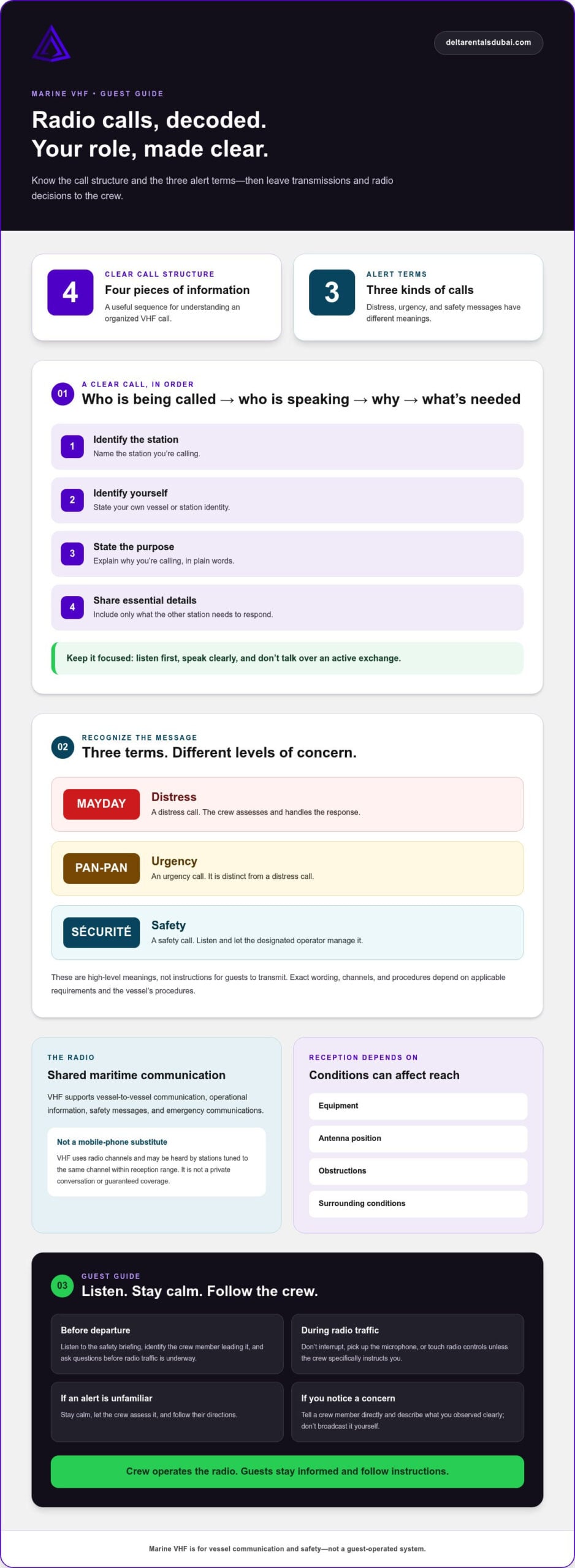
A well-organized VHF call is easier to follow because the listener can quickly identify who is being called, who is speaking, and why. A useful general sequence is: identify the station you’re calling, identify your own vessel or station, state the purpose, then exchange only the details needed to respond.
In short: call the intended station, identify yourself, explain your purpose, and share the essential details. Treat this as a plain-language guide, not a script for every situation. The appropriate channel and exact calling steps depend on applicable rules and the vessel’s procedures. The U.S. Coast Guard’s guide to official VHF distress call procedures is a useful reference for understanding formal radio communication, but it doesn’t replace local requirements or crew direction. For a dubai marina private yacht cruise itinerary, knowing this sequence can help you understand what the crew is doing without taking over.
What details make a routine call easier to understand?
Keep the message focused. A routine call may need clear identification, a location if it’s relevant and appropriate, the reason for calling, and any essential information needed for a reply. Use plain words and a measured pace. Avoid adding background details that don’t help the other station understand or respond.
If a detail needs repeating, say it again clearly rather than rushing through the rest of the message. Don’t guess at a location, use an unfamiliar phrase, or make a call simply to practise. During a charter, leave actual transmissions to the designated operator. If you have information the crew should know, tell a crew member directly and describe what you observed as clearly as you can.
Why listening before transmitting matters
Radio channels are shared. Listening first helps avoid talking over an ongoing exchange, while a brief pause can give another station room to finish or respond. If two messages overlap, part of each may be difficult to understand. Calm, concise speech helps keep communication orderly.
For guests, the practical takeaway is straightforward: don’t pick up the microphone or interrupt radio traffic unless the crew directs you to. If you have a concern, tell a crew member directly. Follow the briefing on how to raise it and let the designated operator manage channel choice and radio procedure.
Clear communication is one part of a well-prepared charter. If you’re also arranging a separate premium drive, explore premium car rental options.
Distress, Urgency, and Safety Calls: Know the Difference
Marine radio terms signal different levels of concern. Recognizing them can help you understand why the crew may respond with focus, but it doesn’t make guests responsible for transmitting or deciding which call to use. The categories below are a high-level guide; exact wording, transmission steps, and channel use must follow applicable requirements and the vessel’s procedures.
| Call category | General meaning | Guest response |
|---|---|---|
| Routine | Ordinary operational communication without a declared urgency or distress. | Let the crew manage the exchange; don’t interrupt. |
| Pan-Pan | An urgency call about a serious situation requiring attention, but not a distress call. | Stay calm and follow crew instructions. |
| Mayday | A distress call indicating grave and imminent danger and a need for immediate assistance. | Alert the crew to any concern; don’t make an unauthorized transmission. |
| Sécurité | A safety announcement that shares important information relevant to navigation or safety. | Listen and allow the crew to assess its relevance. |
When are Mayday, Pan-Pan, and Sécurité used?
Think of the terms as distinct signals, not interchangeable expressions of concern. Mayday is for distress involving grave and imminent danger. Pan-Pan announces urgency, while Sécurité introduces a safety message. These concise meanings don’t cover every qualification or transmission step. The U.S. Coast Guard radio procedures offer a useful reference, but they aren’t a substitute for the requirements that apply to a vessel’s operating area. Guests should follow the crew’s instructions rather than treating a general description as a guide to making a call.
What should a guest do if a safety concern arises?
Tell a crew member promptly. Describe what you noticed in plain, factual language, including where the concern is if that’s relevant. Follow the crew’s directions and don’t handle radio equipment unless specifically instructed. A guest’s role is to pass on useful information, not to assess the correct urgency category or transmit an emergency call.
Even if you hear an unfamiliar alert, keep your response measured. Don’t speculate, crowd the operator, or repeat a message over the radio. Listen for instructions and give the crew space to manage communications. Understanding the difference between routine, urgency, and distress language can help you remain composed, while onboard safety training and official procedures remain the guide for action.
A Guest’s Practical VHF Communication Checklist Before and During Charter
You don’t need to operate a radio or learn a full set of procedures to be prepared. Your role is simpler: understand how to get the crew’s attention, listen to instructions, and speak up if something concerns you. Use this checklist to focus on what is useful as a guest. The crew briefing is the guide to the vessel’s specific instructions and communication practices.
Before departure: understand the onboard briefing
Listen for who is leading the briefing and which crew member you should alert if you need help or notice a concern. Ask about unfamiliar terms, alerts, or instructions while there’s time to clarify them. You don’t need to pass a radio test or handle the equipment. If you are planning a dubai marina private yacht cruise itinerary, it can also help to agree on how you will get the crew’s attention during the trip, especially if the group is spread across the yacht.
- Identify your crew contact. Know whom to approach with a question or concern.
- Understand how instructions will be given. Ask what to listen for and how the crew will get guests’ attention.
- Speak up about communication needs. If you’d prefer a term repeated, explained in simpler language, or delivered another way, mention it before departure. Don’t assume you’re the only guest unfamiliar with radio language.
Confirm your understanding in your own words if an instruction is unclear. A calm question is better than guessing, especially if you’re unfamiliar with the terminology or don’t feel confident speaking the language used in the briefing. Remember the crew contact and the method they explain, so you’re not left deciding how to raise a concern in the moment.
During the charter: stay calm and follow directions
Use this quick checklist:
- Listen first. Let the crew finish speaking before asking a question or raising a concern.
- Don’t transmit independently. Leave radio controls and calls to the designated operator unless the crew specifically directs you otherwise.
- Report concerns clearly. Tell a crew member what you noticed and where, if the location is relevant.
- Follow the instruction given. If you didn’t understand it, say so and ask for it to be repeated.
- Let the crew interpret alerts. An unfamiliar call isn’t a cue to interrupt or act on your own. Stay attentive and follow crew guidance.
The distinction matters: general awareness helps you remain composed, while channel choices, radio operation, and vessel-specific responses belong to the crew. Clear preparation supports a relaxed charter without placing responsibility for communications on guests. If the crew gives an instruction, act on that instruction rather than relying on a general explanation of radio terminology.
If your plans also include a premium drive, message us about a luxury car rental.
How VHF Awareness Fits Into a Well-Prepared Private Yacht Charter
Knowing the purpose of marine VHF can make unfamiliar radio language feel less daunting. You don’t need to manage the radio, interpret every exchange, or memorize formal procedures. The designated crew handles vessel communications. Your part is to pay attention, raise concerns clearly, and follow directions.
That balance supports a more relaxed private yacht experience: informed guests, clear expectations, and crew-led communication. Procedures can vary by vessel, so the briefing is the practical guide to what you should do onboard. General knowledge helps you understand what you hear, but it doesn’t replace the crew’s instructions or official safety guidance.
What a guest should remember after reading
Keep this quick checklist in mind:
- Listen to the briefing. Learn who to approach and how the crew will communicate instructions.
- Share concerns promptly. Tell a crew member what you noticed, using clear, factual language.
- Follow directions. If an instruction or unfamiliar term isn’t clear, ask the crew to repeat or explain it.
- Leave radio operations to the crew. Guests aren’t expected to make routine calls or handle equipment.
If you hear an alert, stay composed and let the crew assess it. A guest’s awareness is helpful, but the right response depends on the situation and vessel procedures. Don’t assume that a term or process works the same way on every charter.
Plan a premium experience with clear expectations
A little preparation helps the day feel smoother. Ask questions during the briefing, mention any communication needs, and make sure you know how to get a crew member’s attention. You don’t need prior radio experience or fluency in specialist terminology to be a considerate, prepared guest.
Delta Rentals Dubai offers luxury yacht rental experiences. Approach the charter with confidence: listen, speak up when something concerns you, and let the designated crew manage communications. Those simple habits help keep your attention where it belongs, on enjoying the experience.
To discuss a premium experience, Speak with Delta Rentals Dubai.
Charter with Confidence and Enjoy the Experience
Marine VHF awareness isn’t about taking control of the radio. It’s about knowing that the crew manages vessel communications, recognizing that routine, urgency, and distress calls mean different things, and staying calm enough to follow directions.
Before departure, listen to the briefing and learn whom to approach with questions or concerns. During the charter, communicate any safety concern promptly, clearly, and directly to the crew. Leave radio operation and response decisions to the designated operator, and ask for an instruction to be repeated if it isn’t clear.
These simple habits help create a relaxed, well-prepared yacht experience. Delta Rentals Dubai offers luxury yacht rentals, alongside premium vehicle and VIP experiences. For a premium vehicle to complement your plans, speak with Delta Rentals Dubai about car rental options. Arrive ready to listen, follow the crew’s guidance, and enjoy your time on the water with confidence.
Frequently Asked Questions
What is a marine VHF radio used for?
A marine VHF radio supports voice communication between vessels and maritime stations for operational and safety purposes. It can also be used during emergencies, with specific calls and procedures depending on the situation, vessel, and applicable guidance. It’s a maritime communication tool, not a replacement for mobile-phone service. As a private charter guest, listen to the crew’s briefing and don’t assume you should operate the radio.
Do private yacht charter guests need to know how to use a VHF radio?
Guests don’t need to operate the VHF radio, but understanding basic terminology and crew instructions can make a dubai marina private yacht cruise itinerary feel more familiar. Listen to the safety briefing, ask for unfamiliar instructions to be clarified, and promptly alert the crew if you notice a concern. Leave radio operation to the designated crew member. This overview introduces key ideas, but it doesn’t replace formal training or vessel-specific guidance.
What is the difference between Mayday and Pan-Pan?
Mayday is the distress signal associated with grave and imminent danger requiring immediate assistance. Pan-Pan signals an urgent situation that needs attention but is distinct from a distress call. These are high-level explanations, not a complete guide to when or how to transmit. Exact use must follow current authoritative maritime guidance and vessel procedures. As a guest, alert the crew to a concern and follow instructions rather than making a radio call yourself.
Can a yacht guest use the VHF radio in an emergency?
Notify the crew immediately and follow their directions. The designated operator normally manages vessel communications, but the appropriate action can depend on the circumstances, equipment, and applicable rules. Don’t assume you’re authorized to use the radio or make an improvised transmission. Follow the vessel’s safety briefing and official guidance that applies. If you can’t find a crew member, use the emergency contact method explained during the briefing rather than guessing at radio procedures.
What should I do if I hear an unfamiliar VHF call during a charter?
Stay calm, listen without interrupting, and follow the crew’s instructions. Don’t touch the radio or transmit unless a crew member specifically directs you to. If you’re unsure whether a call concerns your vessel, bring it to the crew’s attention instead of trying to interpret it or act independently. The crew can assess the communication in context and tell guests whether any action is needed.
What information is usually included in a marine VHF call?
A call generally identifies the station being contacted and the caller, states its purpose, and shares concise information relevant to the exchange. The exact format varies by call type and applicable procedures, so this overview isn’t a transmission script. Guests don’t need to deliver formal radio messages. If you notice something concerning, explain clearly what you observed to a crew member, who can handle any necessary radio traffic.
Is a VHF radio the same as a mobile phone?
No. Marine VHF is a maritime radio system used to communicate with other vessels and relevant stations, while a mobile phone connects through mobile networks. They have different uses and limitations, and neither should be assumed to work everywhere or without interruption. As you plan a dubai marina private yacht cruise itinerary, follow the crew’s directions about onboard communication and how to raise an emergency concern. A phone isn’t a substitute for vessel procedures.