

A yacht’s size and luxury finish don’t determine whether it’s a commercial charter yacht or a private pleasure boat. The key differences between commercial charter yachts and private pleasure boats come down to purpose and use: one is offered to paying guests, while the other is used privately for leisure.
It’s easy to see why the terms can be confusing. Vessels may look similar, yet who operates one, what a charter covers, and which responsibilities apply can vary. Commercial and private use may also involve different safety and insurance expectations, depending on the vessel’s registration and the relevant jurisdiction.
This guide explains what those distinctions mean in practice, from operation and owner responsibilities to the guest experience. You’ll also find questions to help you compare a charter with private use and choose the arrangement that suits your plans. Delta Rentals Dubai offers luxury yacht rental experiences across the United Arab Emirates.
Key Takeaways
- The key differences between commercial charter yachts and private pleasure boats start with their purpose: paid hire versus personal recreation.
- Compare how the vessel is arranged and operated, rather than judging by size or luxury alone.
- Guest responsibilities can vary with the agreement, the operator’s role, and applicable local rules.
- Use your group’s needs, preferred level of planning, and desired involvement to decide which option fits your outing.
- Review the purpose, guest arrangement, operator role, inclusions, safety, and terms before choosing a yacht experience.
What Is the Difference Between a Commercial Charter Yacht and a Private Pleasure Boat?
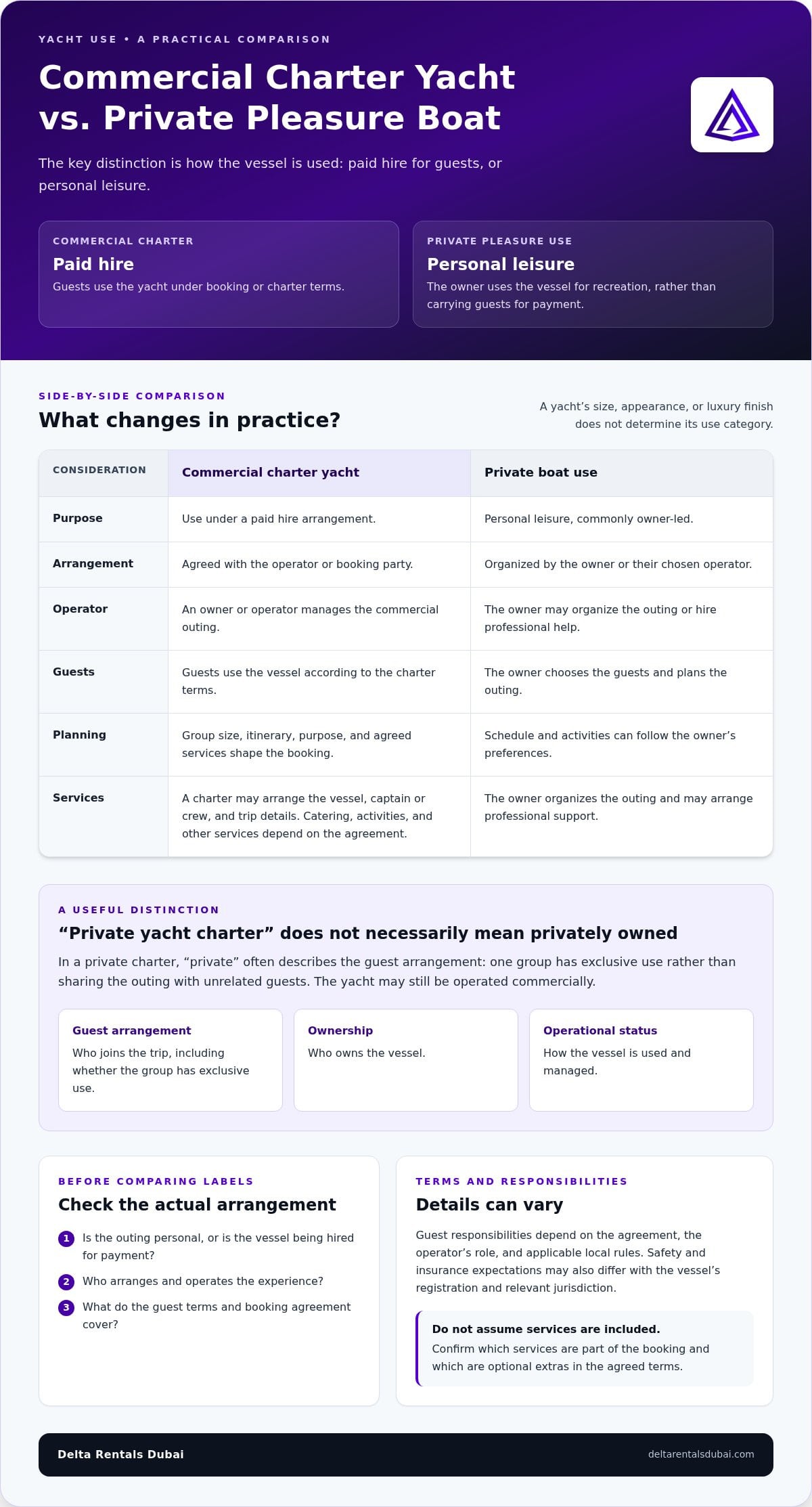
A commercial charter yacht is offered for hire, with guests paying to use it under a booking or charter arrangement. Private pleasure use generally means using a boat for personal leisure rather than carrying guests for payment. The distinction is about how the vessel is used, not how impressive it looks. That’s the starting point for understanding the key differences between commercial charter yachts and private pleasure boats.
Recreational boats, also known as pleasure craft, are generally associated with leisure and sport, as described in this overview of recreational boats. Everyday descriptions don’t always settle a vessel’s legal or operational classification, however. Terminology and requirements vary by jurisdiction, and the relevant details may depend on both the vessel and how it’s used.
Commercial operation involves offering a vessel for hire; private recreational use is personal leisure, not simply a particular size or standard of luxury. A large, refined yacht may be used privately, while a smaller vessel may be operated commercially. Price, appearance, and amenities alone don’t establish the category.
Does “private yacht charter” mean the boat is privately owned?
Not necessarily. In a “private yacht charter,” private often describes the guest arrangement: a group books the yacht for its exclusive use rather than sharing the outing with unrelated guests. The vessel may still be operated commercially by an owner or operator. For example, a group paying to hire a yacht for an outing is using a private booking, while an owner taking the same yacht out for personal leisure is using it recreationally.
Keep the terms separate: exclusive guest use describes who joins the trip; ownership describes who owns the vessel; operational status describes how it’s used and managed. One doesn’t automatically determine the others.
Is a pleasure boat always non-commercial?
No. “Pleasure boat” commonly points to recreational purpose, but it doesn’t answer every question about legal status or operation. If a vessel is offered for paid use, that commercial activity can change the context in which it operates, even if the trip itself is for leisure. The precise classification and requirements depend on the applicable jurisdiction, so don’t treat casual terminology as a universal legal definition.
For a clear comparison, look beyond the label: identify whether the outing is personal or hired, who operates the vessel, and what arrangement governs the guests’ use. Those details reveal more than the yacht’s size or level of luxury.
How Commercial Charter Yachts Operate Compared with Private Boats
A charter is a paid service arrangement, but it doesn’t come with one universal package. The booking terms shape what’s arranged, who operates the vessel, and how the outing is planned. Private recreational use is often organized by the owner, who may set the schedule and decide whether to handle arrangements personally or bring in professional help.
| Consideration | Commercial charter yacht | Private boat use |
|---|---|---|
| Purpose | Use under a paid hire arrangement | Personal leisure, commonly owner-led |
| Arrangement | Agreed with the operator or booking party | Organized by the owner or their chosen operator |
| Operator | An owner or operator manages the commercial outing | The owner may organize it or hire professional help |
| Guests | Guests use the vessel according to the charter terms | The owner chooses the guests and plans the outing |
| Planning | Group size, itinerary, purpose, and agreed services shape the booking | Schedule and activities can follow the owner’s preferences |
What may be arranged as part of a commercial yacht charter?
A charter may arrange access to the vessel, a captain or crew, and agreed trip details. Catering, activities, and other services depend on the arrangement, so don’t assume they’re included. The group’s size, intended itinerary, and reason for the outing can all influence what’s planned. Check which services are included in the booking and which are optional extras in the agreed terms.
For an outing in the United Arab Emirates, focus on the booking terms and the requirements that apply to the vessel and its operation. The key differences between commercial charter yachts and private pleasure boats are best understood through the arrangement, operator role, and applicable local framework, not assumptions based on a label.
What does private recreational use usually involve?
Private outings often follow the owner’s schedule and personal plans, with the owner organizing the route, guests, and activities. But private doesn’t have to mean handling every detail alone: owners may hire professional support for an outing. The practical distinction is who arranges the experience and whether the vessel is being used under a paid charter, not whether a captain or crew is present.
Delta Rentals Dubai offers luxury yacht rental experiences for time on the water. If your plans call for a different kind of premium rental, explore luxury car rental options.
Which Differences Matter Most: Guests, Responsibilities, Safety, and Insurance?
A charter can place an operator in charge of running the outing, but that doesn’t remove every responsibility from guests. The operator or crew may coordinate vessel operations and explain onboard procedures; guests still need to follow instructions, respect conduct expectations, and stay within the agreed itinerary. The owner, operator, and guests can have different roles, shaped by the booking agreement and applicable local rules.
Safety and insurance arrangements depend on the vessel, its use, the agreement, and the jurisdiction. Don’t assume a commercial charter and a privately used boat have identical requirements, or that a charter booking automatically covers every guest or situation.
Who is responsible for the vessel during a charter or private outing?
During a charter, the operator’s role may include coordinating the trip and explaining relevant onboard instructions. Guests should listen to safety briefings, observe boundaries, and follow directions from the person responsible for operating the vessel. The booking terms can clarify the parties’ responsibilities, but they don’t replace any duties that apply under local rules.
For an owner-led private outing, the owner commonly takes on more of the planning and operational coordination, even if they hire professional help. In either arrangement, read the agreement for responsibility and insurance details, including what coverage applies and to whom. Don’t infer coverage from labels such as “private,” “exclusive,” or “charter.”
Do commercial charters and private boats follow the same safety rules?
Not necessarily. Safety procedures, certification expectations, and insurance terms can depend on factors such as the vessel, its use, and the jurisdiction. The International Maritime Organization (IMO) is a global maritime reference, but its conventions shouldn’t be treated as a single rulebook that applies identically to every yacht or outing. Specific legal and insurance requirements vary by jurisdiction, including in the United Arab Emirates.
Before boarding, focus on practical clarity: know who is operating the vessel, pay attention to any safety briefing, understand expected onboard conduct, and be clear about the planned route and any itinerary changes. If plans or conditions shift, follow the operator’s instructions rather than assuming the original schedule takes priority.
These responsibilities are central to the key differences between commercial charter yachts and private pleasure boats. The distinction isn’t simply who gets to relax onboard. It also involves who coordinates the outing, what the agreement says, and how each person is expected to contribute to a safe experience.
How to Decide Whether a Charter Yacht or Private Boat Fits Your Plans
Choose based on the experience you want and how much of the planning you want to handle. A charter can suit a defined outing with an agreed plan; private boat use can offer flexibility for someone who wants to organize leisure time around their own schedule. Neither option is automatically more prestigious or better. The right fit depends on your priorities.
Use this quick decision process:
- Define the occasion. A hosted celebration or planned group outing may benefit from a charter arrangement. For unstructured personal leisure, private use may feel more natural.
- Think about your group. Consider who is joining, what experience they expect, and whether a shared plan will make the outing easier to coordinate.
- Decide how much time you want to spend organizing. A charter’s agreed arrangements can reduce the vessel planning you handle. Private use gives an owner greater freedom, but often comes with more coordination.
- Set your preferred level of involvement. Do you want to focus on the outing, or are you comfortable organizing the vessel and its operation?
- Review the practical details. Understand the itinerary, onboard services, responsibilities, and terms before committing. Don’t assume an inclusion or operating arrangement based on the word “charter.”
When is a commercial yacht charter the more practical choice?
A charter may suit a celebration, hosted group outing, or structured experience where an agreed arrangement matters. The operator and booking terms can set out the trip plan and any agreed services, helping guests understand what has been arranged without taking on the owner’s full planning role. This can be a practical fit if you want a more organized outing, while remembering that specific inclusions depend on the agreement.
When might private pleasure-boat use suit better?
Private use may suit an owner who values flexible leisure plans, personal control over the schedule, or frequent independent outings. That flexibility can bring more planning and operational coordination, whether handled by the owner or supported by hired professionals. For occasional guests, a charter may be simpler; for an owner who enjoys managing the details, private recreation may be the better match.
The key differences between commercial charter yachts and private pleasure boats matter most when they affect your plans, not their perceived status. For a separate premium rental experience, explore luxury vehicle rental options.
Choosing a Yacht Experience: Put the Difference into Practice
The choice becomes clearer when you focus on how you want the outing to work. A commercial charter is a hire arrangement; private pleasure use is personal recreation. The key differences between commercial charter yachts and private pleasure boats affect who organizes the trip, how guests are arranged, and what the agreed terms cover. Use this checklist before deciding:
- Purpose: Is this a hosted occasion or personal leisure?
- Guest arrangement: Is the outing for your group, and how is guest use defined?
- Operator role: Who is coordinating and operating the vessel?
- Inclusions: Which services are agreed, and which are optional?
- Safety: What onboard instructions and conduct expectations apply?
- Terms: What do the itinerary, responsibilities, and cancellation terms say?
What should you clarify before setting out on a charter?
Review the agreed itinerary and timing, how your guests are included, and the services specified for the outing. Read the agreement for cancellation terms and stated responsibilities. Avoid assuming that catering, activities, or other services come as standard. Clear details help your group know what to expect and keep the experience aligned with its purpose, whether it’s a celebration or a relaxed day on the water.
How can a rental experience make planning simpler?
A professionally arranged rental can suit guests who want to enjoy time on the water without taking on the owner’s broader planning and operational role. The booking terms still matter: they set expectations for the outing and its services. Delta Rentals Dubai offers luxury yacht rental experiences across the United Arab Emirates. Explore the luxury yacht rental experience for a relevant next step.
There’s no universal winner. Choose private use if ownership and personal flexibility fit your plans; choose a charter arrangement if you prefer an outing organized around agreed terms. Keep the decision practical, not based on assumptions about prestige, vessel size, or exclusivity. To discuss an arranged outing, discuss a yacht experience.
Choose the Yacht Experience That Fits Your Plans
The key differences between commercial charter yachts and private pleasure boats come down to use: a charter is a hire arrangement, while private pleasure use is personal recreation. A private booking can still involve a commercially operated vessel, so look beyond labels to understand who operates the yacht and how guests are arranged.
Before setting out, review the itinerary, agreed services, onboard instructions, responsibilities, and terms. Safety and insurance arrangements can vary with the vessel, its use, and the applicable jurisdiction. Clear expectations help you choose confidently, whether you want a professionally arranged outing or the flexibility of private ownership.
Delta Rentals Dubai offers luxury yacht rental experiences across the United Arab Emirates. To plan time on the water, discuss a luxury yacht experience. Choose the arrangement that suits your group and enjoy planning your next outing with clarity.
Frequently Asked Questions
What is the main difference between a commercial charter yacht and a private pleasure boat?
A commercial charter yacht is offered for hire as a service, while a private pleasure boat is generally used for personal recreation. The key differences between commercial charter yachts and private pleasure boats relate to use and operation, not simply size, design, or luxury. Also clarify what “private” means: it may describe exclusive use by your guest group, rather than private ownership of the yacht.
Can a private pleasure boat be used for commercial charters?
A boat may be used privately at one time and offered for hire at another, but private ownership alone doesn’t establish that commercial charters are permitted. Applicable requirements can depend on the vessel, its registration, how it’s operated, and the jurisdiction. Before relying on a boat for paid use, establish which local rules apply to that vessel and arrangement. Don’t assume a recreational setup automatically permits commercial hire.
Is a private yacht charter the same as owning a private pleasure boat?
No. A private yacht charter usually means a group books exclusive use for an outing. The yacht may still belong to or be operated by a business as a commercial service. Owning a pleasure boat means the owner possesses or manages it for personal recreation. Because “private” can refer to guest access, ownership, or use, consider the context of the booking rather than relying on that word alone.
What is usually included in a commercial yacht charter?
There’s no universal list of inclusions. A charter agreement may cover use of the yacht and may specify a captain, crew, refreshments, or other services, but don’t assume any of these are included. Review the terms for the particular outing, including the itinerary, timing, guest arrangements, and stated services. This gives you a clear picture of what’s agreed and what may be optional.
Do commercial charter yachts have different safety and insurance requirements?
They may, but requirements and coverage depend on the vessel, its operating arrangement, and the jurisdiction. A general online explanation isn’t a substitute for current local rules or the actual insurance terms. Review the agreement to understand responsibilities and coverage, and verify specific legal, certification, or insurance requirements for the relevant jurisdiction. This is especially useful before an outing where guest roles or operating arrangements aren’t clear.
How do I decide between a yacht charter and a private pleasure boat?
Start with your plans and preferred level of involvement. A charter may suit guests who want an arranged outing with terms and services agreed in advance. Private boat use may suit an owner who values personal control and is prepared to organize or manage the vessel. Compare the group’s needs, itinerary, responsibilities, and agreement details. The best fit is the arrangement that matches how you want to spend your time.