

The most luxurious cooler isn’t always the most useful one. A compartment designed to chill everyday refreshments serves a different purpose from a champagne cooler made for bottles, flutes and a polished rear-seat presentation. Understanding that distinction makes it easier to assess integrated refrigerator and champagne cooler features in flagship executive vehicles, where the name alone rarely tells the whole story.
It’s natural to expect a premium cabin feature to deliver both convenience and occasion. In practice, its value depends on what it can hold, who can access it, how it manages temperature and whether it suits the journey. Specifications can also vary by model, trim and model year, so promotional descriptions alone may not tell you how useful a feature will be day to day.
This guide explains how refrigerators and champagne coolers differ, which details matter when comparing them, and how cabin amenities shape the wider executive-vehicle experience. You’ll also see how to weigh passenger needs and trip type against features designed for entertaining. Whether you’re considering a flagship sedan or a luxury SUV such as the Rolls-Royce Cullinan Black Badge, the aim is simple: choose an experience that feels refined and works for the way you travel.
Key Takeaways
- Distinguish a general-purpose cabin refrigerator from a champagne cooler designed for bottle storage and beverage presentation.
- Assess integrated refrigerator and champagne cooler features in flagship executive vehicles by considering access, usable space and passenger needs.
- Match the feature to the journey, whether passengers want a range of refreshments or a more formal rear-seat experience.
- Compare specifications carefully: equipment can vary by vehicle, trim and model year.
- Choose an executive vehicle by weighing cooling amenities alongside seating comfort, luggage needs, privacy and the occasion.
Integrated Refrigerator and Champagne Cooler Features: What Is the Difference?
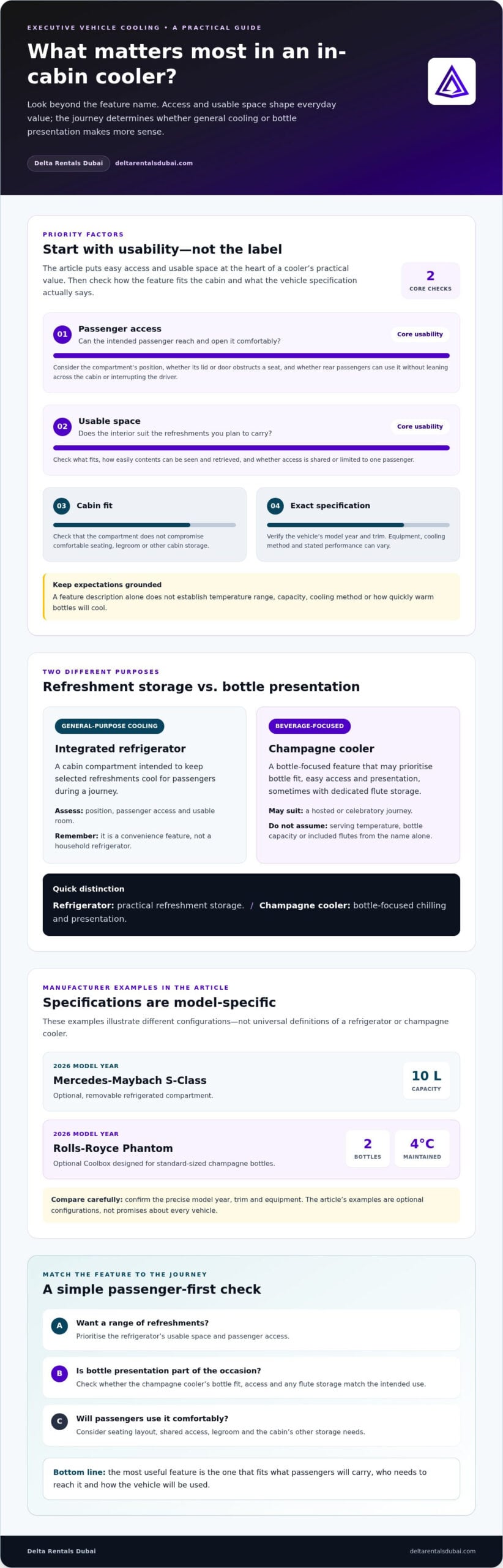
An integrated vehicle refrigerator is a cabin compartment designed to keep selected refreshments cool. A champagne cooler is tailored more specifically to chilling bottles and making them easier to present or serve. One prioritises practical storage; the other adds a beverage-hosting detail. In short: An integrated vehicle refrigerator keeps selected refreshments cool in the cabin, with its usefulness shaped by the design, access and available space.
The distinction matters because feature names don’t guarantee the same equipment across manufacturers. A refrigerator, cool box or champagne cooler can differ in purpose and configuration, and equipment can vary by vehicle, trim and model year. Read the specification, not just the label.
What does an integrated refrigerator do in an executive vehicle?
Its general role is straightforward: keep selected refreshments cool within the cabin for passengers to access during a journey. Practical value depends on where the compartment sits, how easily the intended passenger can reach it and how much usable room remains once refreshments are packed. A feature that’s convenient for rear passengers may be less accessible to the driver. The seating arrangement also affects who can use it comfortably.
Think of it as a convenience feature, not a household refrigerator. The broader history of in-car cooling helps explain why a dedicated cooling compartment is distinct from the vehicle’s air-conditioning system. Neither the word “refrigerator” nor a promotional description alone tells you its temperature range, capacity or cooling method.
How is a champagne cooler different?
A champagne cooler is beverage-focused. Its design may prioritise bottle fit, convenient access and presentation, sometimes with dedicated flute storage. That makes it especially suited to a hosted or celebratory journey rather than general-purpose refreshment storage. The name alone, however, doesn’t establish serving temperature, bottle capacity or whether flutes are included.
Manufacturer examples show why details matter. For the 2026 model year, the Mercedes-Maybach S-Class offers an optional, removable refrigerated compartment with a ten-litre capacity. The 2026 Rolls-Royce Phantom’s optional Coolbox is designed for two standard-sized champagne bottles and maintains 4°C. These are distinct configurations, not universal definitions. Check the specification for the exact model year and trim you’re considering.
Use the practical distinction as your starting point: choose based on what passengers will store, who needs access and whether presentation is part of the experience. The best feature is the one that suits the journey, not simply the one with the most impressive name.
How In-Cabin Cooling Works and What Shapes the Passenger Experience
An in-cabin cooling compartment is a convenience for refreshments during a journey, not a replacement for a household refrigerator. Its real-world usefulness depends on more than whether it cools: passengers need to reach it comfortably, its usable space must suit what they plan to carry, and its operation should fit the way the cabin is used.
For passengers, easy access and usable space matter more than the feature’s label. A well-positioned compartment can make a journey feel more considered. One that is awkward to open or takes up valuable passenger space may see little use.
Which design details affect everyday usability?
Assess the compartment from the perspective of the person who’ll use it. Check whether the lid or door can open without obstructing a seat, whether contents are visible and easy to retrieve, and whether the design reduces legroom or competes with other cabin storage. A layout that works for a front passenger may be inconvenient for someone travelling in the rear.
That difference matters on chauffeur-driven journeys, where rear passengers may be the main users. Consider whether they can reach refreshments from their seats without leaning across the cabin or interrupting the driver. For a group, also think about whether access is shared or limited to one passenger.
What should passengers expect from temperature control?
Performance depends on the cooling system and the manufacturer’s specifications. A label alone doesn’t reveal whether a unit uses compressor-based cooling, thermoelectric technology or another arrangement. Don’t assume the system type, temperature range or speed of cooling without documentation for the precise vehicle, trim and model year.
Keep expectations practical. A compartment intended to maintain refreshments in a cool state may not be designed to rapidly chill bottles that start warm. Look for manufacturer information on what the unit is intended to cool and how it operates. A general feature description is not a promise of a specific result.
- Access: Can the intended passenger reach and open the compartment easily?
- Space: Does its usable interior suit the drinks or refreshments you plan to carry?
- Cabin fit: Does it preserve comfortable seating and leave other storage usable?
- Specification: Does the model-year documentation identify the system and its stated performance?
These details help distinguish an everyday convenience from a feature that mainly adds visual appeal. If cabin layout is part of your decision, you can discuss a luxury vehicle rental with passenger comfort and journey needs in mind.
Refrigerator vs. Champagne Cooler: Which Feature Suits Each Journey?
Choose by the journey, not by the feature’s prestige. A general-purpose refrigerator is often the more practical fit when passengers want different refreshments during a longer trip. A champagne cooler may add more value when the occasion calls for bottle storage and a polished serving experience. Neither is automatically better. The right choice depends on passenger routines, access and the exact vehicle configuration.
| What to compare | Integrated refrigerator | Champagne cooler |
|---|---|---|
| Intended use | Keeping a selection of refreshments cool for general use. | Chilling bottles and supporting beverage presentation. |
| Access | Consider who can reach the compartment and whether its opening suits the seating layout. | Check how bottles are loaded and retrieved, and whether serving items are accommodated. |
| Passenger needs | Useful when a family or group wants varied drinks or refreshments within reach. | Designed around a more specific beverage choice and a hosted or celebratory journey. |
| What to verify | Usable space, cooling method and model-year specification. | Bottle fit, stated cooling performance, serving accessories and trim availability. |
When is an integrated refrigerator the more practical choice?
Think of a family outing, a group transfer or a longer drive with different passengers wanting different refreshments. A general-purpose compartment may better suit that routine than storage designed around a particular bottle shape. Passenger count alone doesn’t decide it: compare the usable space with what you intend to carry, then consider whether people seated in the front or rear can reach it easily. The advantage depends on the verified layout and equipment of the specific vehicle.
When does a champagne cooler add more value?
For a special occasion or formal passenger experience, a dedicated cooler can make bottle presentation part of the cabin’s hospitality. Its appeal depends on practical details, not just refined styling. Check that the compartment accommodates the bottle format you have in mind, that the intended passenger can access it, and that any serving accessories are included in the specified configuration. Some vehicles offer these features only with particular trims or options, so don’t assume every flagship model includes them.
Match the feature to your passengers’ routine and the purpose of the trip. That’s the clearest way to assess integrated refrigerator and champagne cooler features in flagship executive vehicles: everyday variety points toward flexible chilled storage, while a planned moment of presentation may favour a bottle-focused design. Verify the vehicle’s exact specification before treating either label as a promise of capacity or performance.
How to Evaluate Executive-Vehicle Cooling Features Before Choosing
A little specification checking can prevent a premium-sounding feature from disappointing in everyday use. Evaluate the cooler against your passengers, journey and intended refreshments, then verify the equipment for the vehicle’s model year and trim. The same approach applies whether you’re comparing a chauffeur-driven executive cabin or choosing a self-drive luxury SUV.
Which questions clarify whether a cooler will be useful?
Start with the routine. What do passengers plan to keep chilled, who will use the compartment, and how often might they need access? On a chauffeur-driven trip, rear-seat reach may come first; on a self-drive journey, front-passenger access may be more relevant. Trip length and seating layout also shape how much usable space matters. If presentation is part of the occasion, consider whether the design supports that purpose or simply provides chilled storage.
How should model and trim differences be handled?
Compare the precise model year and trim, not just the vehicle’s name. A feature may be standard in one configuration, optional in another or offered differently across markets. Prioritise manufacturer documentation that specifies the equipment and its intended use. Broad marketing terms such as “cooler” or “refrigerator” may not describe capacity, temperature control or system type.
Use this checklist before making a choice:
- Define the purpose. Decide whether you need space for varied refreshments or a focused beverage-presentation feature.
- Check passenger access. Consider who will use it, from which seat, and whether they can open and reach it comfortably.
- Assess usable space. Match the compartment to the refreshments you plan to carry while considering passenger comfort and other cabin storage.
- Verify the specification. Check the exact model year and trim, and distinguish standard equipment from optional or market-specific configurations.
These checks keep integrated refrigerator and champagne cooler features in flagship executive vehicles in perspective: they are useful cabin details, not a substitute for assessing the whole vehicle. A Rolls-Royce Cullinan Black Badge, for example, is a luxury SUV to consider in the context of seating, luggage and the occasion. Don’t assume a particular cooling feature based on the model name alone.
For a vehicle that suits your journey and passenger priorities, discuss your executive vehicle rental.
Choosing a Flagship Vehicle for a More Considered Executive Experience
A refrigerator or champagne cooler can refine a journey, but it shouldn’t define the vehicle choice. The full experience comes from how the cabin supports its passengers: comfortable seating, suitable luggage space, privacy and a layout that fits the occasion. Cooling amenities are one part of that picture, and their configuration depends on the specific vehicle.
Match the vehicle category to the occasion
A luxury SUV may suit passengers who value a spacious cabin and room for luggage, while a chauffeur-driven vehicle offers a different experience by allowing passengers to focus on the journey rather than driving. Neither category guarantees a particular cooler or refrigerator. Consider how many people are travelling, how they’ll use the cabin and what the trip calls for. For broader category considerations, explore this luxury SUV rental guide.
Options such as the Rolls-Royce Cullinan Black Badge, Cadillac Escalade and Range Rover Sport V8 illustrate the range of premium SUV experiences. Treat them as vehicle choices, not as claims about specific cooling equipment. Space, seating arrangement, privacy and luggage needs should all factor into the decision.
Turn feature research into a rental decision
Before comparing vehicles, set your priorities: who is travelling, whether the journey is self-drive or chauffeur-driven, how much luggage you’ll bring, and whether refreshments or beverage presentation matter. Then compare the exact vehicle specification rather than relying on a model name or a broad description of integrated refrigerator and champagne cooler features in flagship executive vehicles.
Cabin amenities make the most sense alongside the wider travel experience. A Rolls-Royce rental guide can help frame that choice around the character of the journey, while keeping comfort and practical needs in view.
Ready to choose a vehicle for your next journey? Speak with Delta Rentals Dubai on WhatsApp.
Choose the Cabin Experience That Fits Your Journey
The right cooling feature is the one that serves your passengers, not simply the one with the most impressive name. A refrigerator generally suits varied refreshments, while a champagne cooler focuses on bottles and presentation. In either case, access, usable space and verified model-year specifications matter more than assumptions based on a vehicle badge.
Keep those priorities in view as you compare integrated refrigerator and champagne cooler features in flagship executive vehicles. Then consider the complete cabin experience: seating comfort, luggage needs, privacy and whether you want to drive or relax as a passenger. Delta Rentals offers premium vehicles across luxury SUV and ultra-luxury categories, alongside luxury chauffeuring, so you can shape the experience around the occasion.
Ready to explore a rental that suits your plans? Discuss your executive vehicle rental with Delta Rentals. Choose with confidence, and make the journey feel as considered as the destination.
Frequently Asked Questions
What is the difference between an integrated refrigerator and a champagne cooler in a car?
An integrated refrigerator is general-purpose chilled storage for selected cabin refreshments, while a champagne cooler focuses on bottles and may support beverage presentation. The distinction is about intended use, not just the name. A refrigerator may suit passengers carrying different drinks; a champagne cooler may better fit a hosted or celebratory journey. Check the vehicle’s exact specification for usable space, bottle fit, access and any serving accessories.
Do all flagship executive vehicles have an integrated refrigerator?
No. Cooling compartments are not universal, and a flagship model name alone doesn’t establish that one is fitted. Equipment can vary by model year, trim, options and market. For example, the 2026 Mercedes-Maybach S-Class offers an optional refrigerated rear compartment. Check the manufacturer’s documentation for the exact configuration you’re considering, and distinguish standard equipment from optional features before relying on a brochure description.
Can a champagne cooler keep every type of bottle at the right temperature?
No. Bottle fit and cooling performance depend on the cooler’s design and stated specifications. A compartment made for standard-sized bottles may not accommodate every shape or size, and the term “champagne cooler” alone doesn’t state its temperature range or how quickly it cools. The 2026 Rolls-Royce Phantom Coolbox, for example, is specified for two standard-sized champagne bottles and maintains 4°C. Check the precise vehicle documentation.
How do I check whether a specific vehicle has a built-in cooler?
Look up the exact model year, trim and market specification in the manufacturer’s materials, then identify whether the cooler is standard, optional or part of a particular package. Search for the precise equipment name and its stated purpose, capacity or temperature details. Avoid relying on a general model description or a photograph alone, since equipment and cabin layouts can differ between versions of the same vehicle.
Is an in-car refrigerator useful on a short journey?
It can be useful if passengers want refreshments close at hand, especially if the drinks are already cool and the compartment is easy to reach. On a brief trip, however, its value may be modest if nobody needs to access it. Consider who is travelling, where they’re seated and whether chilled storage contributes to the experience. Treat it as a convenience, not a household refrigerator or rapid-chilling solution.
What should I compare when choosing an executive vehicle with cabin cooling?
Compare the feature’s intended use, passenger access, usable space and verified cooling specifications. Consider whether the front passenger or rear occupants will use it, whether it suits the refreshments you plan to carry, and whether it affects cabin comfort or storage. The phrase integrated refrigerator and champagne cooler features in flagship executive vehicles covers different configurations, so verify the exact model year and trim rather than comparing labels alone.
Can a chauffeur-driven vehicle have different cooler features from a self-drive model?
Yes, the equipment can differ because the vehicles may have different model years, trims, options or market configurations. Chauffeur-driven travel also changes who is likely to use the compartment: rear passengers may prioritise easy access, while in a self-drive vehicle the front passenger may be the main user. The driving arrangement itself doesn’t guarantee a cooler. Compare the exact vehicle specification and cabin layout for the journey.