
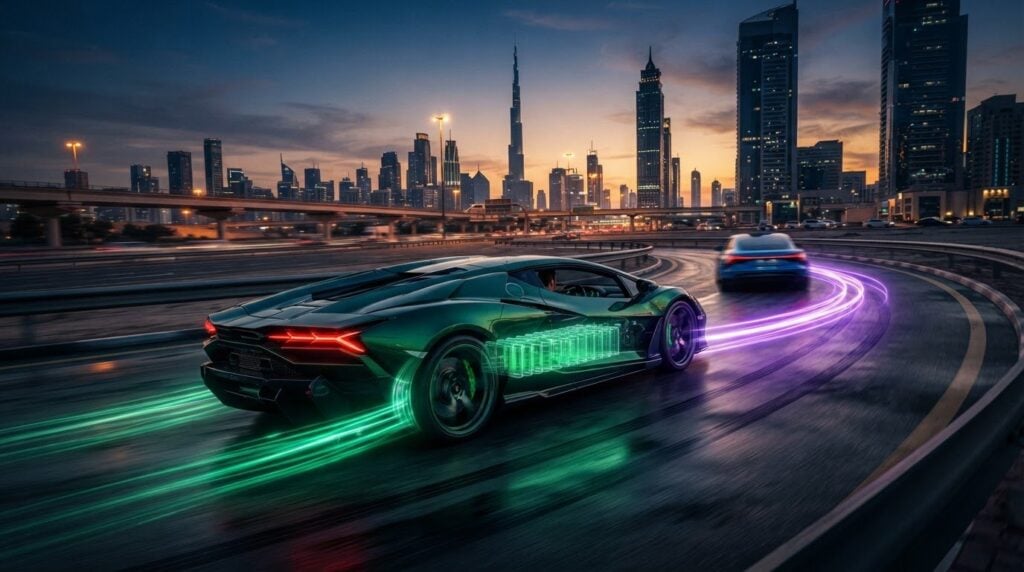
What if the hardest braking zones on a circuit aren’t just slowing you down, but aggressively fueling your next straightaway overtake? If you love pure driving dynamics, you might worry that energy recovery creates a numb, artificial pedal or mimics the sluggish feel of a commuter EV. That skepticism is completely fair. In reality, hybrid battery regeneration in modern supercars operates on an entirely different plane. Rather than muting the experience, elite engineering transforms violent deceleration into relentless forward propulsion while preserving razor-sharp mechanical feedback.
You don’t need to fear a depleted pack after two aggressive hot laps, either. Discover how modern hybrid supercars harvest kinetic energy to deliver relentless acceleration, lap-record track pace, and razor-sharp braking precision. Below, we examine the mechanics of high-rate track replenishment, evaluate how instantaneous corner-exit torque-fill sharpens throttle response, and explore the tactical drive modes that keep electrified flagships permanently primed for peak performance.
Key Takeaways
- Understand how hybrid battery regeneration in modern supercars prioritizes rapid energy recycling over commuter efficiency to deliver continuous corner-exit torque-fill.
- Discover how flagship architectures from Ferrari, McLaren, and Lamborghini configure multi-motor layouts to maintain battery stamina during sustained aggressive driving.
- Learn how advanced brake-by-wire computers blend electric motor resistance with carbon-ceramic friction to eliminate artificial, disconnected pedal feel.
- Master the dynamic cockpit drive modes that allow you to balance immediate peak power deployment with aggressive, on-track battery replenishment.
- Explore how premium seat time in modern electrified exotics reveals the seamless precision engineered into contemporary performance powertrains.
What Is Hybrid Battery Regeneration in Modern Supercars?
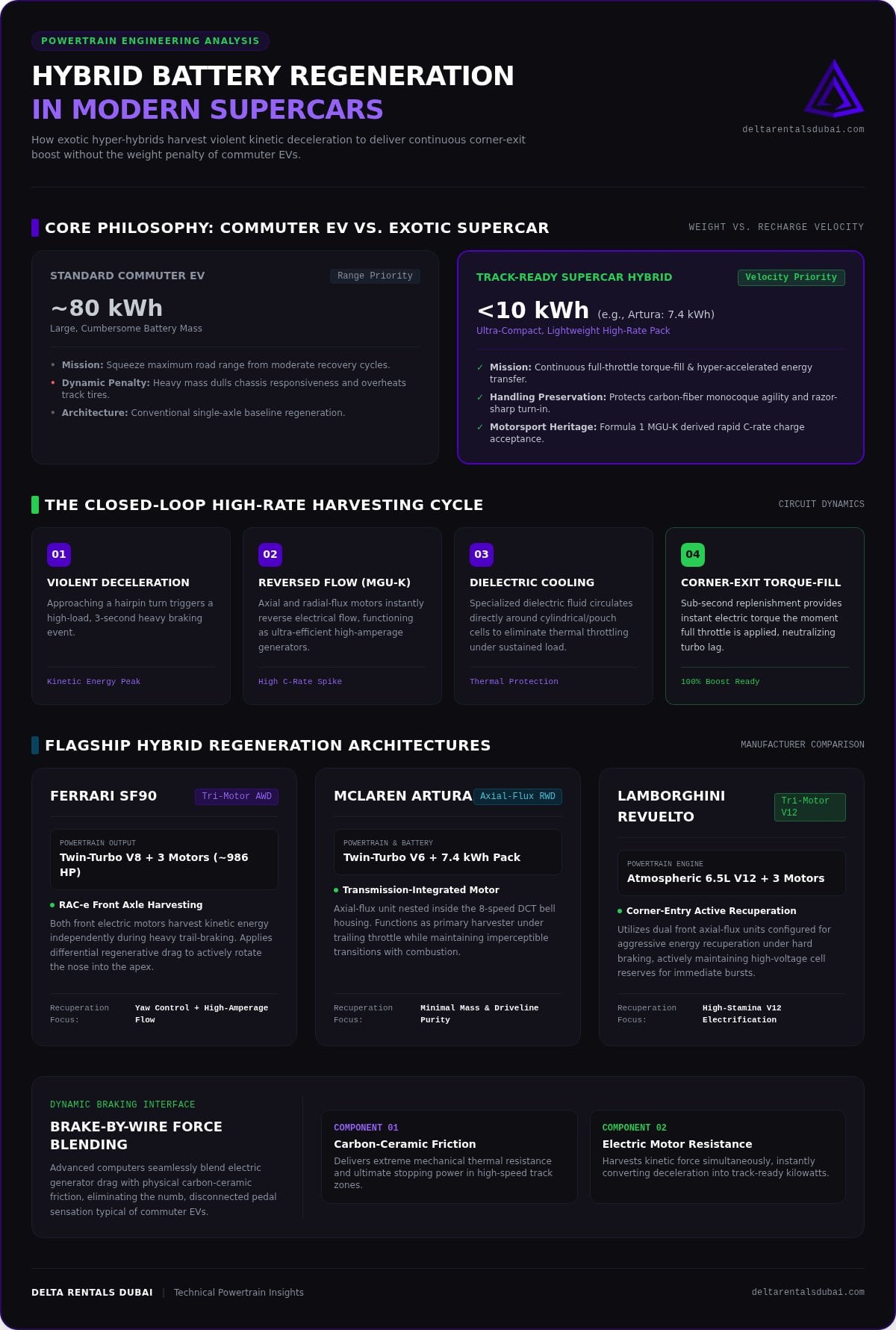
At its core, hybrid battery regeneration in modern supercars is a high-rate kinetic energy harvesting process engineered to convert violent braking deceleration into instantaneous, track-ready electrical performance. Commuter electric vehicles use moderate recovery cycles to squeeze out extra road range. Exotic hybrid powertrains have an entirely different mission. They execute hyper-accelerated energy transfers that instantly feed high-voltage reserves for uninterrupted full-throttle boost.
This dynamic turnaround relies on high-power electric motors mounted directly to the engine or transmission. Advanced radial-flux and axial-flux motors function as ultra-efficient generators during deceleration. The moment you ease off the accelerator or stand on the pedal, the system reverses electrical flow. Kinetic force converts into raw electrical current via sophisticated regenerative braking algorithms, recharging the battery in fractions of a second so that full electric torque is ready the instant you spot corner exit.
Kinetic Energy Recovery Systems: From Formula 1 to the Road
Contemporary hybrid hypercars trace their high-voltage architecture straight to motorsport. The Motor Generator Unit – Kinetic (MGU-K) pioneered in Formula 1 demonstrated how aggressive energy recuperation could eliminate turbo lag and deliver devastating straightaway pace. Road-legal exotics utilize that exact competition philosophy. High-tech cylindrical or pouch cells accept extreme C-rate charging spikes without thermal breakdown, harvesting massive electrical loads during three-second braking events into hairpin turns.
Why Supercars Prioritize Recharge Speed Over Overall Capacity
Weight ruins precision handling. Bolting a cumbersome 80 kWh battery onto a carbon-fiber monocoque compromises turn-in agility, overheats track tires, and dulls chassis responsiveness. Exotic engineering solves this by favoring compact, lightweight batteries, frequently under 10 kWh. The McLaren Artura, for instance, utilizes a tight 7.4 kWh pack to keep total vehicle mass razor-sharp. Rapid hybrid battery regeneration in modern supercars ensures these compact cells refill constantly during spirited driving, eliminating the fear of sudden power depletion without imposing a dynamic handling penalty.
Comparing Regeneration Architectures Across Flagship Hybrid Supercars
Every elite manufacturer approaches energy harvesting with a distinct mechanical philosophy. While passenger EVs settle for basic single-axle recovery, hybrid battery regeneration in modern supercars relies on intricate powertrain topologies designed to handle immense kinetic forces. Advanced cooling systems circulate specialized dielectric fluid around battery cells, preventing thermal throttling even during punishing, high-speed circuit stints.
To understand the variations across elite badges, consider how three leaders engineer their energy capture:
- Ferrari SF90: Uses a tri-motor all-wheel-drive architecture with an electrified front axle to recoup energy while managing yaw.
- McLaren Artura: Employs a single transmission-integrated axial-flux motor, optimizing for purist rear-wheel-drive dynamics and minimal mass.
- Lamborghini Revuelto: Combines an atmospheric 6.5-liter V12 with three motors, utilizing dual front axial-flux units for aggressive corner-entry recuperation.
Ferrari SF90: Tri-Motor Power and RAC-e Front Axle Harvesting
Ferrari pairs a twin-turbo V8 with three electric motors producing roughly 986 horsepower. The signature advantage lies in the RAC-e (cornering electrical simulator) front axle. During heavy trail-braking, both front electric motors harvest kinetic energy independently. The system applies differential regenerative drag to rotate the nose directly into the apex while concurrently feeding high-amperage current back into the central battery.
McLaren Artura: Axial-Flux Efficiency and Lightweight Power Density
McLaren chose a hyper-compact layout. An axial-flux motor sits nested inside the eight-speed dual-clutch transmission bell housing. This motor generates electric push and serves as a primary harvesting unit under trailing throttle. Because it operates cleanly along the driveline, mechanical transitions between electric propulsion and twin-turbo V6 combustion remain imperceptible, keeping driver inputs fluid and pure.
Lamborghini Revuelto: Tri-Motor V12 Electrification and Active Charging
Lamborghini’s Revuelto unleashes 1,001 horsepower through three electric motors paired with an iconic V12. Dual axial-flux motors at the front axle work hard during deceleration to stabilize vehicle pitch and pull kilowatts from the front wheels. Meanwhile, a rear motor mounted directly to the transverse gearbox assists with high-speed generation and lightning-quick downshifts. As these complex powertrains integrate with regenerative braking systems, they create endless reserves of corner-exit acceleration. To feel how this next-generation calibration functions in real time, you can arrange a Ferrari or Lamborghini hybrid experience through a dedicated concierge.
Regenerative Braking vs. Carbon-Ceramic Brakes: The Feel and Physics
One of the biggest anxieties purists harbor about electrified exotics is the loss of pure, communicative brake pedal feel. Early electrified systems felt stepped and artificial, alternating clumsily between motor drag and physical friction. In high-caliber exotics, hybrid battery regeneration in modern supercars takes an entirely different engineering path. It doesn’t replace mechanical friction; it elevates it. By coordinating motor drag with hydraulic pressure, the system stabilizes the chassis under extreme deceleration, preventing rear-axle lift and keeping high-speed turn-in composed.
Brake-by-Wire Precision: Achieving Natural Driver Feedback
Modern exotics utilize sophisticated brake-by-wire architectures that decouple the physical pedal from direct hydraulic lines. High-frequency stroke and pressure sensors read the driver’s foot inputs down to the millisecond. The central vehicle dynamics controller calculates the exact stopping requirement, instantly balancing electric motor resistance with carbon-ceramic clamping force. Because electro-hydraulic actuators adjust fluid pressure in real time, the handoff between motor recuperation and pad friction remains completely invisible. The driver feels only a firm, progressive pedal that inspires immense confidence when trail-braking deep toward an apex.
Thermal Management and Dissipation Under Extreme Driving
Carbon-ceramic discs operate comfortably at extreme track temperatures exceeding 1,400°C without mechanical fade. Even so, repeated threshold braking from triple-digit speeds punishes calipers, boils hydraulic brake fluid, and accelerates tire deg. By harvesting kinetic energy before the friction pads make heavy contact, hybrid battery regeneration in modern supercars absorbs immense deceleration loads. Thermal energy diverts into liquid-cooled battery packs and radiators rather than cooking the wheel hubs, delivering repeatable, lap-after-lap stopping consistency.
Tactical Drive Modes: Mastering Battery Regeneration Behind the Wheel
Extracting continuous speed from an electrified exotic requires deliberate strategy. You don’t manage power passively; you command energy flow directly through steering-wheel rotary dials. Commuter EVs rely on jarring one-pedal deceleration, but supercars minimize lift-off drag to let the chassis coast smoothly. Instead, serious recuperation activates under positive brake pedal pressure or draws surplus combustion torque directly from the engine.
Follow this four-step tactical framework to optimize energy management behind the wheel:
- Select Recharge Mode during transit: Direct excess combustion torque into the electric generators to build a complete baseline charge before arriving at technical roads.
- Switch to Performance Mode for sustained aggressive runs: Balance electrical output with aggressive braking recuperation to maintain steady battery equilibrium across multiple stints.
- Engage Qualify Mode selectively: Unleash full dual-motor or tri-motor electrical boost for outright, maximum-pace flying laps.
- Re-engage Charge Mode on cool-down runs: Spin the combustion generators at cruising speeds to restore pack capacity without needing an external charging plug.
Qualifying vs. Performance vs. Charge Modes Explained
Cockpit controls offer surgical command over electrical reserves. On Ferrari’s eManettino, switching between Qualify and Hybrid shifts calibration from unrestricted discharge to self-sustaining battery balance. In the Lamborghini Revuelto, dedicated Recharge mode tasks the V12 with actively turning the rear motor into a generator, replenishing the central battery in just minutes of spirited driving. Mastering hybrid battery regeneration in modern supercars means knowing when to harvest surplus energy so peak electrified boost is available when you demand it most.
Trail Braking Dynamics and Energy Recovery on Challenging Roads
Approaching a tight apex, trail-braking serves a dual performance role. As you progressively bleed off brake pressure, front electric motors harvest kinetic current while applying differential drag. This regenerative resistance pulls the front end tightly toward the apex, stabilizing vehicle yaw. The moment you spot corner exit, the freshly recharged pack immediately supplies instantaneous torque-fill, launching the car down the straightaway with zero delay.
Ready to experience this cutting-edge calibration from the cockpit? Connect with our team to book a high-performance hybrid supercar today.
Experience Modern Hybrid Supercar Performance with Delta Rentals
Reading about engineering blueprints is one thing; feeling them work through the seat of your pants is another. Hybrid battery regeneration in modern supercars turns abstract energy management into an immediate, breathtaking reality. When you pilot a flawlessly tuned exotic, the fluid handoff from high-g carbon-ceramic braking to instantaneous electrified corner exit delivers an unmatched level of driving satisfaction.
The Electrified Exotic Fleet: Unleashing Unrivaled Hybrid Power
Delta Rentals Dubai provides direct access to the world’s most sophisticated electrified flagships alongside celebrated track-bred machinery:
- Ferrari SF90: Experience 986 combined horsepower, all-wheel-drive traction, and lightning-fast energy recuperation that rockets you to 100 km/h in roughly 2.5 seconds.
- McLaren Artura: Discover the purist balance of an ultra-lightweight carbon monocoque backed by instantaneous axial-flux torque-fill.
- Porsche 911 GT3 RS: Complement hybrid precision with the uncompromising aerodynamic downforce and raw acoustics of a naturally aspirated icon.
Every exotic in the fleet undergoes exhaustive technical inspections. High-voltage battery systems, cooling circuits, and braking hardware are maintained in pristine condition to guarantee that every run delivers factory-rated performance.
White-Glove VIP Concierge and Frictionless Nationwide Delivery
Securing high-tier seat time shouldn’t come with traditional rental friction. Enjoy seamless vehicle handover directly to your luxury hotel, private residence, or executive venue. Backed by verified five-star service and transparent communication, the dedicated team handles your reservation with speed and discretion. Experience firsthand how hybrid battery regeneration in modern supercars reshapes exotic dynamics. Connect with Delta Rentals Dubai to Reserve Your Hybrid Supercar through our dedicated VIP WhatsApp concierge.
Step Into the Future of Supercar Performance
Electrification has permanently rewritten the rules of high-speed dynamics. Hybrid battery regeneration in modern supercars proves that energy recovery is not about efficiency compromises; it delivers relentless corner-exit acceleration, thermal brake protection, and razor-sharp chassis balance. With compact, high-rate battery packs continuously replenished through aggressive deceleration and combustion charging, you command endless reserves of electrified torque on every single run.
Experiencing this motorsport-derived technology firsthand is seamless. Backed by over 300 5-star Google reviews and responsive nationwide delivery, our impeccably maintained fleet puts you behind the wheel of benchmarks like the Ferrari SF90, McLaren Artura, or track-bred Porsche 911 GT3 RS. Discover the precision of next-generation performance with complete confidence and zero friction. Connect with Delta Rentals on WhatsApp to Reserve Your Supercar Experience today.
Frequently Asked Questions
How does hybrid battery regeneration work in modern supercars?
Hybrid battery regeneration in modern supercars works by reversing the electric motors during deceleration to convert kinetic energy back into electrical voltage. When you release the throttle or press the brake pedal, axial-flux or radial-flux electric motors function as generators. This resistance rapidly slows the vehicle while feeding intense electrical current into a liquid-cooled battery. The harvested charge is stored instantly, primed to deliver immediate torque-fill when you accelerate out of the next turn.
Does regenerative braking ruin the brake pedal feel in high-performance exotic cars?
No, modern hybrid supercars preserve razor-sharp, natural brake feel by utilizing sophisticated brake-by-wire computer systems. Instead of a crude mechanical tug-of-war, digital pressure sensors analyze foot stroke and hydraulic resistance thousands of times per second. The system blends electric motor drag with high-friction carbon-ceramic discs without any physical hesitation. You get a firm, progressive pedal that lets you trail-brake with absolute precision and complete confidence.
Can a hybrid supercar battery completely run out of power on a fast drive?
A hybrid supercar battery will almost never drain completely during spirited driving due to proactive in-flight charging systems. While dedicated qualifying modes can deplete electrical reserves over a maximum-effort lap, balanced performance modes prevent full discharge. The internal combustion engine constantly turns dedicated motor-generators to refill cells, while violent deceleration zones pump rapid kilowatts back into the pack. You maintain electrified corner-exit boost throughout your entire drive.
What is the difference between EV regenerative braking and supercar energy harvesting?
EV regeneration focuses on maximizing driving range, whereas supercar energy harvesting is engineered strictly for rapid power cycling and track stamina. Passenger EVs use gradual recuperation rates to gain gentle road miles and often simulate heavy one-pedal drag. High-end exotics harvest massive electrical spikes across brief, violent deceleration events. Their liquid-cooled cells accept immense C-rate charging current, recycling energy specifically to eliminate turbo lag and deliver continuous straightaway acceleration.
How quickly can a modern hybrid supercar recharge its battery while driving?
A modern hybrid supercar can completely recharge its depleted battery pack in just a few minutes of spirited road driving. Because exotic hybrid batteries are compact and engineered for rapid thermal dissipation, activating a dedicated charge mode directs surplus combustion power to the electric generators. Combined with heavy braking zones, systems like those in the Lamborghini Revuelto or Ferrari SF90 can restore a full state of charge within roughly five to ten minutes of steady driving.
Do hybrid supercars use one-pedal driving like normal electric cars?
Hybrid supercars deliberately avoid one-pedal driving to preserve classic high-speed coasting dynamics and cornering balance. Sudden lift-off regenerative drag can unbalance a mid-engine chassis mid-corner and induce unwanted forward weight transfer. Engineers calibrate exotics to freewheel naturally when you lift off the accelerator. Substantial hybrid battery regeneration in modern supercars only kicks in when you actively apply foot pressure to the brake pedal or engage dedicated cockpit charge modes.
Why do hybrid supercars have such small battery capacities compared to daily EVs?
Hybrid supercars carry small batteries to keep overall curb weight low and safeguard agile handling dynamics. Heavy 80 kWh battery packs add hundreds of kilograms that dull steering response, overheat tires, and reduce circuit agility. Flagship exotics carry compact packs, often under 10 kWh, relying on ultra-fast charge and discharge cycles instead. This strategy delivers explosive electric acceleration while preserving the razor-sharp handling purists expect from an authentic performance machine.