

If you’re wondering how to prevent low front splitter damage on steep hotel driveways, pause before you reach the entrance. Check the slope, the transition onto and off the ramp, and the space available to turn. A sharp change in height, raised threshold or tight turn can leave a low front end vulnerable to scraping.
That uncertainty can be stressful in a valuable car or rental. A diagonal approach may help in some situations, while a front-lift system may provide extra clearance on an equipped vehicle. Neither is a substitute for judging the entrance carefully. If the route looks unsafe or you can’t see it clearly, stopping and choosing another way in may be the better decision, whether you’re driving a Porsche 911 GT3 RS or another low-front vehicle.
This guide explains what to look for, how to approach slowly and smoothly, and when a front lift, spotter or alternate route may help. Use the steps as a practical plan, not a guarantee that every driveway can be cleared safely.
Key Takeaways
- Read the entrance before turning in, looking for abrupt transitions, raised edges and limited turning space.
- Approach slowly and smoothly, accounting for visibility, traffic, passengers and luggage.
- Compare a front lift, diagonal approach, spotter assistance and an alternate route, and use only an option that is safe in the available space.
- Use an arrival checklist to prepare before reaching the entrance and reassess as you go.
- Choose a rental with the whole journey in mind. Vehicle category alone doesn’t establish ground clearance or front-lift equipment.
Why steep hotel driveways put a low front splitter at risk
A front splitter is a low panel at the front of a vehicle. It can help manage airflow and, on some performance cars, contribute to aerodynamic performance. Its position leaves less room to clear sudden changes in road height. At a hotel entrance, the risk often comes from where one surface meets another, rather than from the ramp alone.
A steep ramp-to-flat transition can bring the front splitter into contact even when the ramp itself looks manageable. The slope, transition shape, vehicle load and approach angle all affect clearance. Passengers and luggage can compress the suspension and reduce the available margin, although the effect varies by vehicle.
Which parts of a driveway create the greatest scraping risk?
Look at both ends of the ramp: where the road rises onto it and where the incline levels out. At a sharp crest, the front underside may come close to the surface as the vehicle reaches the top. A raised gutter or abrupt lip can cause contact before the ramp even begins. The shape of these transitions may matter more than the driveway’s overall slope.
Ground clearance is the vertical space beneath the vehicle. Approach angle describes how steep an obstacle the front can meet before the front end makes contact. They are related, but not interchangeable. A car may have some clearance beneath its body while its front overhang remains vulnerable at a sharp incline. This overview of approach angle explains the geometry. There is no universal safe angle or clearance figure because both vehicle design and driveway shape matter.
Why low sports cars need a more deliberate approach
A low front end leaves less tolerance for sudden changes in elevation. Track-inspired designs, including the Porsche 911 GT3 RS, can have prominent aerodynamic components, so it’s sensible to understand the vehicle’s layout before approaching a steep entrance. See the Porsche 911 GT3 RS aerodynamics guide for more context.
The splitter is not the only part at risk. The centre underbody may scrape on a crest, while a rear diffuser or other low rear component can be exposed as the vehicle descends or crosses a transition. Clearing the entrance with the nose does not mean the whole vehicle is clear. Preventing damage starts with assessing the complete transition, not judging the ramp by appearance alone.
How to approach a steep hotel driveway without scraping
Use a calm sequence: pause, assess, choose a clear line, then move slowly. Rushing leaves little time to respond if the front gets close to the surface. A deliberate approach makes the decision more manageable and helps you avoid last-second corrections.
A careful approach: assess, align, and move slowly
Before entering, look for a sharp crest, gutter, raised edge, loose object or limited turning space. Check for pedestrians and moving vehicles as well. If you can’t see the transition clearly, don’t assume it is clear. Wait until you have a better view or choose another access route.
A diagonal line may make the front meet the incline less abruptly, but use it only if there is enough room and it won’t take you into traffic, near pedestrians or across an unsafe path. If the entrance is narrow or visibility is limited, stay aligned with the available safe route. Move at a walking pace with gentle, steady control. Avoid sudden acceleration, braking or steering changes while the wheels cross the transition.
If contact seems likely, stop. Don’t accelerate or force the car over a lip. Reassess from a safe position and choose another route if needed. A pause is easier to manage than splitter or underbody damage.
Using a front lift system and a spotter safely
If the vehicle has a front-lift system, use it only if you understand its controls and the vehicle is in a suitable position for operation. A lift can temporarily increase front clearance, but it won’t make every ramp or sharp transition safe. Learn how the system operates before approaching an obstacle, and don’t assume a rental vehicle is equipped with one.
A spotter can help judge distance when the driver’s view is restricted. Agree on simple signals before moving, keep the spotter in view, and have them stand to the side in a safe place, never in front of or behind the car. Stop if you lose sight of them or can’t understand their signal. If nobody can guide you safely, don’t improvise.
Planning a rental around steep entrances? Discuss your vehicle and arrival plans before setting off.
Front lift, diagonal approach, or another route: compare your options
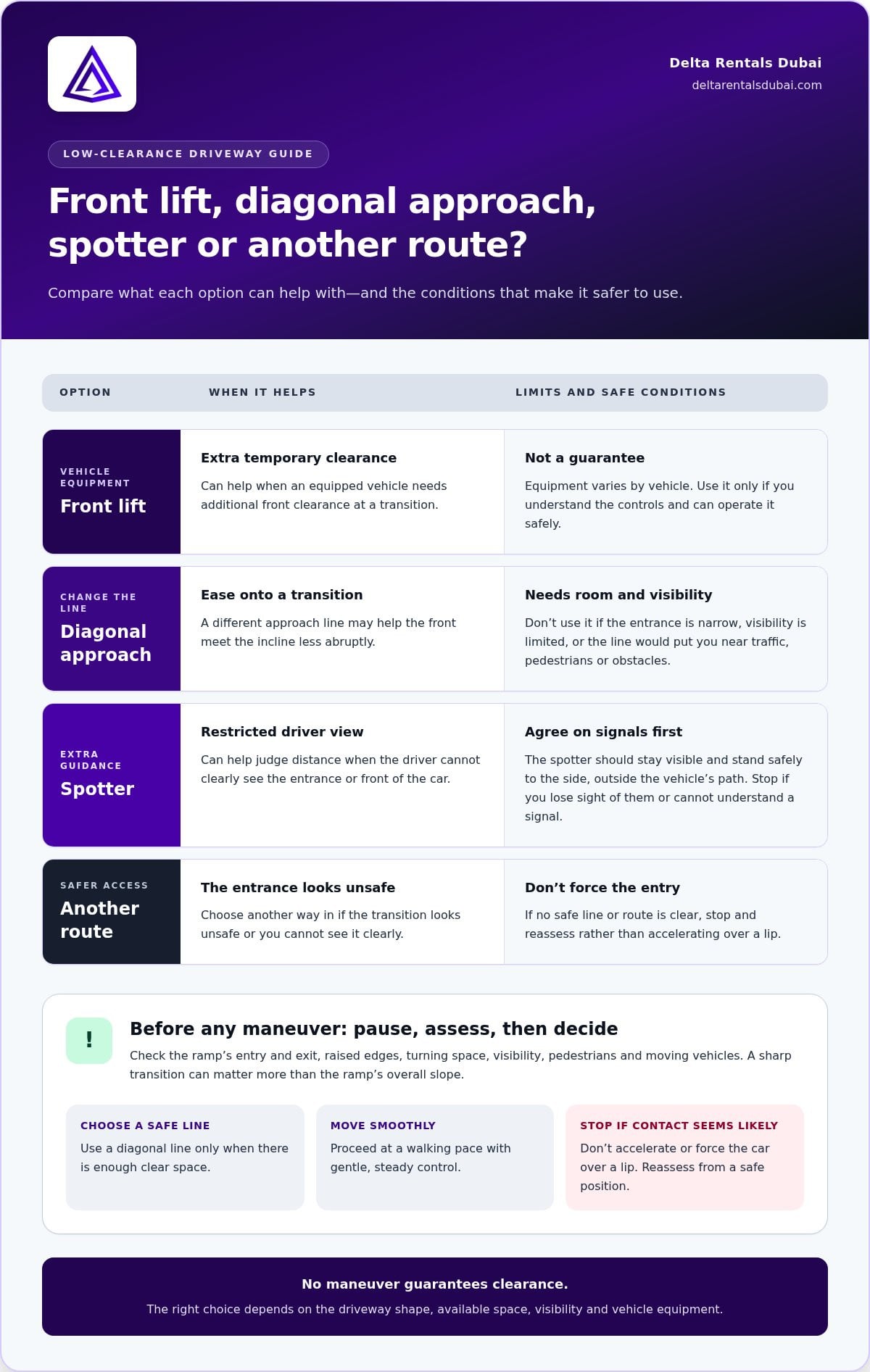
The right choice depends on what you can see, the driveway’s shape and the vehicle’s equipment. Use this comparison to decide whether a manoeuvre is sensible or whether it’s safer to stop and find another way in.
| Option | When it helps | Limits and safe conditions |
|---|---|---|
| Front lift | When an equipped vehicle needs extra temporary clearance at a transition. | Vehicle-dependent and not a guarantee against contact. Use only if you understand the controls and can operate the system safely. |
| Diagonal approach | When changing the car’s line can ease the front over a transition. | Requires enough clear space and good visibility. Don’t use it if traffic, pedestrians, obstacles or a narrow entrance make the angle unsafe. |
| Spotter assistance | When the driver can’t clearly see the entrance or the front of the car. | Agree on clear signals first. The spotter must stand safely to the side, outside the vehicle’s path. |
| Alternate access route | When the ramp’s shape, turning room or clearance remains uncertain. | Use a suitable route you can assess clearly. If there is no safe option, stop rather than force the vehicle through. |
Planning a premium rental for your journey? Discuss a premium rental with our team.
When a front lift can help, and what it cannot do
A front lift can add temporary clearance on a vehicle equipped with the system, but it won’t change the ramp’s shape or remove every risk of splitter contact. Learn how to activate and lower it before approaching an obstacle, and follow the vehicle’s operating instructions. Don’t rely on a lift to make an uncertain entrance safe.
When to choose a spotter or a different access route
Use a spotter if your view of the transition is restricted and you can communicate clearly without distraction. If the angle, clearance or turning space still feels uncertain, stop and consider another suitable entrance. A higher-riding vehicle category may suit some journeys, but category alone doesn’t establish a model’s ground clearance or guarantee it will clear a particular driveway. Choose the option that offers a clear, controlled path, not simply the one that gets you moving.
A practical hotel-arrival checklist for low-clearance cars
A short routine can turn a tense entrance into a clear decision. Follow these checks in order, and treat uncertainty as a reason to pause rather than try the same risky line again.
Before reaching the driveway
- Slow down early. Leave enough room to assess the entrance without braking abruptly or blocking traffic.
- Choose a safe place to pause. Consider whether another suitable access route is available before approaching the ramp.
- Review the vehicle. If you’re driving a rental, take clear photos of visible pre-existing marks, including those on the front splitter and lower body, before setting off.
- Learn the controls. If the vehicle has a front-lift system, understand how to operate it before you need it. Don’t assume every vehicle has one.
At the entrance
- Assess visibility, traffic and space. Look for a clear view of the transition and enough room to manoeuvre without putting pedestrians or other vehicles at risk.
- Use a spotter if available. Agree on simple, unambiguous signals. The spotter should stand safely to the side, where you can see them, and never in the vehicle’s path.
- Commit only to a clear line. If the entrance is obstructed, the turn is too tight or the transition is hard to judge, stop and reassess. Don’t repeatedly attempt a line that may cause contact.
During the manoeuvre and after parking
- Move gently. Keep control inputs smooth and slow. If the splitter touches the surface or the car feels impeded, stop immediately. Don’t press forward or use acceleration to force the vehicle over an obstacle.
- Reassess before continuing. If you can’t identify a safe way through, choose another suitable route or abandon the manoeuvre. Protecting the vehicle matters more than completing the turn in one attempt.
- Check the front once parked. Look for visible marks or damage without reaching beneath the vehicle. If contact occurred, document what happened and the visible condition promptly, then follow the reporting steps in the rental agreement.
The routine is simple: prepare before arrival, make a fresh safety check at the entrance and stop when the route is no longer clear. For a rental that suits your plans, discuss your vehicle and arrival plans with our team.
Choose a rental plan that suits low-clearance driveway access
A premium car should suit the whole journey, not just the drive between destinations. Before choosing a rental, think about where you’ll go, how you’ll arrive and what the vehicle needs to carry. If your itinerary includes a hotel with a steep entrance or tight parking, plan for that access rather than treating it as a surprise.
Match the vehicle choice to the journey
Consider the entrance alongside your planned stops. Think about the driveway’s slope and turning room, parking conditions at each destination, and whether you’ll be carrying several passengers or substantial luggage. These details affect how comfortable you may feel manoeuvring and parking.
Sports cars and luxury SUVs offer different experiences, but the category alone doesn’t tell you a vehicle’s exact ground clearance or whether it has a front-lift system. Don’t assume an SUV will clear every steep transition or that a performance car has lift equipment. Vehicle specifications and driveway geometry both matter. Choose with the full itinerary in mind, then assess each entrance when you arrive.
Plan a confident premium rental experience
Build a simple arrival plan: assess the entrance early, take a careful line only when space and visibility allow, use a spotter if it is safe and useful, and stop if the route remains uncertain. Include luggage and passengers in your plan. Leave enough time to make a considered choice instead of feeling pressured to enter a tight ramp.
Delta Rentals Dubai offers premium and high-performance rentals, including the Porsche 911 GT3 RS. It’s a distinctive option for a performance-focused journey, but the model name alone doesn’t establish its ground clearance or equipment. Plan around the specific vehicle and your route, not assumptions about its category.
Preventing splitter damage means pairing the right rental experience with a clear arrival plan and never forcing a manoeuvre you can’t judge confidently. Plan your premium car rental with Delta Rentals Dubai.
Make Your Arrival Plan Before You Set Off
A steep hotel driveway doesn’t have to turn a premium drive into a stressful arrival. Judge the transition before committing, move with care, and choose another route if the entrance still feels uncertain. A diagonal approach or front lift may help in the right conditions, but neither replaces a clear view and a safe plan.
Assess early, account for the vehicle and its load, and stop rather than force a risky manoeuvre. Match your rental to the wider journey, too. Vehicle category alone doesn’t guarantee a particular clearance or front-lift system.
Delta Rentals Dubai offers premium and high-performance vehicle rentals across the UAE, including the Porsche 911 GT3 RS. Plan your route and vehicle choice, then plan your premium car rental with Delta Rentals Dubai.
Frequently Asked Questions
Can approaching a steep driveway diagonally prevent front splitter damage?
A diagonal approach may reduce the chance of the front splitter contacting a driveway transition, but it can’t guarantee clearance. Turning across the slope changes how the front wheels and bumper meet the incline, which may help on some entrances. Use this line only when there’s enough space, visibility is clear, and traffic and pedestrians aren’t put at risk. If the entrance is narrow or the transition still looks too sharp, stop and reassess.
Does a front-lift system prevent a low splitter from scraping?
No. A front-lift system can temporarily raise the front of a vehicle equipped with one, but it doesn’t make every driveway safe or eliminate all contact risk. The transition may still be too abrupt, and other low vehicle components can also be vulnerable. Use the system only if you know its controls and operating instructions. Don’t assume a rental has a front lift or rely on one instead of assessing the entrance.
How should I drive a low sports car up a steep hotel driveway?
Pause before the entrance, check the ramp’s shape, visibility, traffic and available turning space, then choose a clear path. Move slowly with smooth, steady control. A diagonal line may help only if it’s safe and there’s room to use it. If you’re unsure about clearance, use a spotter where safe or choose another suitable route. Don’t rush the decision.
What should I do if my front splitter touches the driveway?
Stop as soon as you notice contact or feel the vehicle being impeded. Don’t accelerate or force the car over the surface. Once it’s safe, reassess the route and avoid repeating the same manoeuvre if contact seems likely again. After parking safely, check for visible damage without reaching beneath the vehicle. If it’s a rental, take clear photos and follow the incident-reporting steps in your rental agreement.
Can a hotel driveway damage a rental car’s underbody?
Yes. A sharp entrance lip, steep crest or abrupt change from ramp to level ground can bring the front splitter, central underbody or a low rear component into contact with the surface. The risk depends on the driveway shape, vehicle design, load and approach. Assess the full transition rather than judging only the ramp’s overall slope. If contact occurs, stop and follow the rental agreement’s reporting instructions.
Should I choose a different car if my hotel has a steep driveway?
Consider another vehicle if the entrance appears difficult to assess or navigate, but don’t rely on vehicle category alone to predict clearance. Sports cars and luxury SUVs differ, and the category doesn’t establish exact ground clearance or front-lift equipment. Weigh the driveway alongside your planned stops, passengers, luggage and comfort with low-clearance driving. Choose a vehicle that suits the whole trip, and plan an alternate route if the entrance remains uncertain.