
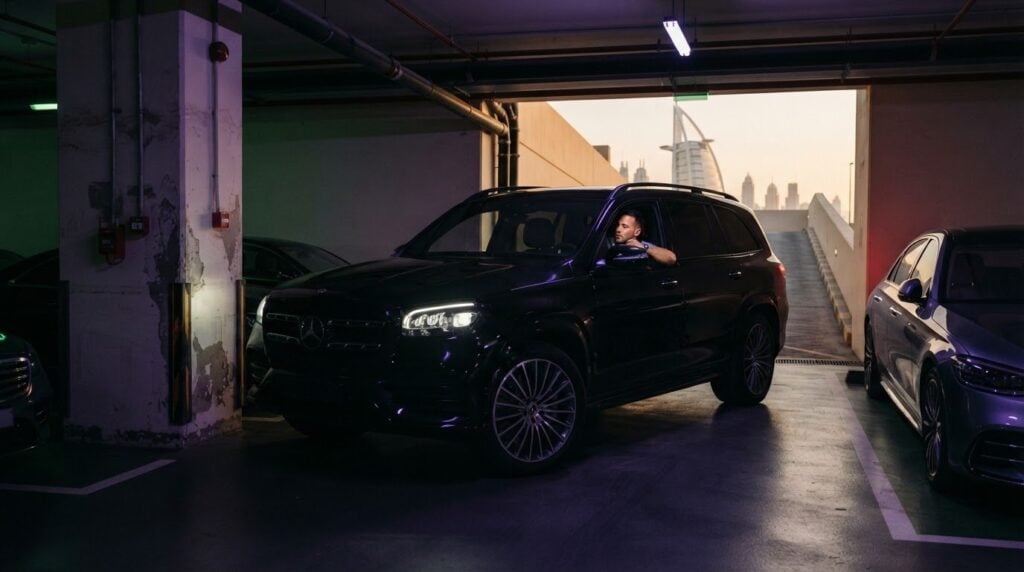
What if the key to tight parking isn’t turning sooner, but understanding the space around your SUV first? For anyone navigating UAE parking in a full-size luxury SUV, narrow bays, close pillars and blind spots can make even a simple manoeuvre feel uncertain. A spacious cabin is a pleasure on the road, but the vehicle’s width, length and turning circle call for a considered approach.
You don’t need to rush or rely on guesswork. A calm, repeatable method helps you judge clearance, make tighter turns with control and avoid scrapes. This guide explains how to use mirrors and parking aids, when to pause and reposition, and how a spotter can help when visibility is limited.
Before setting off in a premium SUV, take time to familiarise yourself with the vehicle and its visibility. Whether you’re driving a Range Rover Sport V8, Cadillac Escalade or Rolls-Royce Cullinan Black Badge from Delta Rentals Dubai, learning how that specific vehicle responds makes close manoeuvres more manageable. Ahead, you’ll find practical steps for assessing space, approaching a turn and parking in a tight bay.
Key Takeaways
- Learn why a large SUV needs extra room to turn and how its rear wheels may follow a different path from the front.
- Use mirrors, sensors and cameras as complementary aids, while staying alert to areas they may not show.
- Follow a calm sequence: pause, assess clearance, position carefully, move slowly and recheck your surroundings.
- Make navigating Dubai parking in a full-size luxury SUV more manageable by accounting for kerbs, overhead clearance, markings and nearby traffic.
- Build confidence by practising in an open space before tackling a tight bay, and pause or reposition whenever the space feels uncertain.
Why a Full-Size Luxury SUV Needs a Different Parking Approach
A larger vehicle changes how much room each manoeuvre needs. A bay that feels straightforward in a smaller car can leave less margin for an SUV’s wheels, front corners and rear bodywork. The answer isn’t to rush or rely on habits from another vehicle. Understand the SUV’s proportions and give yourself room to move deliberately.
Turning circle is the space a vehicle needs to complete a turn. A wider turning circle can mean starting the turn from farther back or allowing more room at the sides. The measurement helps describe how tightly a vehicle can turn, but real clearance also depends on the route and nearby obstacles. This explanation of a wide turning circle outlines the technical distinction between turning measurements.
When navigating Dubai parking in a full-size luxury SUV, familiarity matters more than confidence built in a smaller car. The vehicle’s length, width and wheelbase affect how much room a manoeuvre takes. Its steering setup affects how sharply the front wheels can turn, while your seated position influences how accurately you judge the edges. Learn the specific vehicle before entering a confined space.
Which dimensions matter most in a tight parking space?
Width matters when passing pillars, kerbs or neighbouring vehicles, and when you need room to open a door after parking. Length affects how much clearance the front needs before turning and how much space the rear may swing through. Wheelbase, the distance between the front and rear axles, also influences the space needed to turn. A longer wheelbase can require a broader path, so don’t assume the SUV will follow the line you’d take in a smaller car.
Why does a large SUV feel different from a smaller car?
An elevated seat gives you a different view of the road, but it doesn’t reveal every corner or eliminate blind spots. The bonnet, rear corners and lower areas beside the vehicle can still be difficult to judge from the driver’s seat. Before entering a tight bay, adjust your seat and mirrors, then take time to understand where the SUV’s edges sit in relation to what you can see. Calm, familiar checks beat guesswork.
Luxury SUVs such as the Range Rover Sport V8, Cadillac Escalade and Rolls-Royce Cullinan Black Badge each have their own proportions and feel. Don’t transfer assumptions from one model to another. Take a few minutes to get acquainted with the vehicle before your next low-speed manoeuvre.
How a Wide Turning Circle Shapes Every Low-Speed Manoeuvre
A turning circle describes how much room a vehicle needs to complete a turn. The swept path is different: it’s the full area occupied by the vehicle as it moves through that turn. Knowing the turning circle alone won’t show whether a pillar, kerb or parked car sits in the SUV’s path.
What is the difference between turning circle and swept path?
Picture a top-down view of an SUV turning around a corner. Its front wheels trace one curved line, while its rear wheels follow a tighter line inside it. The body also occupies space beyond the wheel tracks, from the front corners to the rear edges. That entire footprint in motion is the swept path. A bay may look wide enough for the SUV to turn, yet leave too little clearance for its body to pass safely.
This is why a low-speed manoeuvre needs more than a glance at the turning space. As you steer, the nose can move outward toward an obstacle, while the rear wheels cut closer to the inside of the turn. Depending on the angle and available room, an outer rear corner may also swing toward something nearby. Keep checking both sides rather than focusing only on the direction the SUV is travelling.
How do wheelbase and rear swing affect tight turns?
The wheelbase affects how the vehicle follows a curve. In a longer SUV, the rear axle is farther from the front, so the rear wheels can cut inside the front wheels’ path more noticeably during a tight turn. Long bodywork adds another consideration: a corner can move closer to a pillar or adjacent vehicle even when the tyres appear clear. Watch the whole vehicle’s path, not just the wheels.
Slow down, steer deliberately and keep checking the space around the entire vehicle. Turn gradually, pause if a corner’s clearance becomes uncertain, and adjust your position before continuing. Rushing makes it harder to notice how the nose and rear are moving in relation to nearby obstacles.
For official parking information and services, consult the RTA’s parking services. Parking rules and bay access are separate from vehicle geometry, but both matter when navigating Dubai parking in a full-size luxury SUV. Delta Rentals Dubai offers premium SUV rentals, including the Range Rover Sport V8 and Cadillac Escalade. Explore luxury SUV rental options, then take time to familiarise yourself with the vehicle before attempting a tight manoeuvre.
Mirrors, Parking Sensors, and Cameras: What Each Can Tell You
A large SUV’s driver aids can make close manoeuvres easier to assess, but each shows only part of the picture. Equipment and coverage vary by vehicle, so take a moment to understand the systems in the SUV you’re driving. Use screens and alerts to support your judgement, not replace looking around directly.
| Aid | What it can help you see or sense | What may remain unclear |
|---|---|---|
| Mirrors | Vehicles and obstacles along the sides and behind, depending on mirror adjustment. | Areas close to the body, corners and blind spots. |
| Parking sensors | Proximity to objects within the sensors’ detection area, usually through alerts. | The object’s exact shape, position or height, and anything outside sensor coverage. |
| Reversing camera | The view behind the SUV while reversing. | Areas beyond the camera’s frame, the sides and sometimes distance, which can be hard to judge on screen. |
| Surround-view camera | A combined view of areas around the vehicle, if the SUV is equipped with the system. | Blind spots or details obscured by the vehicle, and precise distance due to the displayed perspective. |
How should you use mirrors and cameras together?
Set your mirrors before moving, then use them to monitor both sides as you manoeuvre. Check the camera view for nearby obstacles, but confirm what you see by looking directly around the vehicle whenever it’s safe. Camera perspective can flatten or distort distance. A kerb that appears comfortably clear on screen may be closer than it looks.
What can parking sensors detect, and what can they miss?
Sensor alerts signal proximity; they don’t provide a complete view or identify every obstacle. Low, narrow or awkwardly positioned objects may be harder to assess, and coverage differs between vehicles. If an alert sounds unexpectedly or the display leaves you unsure, stop and recheck your surroundings before moving again.
Build a simple sequence: mirrors for the sides, camera for the immediate view, sensors for proximity, then direct observation to verify. This layered check is useful in tight bays, where a pillar or neighbouring vehicle can sit just outside one aid’s view. For broader resources on parking design and management, the National Parking Association offers information about parking industry standards. Keep your attention on the space around your SUV, and treat every aid as one part of your assessment.
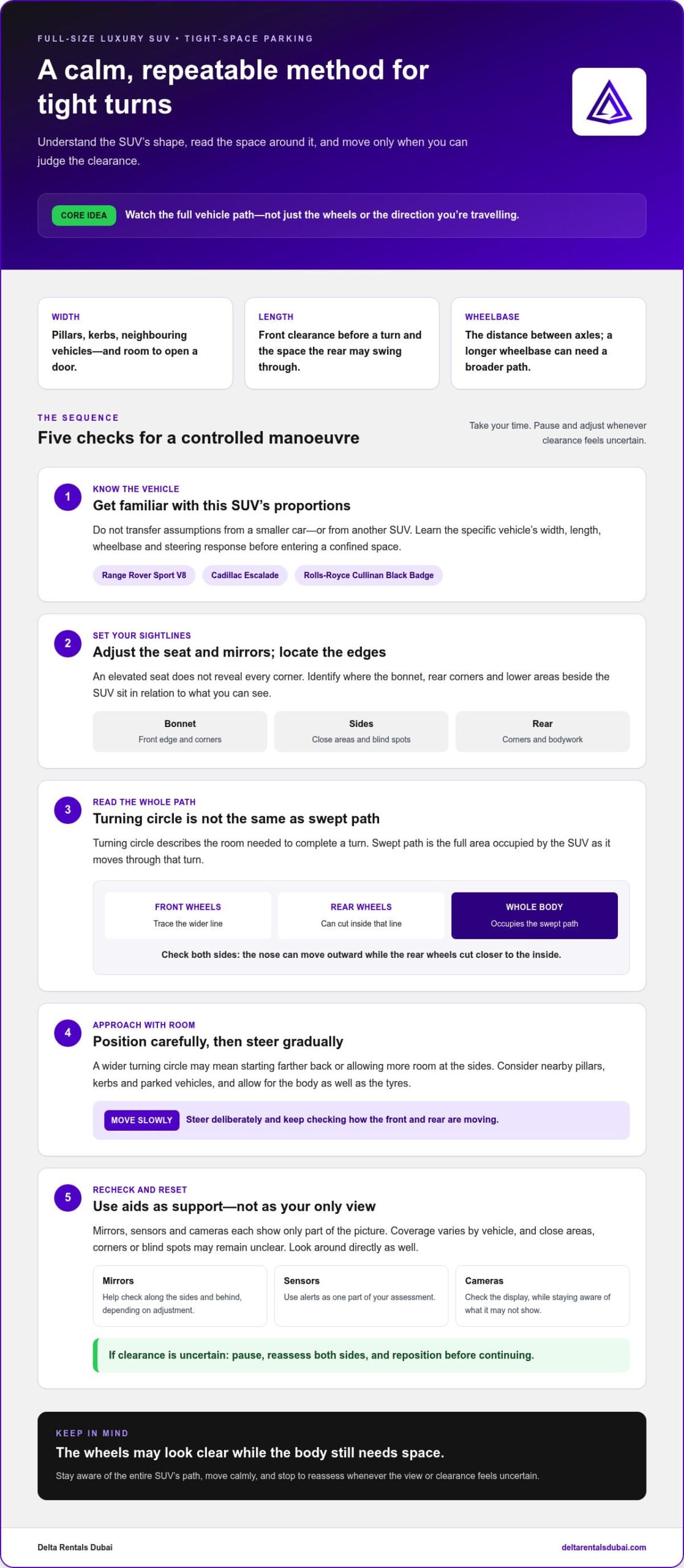
A Step-by-Step Method for Tight Turns and Parking
Use the same sequence each time you face a confined turn or bay. A repeatable routine keeps the manoeuvre deliberate and gives you clear moments to stop if the space doesn’t feel right.
- Pause. Stop before entering the tight area. Give yourself time to settle and avoid reacting to pressure from nearby traffic.
- Assess. Check the route, overhead clearance, surface markings, kerbs and nearby vehicles or moving traffic. Look for obstacles at ground level as well as around the SUV’s body.
- Position. Start from a place that leaves room to turn. Check front and side clearance, and consider where the rear will travel.
- Move slowly. Make small, deliberate steering inputs. Keep checking mirrors, available camera views and your surroundings.
- Recheck. Stop if your view, alignment or clearance becomes uncertain. Reassess and reposition rather than forcing the manoeuvre.
How do you make a tight turn without clipping an obstacle?
Approach at a controlled pace and create room before turning the steering wheel. Check the front corner, both sides and the rear path as the SUV moves. If a kerb, pillar or nearby vehicle comes too close, stop, reset your position and try a clearer line. A spotter can help where visibility is limited, but agree on simple signals first. They should stand where you can see them, away from the vehicle’s path, and never between the SUV and an obstacle.
How do you reverse a full-size SUV into a parking space?
Choose a bay with enough room to enter and exit comfortably, not simply one the SUV can fit inside. Reverse at walking pace, checking mirrors, camera views and the area around the vehicle. Use small corrections to improve alignment. Stop if you lose sight of a person, the view is unclear or the SUV’s position feels uncertain. Recheck before continuing.
Remember: pause, assess, position, move slowly, recheck. This five-step checklist makes navigating Dubai parking in a full-size luxury SUV more measured, especially when a tight turn and busy parking area leave little room for guesswork. Delta Rentals Dubai offers premium SUV rentals. Enquire about renting a luxury SUV.
Build Confidence Before Taking a Luxury SUV Into Tight Spaces
A full-size SUV can feel unfamiliar at first. That’s normal. Its size takes practice, but calm, slow checks reduce guesswork and help you decide when to continue, pause or reposition. Before attempting a confined bay, spend time in an open, low-pressure space getting used to the vehicle’s controls, mirrors and available parking aids.
What should you practise before parking in a confined space?
Start with simple movements. Practise reversing in a straight line, making gentle turns and stopping beside a chosen reference point. Notice how the front, rear and sides appear from the driver’s seat, then compare what you see in the mirrors and camera views with the vehicle’s actual position. Repeat each manoeuvre until your steering and clearance checks feel measured, not rushed.
Use this familiarisation routine before navigating Dubai parking in a full-size luxury SUV:
- Adjust your seat and mirrors so you can see clearly.
- Identify the vehicle’s controls and understand how its parking aids display or signal obstacles.
- Practise reversing and turning slowly in open space, checking the SUV’s position after each movement.
- Stop at a reference point, then check how close the front, rear and sides are to it.
Don’t treat a camera or sensor as a substitute for looking around. Use each aid as part of a deliberate check, and stop whenever you’re unsure about clearance.
When is a different driving option more comfortable?
If you’d rather not self-park, chauffeuring can be a more comfortable way to travel. Delta Rentals Dubai’s premium fleet includes full-size SUVs such as the Range Rover Sport V8, Cadillac Escalade and Rolls-Royce Cullinan Black Badge. For readers weighing up the options, the luxury SUV rental guide and luxury chauffeur service guide offer relevant next steps.
Choose the approach that suits your plans and comfort level. If you’d like to get familiar with a spacious luxury SUV at your own pace, explore luxury SUV rental options.
Take Your Next SUV Manoeuvre With Confidence
Tight parking becomes more manageable when you understand the space your SUV needs, keep track of its full path and make deliberate, low-speed moves. Mirrors, sensors and cameras can help you judge clearance, but they work best alongside direct observation. If alignment or visibility feels uncertain, pause and reposition instead of forcing the turn.
For navigating Dubai parking in a full-size luxury SUV, practise the basics in an open space before tackling a confined bay. Get familiar with the vehicle’s proportions and controls, then use the same calm checks each time. Preparation can replace guesswork with a more measured approach.
Delta Rentals Dubai offers premium vehicles for a luxury driving experience, including full-size SUVs such as the Range Rover Sport V8 and Cadillac Escalade. Choose the spacious drive that suits your plans, take time to get comfortable behind the wheel, and enjoy the experience with confidence. Explore a premium SUV rental and make your next drive your own.
Frequently Asked Questions
How do you park a full-size luxury SUV in a tight space?
Park a full-size luxury SUV by slowing down, checking the space and manoeuvring in small, deliberate steps. Before entering, assess bay width, kerbs, overhead clearance, nearby vehicles and traffic. Position the SUV to leave room for the turn, then use mirrors and available parking aids alongside direct observation. Stop and reset if you’re unsure about clearance. A steady routine makes navigating Dubai parking in a full-size luxury SUV less dependent on guesswork.
What is a wide turning circle in an SUV?
A wide turning circle means the SUV needs more room to complete a turn than a vehicle with a tighter turning circle. The space required varies with the vehicle’s design and steering, so don’t assume the same turning point will work across different models. In a confined area, allow room for the front to swing outward and the rear wheels to follow a different path. Make the turn slowly and check the full vehicle’s clearance.
How do you reverse a large SUV into a parking space?
Choose a bay with enough room to enter and exit, then reverse at walking pace. Check your mirrors, available camera views and surroundings before and during the manoeuvre. Use small steering corrections, watching the SUV’s alignment and clearance on both sides. If you lose sight of an obstacle or aren’t sure how close a corner is, stop. Recheck your position and continue only when the path is clear.
Are parking sensors and cameras enough to park a large SUV safely?
No. Sensors and cameras support your judgement, but they don’t provide a complete view of every obstacle or blind spot. Sensors indicate proximity, while camera views can make distance difficult to judge or leave areas outside the frame. Use these aids with adjusted mirrors and direct observation. If an alert, image or view is unclear, stop and check your surroundings before moving again. The exact systems and coverage can vary between vehicles.
Why does the rear of an SUV move closer to obstacles during a tight turn?
During a tight turn, the rear wheels generally trace a path inside the front wheels’ path. This is called off-tracking, and it can bring a rear wheel or lower bodywork closer to an inside kerb or obstacle. At the same time, the SUV’s front or outer rear corner may swing outward. Keep checking both sides and the vehicle’s full path, not just the direction the front wheels point.
How can I get more confident driving a full-size luxury SUV?
Build confidence by practising in an open, low-pressure space before attempting confined parking. Try straight-line reversing, gentle turns and stopping beside a reference point. Learn how the vehicle’s front, rear and sides appear from the driver’s seat, and get familiar with its controls and parking aids. Repeat each movement at a calm pace. For example, a Range Rover Sport V8 or Cadillac Escalade calls for learning that specific vehicle’s proportions rather than relying on habits from a smaller car.