

What if the safest way into a multi-tier garage is deciding not to enter? If you’re wondering how to navigate multi tier parking garages with an extra wide exotic vehicle, that hesitation makes sense. A low splitter, uncertain height clearance, narrow ramp or tight turn can make parking stressful. Confidence alone won’t tell you whether the route fits your car.
A measured check will. Before committing, review the posted height and access information, consider the vehicle’s width and low front end, and look for a route with room to manoeuvre. Move slowly, pause if visibility or clearance is uncertain, and treat choosing another space as good judgement, not a setback.
This guide explains how to assess a garage before entry, approach ramps and turns calmly, and recognise when to stop or choose another option. If you’re planning a drive in a Porsche 911 GT3 RS rental, make parking part of the plan rather than an afterthought. If you’d rather leave the manoeuvring to someone else, luxury chauffeuring offers another way to enjoy the journey.
Key Takeaways
- Use a pre-entry checklist to assess whether a garage’s width, height, ramp angle and route appear suitable for your vehicle.
- Learn how to navigate multi tier parking garages with an extra wide exotic vehicle by choosing a route with visibility and room to turn, not just an apparently open space.
- Compare open-access routes, tighter multi-tier paths and alternative parking plans before committing to a difficult manoeuvre.
- Follow a calm routine on ramps and turns: pause, inspect, proceed slowly and reassess if clearance or visibility becomes uncertain.
- Recognise when to stop and choose another option. No driving technique can make inadequate clearance safe.
Why multi-tier garages demand a different approach in an extra-wide exotic vehicle
Assess the full route and its clearances before committing to a garage. A straight entrance can look generous, but the route may narrow at a ramp, turn between columns or lead to an aisle crowded with parked vehicles. If you’re learning how to navigate multi tier parking garages with an extra wide exotic vehicle, judge the route all the way to the intended parking level, not by the entrance alone.
A clearance-first check means assessing whether your vehicle can travel the entire route, including turns and transitions, without scraping or being forced through a tight fit. That involves more than checking one posted height limit or looking at the width of a marked bay. The design and layout of multi-story car parks can include multiple levels, ramps and connecting aisles, so the full route matters.
What makes a multi-tier garage challenging for a wide exotic car?
Width affects more than parking between bay lines. A car may fit through an open entrance but leave little room to adjust its path around a column or through a narrow corner. Turns require space for the vehicle to follow its arc, while walls, pillars and other vehicles can limit visibility and manoeuvring room.
Low front bodywork adds another consideration. At a steep ramp transition, the front splitter or underbody may be vulnerable if the vehicle’s approach angle and the change in slope don’t suit the surface. Width, turning behaviour and ground clearance vary by model, so don’t assume that experience in one exotic car guarantees the same fit in another.
Why confidence and driver-assistance features are not enough
Cameras and parking sensors can help you spot nearby obstacles, but they don’t establish clearance along an unfamiliar route. They may not show what lies beyond the camera’s view, how a ramp changes beneath the car or whether the vehicle can complete a turn without getting too close to a wall or column.
Slow down and assess each section before proceeding. If an opening looks too narrow, a ramp transition seems unsuitable or you can’t see enough of the route to judge it, stop. Don’t rely on confidence, sensors or a last-second correction to squeeze through. If clearance doesn’t look adequate, choose a different entrance, parking plan or vehicle.
Check width, height, turning space, and ramp angles before entering
Assess the whole route, not just the entrance. A posted height limit may help you rule out a garage, but it won’t tell you whether a wide vehicle can pass between columns, complete a tight turn or clear a ramp transition. When learning how to navigate multi tier parking garages with an extra wide exotic vehicle, combine the vehicle’s specifications with a visual review of the garage layout.
Which dimensions and garage details should you assess?
Start with the manufacturer’s published specifications for the exact vehicle you’re driving. Check its width, height, length and turning information, and note whether the stated width includes mirrors. Then compare those figures with posted limits and the visible route. Specifications describe the vehicle, but they don’t prove that every part of the garage has enough usable space.
- Entry: Read posted height and access signs. Look for height bars, narrow lanes, barriers and sharp approaches.
- Route: Scan for columns, tight corners, ramp edges and changes in direction before committing.
- Turning room: Consider whether the vehicle can complete each turn without bringing its front or rear close to a wall or obstruction.
- Parking area: Columns and neighbouring vehicles can reduce practical manoeuvring space, even when a marked bay looks wide enough.
Review the facility’s current signs and access information. Don’t assume that one measurement, such as entrance width, proves the full route is suitable.
How do ramps and transitions affect a low vehicle?
Pay attention to where level ground meets a slope, ramp or raised threshold. An abrupt change in surface angle can bring low front bodywork or the underbody close to the ground, particularly as the vehicle enters or leaves the transition. There isn’t one universal ramp angle that guarantees clearance across different vehicles and garage layouts.
Where it’s safe and permitted, visually inspect the approach and departure before proceeding. Consider the slope, the transition at its base or crest, and whether you can see enough of the path ahead. If the geometry looks abrupt or you can’t judge clearance confidently, stop and choose another route or parking plan. Moving slowly gives you more time to assess, but it can’t make an unsuitable transition safe.
If garage access is shaping your vehicle choice, you can explore an exotic-car rental as part of planning your drive.
Compare the garage route, parking options, and a safer alternative
Choose based on the full route through the parking area, not the appearance of a single bay. A marked space may look generous, but the approach could involve a narrow aisle, tight turn or ramp transition with little room to manoeuvre. Compare the route before entering, and consider another plan if key details are unclear.
| Option | Visibility | Turning room | Ramp transitions | Clearance uncertainty |
|---|---|---|---|---|
| Open-access garage route | Often easier to assess when the route ahead is visible | Potentially more room, but inspect corners and obstructions | Check each slope and level change | Lower only when the full route is clear to assess |
| Tight multi-tier route | May be limited by walls, columns or blind turns | Restricted turns can leave little room to correct | Transitions may be hard to judge from the entrance | Higher if key sections are hidden or congested |
| Alternative parking plan | Depends on the location and approach | May avoid tight garage turns, but assess access | May avoid ramps, depending on the route | Can be lower when the route is visible and straightforward |
How can you judge a route before choosing a parking level?
Prioritise clear sightlines, fewer tight turns and ramp transitions you can see before reaching them. Consider both entry and exit: can you approach at a controlled pace without blocking other drivers or needing a sudden correction? If you can’t see how the route continues, don’t assume the next level will be easier. Choose a more conservative parking option rather than guessing.
Vehicle shape is one factor, but no body style guarantees a particular garage will fit. If you’re weighing an SUV against a lower-profile exotic, this luxury SUV rental guide can help frame the trade-offs. You’ll still need to assess the route itself.
When is another vehicle or chauffeured option more practical?
If your plans involve repeated visits to destinations with tight or unfamiliar garages, choosing a vehicle that suits the access conditions and your comfort can simplify the day. Let the trip’s practical needs guide your choice, not appearance alone. A luxury SUV may suit different plans than an exotic car, but assess the specific vehicle and route rather than assuming either will fit.
If you’d rather not manage parking yourself, consider a luxury chauffeured journey as an alternative. Choose the plan that lets you reach each stop comfortably, without forcing a questionable garage entry.
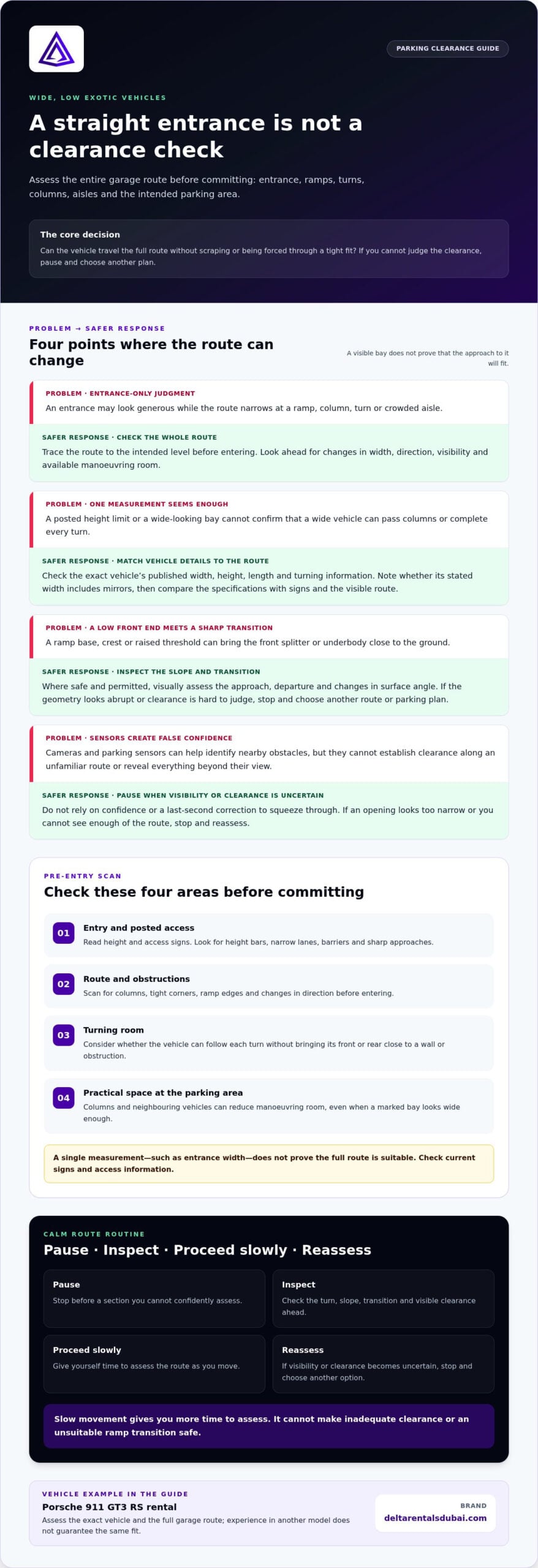
Follow this step-by-step routine on ramps, turns, and parking levels
A repeatable routine helps you make deliberate decisions as the route changes from an open approach to a ramp or tight turn. Use these steps to put how to navigate multi tier parking garages with an extra wide exotic vehicle into practice without rushing or relying on guesswork.
- Pause before the barrier. Stop only where it’s safe and permitted. Don’t hold up approaching traffic while deciding whether to enter.
- Read the signs. Check posted height limits, access instructions and parking information. Understand the route and any restrictions before proceeding.
- Inspect what you can see. Look for narrow points, columns, sharp turns, ramp transitions, pedestrians and vehicles approaching from another direction. If the route ahead is hidden, don’t enter just to test it.
- Proceed at a controlled pace. Keep steering and acceleration smooth. Leave enough room from walls and columns for the vehicle’s path, while staying aware of other drivers and giving them space to pass where appropriate.
- Reassess at each change. Pause at a safe point if the view, slope or available clearance differs from what you expected. Continue only when you can judge the next section.
Before the barrier: pause, inspect, and decide
Give yourself time to decide before reaching a point where turning away becomes difficult. Scan for pinch points, steep transitions, pedestrians and conflicting traffic. If another driver is close behind, don’t let pressure dictate your choice. Wait for a safe opportunity to assess the route or choose another parking plan.
A spotter can help you judge distances only when it’s safe and permitted for them to stand clear of moving vehicles. Agree on simple, unmistakable directions beforehand, keep the spotter in view, and stop if communication breaks down. A spotter can’t make inadequate clearance safe.
On ramps and around tight turns
Take ramps and corners steadily. Avoid abrupt steering or acceleration, and check both front corners as well as the vehicle’s path around the turn. Don’t focus only on the nose: the rear can follow a different path through a tight corner. If visibility or clearance becomes uncertain, stop where it’s safe rather than continuing without a clear view.
If a manoeuvre feels uncertain, stop safely and reassess; never force the car through a questionable gap. For a premium drive that fits your plans, explore an exotic-car rental as part of your vehicle choice.
Choose an exotic-car experience that suits your parking plans
No driving technique can make unsuitable clearance safe. If a garage entrance, ramp or turn looks too tight, stop and choose another parking plan. That’s not a failure of skill; it’s a sensible way to protect the vehicle and keep your journey composed.
Planning how to navigate multi tier parking garages with an extra wide exotic vehicle starts before you set off. Map your likely stops and consider the parking conditions at each one. If your itinerary relies on unfamiliar multi-level garages, narrow entrances or repeated tight turns, factor that in when choosing a vehicle. The driving experience matters, but so does feeling comfortable whenever you arrive and park.
How do you match a rental vehicle to your itinerary?
Think about the full route, not just the first destination. Note where you expect to park, whether the garage approach is visible and how often you’ll need to enter or exit constrained spaces. Then weigh the driving experience you want against the access demands of the trip. A vehicle that suits one stop may make the rest of the itinerary less convenient.
Vehicle shape can inform your choice, but no body style guarantees that a particular garage will be suitable. For a model-specific introduction, read the Porsche 911 GT3 RS rental guide, then assess your intended route and the exact vehicle separately. Don’t infer dimensions or parking compatibility from a model name or appearance.
Plan the experience with Delta Rentals Dubai
Delta Rentals Dubai offers premium vehicle options for planned travel in the UAE, including the Porsche 911 GT3 RS, Rolls-Royce Cullinan Black Badge and McLaren Artura. Choose with your destinations, parking conditions and driving comfort in mind. Published vehicle specifications can inform your assessment, but they can’t confirm that every turn, ramp and bay along your route will work.
If you’d rather enjoy the journey without manoeuvring or parking the car yourself, luxury chauffeuring is another option. Choose the experience that fits your full itinerary, not simply the vehicle that makes the strongest first impression.
Discuss your rental plans with Delta Rentals Dubai and choose an experience that suits your drive.
Plan a smoother drive from the first turn
The essentials of how to navigate multi tier parking garages with an extra wide exotic vehicle are straightforward: assess the full route before entering, move deliberately through ramps and turns, and stop if clearance is uncertain. A marked bay or confident manoeuvre can’t make an unsuitable entrance or ramp safe.
Make parking part of your vehicle choice. Consider the garages and access conditions along your itinerary, as well as the driving experience you want and your comfort behind the wheel. Delta Rentals Dubai offers Porsche 911 GT3 RS rentals, alongside premium sports cars and luxury SUVs. If you’d prefer not to handle parking yourself, luxury chauffeuring is another way to enjoy the journey.
Choose the experience that fits your plans, and give yourself permission to take a different route or parking option when the fit isn’t clear. Discuss your rental plans with Delta Rentals Dubai and set out with a clear plan for a confident, enjoyable drive.
Frequently Asked Questions
Can an extra-wide exotic car fit in a multi-tier parking garage?
It can, but fit depends on the specific vehicle and the garage’s full route. Compare the vehicle’s published width and height with posted limits, then assess turning space, columns, ramp transitions and aisle width. A marked bay or open entrance alone doesn’t prove the route is suitable. If any section looks too narrow or its clearance is uncertain, choose another parking option rather than trying to squeeze through.
How do I check whether a garage is suitable for a low sports car?
Check the garage’s posted height and access information, then assess the route for steep ramps, raised thresholds, sharp transitions and tight turns. Look beyond the entrance to the levels and aisles you’ll use. Compare the route with the exact vehicle’s published specifications, including ground clearance if available, but don’t treat a single figure as proof of fit. If you can’t confidently judge a transition, don’t proceed.
Should I use parking sensors in a narrow parking garage?
Yes, use sensors as an extra source of information, not your only guide. They can alert you to nearby objects, but they don’t assess every part of a turn, the vehicle’s path around a column or clearance beneath its body. Move slowly, check your mirrors and surroundings, and stop if the space becomes uncertain. Sensors support your judgement; they don’t make a tight opening safe.
What should I do if an exotic car scrapes on a garage ramp?
Stop as soon as it’s safe and avoid repeating the manoeuvre. Once parked safely, check for visible damage without reaching under the vehicle or placing yourself in traffic. If you notice damage, warning lights, unusual sounds or changes in how the car drives, don’t continue until it has been assessed by a qualified professional. If it’s a rental, follow the incident instructions in your rental agreement.
Is it safe to use a multi-tier garage with an unfamiliar exotic car?
It may be, if you understand the vehicle’s dimensions and controls and can assess the full garage route. To decide how to navigate multi tier parking garages with an extra wide exotic vehicle, check the exact model’s specifications, posted limits, ramps and turns before entering. Don’t assume experience in another car carries over. If the route or vehicle behaviour is unfamiliar and clearance isn’t clear, choose another option.
How should I take a tight turn in a wide exotic car?
Approach slowly and steer smoothly, leaving enough room from walls and columns while staying aware of other drivers and pedestrians. Watch both front corners and remember that the rear follows a different path through a turn. Don’t make a sudden correction to force the turn. If you can’t see the route clearly or judge the available space, stop safely and reassess before moving again.
Can a parking camera show whether my car will clear a ramp?
No, a parking camera can’t reliably confirm that the car will clear a ramp. Its view may show nearby surfaces or obstacles, but it doesn’t measure underbody clearance or fully reveal how the vehicle meets a slope or threshold. Use the camera alongside a careful visual assessment and the vehicle’s specifications. If the transition looks abrupt or you can’t judge it, stop and choose a safer route.