

A premium badge doesn’t make a rental a business expense. If you’re considering how to justify a luxury car rental as a business expense, start with the work the vehicle supports, not its prestige. A rental for a documented client engagement, business event, or production brief has a clearer purpose to assess than one chosen mainly for personal enjoyment.
The key is to identify the business activity, explain how the rental relates to it, and distinguish any personal use in your records. Even with a clear business purpose, tax eligibility isn’t automatic. The treatment depends on your circumstances and applicable UAE rules.
This guide covers how to assess the business purpose, keep records that connect the rental to your work, and prepare for a review by a qualified UAE tax professional. A rental can provide access to a premium vehicle for a defined engagement, but that alone doesn’t guarantee tax deductibility.
Key Takeaways
- Learn how to justify a luxury car rental as a business expense by tying it to a specific, documented business activity, not the vehicle’s prestige.
- Keep the rental agreement, invoice, payment evidence, and internal approval together so the records tell a consistent story.
- Compare the vehicle with the business need, available alternatives, and expected deliverables before deciding whether it’s proportionate.
- Use a clear review sequence: prepare the business brief, obtain approval, document the rental and its use, then review the records.
- Keep the rental decision separate from tax treatment and discuss UAE-specific questions with a qualified tax professional.
What makes a luxury car rental a business expense?
A defensible rationale starts with a business activity and explains how the rental supports it. Prestige, performance, or visual appeal isn’t a business purpose by itself. A general definition of a business expense can provide background, but it doesn’t determine how a particular rental is treated under UAE rules.
Consider two separate questions: Was there a genuine commercial reason to rent the vehicle? How should the expense be treated for tax purposes? A clear answer to the first helps explain the decision, but doesn’t guarantee the second. UAE tax treatment depends on current rules and the business’s circumstances, so don’t rely on foreign tax articles as guidance for a UAE situation.
How to identify a genuine business purpose
Name the activity the rental supports, such as a scheduled client engagement, a production with a defined brief, or a corporate event. Then explain what the vehicle contributes. It might be specified in a production brief or included as part of an agreed event experience. Describe that connection directly instead of relying on broad claims about image or exposure.
Status, personal enjoyment, or vague “brand exposure” doesn’t explain why the business needed the rental. If the vehicle is also used for personal reasons, distinguish that use in the business’s records.
Why rental treatment is not the same as vehicle ownership
A rental provides temporary access for an agreed period. Buying a vehicle means the business acquires an asset, which raises different accounting and tax questions, including how ownership and depreciation may be treated. Advice about purchase deductions or depreciation may not address the treatment of a time-limited rental.
A business rationale explains why the rental supports the activity. It does not, by itself, establish tax eligibility.
To assess how to justify a luxury car rental as a business expense, begin with the commercial need and match the rental to it. For example, a vehicle chosen for a production should fit the documented creative brief and planned deliverables. If the explanation rests mainly on the car being impressive, the business case needs more substance.
Keep the rental decision and tax review related but distinct. A business can document why it arranged temporary vehicle access without assuming that the full charge qualifies for a particular tax treatment. Have a qualified UAE tax professional assess the facts against current UAE requirements before deciding how to account for the expense.
What evidence supports a luxury car rental’s business purpose?
A strong file tells one consistent story: what the business planned, why a rental was relevant, who approved it, how the vehicle was used, and how the charge was paid. A general explanation of the ordinary and necessary concept can offer background, but it isn’t UAE tax advice and doesn’t determine the treatment of a particular rental.
Build the file as the activity unfolds, rather than trying to reconstruct it from memory later. Connect the business need to the booking, rental dates, actual use, and outcome. If the records contradict one another, or the rental period doesn’t match the stated activity, the rationale becomes harder to follow.
Build a rental documentation file
Keep the records together in one digital or paper file. Start with a brief note of the purpose, rental date range, responsible employee, and approving manager. Add documents that show the plan existed and had a business context.
- Rental and payment records: Keep the rental agreement, invoice, payment evidence, and relevant correspondence together.
- Activity records: Attach the meeting agenda, client or event invitation, production brief, or other material connected to the stated purpose.
- Approval: Retain the internal approval and specify the activity or deliverable it covers.
Check that dates match across the file. A rental for a production should align with its brief or call sheet; a rental for a client engagement should correspond with meeting records. Ask a qualified UAE tax professional about current requirements for invoices, VAT records, and related treatment before relying on them for tax purposes.
Track use and business outcomes
Keep a log during the rental period. Record business-related dates, destinations, and activities, and identify personal use separately. The format can be simple, but each entry should be specific enough to connect the vehicle use to the documented purpose.
Close the file with a short, factual outcome note. For example, record that a client meeting took place or that specified campaign assets were completed. Describe what happened, not a promised commercial return. This gives finance or operations a clear record to review without overstating the result.
In practice, how to justify a luxury car rental as a business expense comes down to consistency: the brief, approval, agreement, invoice, payment, and use log should support the same business explanation. Once the purpose and date range are clear, you can explore luxury car rental options for the activity, while keeping the tax assessment with your UAE professional.
Does a luxury car rental make sense for the business use?
Assess the choice against the task, not the image it creates. A premium rental may fit a defined client, event, or production requirement, but the business should be able to explain why that vehicle suits the activity better than a standard vehicle or another transport option. This comparison supports an informed business decision; it doesn’t guarantee a tax outcome.
Compare plausible business-use scenarios
Before approval, make a short comparison that sets out the objective, practical need, alternatives, and expected output. Be specific enough for someone outside the project to understand why the vehicle is being considered.
| Planned activity | Business need to assess | Alternative and expected output |
|---|---|---|
| Executive or client transport | Does the meeting schedule or attendee requirement support a premium vehicle? | Compare with standard transport; identify the planned meetings or client itinerary. |
| Corporate event | Does the written event brief specify a vehicle as part of the experience? | Compare with other event arrangements; name the event materials or activity it supports. |
| Campaign or production | Does the creative brief call for this type of vehicle? | Compare with a different vehicle or production approach; define the planned campaign assets. |
For example, a Porsche 911 GT3 RS or Rolls-Royce Cullinan Black Badge may fit a particular production brief, but the model name alone proves nothing. If a less prominent vehicle or another transport option would serve the same purpose just as well, explain why the premium choice is still proportionate. A claim such as “brand exposure” needs a clear brief and planned outputs to support it.
Address personal use and overstatement risks
Compare the planned use with what actually happens. Record personal days, leisure detours, or other non-business use accurately. Don’t describe the full rental period as business use if it wasn’t. If actual use differs from the original brief, note the reason and keep a truthful account.
Keep tax references within their proper jurisdiction. The IRS page on a deductible car expense explains US rules, not UAE treatment. Use your comparison to assess business fit, then discuss UAE eligibility separately with a qualified UAE tax professional. A credible decision shows why the vehicle suited the documented activity, not simply why it was impressive.
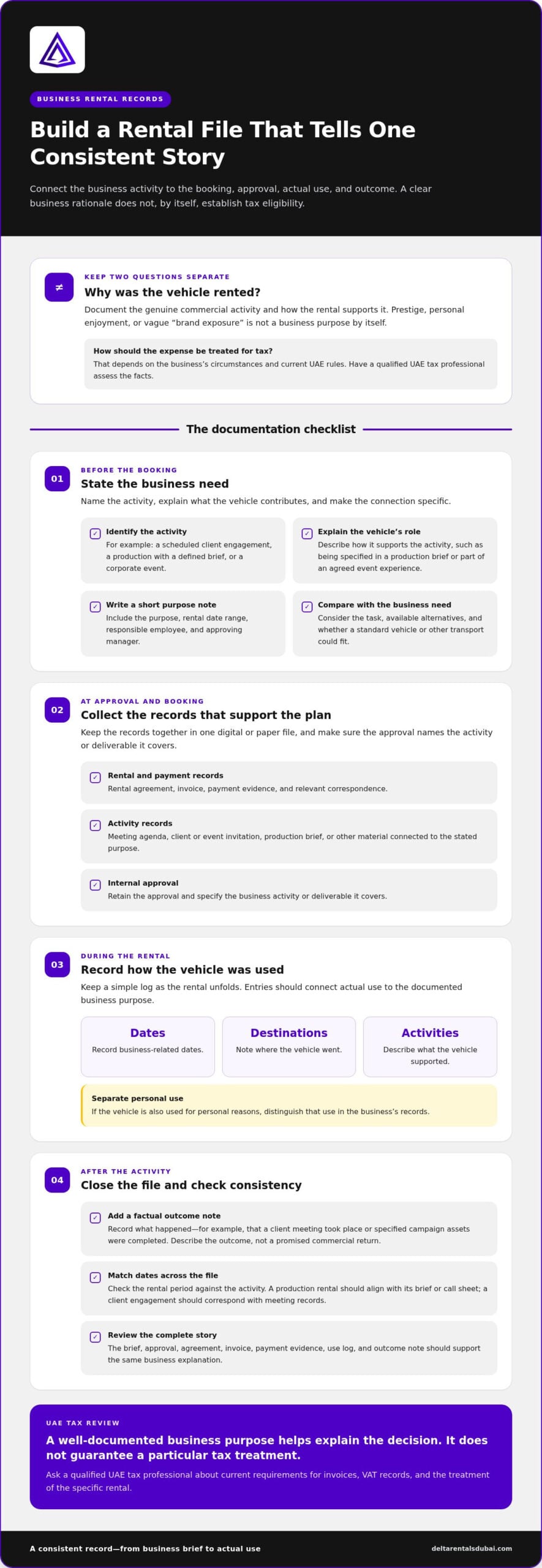
How to document and review the rental before booking
Put the business case first. A clear workflow gives finance and operations a decision trail from the initial brief to the final review. Approve the purpose and vehicle fit before booking, then check that the completed records reflect what actually happened.
Before the rental: approve the business case
- 1. Write the brief. Name the business activity, participants, dates, and intended outcome. For a production, identify the planned deliverables; for a client engagement, note the relevant meeting or itinerary.
- 2. Explain the vehicle choice. Describe why the vehicle category suits the activity. Compare reasonable alternatives, such as a standard vehicle or other transport, and record why they would or wouldn’t meet the same need.
- 3. Obtain internal approval. Have the appropriate manager approve the business rationale before booking. Keep the approval with the brief so the decision is clear and dated.
- 4. Retain booking records. Once approved, save the booking confirmation, rental agreement, and correspondence in the same file. Check that the rental dates and vehicle details match the approved plan.
During and after the rental: reconcile and review
- 5. Record actual use. Keep a timely log of business activities and distinguish any personal use. If plans change, note what changed and why instead of rewriting the original brief.
- 6. Match the final documents. Compare the invoice and payment evidence with the approved booking. Reconcile the final rental dates and charges with the agreement, then check the usage log against the stated business purpose.
- 7. Close the file with an outcome. Record what took place, such as the meeting held or production deliverables completed. Keep this factual; don’t imply that the rental produced guaranteed revenue or results.
- 8. Seek UAE-specific tax review. Give the complete file to a qualified UAE tax professional to assess its treatment under current applicable rules. Organized records support a review, but don’t guarantee deductibility.
This sequence makes how to justify a luxury car rental as a business expense a reviewable process: brief, approval, booking, actual use, reconciliation, and professional assessment. Keep the vehicle rental decision separate from tax advice.
With your business brief and approval in place, you can arrange a luxury car rental around your activity.
Arrange a luxury car rental around a clear business brief
A luxury vehicle can support a defined business occasion, but the rental and its tax treatment are separate decisions. The rental provides access to a vehicle for the planned activity; it doesn’t guarantee a deduction. Keep that distinction clear as you move from business need to vehicle choice, approval, record-keeping, and UAE professional review.
Match the rental to the business occasion
Start with the occasion and its practical requirements. Is the vehicle part of a production brief, a corporate event, or a client-facing engagement? Set out the dates, intended use, participants, and expected outcome before choosing a vehicle. Then decide which category fits the activity and explain why.
A Porsche 911 GT3 RS may suit a performance-focused production brief, while a Rolls-Royce Cullinan Black Badge may fit a client-facing transport requirement. These are rental examples, not tax recommendations. The business case comes from the documented activity and vehicle fit, not the model name.
Use this sequence to keep the decision focused:
- Business occasion: Define the activity and its purpose.
- Vehicle requirements: Identify what the activity calls for, such as its role in a production or the needs of client transport.
- Approval and records: Document the rationale, obtain internal approval, and retain the rental and usage records.
- Tax review: Ask a qualified UAE tax professional to assess the facts under current applicable rules.
Make the next step straightforward
Before arranging the rental, prepare the date range, business occasion, vehicle requirements, and relevant booking details. For a performance-oriented brief, explore the Porsche 911 GT3 RS rental as one possible option. For client-facing transport, consider whether the Rolls-Royce Cullinan Black Badge fits the practical requirements. In either case, choose the vehicle to fit the brief, not as a substitute for one.
That is the practical answer to how to justify a luxury car rental as a business expense: connect the rental to a real business activity, document the vehicle fit and approval, keep consistent records, and leave tax eligibility to a UAE professional. Delta Rentals Dubai provides premium vehicle hire for defined occasions, while your tax adviser assesses the treatment separately.
Discuss a luxury vehicle rental for your business occasion.
Make Your Business Rental Decision with Confidence
A credible rental decision starts with a defined business activity, a vehicle that fits its practical needs, and approval before booking. Keep the agreement, invoice, payment evidence, and use records aligned with that purpose, including any personal use. These steps clarify how to justify a luxury car rental as a business expense, but they don’t guarantee a tax deduction.
Delta Rentals Dubai offers premium vehicle rentals across the United Arab Emirates, including options such as the Porsche 911 GT3 RS and Rolls-Royce Cullinan Black Badge. Choose based on the occasion and requirements, then have a qualified UAE tax professional assess the records against current rules. Vehicle hire supports the activity; tax treatment is a separate decision.
Have a defined business occasion in mind? Discuss a luxury vehicle rental for your business occasion. A clear brief and organized records help you move forward with confidence.
Frequently Asked Questions
Can a luxury car rental be treated as a business expense in the UAE?
Possibly, but a luxury rental isn’t automatically eligible for business expense treatment in the UAE. The business should be able to explain the commercial purpose, show how the rental relates to its activities, and retain consistent records. The answer to how to justify a luxury car rental as a business expense starts with that documented rationale. A qualified UAE tax professional can assess eligibility under current rules and the business’s circumstances.
What documentation should a business keep for a luxury car rental?
Keep records that connect the original business need to the rental and its actual use. A file could include the business brief, internal approval, rental agreement, invoice, payment evidence, and related correspondence. Add relevant meeting agendas, event invitations, client records, or production documents. Keep a usage log too, and check that the rental dates and vehicle details align across the booking, supporting materials, and final records.
Is using a luxury car for client hospitality enough to justify the rental?
Not by itself. Explain the client engagement, why the vehicle was relevant to the planned hospitality, and how the choice fits the occasion and attendee needs. Keep supporting material, such as the meeting schedule or event brief, and compare the rental with reasonable alternatives. A general claim that the vehicle impresses clients or enhances status is weaker than a specific business rationale supported by timely records.
How do I separate personal use from business use of a rental car?
Record the vehicle’s business-related dates, destinations, and activities as they occur, and identify personal days or detours separately. Keep the business log alongside the rental dates and supporting meeting or event records. If actual use changes from the original plan, note the change accurately. Don’t describe the whole rental period as business use if personal use occurred. Ask a UAE tax professional how mixed use affects the relevant tax treatment.
Does renting a luxury car qualify as a marketing expense?
It may support a marketing activity, but calling it “marketing” doesn’t establish its purpose or tax treatment. Link the rental to a written campaign or production brief that identifies the vehicle’s role and planned outputs, such as specific campaign assets. Keep evidence of the activity and actual use. A vehicle selected mainly for prestige, without a clear connection to the marketing work, needs a stronger business rationale.
Is renting a luxury car different from buying one for a company?
Yes. A rental provides access for an agreed period, while a purchase means the company acquires a vehicle. Those arrangements raise different accounting and tax questions. Guidance on company-vehicle ownership, purchase deductions, or depreciation may not answer how a temporary rental should be assessed. Document the rental’s business purpose separately, then ask a qualified UAE tax professional to review its treatment under current rules.
Should a business consult a UAE tax professional before claiming the expense?
Yes. A qualified UAE tax professional can review the business purpose, rental and payment records, actual use, and relevant current rules before the business decides how to treat the expense. This is especially useful if the rental involved personal use, marketing activity, or questions about invoices or VAT. Organize the supporting documents first, and don’t treat the rental itself or its commercial rationale as a guarantee of deductibility.