

What if a tire that looks nearly new has been aging for years? Knowing how to check tire date codes and wear indicators on rented supercars helps you look beyond polished bodywork and make an informed decision before setting off. Low-profile performance tires can make cracks, uneven wear, and sidewall damage harder to spot at a glance, so a consistent visual check matters.
It’s reasonable to want confidence in a car before driving it, especially when you’re handing over the keys to a performance model such as a Porsche 911 GT3 RS. This guide explains where to find a tire’s manufacturing date code, how to read it, and how to check tread wear indicators and visible condition without specialist equipment.
You’ll also learn what to photograph, how to describe a concern clearly, and what to do if a tire looks worn or damaged at handover. A calm check before departure helps set clear expectations and prepare you for the drive.
Key Takeaways
- Check each accessible tire’s sidewall and tread in a consistent sequence.
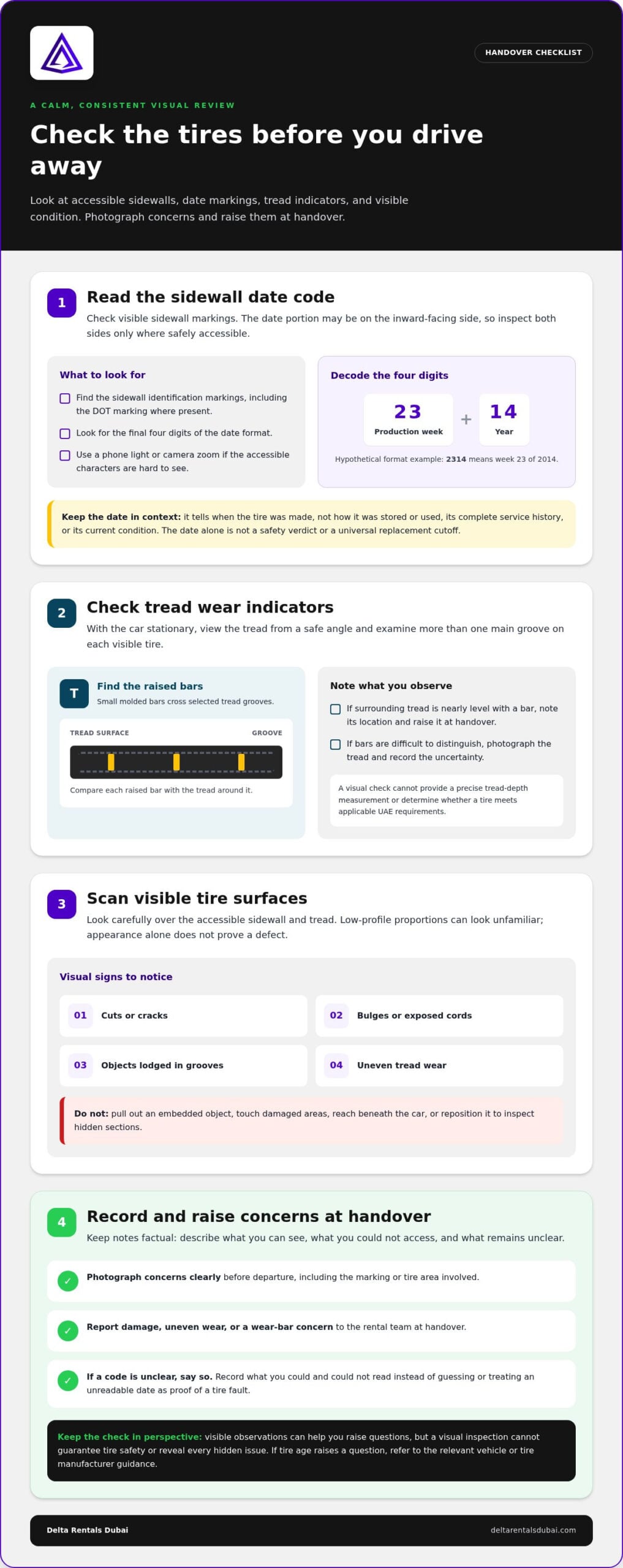
- Read the four-digit date code using its first two digits for the production week and its last two for the year.
- Look for raised wear bars in the tread grooves, then scan the visible tire surfaces for damage or uneven wear.
- Photograph concerns clearly before departure and raise them at handover.
- If a code is unclear, record that fact rather than guessing or treating an unreadable date as proof of a tire fault.
Why checking tire date codes and wear matters on a rented supercar
A premium drive should begin with confidence, not uncertainty. Before setting off, look over the tires. The manufacturing date is one piece of information; tread wear and visible condition are others. Taken together, these observations give you useful details to raise at handover. A quick visual check cannot guarantee a tire’s safety or reveal every hidden issue.
Keep the process simple and repeatable: inspect each visible sidewall, read the date code where accessible, examine the tread, and photograph anything concerning. Report concerns before departure. If a code is difficult to see, don’t guess or treat that alone as evidence of a fault. Record what you could and couldn’t read, then raise it at handover.
What a tire date code can, and cannot, tell you
A date code indicates when the tire was manufactured. It doesn’t tell you how the tire was stored or used, or provide its complete service history. The date alone also doesn’t establish the tire’s current condition. Tires of similar age can show different signs of wear, and damage may not be obvious at a glance.
There isn’t a universal age cutoff to apply based on this check alone. If the tire’s age raises a question, refer to the relevant vehicle or tire manufacturer guidance and report the finding during handover. The Tire code reference explains sidewall markings, including date-related coding.
Why supercar tires deserve a deliberate visual check
Low-profile tires have shorter sidewalls than many everyday tires, so their proportions can look unfamiliar. That appearance isn’t, by itself, proof of a defect. Scan the visible sidewall and tread carefully rather than relying on a quick glance or the car’s polished presentation.
Performance vehicles are designed for responsive driving, so it’s useful to notice whether tread wear appears uneven across a tire or differs from one tire to another. That observation isn’t a diagnosis: a visual check can’t confirm the cause or assess hidden damage. The Porsche 911 GT3 RS is a performance model in Delta Rentals Dubai’s fleet, but don’t assume a particular tire specification from the model name. Record what you see and report anything damaged, uneven, or unclear before departure.
How to find and read a supercar tire date code
Start with the tire sidewall, the raised lettering on its outer surface. The date can be part of a longer Tire Identification Number (TIN), and the full marking may not face outward. Don’t move or lift the vehicle to reach it. A phone light and camera zoom can help you inspect accessible markings at handover.
Where the date code appears on the tire
Look for the DOT marking where present, then follow the nearby identification characters to the date portion. Markings can vary, and the complete TIN may appear on only one sidewall. Check both sides of each tire if they’re safely visible. For general tire safety and maintenance background, see the NHTSA tire safety guide, a U.S. publication rather than a statement of UAE rental rules.
- Find the sidewall markings. Scan the visible sidewall for the longer identification sequence.
- Look for the final four digits. On tires using this date format, these digits indicate the production week and year.
- Check the opposite side if accessible. The full date portion may be molded on the inward-facing sidewall. Don’t reach beneath the car or try to reposition it.
- Record what you can read. Take a clear photo if the digits are difficult to see, and note any uncertainty for handover.
How to decode the four digits accurately
Read the first two digits as the production week and the last two as the year. This format identifies when the tire was made; it doesn’t establish the tire’s condition or provide a safety verdict. Don’t infer a universal replacement cutoff from the date alone. If age raises a question, refer to guidance from the vehicle or tire manufacturer.
Hypothetical format example: 2314. The “23” means week 23, and “14” means 2014. This example explains the code format only; it isn’t an assessment of a tire’s suitability. If you can’t distinguish a digit, avoid guessing. Photograph the marking and report that you couldn’t read it clearly before setting off.
Checking the date code is one part of a broader review that includes tread and visible condition. Once your handover notes are in order, you can explore a supercar rental with clearer expectations.
How to check tread wear indicators and visible tire condition
Tread wear indicators are small raised bars molded across selected grooves in the tire tread. They’re not the markings on the sidewall. Look into several main grooves and compare each bar with the tread surface around it. If the surrounding tread is nearly level with a bar, note its location and report it before departure. A visual check can flag a concern, but it can’t provide a precise tread-depth measurement or establish whether a tire meets applicable UAE requirements.
How to spot tread wear indicator bars
With the car stationary, view the tread from a safe angle and find the narrow bars crossing the grooves. Check more than one groove on each visible tire. The NHTSA tire safety information explains how built-in treadwear indicators work. It’s a U.S. government resource, not a statement of UAE rules. If the bars are hard to distinguish, photograph the tread and mention the uncertainty at handover rather than guessing.
What sidewall and tread warning signs to notice
Scan the visible sidewall and tread for cuts, cracks, bulges, exposed cords, or objects lodged in the grooves. Don’t pull out an embedded object, touch damaged areas, or reposition the car to see hidden sections. Where visible, compare the inner, centre, and outer tread areas, then look across the other tires for differences. Uneven-looking wear is worth recording, but a visual observation alone can’t diagnose its cause.
Dashboard tire warnings add useful context, but they don’t replace a walk-around. A warning light may not show visible damage, and no warning light doesn’t confirm that the tires have no visible concerns.
Quick comparison guide
- Tread looks consistent: There’s no obvious damage, and the wear bars sit below the surrounding tread. Continue the handover check; this appearance isn’t a safety guarantee.
- Indicators nearly level: The surrounding tread appears close to the bars. Photograph the area and report it before driving.
- Visible damage: A bulge, deep cut, exposed cords, significant cracking, or an embedded object needs prompt attention. Don’t set off until you’ve raised it at handover.
Make the check repeatable: inspect multiple grooves and every accessible tire, compare the wear pattern, note any warning light, and photograph concerns clearly. This helps you document what you see, but it doesn’t certify the tire’s condition.
A renter’s step-by-step tire check before driving away
A consistent handover check takes a few focused minutes and gives you a record of what you observed before departure. Stick to what you can see. Don’t crawl under the vehicle, move it to reach a hidden area, or attempt to diagnose a tire problem yourself.
A practical five-step check at handover
- Walk around the vehicle. View each tire from a safe standing position and note any obvious difference in appearance or condition.
- Scan sidewalls and tread. Check accessible surfaces for cracks, cuts, bulges, embedded objects, or uneven-looking tread. Don’t touch damage or remove anything lodged in a tire.
- Read accessible date codes. Look for manufacturing date markings you can see without reaching beneath or repositioning the car. Record unclear digits instead of guessing.
- Review the dashboard. Note any tire-related warning light or message. Treat it as extra information, not a replacement for looking at the tires.
- Document and report concerns. Take clear photos and raise anything concerning through the rental handover channel before driving away.
How to document and raise a tire concern
Make your record specific and neutral. Identify the tire’s position, such as front left or rear right, describe the visible marking or damage, and add a short factual note. For example: “Rear left tire, visible crack on outer sidewall; photographed at handover.” Avoid guessing what caused it or declaring the tire legally unsafe.
Take one wider photo showing which tire you mean, then a close-up of the affected area. Preserve the original images and relevant handover communication. If the date code is unreadable, say so plainly; that uncertainty alone doesn’t prove a tire defect.
If you see apparent serious damage, pause departure and report it through the handover channel. Wait for the concern to be addressed before setting off. Clear notes and timely communication help establish what you observed and when.
Use this sequence as your final handover routine: walk around, inspect each visible tire, read accessible codes, check the dashboard, then photograph and report concerns. It makes the check a practical pre-drive habit without asking you to make a technical diagnosis.
Ready to plan a supercar rental with a clear handover in mind? Explore your rental options.
What to do with findings before a supercar rental
Finish your check by sorting what you observed, not by trying to diagnose the tire. A date code, tread indicators, sidewall appearance, and dashboard alerts each provide separate information. None reveals a tire’s full history, confirms hidden damage, or establishes legal compliance. Keep your notes factual and share concerns with the rental handover team before departure.
How to interpret what you see without overreacting
- No visible concern: You haven’t spotted obvious damage, and nothing visible stands out. This isn’t a guarantee of tire safety, but you can record that the visual check raised no concern.
- Unclear finding: A date code is unreadable, or you’re unsure what a marking or wear pattern means. Note what you observed and raise the uncertainty at handover. An unreadable date code alone doesn’t establish tire condition or prove a safety issue.
- Apparent damage: You see a bulge, cut, exposed cords, or another clear concern. Don’t drive away while it remains unresolved. Report what you found and pause departure until the concern has been addressed.
A visual inspection has limits. Don’t infer storage or use history from a date code, or hidden damage from a surface that looks normal. Describe visible evidence and leave technical assessment to the handover process.
Make the handover part of a confident rental experience
Keep the routine calm and concise. Walk around the car, check visible tread and sidewalls, read accessible date codes, review the dashboard, and photograph anything unclear or concerning. In your note, specify the tire’s position and what you observed. For example: “Front right, date code not readable from the visible sidewall,” or “Rear left, visible sidewall bulge.” Share the information before setting off and retain the related handover communication.
This process helps you make a practical visual review without turning it into a safety diagnosis. Whether you’re considering a Porsche 911 GT3 RS or another supercar, clear observations and timely communication support a more informed start to the drive.
Planning your next supercar experience? Discuss your supercar rental.
Make your next supercar handover feel more confident
A calm tire check helps you begin a rental with clearer expectations. Remember the essentials: the date code shows when a tire was made, tread wear indicators offer a separate visual clue, and visible damage or uncertainty should be documented and raised before departure. No quick visual review can reveal every hidden issue, so stick to what you can observe and describe it clearly.
Knowing how to check tire date codes and wear indicators on rented supercars gives you a simple routine to repeat at handover, whether you’re considering the Porsche 911 GT3 RS or another performance car. Take your time, keep your notes factual, and let the rental handover team address any concern before you set off.
Planning a premium drive? Discuss your supercar rental and take the next step toward an informed, enjoyable experience.
Frequently Asked Questions
How do you read a tire date code?
Read the final four digits of the date portion as the production week and year. The first two digits indicate the week, and the last two indicate the year. For example, 2524 means the tire was manufactured in week 25 of 2024. Treat this as a manufacturing date, not a verdict on tire safety. Compare it with the tire or vehicle manufacturer’s guidance if its age raises a concern.
Where is the tire date code located?
The date code is molded into the tire’s sidewall, often within a longer identification marking that may include a DOT marking. Check the outward-facing side first, but the complete date portion may be on the opposite sidewall. Use a phone light or camera zoom to read accessible markings. Don’t crawl beneath or move the vehicle to find a hidden code. If it isn’t readable, record that uncertainty and mention it at handover.
What are tire wear indicators, and how do I check them?
Tire wear indicators are small raised bars molded across grooves in the tread, not markings on the sidewall. Look into several main grooves and compare each bar with the tread around it. If the tread appears nearly level with an indicator, photograph the area and report it before departure. Check more than one groove and tire for uneven wear. This visual review doesn’t replace a professional tread-depth measurement or determine compliance with local requirements.
Does an older tire automatically mean a rented supercar is unsafe?
No. A manufacturing date alone doesn’t establish whether a tire is safe or unsafe. It doesn’t reveal the tire’s storage conditions, use, service history, or hidden damage. Consider the date alongside visible tread and sidewall condition, and refer to manufacturer guidance where age is a concern. Don’t apply a universal age cutoff or make a safety judgment from the code alone. If something looks concerning, document it and raise it at handover.
What should I do if a rented supercar tire looks damaged?
Report visible damage through the rental handover channel before driving away. Take a wide photo showing which tire is involved and a close-up of the concern. Describe its position and appearance factually, such as “front left, visible sidewall bulge.” Don’t remove embedded objects or try to diagnose the cause. If the damage appears serious, pause departure and don’t drive until the concern has been addressed.
Can I check a supercar tire without special tools?
Yes. You can visually inspect accessible sidewalls and tread, look for wear bars or obvious damage, and use a phone light or camera zoom to read markings. No special tool is needed for this basic observation. However, a visual check can’t give a precise tread-depth or pressure reading, and it won’t reveal every hidden issue. Record what you can see, photograph anything unclear, and report concerns during handover.
Should I check tire pressure before driving a rented supercar?
Check for a tire-pressure warning on the dashboard and follow the vehicle’s pressure guidance, such as its owner’s manual or pressure label. Don’t guess a target value or use the maximum pressure printed on the tire sidewall as the recommended setting. Appearance alone can’t confirm correct pressure. If a warning is active or a tire appears unusually low, raise it with the rental handover team before setting off.