

A steep garage threshold can turn a confident arrival into the sound every low-clearance driver dreads: carbon fibre scraping concrete. Avoiding underbody diffuser contact on steep parking garage thresholds takes more than approaching slowly; the right line, angle and use of vehicle lift technology can make all the difference.
If you worry about damage charges or feel tense entering an unfamiliar parking structure, that caution makes sense. High-performance aerodynamics depend on low clearance, so a 911 GT3 RS deserves deliberate handling around abrupt ramps and transitions. The good news: a few practical techniques can help you approach these obstacles with far more confidence.
This guide explains how to assess a threshold, position your car diagonally when appropriate, and move across a ramp smoothly without rushing or stopping in the wrong place. You’ll also learn when to use a factory front axle lift, how to check whether your vehicle has one, and why lift technology is a helpful tool rather than a substitute for careful driving. Take a measured approach, protect vulnerable underbody components, and make unfamiliar garages feel manageable.
Key Takeaways
- Learn how approach and departure angles affect the risk of a splitter or rear diffuser contacting a threshold.
- See why changing your approach line can matter as much as reducing speed when crossing a steep transition.
- Understand when a front axle lift can help, and why you should activate it before reaching the incline.
- Use a simple assessment routine to make avoiding underbody diffuser contact on steep parking garage thresholds more manageable.
- Know what vehicle-specific clearance and lift-system details to check before driving an unfamiliar high-performance car.
Understanding the Physics: Approach and Departure Angles
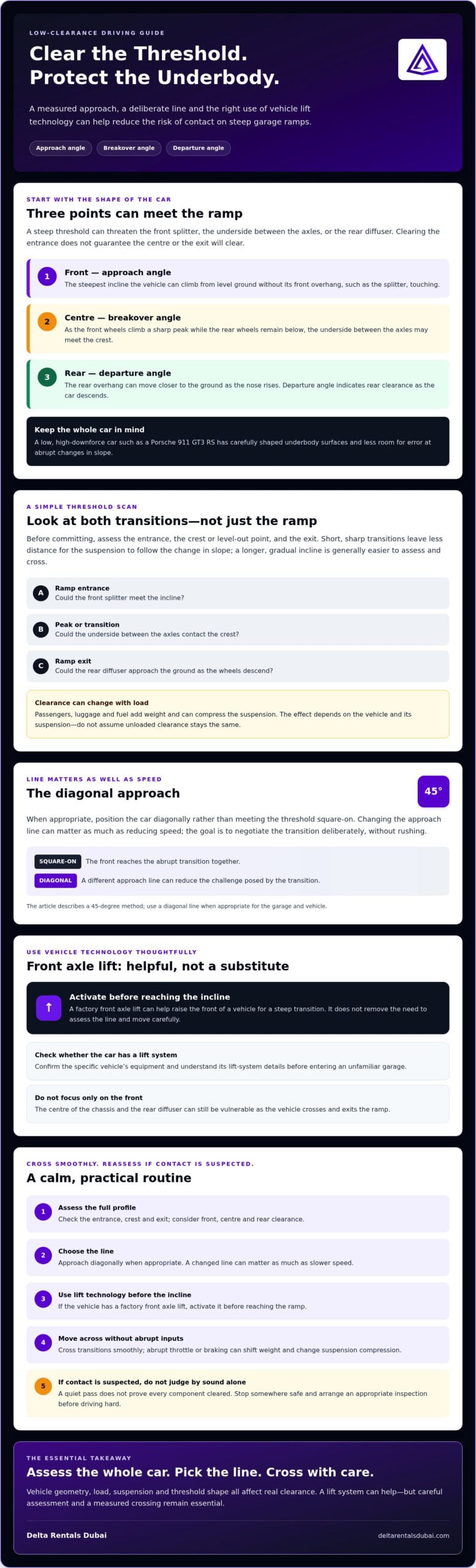
A steep threshold challenges a low sports car at three points: the front splitter, the centre of the chassis and the rear diffuser. Understanding the geometry helps you anticipate which part is at risk before you commit to the ramp. Approach and departure angles describe how steep an obstacle a vehicle can negotiate without its bodywork making contact.
The approach angle is the steepest incline a vehicle can climb from level ground without its front overhang, such as a splitter, touching. The departure angle describes the rear clearance between the tyre contact patch and the lowest point of the rear overhang. High-downforce cars such as the Porsche 911 GT3 RS are designed around aerodynamic performance, with low bodywork and carefully shaped underfloor surfaces. That precision leaves less room for error at abrupt changes in slope.
Breakover angle is the centre-of-car trap. As the front wheels climb a sharp peak and the rear wheels remain below it, the underside between the axles can meet the crest. A long wheelbase and low central components can increase this risk. A car may clear the entry and still scrape at the top.
Why the Rear Diffuser Is at Risk
Watch what happens as the nose rises. The body pitches, and the rear overhang can move closer to the ground, putting the diffuser at risk even if the front clears. A diffuser’s construction varies by vehicle, but carbon-fibre components are vulnerable to impact and may be costly to repair or replace. Departure angle is the critical measure of rear clearance because it indicates how steep a descent the diffuser can clear without contact.
Identifying Dangerous Thresholds in the UAE
Assess the shape before entering. A short, sharp incline or abrupt ramp-to-floor transition gives the suspension little distance to follow the changing slope; a longer, gradual incline is generally easier to assess and cross. Look closely at both the ramp entrance and the point where it levels out. Those transition points can catch a splitter, chassis or diffuser even when the main slope looks manageable.
Vehicle load matters, too. Passengers and luggage add weight, which can compress the suspension and reduce available clearance; a full fuel tank adds weight as well. The effect depends on the vehicle and its suspension, so don’t assume the unloaded clearance will remain unchanged. For avoiding underbody diffuser contact on steep parking garage thresholds, judge the whole car’s geometry, including its centre and rear, rather than focusing only on the front bumper.
The Vulnerability of Underbody Aerodynamics
A diffuser isn’t decorative trim. It helps manage airflow beneath the car: air accelerates under the floor, then the diffuser’s rising shape helps it expand and slow in a controlled way. This contributes to the aerodynamic balance that supports high-speed stability. A scrape can crack a panel, loosen a fixing or deform a surface, potentially disturbing that airflow. The extent of any effect depends on the damage, so don’t assume a mark is harmless simply because the car still feels normal.
Materials matter. Some vehicles use flexible plastic lips designed to tolerate light contact; structural splitters and aerodynamic components may use carbon fibre or other rigid materials. Construction varies by model, and a carbon-fibre part can be vulnerable to impact. A scrape may be more than cosmetic: damage to a panel or its mounting points can affect how it sits and functions.
Front Splitter Versus Rear Diffuser
The splitter often meets an obstacle first as the nose climbs. But the rear diffuser deserves equal attention as the car exits: when the rear wheels descend from the ramp, the body angle changes and the rear overhang can approach the ground. On an incline, acceleration and braking also shift weight between the axles, changing suspension compression and the car’s rake, its front-to-rear height relationship.
There’s another risk at the bottom transition. The suspension may compress as the wheels pass from ramp to level floor, then rebound. That movement can briefly change underbody clearance. Cross transitions smoothly and avoid abrupt throttle or brake inputs. J.D. Power explains how vehicle angles indicate how steep of an obstacle you can climb, but real clearance also depends on the car’s load, suspension and the shape of the threshold.
The Cost of Aerodynamic Damage
Don’t rely on sound alone. A quiet pass doesn’t prove that every component cleared, and a visible scuff doesn’t reveal whether a fixing or panel underneath has been affected. If you hear contact or suspect an impact, stop somewhere safe and arrange an appropriate inspection before driving the car hard. Underbody checks may involve raising the vehicle and examining vulnerable parts; don’t assume a rental provider uses a particular inspection tool or process.
Before choosing a high-performance rental, ask about the vehicle’s underbody condition, clearance and any lift-system instructions. Delta Rentals’ fleet includes the Porsche 911 GT3 RS, a car whose aerodynamic design calls for careful handling. For avoiding underbody diffuser contact on steep parking garage thresholds, a vehicle-specific briefing can help you understand the components at risk; you can explore the rental fleet or ask about vehicle-specific clearance before you set off.
How to Navigate Steep Thresholds: The 45-Degree Method
A diagonal approach changes how the car meets a sharp transition. Instead of both front wheels climbing the threshold together, one crosses first, then the other. This staggers the body’s movement and can reduce the chance of the front splitter or central underbody striking the crest. It’s a useful technique, not a guarantee: the threshold, vehicle and available space all matter.
Before turning across the ramp, check mirrors and surroundings. Don’t angle across a lane if it blocks traffic, leaves too little room to straighten, or compromises visibility. If the approach can’t be made safely, choose another route or stop and reassess. For avoiding underbody diffuser contact on steep parking garage thresholds, control and clearance come first, not forcing a manoeuvre.
Step-by-Step: Executing the Diagonal Approach
- Assess the path. Look at the ramp’s entrance and exit, identify the sharpest transition, and check that there’s enough room to cross diagonally and realign.
- Approach at an angle. Where the space allows, aim for roughly 45 degrees rather than heading straight at the threshold. The angle lets one wheel begin climbing before the other.
- Move at a crawl. Keep the car’s motion smooth and controlled. A very slow pace, around 1–3 km/h where safe, can help limit abrupt suspension movement; adjust to visibility, traffic and the vehicle’s response.
- Let the first front wheel crest. Once it has cleared the high point, steer gradually towards straight so the second front wheel follows without a sudden correction.
- Hold a steady, gentle throttle. Avoid sharp acceleration or braking across the transition. Continue slowly until the rear wheels and underbody have cleared, then straighten fully.
Take the exit just as deliberately. The rear diffuser still needs clearance as the back wheels descend and the car’s angle changes. Don’t assume the front clearing means the whole vehicle is safe.
Common Mistakes to Avoid
- Braking on the threshold: Hard braking shifts weight forward and can compress the front suspension, reducing splitter clearance. Set your speed before the ramp and avoid abrupt inputs while crossing.
- Straightening too soon: Bringing both wheels onto the transition together can make the chassis meet the peak. Keep the diagonal line until the front has cleared, then straighten smoothly.
- Rushing the exit: Acceleration can alter the car’s pitch, while speed increases suspension movement. Clear the rear slowly and steadily.
Use the method only when it’s safe and practical. If the ramp is too narrow, traffic is close, or you can’t judge the clearance, pause in a safe place and choose a less demanding route.
Leveraging Vehicle Technology: Front Axle Lift Systems
A front axle lift (FAL) raises the nose to help clear ramps, speed humps and other obstacles. Porsche’s front axle lift system can raise the front of the car by 40 mm, or about 1.57 inches. The extra clearance can protect a low splitter, but it doesn’t change the shape of the ramp or guarantee that the entire underbody will clear.
Activate the lift before reaching the incline. Give the system time to raise the front, and confirm its status using the vehicle’s display or the instructions provided for that model. Don’t try to activate it while already climbing a threshold: your attention should stay on the car’s position, surroundings and smooth progress. Operating limits and controls vary by vehicle, so check the owner’s instructions rather than relying on a generic speed or button location.
Some modern systems can save locations and automatically raise the vehicle when it approaches them using GPS. Treat that feature as added convenience, not a substitute for checking the lift is active. A system may not recognise an unfamiliar garage entrance or every ramp transition.
Know Your Vehicle’s Lift Controls
Don’t assume every Porsche 911 GT3 RS, or every rental vehicle, has the same lift equipment or controls. Before setting off, ask whether the specific car is equipped with front axle lift, where its control is, what dashboard confirmation to look for, and whether the system needs time to reach its raised position. A vehicle-specific briefing removes guesswork at the threshold.
When Technology Isn’t Enough
A front axle lift raises the nose; it may not raise the rear diffuser or protect the centre of the car at a sharp crest. Combine lift technology with a slow, diagonal approach where space and traffic conditions make that manoeuvre safe. If the car doesn’t have lift, assess the ramp carefully and use the diagonal technique only when there’s enough room to enter, cross and straighten without obstructing others.
For avoiding underbody diffuser contact on steep parking garage thresholds, think of lift as one part of a considered approach: confirm the equipment, activate it in advance, and still manage the whole car’s path over both the incline and its transitions. If you’re considering a high-performance rental, ask about its lift equipment and controls before driving. Ask about lift-equipped rental options.
Renting with Confidence: The Delta Rentals Standard
A high-performance rental should feel exciting, not uncertain. Confidence comes from knowing the car’s controls and clearance, understanding how to handle a steep entrance, and checking the rental terms before you drive. No-deposit options can make the booking process more straightforward, but they aren’t a substitute for reviewing the agreement or understanding what protection applies if damage occurs.
Delta Rentals Dubai offers high-performance vehicles including the Porsche 911 GT3 RS and McLaren Artura. Their aerodynamic designs and vehicle features differ, so don’t assume one model has more threshold clearance than another without confirming the details for the specific car. Ask about its front axle lift, parking sensors, underbody condition and any instructions for operating its equipment. A clear briefing helps turn unfamiliar technology into practical knowledge.
Pre-Hire Briefings: Know the Car Before You Set Off
Before driving away, request a walkthrough of the vehicle-specific controls. Confirm whether the car has a lift system, how to activate it, what dashboard indication confirms it’s raised, and how its parking sensors behave. Sensors can assist with nearby obstacles, but they may not detect a low splitter or diffuser approaching a ramp crest. Pair the briefing with a careful visual check of the route and the techniques covered earlier in this guide.
Ask what to do if you encounter a steep or unfamiliar threshold, and clarify how to document any pre-existing marks. Delta Rentals Dubai has 300+ five-star Google reviews, a useful trust signal when evaluating customer experience. Reviews don’t replace your own checks: read the rental terms, understand the damage process, and record the vehicle’s condition before departure.
Choose for the Route, Not Assumptions
Consider the parking structures and entrances on your itinerary before selecting a car. A higher-riding vehicle may suit a route with frequent abrupt transitions, while a low, track-focused car calls for more deliberate planning. But vehicle category alone doesn’t establish clearance. Compare the specific vehicle’s dimensions and equipment, and ask about any lift technology rather than assuming the Porsche 911 GT3 RS or McLaren Artura will handle a threshold a certain way.
For avoiding underbody diffuser contact on steep parking garage thresholds, combine the right vehicle information with a controlled approach. Explore Delta Rentals Dubai’s no-deposit supercar rental options, then confirm the vehicle-specific details and rental conditions before booking. A well-understood car and a calm plan help you enjoy the drive with greater confidence.
Drive With Precision and Confidence
Protecting a low-clearance performance car starts before the wheels reach the ramp. Read the threshold from entry to exit, approach diagonally when it’s safe, and keep your speed and steering smooth. Front axle lift can add useful nose clearance, but it doesn’t protect the rear diffuser or replace careful driving.
That preparation matters just as much in a rental. Before setting off, ask about the specific car’s clearance, lift controls and underbody condition, and review the rental terms so you understand the damage process. Delta Rentals offers no-deposit rental options, expert pre-hire briefings and a fleet that includes the Porsche 911 GT3 RS. Its 300+ five-star Google reviews offer another point of reference as you assess the experience.
With the right knowledge, avoiding underbody diffuser contact on steep parking garage thresholds becomes a manageable part of driving a high-performance car. Ask Delta Rentals about renting the Porsche 911 GT3 RS and get familiar with the vehicle before you drive. Take it steady, trust your preparation, and enjoy the road ahead.
Frequently Asked Questions
What is the best angle to approach a steep ramp in a supercar?
When there’s enough room and it’s safe, approach diagonally, often around 45 degrees, so one front wheel crosses the transition before the other. This can reduce the chance of the front splitter or centre of the car contacting the crest. Check mirrors and traffic before turning across the ramp, and don’t force the manoeuvre in a narrow or busy space. Move slowly, steer smoothly, and take the exit just as carefully.
Does the Porsche 911 GT3 RS have a front axle lift system?
Some Porsche models offer front axle lift, but don’t assume a particular 911 GT3 RS has it or that every rental is equipped the same way. Equipment can depend on the exact vehicle specification. Before driving, ask whether the car has a lift system, how to operate it, and what dashboard indicator confirms it’s raised. A vehicle-specific briefing is more reliable than relying on the model name alone.
What should I do if I hear a scraping sound under the car?
Stop as soon as you can do so safely, and don’t continue over the obstacle to see whether the sound happens again. Once parked in a safe place, look for visible damage without reaching under the vehicle. If it’s a rental, contact the rental company promptly, follow its instructions, and document what happened and any visible marks. Arrange an appropriate inspection before driving hard, since a scrape may affect hidden panels or fixings.
Can a rear diffuser be damaged on a parking threshold?
Yes. The rear diffuser can strike the ground as the car’s rear wheels descend from a ramp or the body angle changes over a crest. Clearing the entrance with the front splitter doesn’t mean the entire underbody has cleared. Watch the exit transition as carefully as the approach, and avoid rushing. A diagonal path may help when there’s adequate space, but the vehicle’s clearance and the threshold shape still determine the risk.
Is underbody damage covered by supercar rental insurance?
Coverage depends on the rental agreement and the specific protection selected, so don’t assume underbody or diffuser damage is covered. Before driving, ask how the agreement treats underbody damage, what exclusions apply, and what steps to take after an impact. Review the terms rather than relying on a general description of insurance. No-deposit rental options do not, by themselves, establish what damage protection applies or remove your responsibility under the agreement.
How do I know if my supercar is too low for a specific parking garage?
You can’t determine that from ground clearance alone. Inspect the entrance, ramp crest and exit transition, paying particular attention to short, sharp changes in slope. Ask about the specific car’s clearance, lift equipment and any relevant operating guidance, then compare that information with the route. If visibility is poor or you’re unsure the car can clear the ramp, don’t guess. Choose another entrance or parking option where possible.
Why is carbon fibre so expensive to repair on supercars?
Carbon-fibre components can require specialist assessment and repair because damage may affect the material’s structure, not just its visible finish. The work can involve identifying hidden cracks or delamination, matching the component’s construction, and restoring its strength and shape. Repair methods and costs vary by part and damage, so there’s no single price to quote. Treat a scrape as a reason to arrange an inspection, not simply as a cosmetic mark.
Does the speed of approach affect the risk of scraping?
Yes. Excess speed can increase suspension movement when the wheels meet a ramp or transition, while abrupt braking or acceleration can change the car’s pitch and available clearance. Slow to a controlled crawl and use smooth steering and throttle. But speed alone doesn’t solve the problem: a low car can still contact a sharp crest even when moving slowly. Assess the geometry, choose a suitable line, and proceed only when it’s safe.