

What if the turbo surge that makes a twin turbo car thrilling is also the moment that catches you out? If you worry about the rear stepping wide as boost arrives, it’s worth respecting that risk. Avoiding sudden torque snap oversteer in high output twin turbo cars starts with anticipating power delivery, not reacting after grip begins to fade. Abrupt throttle changes, steering inputs, or lifting mid-corner can unsettle the rear, especially when the car is carrying significant power.
Smooth, deliberate inputs make a real difference. This guide explains how boost threshold affects corner exits, how to apply throttle progressively, and how to use electronic stability aids as support rather than a substitute for sound judgment. The aim is greater confidence, more composed exits, and safer performance driving.
We’ll cover how to read the car’s response, why patience matters when power arrives, and how to practise in a controlled setting. Whether you’re learning the character of a high-output Ferrari or exploring a twin-turbo hybrid such as the McLaren Artura, treat every increase in pace as something to earn. Learn the timing, and the power becomes more predictable.
Key Takeaways
- Learn what happens as boost arrives and why rear grip can change faster than expected.
- Use progressive throttle inputs to control acceleration and make corner exits more composed.
- Understand how weight transfer affects stability, and why abrupt inputs can make a slide harder to manage.
- Use electronic stability control as support, and choose driving modes with care.
- Build confidence in avoiding sudden torque snap oversteer in high output twin turbo cars by practising in a controlled setting before increasing pace.
What is Torque Snap Oversteer? The Science of the ‘Turbo Kick’
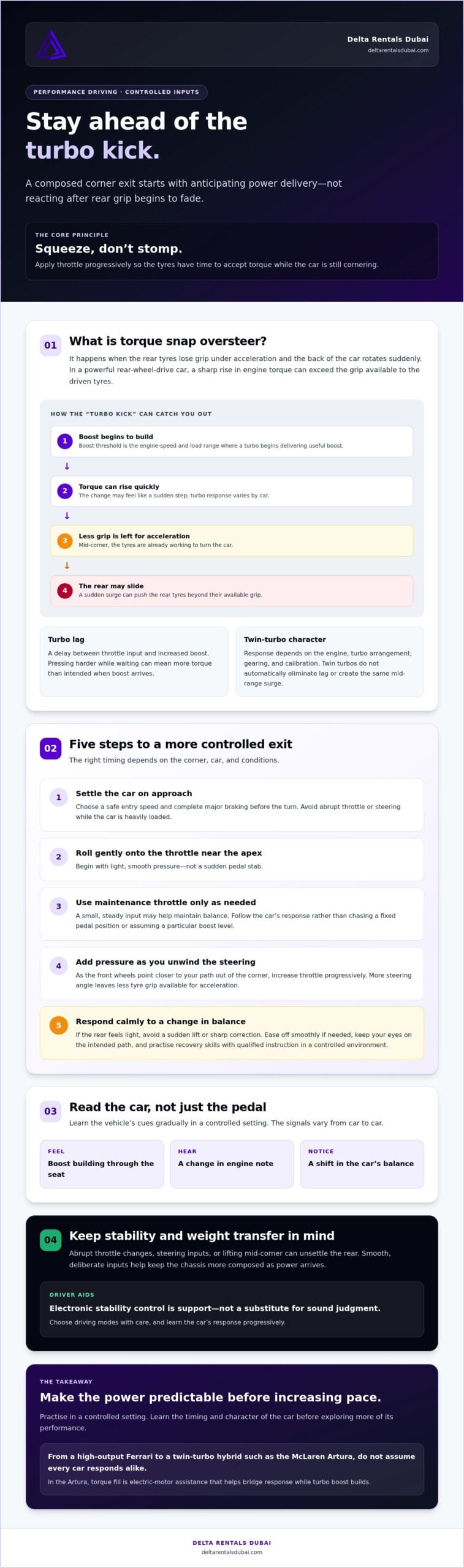
Torque snap oversteer happens when the rear tyres lose grip under acceleration and the back of the car rotates suddenly. It isn’t simply a matter of steering angle. In a powerful rear-wheel-drive car, a sharp rise in engine torque can exceed the grip available to the driven tyres. For a useful grounding in the underlying dynamics, see the science of oversteer.
The turbo “kick” can make this harder to anticipate. The boost threshold is the engine-speed and load range where a turbocharger begins delivering useful boost. It isn’t one universal RPM figure, and power doesn’t literally multiply exponentially. However, as boost builds, torque can rise quickly enough to feel like a sudden step. Mid-corner, the tyres are already working to turn the car, leaving less grip in reserve for acceleration. Add a torque surge and the rear may slide before the driver has time to adjust.
A naturally aspirated engine often delivers power more progressively as revs climb, though response depends on the engine and throttle. A high-output turbo can feel less linear, with a stronger response as boost builds. That contrast matters when avoiding sudden torque snap oversteer in high output twin turbo cars. Read the car’s response, not just the accelerator position.
The Role of Turbo Lag in Snap Oversteer
Turbo lag is the delay between a throttle input and the resulting increase in boost. If the car seems slow to respond, a driver may press harder or hold the throttle down, then get more torque than intended as boost arrives. In a corner, that delayed surge can push the rear tyres beyond their available grip. The “pendulum effect” describes the sudden rotation that can follow when the rear steps out after the driver has committed to a line.
Why High-Output Twin Turbos Are Unique
Twin-turbo systems can be designed to improve response, but their behaviour varies with the engine, turbo arrangement, gearing, and calibration. They don’t automatically eliminate lag or produce the same mid-range surge. High-output turbo engines can deliver strong torque, so abrupt power application in a rear-wheel-drive car may challenge rear grip, particularly while the car is loaded in a turn. Smooth inputs remain essential.
In a hybrid-assisted turbo such as the McLaren Artura, torque fill is electric-motor assistance that helps bridge the response while turbo boost builds.
That blended delivery can feel different from a conventional turbo setup, so don’t assume every car responds alike. Learn its character progressively, and explore its performance in a controlled setting rather than discovering the boost threshold mid-corner.
Mastering Throttle Modulation: 5 Steps to Controlled Acceleration
Throttle modulation is your most direct tool for managing a turbocharged car’s power at corner exit. Think squeeze, don’t stomp. A progressive pedal input gives the tyres time to accept torque instead of asking them to handle a sudden surge while also cornering. Anticipate the boost rather than waiting for it to catch you by surprise.
Pay attention to the car’s response. You may sense boost building through the seat, hear the engine note change, or feel the car’s balance shift. These cues vary by vehicle, so learn them gradually in a controlled setting. Smooth inputs also help manage the chassis dynamics and weight transfer that influence how much grip each tyre can use.
A Five-Step Modulation Technique
- Approach with a settled car. Choose a safe entry speed and complete major braking before the turn. Avoid abrupt throttle or steering inputs while the car is heavily loaded.
- Roll gently onto the throttle near the apex. Start with light, smooth pressure rather than a sudden pedal stab. The right timing depends on the corner, car, and conditions.
- Use maintenance throttle only as needed. A small, steady input can help maintain balance, but it won’t keep every turbo spinning or guarantee a particular boost level. Follow the car’s response rather than chasing a fixed pedal position.
- Increase pressure as you unwind the steering. As the front wheels point closer to your path out of the corner, add throttle progressively. More steering angle leaves less tyre grip available for acceleration.
- Respond calmly to a change in balance. If the rear feels light, don’t suddenly lift or make a sharp correction. Ease off smoothly if needed, keep your eyes on the intended path, and practise recovery skills with qualified instruction in a controlled environment.
Manage the Boost Hit on Exit
Reserve stronger acceleration for when the steering is opening and the car is stable. Imagine a string joining your steering wheel to your throttle foot: as steering lock decreases, you can progressively add pedal. It’s a useful reminder, not a rigid formula. Full throttle isn’t automatically safe just because the wheels look nearly straight. Available grip, surface conditions, and the car’s response still matter.
In some cars, selecting a higher gear can soften the torque delivered at the wheels, but gear choice depends on the vehicle and situation. Don’t shift mid-corner or use a higher gear as a substitute for smooth inputs. Build your feel on a closed course before exploring more power. Drivers considering a high-performance car can ask about available performance cars and learn each model’s controls before driving.
Chassis Dynamics: Managing Weight Transfer During Boost
As a car accelerates, weight shifts rearward and the suspension compresses, making the rear appear to “squat.” That load can help the driven tyres maintain contact, but it doesn’t guarantee grip. Tyres have a finite capacity, and engine torque can overwhelm it. The contact patch is where each tyre meets the road. Vertical load affects the grip available there, though grip doesn’t increase in direct proportion to load. For a clear foundation in chassis dynamics, consider how weight transfer changes the balance of the whole car, not just its suspension movement.
Mid-corner, the tyres are already generating lateral grip. A boost surge adds demand at the rear, and a sudden lift can shift load forward just as the rear tyres are struggling. Understanding that sequence is central to avoiding sudden torque snap oversteer in high output twin turbo cars. Smoothness preserves options; abrupt inputs can narrow them.
The Danger of Lift-Off Oversteer
If the rear starts to move, jumping off the accelerator may feel like the safest response. But a sudden lift can transfer load forward and reduce the rear tyres’ grip further, increasing rotation. Avoid a sharp pedal change or steering correction. If the movement is minor, stay calm, look toward your intended path, and make only measured inputs appropriate to the car and situation. There’s no universal recovery move. Practise vehicle-control skills with qualified instruction in a controlled environment.
To settle the car during ordinary cornering, ease off the throttle progressively rather than snapping the pedal shut. A small boost-induced wiggle is a cue to avoid adding more power or making abrupt steering inputs. Prioritise smoothness and space, and reduce pace until the car feels composed.
Suspension and Aero Interaction
Suspension controls how the chassis responds to load changes. A firmer, track-focused setup may limit body movement compared with a softer road-oriented car, but it won’t prevent a torque spike from exceeding tyre grip. The response also depends on the specific vehicle and setup. Active aerodynamics, where fitted, can influence stability at speed, but they aren’t a substitute for careful throttle control. Check the vehicle’s specifications rather than assuming it has a particular feature or handling behaviour.
The Porsche 911 GT3 RS in the fleet is naturally aspirated, so it doesn’t illustrate twin-turbo boost delivery. It can still help show why track-focused vehicle dynamics reward precise inputs. Explore the high-performance vehicle fleet with that distinction in mind: learn each car’s character before exploring its limits, and keep performance driving to a controlled setting.
Leveraging Traction Control and Modern Driver Aids
Electronic stability control (ESC) and traction control are there to support your inputs, not replace them. In a high-output car, these systems can detect wheel slip or a developing loss of stability, then reduce engine torque or apply braking to help the car remain controlled. They’re useful when boost arrives quickly, but they can’t create grip that the tyres don’t have. If you enter a corner too fast, electronics can’t repeal the laws of physics.
For avoiding sudden torque snap oversteer in high output twin turbo cars, keep driver aids active on public roads and learn what each setting changes before selecting it. Sport or Track modes vary by model. Some allow more wheel slip or later intervention, but that doesn’t mean they’ll prevent every slide. Check the owner’s manual, and don’t disable stability systems to chase a sharper feel on public roads.
Traction Control vs. Stability Control
Traction control helps manage wheelspin under acceleration, which is especially useful when turbo torque reaches the driven wheels. Stability control monitors the car’s direction and can apply individual brakes or reduce engine power when it detects a developing slide. The systems may work together, but their behaviour and mode names differ between cars. Use the manufacturer-recommended setting, and treat any less intrusive mode as a change in assistance, not permission to push harder.
Tyre Temperature and Grip Threshold
Even well-calibrated electronics depend on tyre grip. A cold tyre may not respond like one warmed gradually through normal driving, and a warm day alone doesn’t confirm that the tyres are ready for high loads. A tyre’s heat cycle is its rise in temperature during use and cooling afterward; grip and response can change with temperature and condition. There’s no universal warm-up time for every car, tyre, or road. Begin gently, avoid abrupt acceleration, and build pace only in a controlled environment.
Before a spirited drive, check tyre condition and pressure against the vehicle manufacturer’s guidance. Pressure changes as tyres warm, so follow the specified procedure rather than guessing or adjusting based on feel. Pay attention to warnings from the car’s monitoring systems. If a tyre looks damaged or a warning appears, don’t push on.
Vehicle systems and instructions are model-specific. Review the equipment and guidance for the car you plan to drive through the performance vehicle fleet, and ask the rental provider if a setting or warning isn’t clear. For help choosing a car and understanding its driver aids, ask about a performance car rental.
Mastering the High-Output Experience: Practical Application
Mastery starts before the road opens up. Treat each high-output car as its own machine: learn its controls, understand how its power arrives, and build pace gradually. That considered approach matters whether you’re driving a twin-turbo Ferrari or a hybrid-assisted car such as the McLaren Artura.
Before exploring cornering performance, practise progressive throttle inputs in a straight line at a safe, legal speed, ideally in a controlled driving environment. Notice how the car responds as you ease onto the accelerator, and keep stability systems active. This lets you learn the response without combining a boost surge with steering load. For avoiding sudden torque snap oversteer in high output twin turbo cars, patience is a performance skill.
Build Pace Safely
Use the “slow in, fast out” principle: enter a corner at a pace that lets you keep the car settled, then accelerate progressively as you unwind the steering. Fewer mid-corner corrections mean fewer abrupt demands on the tyres. While learning a car, a higher gear may soften the response in some vehicles, but gear choice depends on the transmission, speed, and conditions. Select it before the corner if appropriate, and follow the manufacturer’s guidance. The aim isn’t a lap record. It’s a composed, seamless drive.
Change one thing at a time. First learn the throttle response on a straight. Then focus on smooth corner entry and exit at a restrained pace in a suitable controlled setting. If the car feels unsettled, reduce pace rather than trying to prove your control. Never use public roads to test a vehicle’s limits.
A Considered Supercar Experience
Delta Rentals’ fleet includes high-performance models such as the McLaren Artura and high-output Ferraris. Each car can feel different, so ask about its controls, driver-aid settings, and any vehicle-specific guidance before setting off. Don’t assume a familiar badge means familiar power delivery. Confidence comes from understanding the individual car, not rushing to its limits.
For enthusiasts across the UAE, choosing a premium vehicle is only one part of the experience. Read the rental terms, confirm what’s included, and make sure you understand the car before driving. The pleasure is in feeling the power arrive smoothly and keeping the car composed, not chasing a dramatic moment.
Ready to explore a high-performance car at a considered pace? Book your elite driving experience and ask about the vehicle’s features and rental details before you set out.
Avoiding Sudden Torque Snap Oversteer in High Output Twin Turbo Cars
Confidence in a twin-turbo car comes from timing, not bravado. Read the boost, feed in throttle progressively, and unwind the steering as you accelerate. Respect weight transfer and keep driver aids active while you learn how the car responds. These habits make avoiding sudden torque snap oversteer in high output twin turbo cars a practical discipline, helping you enjoy smoother exits without asking the tyres for more grip than they have.
Build your understanding gradually and practise performance driving in a controlled environment. Delta Rentals offers high-performance vehicles, including the McLaren Artura and high-output Ferraris. Ask about vehicle-specific features and whether no-deposit options apply to the model you’re considering.
Ready to experience the power with a measured approach? Explore a supercar rental and confirm the car’s controls and driving guidance before setting out. Learn its response, build pace patiently, and enjoy the drive with greater confidence.
Frequently Asked Questions
What exactly is snap oversteer in a turbo car?
Snap oversteer is a sudden loss of rear-tyre grip that makes the back of the car rotate outward. In a turbo car, a rapid rise in torque can trigger it, especially if you accelerate sharply while cornering. Abruptly lifting off the throttle or making a sudden steering correction can also unsettle the car. It’s different from a controlled slide because it develops unexpectedly and can be difficult to manage.
Is it safe to drive a high-output RWD car in the rain?
It can be driven in rain, but reduced grip means you need to lower your speed and be especially smooth with steering, braking, and throttle. Leave more space, avoid sudden acceleration, and don’t test the car’s performance on wet public roads. If visibility or conditions make the drive feel unsafe, slow down or stop somewhere safe. The car’s power and driver aids can’t remove the risks of a slippery surface.
Can traction control completely prevent a spin from turbo boost?
No. Traction control and electronic stability control can reduce wheelspin or help manage a developing slide, but they can’t guarantee that the car won’t spin. Their effectiveness depends on the vehicle, tyres, surface, speed, and available grip. For avoiding sudden torque snap oversteer in high output twin turbo cars, keep driver aids active, use smooth inputs, and never treat the systems as permission to drive beyond your ability.
Why do twin-turbo cars feel more dangerous than naturally aspirated ones?
They can feel more abrupt because turbocharged engines may deliver a strong increase in torque as boost builds, while naturally aspirated engines often feel more progressive. That isn’t true of every car: engine design, gearing, calibration, and drivetrain all affect response. Learn the specific vehicle gradually. Don’t assume power delivery will match another car, even if both have twin-turbo engines.
Should I downshift to a lower gear before the turbos kick in?
Not automatically. A downshift can raise engine speed and increase the torque available at the wheels, potentially making acceleration sharper. Choose a suitable gear before a corner, following the vehicle’s guidance, and make shifts smoothly. Avoid sudden downshifts or gear changes while the car is unsettled. If you’re unfamiliar with the vehicle, prioritise a predictable response over keeping the engine near its boost range.
What should I do if the back end starts to slide under boost?
Stay focused on your intended path and avoid panicked inputs. Abruptly lifting off or making a sharp steering correction can worsen the loss of balance. Make only smooth, measured adjustments appropriate to the car, and let active stability systems assist. If you can’t confidently manage the slide, reduce speed and seek qualified instruction before trying performance driving again. Practise vehicle-control skills only in a controlled setting.
How do I know when my tyres are warm enough for full power?
There isn’t one reliable warm-up time or visual cue for every tyre and car. Temperature, tyre condition, pressure, driving style, and vehicle guidance all matter. Start gently, avoid abrupt acceleration, and follow the manufacturer’s instructions for tyre pressures and use. Don’t judge readiness by touch or assume the tyres are prepared for high loads after ordinary driving. Save performance driving for a suitable controlled environment.
Does the McLaren Artura have snap oversteer issues?
It isn’t accurate to label the McLaren Artura as having an inherent snap-oversteer problem based on the information available here. It’s a hybrid twin-turbo performance car, and its response depends on conditions, driver inputs, settings, and available grip. Learn its controls and follow the vehicle’s guidance before driving. Build pace progressively, keep appropriate driver aids active, and don’t explore the car’s limits on public roads.