

The trickiest part of driving a low supercar may be the last few metres into a car park. A steep ramp, sharp driveway transition or raised speed bump can bring the front end uncomfortably close to the ground. Knowing how to avoid scraping the front of a low supercar starts with spotting the risk early, not reacting at the last moment.
Clearance can be difficult to judge from the driver’s seat. An angled approach or nose-lift system may help in some situations, but neither removes the need to assess the surface and drive carefully. A calm, deliberate routine gives you more time to decide what to do before reaching an obstacle.
This guide explains why front ends scrape and how to assess ramps, driveways and speed bumps before crossing them. You’ll learn when to slow down, how to choose an approach and what to consider if the car has a lift system. If you’re preparing to drive a high-performance rental such as a Porsche 911 GT3 RS, learn that specific car’s controls and clearance before setting off.
Key Takeaways
- Recognise how limited clearance and a long front overhang can make a ramp or raised obstacle risky.
- Choose a gradual approach and move with control to reduce the risk of scraping the front of a low supercar.
- Understand when a nose-lift system may help, and why it cannot replace a careful assessment of the obstacle.
- Use a pre-crossing routine: stop somewhere safe, check your sightline, and look for traffic and pedestrians.
- Before setting off, learn the specific car’s clearance, controls and instructions so you can make informed decisions.
Why the Front of a Low Supercar Scrapes on Ramps and Speed Bumps
Front-end scraping happens when the bumper, front lip or underside touches the road or a raised surface. A low supercar has less space between its bodywork and the ground, so an obstacle a taller car clears may come uncomfortably close. The car’s shape matters too. A long front overhang places the nose farther ahead of the front wheels, increasing the chance it will meet a slope before the wheels climb onto it.
Pay particular attention where flat ground changes into an incline or an incline levels out. At these transitions, the car’s angle relative to the surface changes quickly. The front can approach the road as the tyres begin climbing, or the underside can meet the crest as the car moves over it. Suspension affects how the body moves as the wheels cross uneven ground. Understanding basic vehicle suspension systems helps explain why clearance in motion may differ from what it appears to be while parked.
Clearance sets the margin, front overhang extends the nose, and a sharp change in slope can use up both before the front wheels reach level ground. That’s why learning how to avoid scraping the front of a low supercar starts with reading the surface, not judging an obstacle by height alone.
Which parts of a low supercar are most exposed?
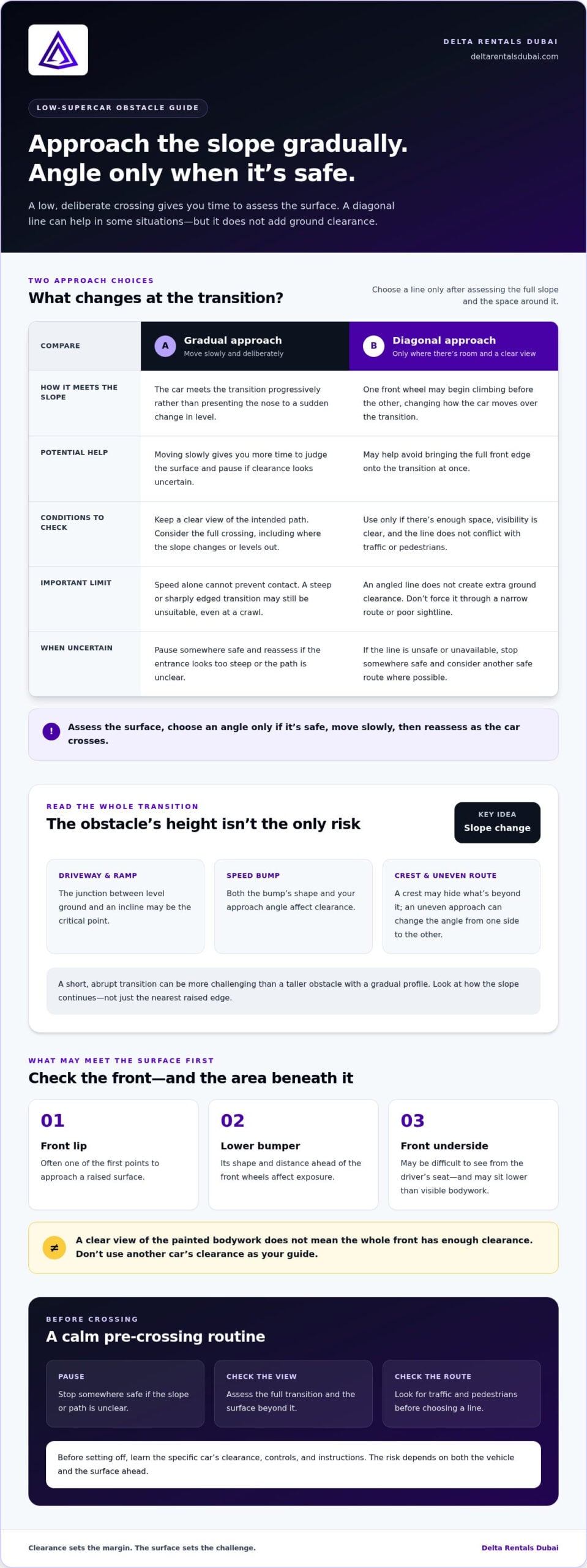
The front lip and lower bumper are often the first points to approach a raised surface. Contact can also happen beneath the front section, where it may be difficult to see from the driver’s seat. A clear view of the painted bodywork does not mean the whole front has enough clearance, because the underside may be lower or harder to see.
Ground clearance, bumper shape and the distance from the front wheels to the nose all affect which areas are most exposed. Don’t use another car’s clearance as a guide, even if it looks similar. The risk depends on the specific vehicle and the surface in front of it.
Which everyday obstacles create the sharpest approach changes?
Watch for steep driveway entrances, speed bumps, parking ramps and raised or sloping thresholds. A short, abrupt transition can be more challenging than a taller obstacle with a gradual profile. On a ramp, the junction between level ground and the incline may be the critical point. On a speed bump, both its shape and the angle at which you approach affect clearance.
Visibility and route matter too. A crest may hide the surface beyond it, while an uneven approach can change the angle from one side to the other. Look at the whole transition, not just the nearest raised edge. If you can’t see how the slope continues, treat clearance as uncertain and assess the route before committing.
How Approach Angle and Low Speed Help a Supercar Clear Obstacles
A gradual approach helps the car meet a slope progressively instead of presenting the nose to a sudden change in level. Moving slowly gives you more time to judge the surface and pause if clearance looks uncertain. Speed alone cannot prevent contact: a steep or sharply edged transition may still be unsuitable, even at a crawl.
Where there’s enough space, crossing at an angle can let one front wheel begin climbing before the other. This changes how the car moves over the transition and may help avoid bringing the full front edge onto it at once. It does not create extra ground clearance, and it is not suitable if the route is narrow, visibility is poor, or traffic or pedestrians make the line unsafe. Vehicle movement depends on several interacting factors, as SAE International’s overview of vehicle dynamics and handling explains.
Assess the surface, choose an angle only if it’s safe, move slowly, then reassess as the car crosses. This is a practical starting point for how to avoid scraping the front of a low supercar, not a guarantee that every obstacle can be cleared.
How do you approach a driveway or ramp at an angle?
Choose your line before reaching the slope. If there’s enough room and a clear view, position the car so it meets the transition diagonally, with one front wheel approaching before the other. Move gradually and avoid turning sharply once the car is on the ramp. If the entrance looks too steep, the path is unclear, or another road user limits your options, stop somewhere safe and reassess.
Why should you avoid rushing or forcing the crossing?
Abrupt steering or acceleration leaves less time to respond if the surface changes or the nose appears close to contact. Use smooth inputs and keep a clear view of your intended path. Don’t force an angled line through traffic, across a pedestrian’s path, or over a transition you can’t properly assess. If it doesn’t look suitable, pause and choose another safe route where possible.
Consider the whole crossing, not just the first edge. A driveway may rise sharply and then level out; a parking ramp can change angle again near its crest. Choose an approach that lets you see where the car will travel, leaves room to adjust and avoids conflict with other road users. If those conditions aren’t there, an angled crossing isn’t the answer.
For a high-performance rental, preparation can make the drive feel more composed. If you’re considering a supercar rental, familiarise yourself with that specific car’s controls and clearance before setting off.
When a Supercar Nose-Lift System Helps, and What It Cannot Do
A front-axle or nose-lift system raises the front of some vehicles to provide extra clearance in selected situations. It can be useful when approaching a ramp or driveway transition, but it won’t make every obstacle safe to cross. Treat it as an aid, not a substitute for judging the route.
A lift changes the car’s position only within the system’s design and operating limits. It may not provide enough room for a particularly steep entrance, an abrupt crest or an uneven surface. The slope, the available path and the car’s clearance still matter. Raising the nose also doesn’t remove the need to move carefully or watch for other road users.
To understand how to avoid scraping the front of a low supercar, learn whether the specific vehicle has a lift system and how it is meant to be used before you encounter an obstacle. Don’t assume a feature is present because of the badge or model name. Equipment and controls can vary between vehicles and model years.
What should you know before using front-axle lift?
Read the relevant vehicle instructions before setting off. The control’s location, activation method and operating conditions differ between vehicles, so don’t rely on experience with another car. Learn how the system indicates that it’s active, when it can be used, and what limits the vehicle guidance describes. If you’re driving a rental, include these controls in your walk-through before departure.
Use the lift early enough to follow the vehicle’s instructions, rather than searching for a button as you reach the obstacle. Keep your attention on the road and understand when the system should be engaged or disengaged. If a warning or unfamiliar response appears, don’t guess what it means. Pause somewhere safe and consult the instructions.
What if the car has no lift system?
Use the same careful judgement without relying on extra clearance. Inspect the transition, choose a gradual route where there’s enough space, and use controlled inputs. Even a familiar driveway can present a different challenge if the approach is obstructed or the surface isn’t clearly visible. Don’t improvise by placing objects in the road or trying to alter the obstacle.
If the slope seems too steep, the path is unclear, or you can’t judge whether the front will clear, don’t force the crossing. Stop in a safe place and consider another suitable route. On a high-performance rental, knowing the specific car’s controls and limits helps you make that decision. A lift system can support your judgement, but you still need to decide whether to proceed.
A Simple Pre-Crossing Routine for Driveways, Speed Bumps, and Ramps
Make your decision before the front wheels reach an unfamiliar transition. A brief, repeatable check helps you spot a poor line, account for other road users and decide whether to proceed or turn back. The aim isn’t to make every obstacle passable. It’s to choose a crossing you can see and assess carefully.
What to check before the front wheels reach the obstacle
Approach only when you can pause without blocking traffic or creating a hazard. Assess the slope, the shape of the transition, the surface condition, the available width and how clearly you can see the route beyond it. If you need a closer look, stop in a safe place first. Never step into traffic or ask someone to stand where they could be struck.
- Choose a safe stopping point. Leave enough space to pause before the ramp, driveway or bump. Don’t stop in a live lane or where another driver may not expect a stationary vehicle.
- Read the full surface. Look beyond the nearest edge. Check whether the transition is abrupt, uneven, narrow or difficult to see, and note anything that could restrict your route.
- Check who’s around you. Look for moving traffic, pedestrians and vehicles entering or leaving the same access. Wait until you can proceed without rushing or making an unpredictable manoeuvre.
- Set your line in advance. Decide whether a gradual approach fits the width and visibility available. An angled line is an option only if there’s room to use it safely without crossing into another path.
How to cross, and when to choose another route
Once you’ve selected a safe path, keep the car aligned with it and move forward with smooth, measured inputs. Avoid changing direction abruptly while crossing. Monitor the front’s position relative to the surface, but keep checking the wider scene too. If the nose appears closer to the ground than expected, pause only if you can do so safely, then reassess instead of pressing on.
Don’t proceed if you can’t see the transition clearly, the available width won’t accommodate your chosen line, or traffic and pedestrians leave no safe opportunity. If the entrance appears unsuitable, look for another safe route rather than forcing the crossing. This routine is central to how to avoid scraping the front of a low supercar, while recognising that every surface and vehicle is different.
Before a high-performance drive, make time to understand the specific car’s clearance and controls. Explore premium supercar rental options and set off prepared for the car you’ll be driving.
Prepare for a Low-Supercar Drive: Know the Car Before You Set Off
A few minutes of familiarisation can make an unfamiliar supercar feel more predictable. Learn how the car sits, what you can see from the driver’s seat and which controls affect its clearance before you meet a steep entrance or tight parking ramp. This preparation matters because cars that look similar may differ in equipment, visibility and controls.
For guidance on how to avoid scraping the front of a low supercar, focus on the specific vehicle rather than making assumptions based on its badge or model name. Delta Rentals Dubai offers the Porsche 911 GT3 RS. Learn the controls and clearance of the specific car you’ll drive. The Porsche 911 GT3 RS rental details provide a starting point for exploring this rental option, and the vehicle’s own instructions explain its controls.
What should you learn about an unfamiliar supercar?
While parked, review the vehicle instructions and locate the controls you may need before driving. Check whether front lift is fitted and learn how it operates, rather than inferring equipment from the model name or appearance. From the driver’s seat, get a feel for how much of the front end you can see and how much room the car needs to turn. Don’t test unfamiliar controls while moving.
- Locate clearance-related controls and understand their instructions.
- Adjust your seating position and mirrors for a clear view.
- Notice how the front corners relate to your sightlines when manoeuvring.
- Allow extra room for turns and tight entrances until the car feels familiar.
How can you make the first drive feel more composed?
Plan your route before setting off and, where practical, avoid unfamiliar steep entrances until you can assess them safely. Don’t automatically follow another car across a ramp: its clearance, line and visibility may differ from yours. Leave yourself time to pause, inspect the approach from a safe position and choose a suitable path. A composed drive is worth more than saving a few moments.
Give yourself space to learn the car’s responses on a clear, suitable route before navigating confined areas. Keep inputs smooth and leave room to stop if an entrance is difficult to judge. If you’re comparing models, explore premium supercar rental options with the particular car’s design and your planned drive in mind. Familiarity helps you make deliberate choices, but no routine can guarantee that every obstacle will be clearable.
Choose preparation over guesswork. For a calm start, ask about renting a supercar and discuss the vehicle that suits your drive.
Set Off With Confidence
A low supercar rewards a driver who gives each unfamiliar road transition a moment of thought. Let preparation shape the drive, not anxiety: understand the car, take your time when something looks uncertain, and be ready to choose a different route. That measured mindset is the practical answer to how to avoid scraping the front of a low supercar, while recognising that no technique can promise clearance in every situation.
Delta Rentals Dubai’s fleet includes the Porsche 911 GT3 RS. Whichever car you’re considering, learn its specific controls and clearance as part of getting ready to drive. That preparation can help you focus on enjoying the experience with greater confidence.
Ready to plan your drive? Ask about renting a supercar and take the next step towards a composed, rewarding drive.
Frequently Asked Questions
Can a nose-lift system prevent every front-end scrape?
No. A nose-lift system raises the front only within its designed range, so it may not provide enough clearance for a severe slope, sharp crest or uneven surface. It also won’t protect every area beneath the car. Follow the vehicle’s instructions and assess the entire crossing before proceeding. If the obstacle still looks too abrupt or difficult to judge, don’t rely on the lift alone to make it safe.
What should I do if I hear the front of a supercar scrape?
Ease off and stop in a safe place as soon as you can. Don’t keep moving forward just to see whether the sound stops. Once parked safely, look for visible damage or anything hanging down, but don’t reach under the car. If a part appears loose, you notice a fluid leak, or the car handles differently, avoid continuing the drive until it has been assessed. For a rental, notify the rental provider.
Is it safer to reverse over a steep driveway in a low car?
Not automatically. Reversing changes which end of the car meets the slope first, but it can also reduce your view of pedestrians, traffic or the path behind you. Don’t reverse into a road or an area you can’t see clearly. Consider reversing only when the route is visible and clear, and you can manoeuvre without putting anyone at risk. If you’re unsure, choose a different safe entrance.
Can speed bumps damage the underside even if the front bumper clears?
Yes. The bumper can pass over the bump while a lower part farther back contacts it, particularly as the car moves across the crest. The bump’s profile, the car’s underbody shape and how its wheels meet the raised section all affect clearance. Don’t judge the entire underside by what you can see from the driver’s seat. If contact occurs, stop safely and check for unusual sounds or changes in handling.
Should someone guide me over a ramp or driveway?
A guide can help you judge distance when your view is limited, but only if they can stand in a safe place, remain visible and communicate clearly. Agree on simple signals before moving. Stop immediately if you lose sight of them or don’t understand a signal. A guide can’t guarantee that the car will clear the surface, so use their help to improve visibility, not as a reason to attempt a crossing that otherwise seems unsafe.
What happens if the front lip is already very close to the ground?
Treat the small visible gap as a reason to be selective about where you drive. Don’t approach a raised edge until you can judge the surface and available route. If the lip looks lower than before, appears loose or has been damaged, don’t assume it’s simply the car’s normal stance. Park safely and arrange an appropriate inspection before continuing if the part may be insecure. When uncertain, take another route.