

A luxury badge alone shouldn’t decide whether you’re charged for interior cleaning. Understanding how luxury car rental firms calculate interior sanitization and cleaning fees starts with a practical question: did the vehicle need work beyond routine preparation, and can the rental provider explain what that work involved?
It’s reasonable to expect a premium interior to receive careful attention. But standard cleaning between rentals isn’t automatically an extra charge, and each rental agreement may define its own fee triggers. Stains, lingering odours, sand, or pet hair might affect an assessment, while delicate materials may need careful handling. Neither the vehicle’s value nor its luxury finish, by itself, explains a fee.
This guide explains what may influence a cleaning assessment, what evidence to look for if a charge appears, and what to inspect and document before returning a car. It also offers practical questions to ask about fee triggers, calculation methods, and proof of additional work. Before booking with Delta Rentals Dubai, confirm the applicable agreement and return expectations directly. Compare written policies rather than relying on assumptions.
Key Takeaways
- An extra interior cleaning charge may relate to work beyond routine vehicle preparation. The rental agreement defines the relevant terms.
- The affected area, type of residue, labour, and any specialist treatment may shape an assessment.
- To understand how luxury car rental firms calculate interior sanitization and cleaning fees, check the stated triggers and assessment process rather than assuming every provider uses the same formula.
- A simple pickup-and-return checklist can document the cabin’s condition and help if a charge needs clarification.
- Ask a UAE rental provider about written terms, inspection records, fee explanations, and the right contact for questions.
How luxury car rental firms calculate interior sanitization and cleaning fees
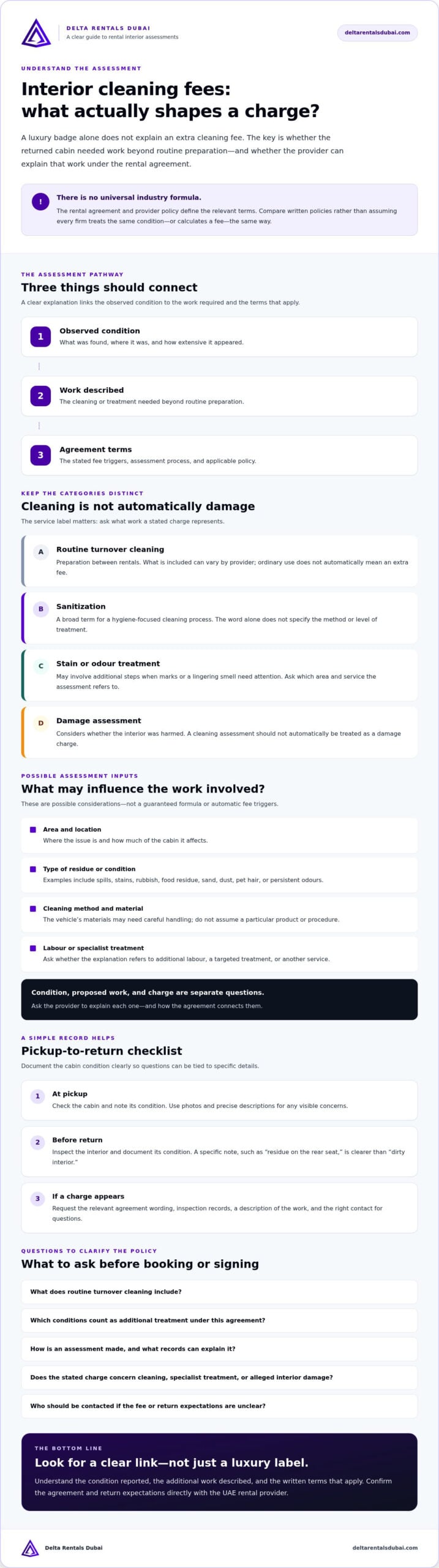
An extra interior charge may apply when a returned vehicle needs work beyond routine preparation for its next rental. There’s no universal industry formula for deciding when that threshold is met or how a charge is assessed. The rental agreement and provider’s policy govern, so check the wording before booking rather than assuming every firm treats the same condition alike.
Keep the service categories distinct. Routine cleaning prepares the cabin for the next renter. Sanitization is a broad term for a cleaning or hygiene process, while stain treatment targets marks on upholstery or other surfaces. Odour treatment may involve additional steps to address a lingering smell. Damage assessment is different: it considers whether the interior has been harmed, not simply whether it needs cleaning. A cleaning assessment shouldn’t automatically be treated as a damage charge.
A clear fee explanation should identify the vehicle’s condition, the work required, and the rental terms that apply. Use those details to ask focused questions if a charge is unclear.
Routine turnover cleaning versus additional interior treatment
Rental providers prepare vehicles between bookings, but the services included in routine turnover can vary. Ordinary use doesn’t automatically mean an extra fee. Additional treatment may be considered if unusual soil, a spill, persistent odour, or staining calls for more than the provider’s standard preparation. Before signing, ask what the agreement counts as routine and what it defines as exceptional.
What sanitization means in a rental context
“Sanitization” can describe a hygiene-focused cleaning process, but the term alone doesn’t tell you what work will be done. Surface cleaning may differ from deeper upholstery treatment or odour remediation. The method may depend on the affected material and condition, so don’t assume a particular product or procedure is used. For context on the range of cleaning and restoration work, read what auto detailing involves. Then ask the rental provider which service a stated charge represents.
For a useful assessment, look for a connection between the reported condition and the work described. A fee explanation that only says “cleaning” leaves important questions unanswered: Was the concern a spill, stain, or odour? Which area needed attention? Was the charge for cleaning, specialist treatment, or alleged interior damage? Request the relevant agreement wording and a clear description of the work, especially if those categories have different terms.
Luxury interiors may use materials that need careful handling, but a vehicle’s premium status alone doesn’t establish that an extra charge is due. To understand how luxury car rental firms calculate interior sanitization and cleaning fees, focus on the documented condition, the stated service, and the policy agreed at booking. If anything is unclear, ask for clarification before signing and confirm the return expectations for your rental.
Which factors can influence luxury car interior cleaning assessments?
There’s no single calculation used by every rental firm. An assessment may consider the size and location of the affected area, the type of residue, the cleaning method needed, the labour involved, and whether specialist treatment is requested. These are possible inputs, not a guaranteed formula. The provider’s written policy should explain how, or whether, they affect a charge.
The observed condition, the work proposed, and the charge under the agreement are separate questions. Ask the provider to explain each one. For general background on rental agreements and additional fees, the US Federal Trade Commission offers consumer guidance on rental fees. That guidance is specific to its jurisdiction, so rely on the applicable agreement and relevant guidance for your rental in the UAE.
Condition, location, and extent of the interior issue
A small spill on one floor mat may call for a different response from staining across several seats or residue spread through the cabin. Rubbish, food residue, sand, dust, and persistent odours are examples a firm might assess, not automatic fee triggers. The location and spread can help explain the scope of work. Photos and a precise description, such as “residue on the rear seat” instead of “dirty interior,” make the assessment easier to understand.
Cleaning scope, specialist work, and vehicle interiors
Upholstery, carpets, trim, and touchpoints may need different approaches depending on their material and condition. A surface clean may not address a set-in stain or lingering odour, so deeper treatment could be considered separately. That doesn’t mean every luxury vehicle costs more to clean or requires a special process. Ask what treatment is proposed, which area it covers, and how the rental terms apply.
To evaluate an assessment, connect the evidence to the requested work: identify the affected surface, note the residue or issue, and ask why the described method is needed. If the explanation mentions specialist treatment, ask what that means rather than treating the label alone as proof of a charge. This helps explain how luxury car rental firms calculate interior sanitization and cleaning fees without assuming every provider follows the same method.
Before booking with Delta Rentals Dubai, confirm the current vehicle-return and cleaning terms for your rental directly. You can ask Delta about its rental agreement and return expectations.
How to compare cleaning-fee explanations across rental agreements
Compare the written terms, not just the headline description of a cleaning policy. One provider may explain what routine turnover includes, while another may focus on extra-charge triggers. To understand how luxury car rental firms calculate interior sanitization and cleaning fees, check whether each agreement connects a defined return condition to an assessment process and a way to raise questions.
| What to compare | What to look for |
|---|---|
| Routine cleaning | Does the agreement explain what cabin preparation is normally included between rentals? |
| Charge triggers | Does it define terms such as excessive soiling, odour, stains, or special treatment? |
| Evidence | Does it say whether photos, inspection notes, or service records may support an assessment? |
| Assessment process | Can you see how the provider records the condition, describes the work, and communicates a charge? |
| Dispute contact | Does the agreement identify whom to contact and how to query an assessment? |
Keep cleaning charges separate from other parts of the final account. Damage claims, fuel, tolls, and other charges relate to different issues and may be covered by separate terms. If a charge appears, ask which category it falls under and which clause applies. A cleaning label doesn’t explain a damage claim, and an unrelated charge doesn’t establish the cabin’s condition.
Questions to ask before confirming a luxury rental
Get clear answers before signing. Ask what interior condition is expected at return, what routine cleaning includes, and which conditions may lead to additional work. Find out how that work is documented and how you’ll be notified if an assessment is made. Also check whether the agreement explains how to query the decision and who handles that request.
What a clear fee explanation should identify
Look for three connected details: the condition observed, the cleaning scope proposed, and the relevant agreement term. Photos, inspection notes, or service records may help show how an assessment was made. A label such as “excessive cleaning” without a description of the condition or service is a reason to ask for clarification. It doesn’t explain the basis for the charge.
Policies can differ, so compare the actual written terms for each premium rental rather than relying on another company’s approach or assuming one UAE-wide formula applies. Before booking with Delta Rentals Dubai, ask directly for the applicable agreement and current vehicle-return expectations.
How to protect yourself from disputed interior cleaning fees in the UAE
A clear record makes it easier to discuss an interior cleaning assessment fairly. Follow the same sequence at collection and return: understand the terms, capture the cabin’s condition, and keep the provider’s responses. This won’t determine whether a fee applies, but it gives both sides useful context if the return condition is questioned.
Before and during the rental
- Review the agreement. Before confirming, read the cleaning and return-condition clauses. Check how the provider defines routine cleaning, excessive soiling, odour, stains, or additional treatment. Ask about wording you can’t interpret.
- Record the pickup condition. Take clear, time-stamped photos of the cabin at collection, including seats, carpets, floor mats, and visible trim. Photograph pre-existing marks or residue close up and in context, so their location is clear. Tell the provider promptly about concerns and keep a record of the communication.
- Maintain the interior sensibly. Remove rubbish and personal items as you go. Use care around food and drinks, and limit tracked-in debris where practical. These steps don’t mean ordinary use will lead to a charge; they help you return the vehicle in a condition you can document clearly.
At return and if a charge is raised
- Inspect before handover. Check the cabin under good lighting. Look over the same areas you recorded at pickup and note any new spills, marks, or residue. Follow the provider’s stated return and inspection process.
- Photograph the return condition. Take time-stamped wide shots and close-ups of relevant surfaces before handing over the keys. Keep the original files where possible, along with your pickup images and any messages about existing marks.
- Request specifics if charged. Ask for an itemized explanation linking the observed condition to the cleaning work and the applicable rental terms. Request any available inspection notes, photos, or service records, and use the provider’s stated process to query the assessment. Keep communications and supporting evidence together.
Before handing over the keys, document the cabin’s overall condition, any visible marks, and clear time-stamped photos of the areas in question. These records can help you assess how luxury car rental firms calculate interior sanitization and cleaning fees without assuming every provider uses the same policy.
Confirm Delta Rentals Dubai’s current agreement and vehicle-return expectations directly before booking. Ask Delta about its rental terms and return expectations.
Choosing a luxury rental provider with clear interior-return expectations
A polished vehicle experience should come with understandable rental terms. Before choosing a premium car, check whether the provider makes its return expectations easy to review, explains how handover condition is recorded, and offers a clear way to ask questions. These details help you compare agreements on more than the vehicle itself.
Signs of a transparent rental process
Look for written guidance you can access before confirming a booking. It should distinguish routine vehicle preparation from exceptional cleaning work and explain which interior conditions may prompt further assessment. Check whether the provider describes how condition is recorded at collection and return, and how renters can query an assessment. Clear, responsive answers are useful; vague assurances leave important terms unresolved.
As you compare vehicles, you can review Delta Rentals Dubai’s luxury rental fleet, which includes premium supercars and luxury vehicles. Treat the vehicle choice and rental terms as separate parts of your decision. A premium model, polished photographs, or another renter’s account can’t confirm the cleaning policy that applies to your booking.
Confirm the terms for your selected vehicle
Request the current agreement and return expectations for the specific vehicle before booking. Ask what routine interior preparation includes, what conditions could call for additional cleaning or treatment, and how an inspection is documented. Confirm whom to contact if you need an explanation. These questions give you a practical basis for understanding how luxury car rental firms calculate interior sanitization and cleaning fees, without assuming every provider uses the same policy.
Delta Rentals Dubai offers a range of premium supercars and luxury vehicles. Confirm the applicable agreement directly, and don’t assume that cleaning or sanitization services are included, waived, or chargeable unless the terms say so. Keep the response with your booking details.
Choose a provider whose written terms are accessible, whose return process is clear, and whose team can explain how to raise a question. If you’re considering a rental with Delta, ask about the applicable rental agreement and vehicle-return expectations on WhatsApp before booking.
Book with clear expectations from the start
A cleaning charge should be explained through the vehicle’s observed condition, the work proposed, and the rental terms that apply. There’s no universal formula, so compare agreements rather than assuming every provider treats stains, odours, or additional interior treatment the same way. Clear pickup and return photos can also help you keep a useful record.
The practical takeaway from understanding how luxury car rental firms calculate interior sanitization and cleaning fees is to check the written policy before booking, ask what routine preparation includes, and find out how an assessment can be queried. A premium vehicle deserves careful handling, and clear questions help set expectations on both sides.
Delta Rentals Dubai offers premium supercar and luxury-vehicle rentals. Verify the current agreement and return expectations directly before you book. Ask Delta about your rental terms on WhatsApp before making your decision.
Frequently Asked Questions
Is a luxury car rental cleaning fee automatically charged?
No, an extra cleaning fee isn’t automatic for every premium rental. Providers may include routine vehicle preparation as part of their service and treat exceptional cleaning separately, but policies vary. The rental agreement controls what condition is expected at return and what may lead to an additional assessment. Check those terms and ask the provider before booking. For a Delta rental, confirm the current return and cleaning terms directly.
What can cause an interior sanitization or cleaning fee?
A provider may assess unusual spills, staining, substantial residue, rubbish, or persistent odours, depending on its written terms and the work required. These are examples, not automatic fee triggers. If a charge is proposed, ask the provider to identify the observed condition, describe the cleaning or treatment involved, and point to the relevant agreement clause. This helps you understand the assessment instead of relying on a general label.
How do rental firms calculate interior cleaning fees?
There’s no single industry formula for how luxury car rental firms calculate interior sanitization and cleaning fees. Depending on the provider’s policy, an assessment may consider the condition, affected area, cleaning scope, labour, or specialist treatment. Don’t assume a label such as “deep cleaning” alone justifies a fee. Ask what condition was recorded, what work is proposed, and which signed rental term applies.
Do I need to sanitize a rental car before returning it?
Follow the return-condition instructions in your agreement rather than assuming you must arrange professional sanitization yourself. Before handover, remove your personal belongings and rubbish, and tell the provider about any spills or concerns. If the agreement or provider specifies a hygiene expectation, ask what it requires and whether a particular service is expected. A quick personal clean shouldn’t be assumed to replace any professional service stated in the rental terms.
Can I dispute a luxury rental car cleaning charge?
You can raise a query through the provider’s stated process if a cleaning charge seems unclear. Keep your pickup and return photos, relevant messages, inspection notes, and a copy of the rental agreement together. Then ask which condition was observed, what work the charge relates to, and which term applies. These records can help clarify the assessment, but they don’t guarantee a particular outcome.
How can I avoid unexpected interior cleaning charges when renting a luxury car?
Review the return terms before booking, document the cabin at handover, take sensible care with food and drinks, and photograph the interior again at return. Clear, time-stamped images can help show the vehicle’s condition, including any pre-existing marks. These steps support a clearer conversation if questions arise, but they can’t guarantee that no charge will apply. The provider’s written policy and your signed agreement remain central.