

What if quiet mode changes the character of a performance car without making it silent? That’s the key to understanding high performance exhaust valve controls and quiet neighborhood driving modes. Exhaust valves can route gases through different paths to shape the sound, while a selected driving mode may also adjust throttle response or gear changes, depending on the vehicle.
If you’re concerned about disturbing people nearby, look beyond the mode label. “Quiet” doesn’t necessarily mean silent, and it doesn’t guarantee that every part of the car’s sound or performance will change. The effect depends on the vehicle’s equipment and how its systems are designed.
This guide explains how active exhaust valves work, what quieter settings may change, and what they can’t promise. It also offers practical ways to drive considerately, from checking the controls to accelerating smoothly. If you’re considering a performance-car rental, confirm the specific vehicle’s exhaust equipment and available modes before arranging it. Features can vary from one model to another.
Key Takeaways
- Learn how exhaust valves can change the route exhaust gases take and shape a car’s sound.
- Understand why driving modes and exhaust hardware are related but not the same, and why features vary by vehicle.
- See why a quieter setting may soften a car’s sound without making it silent or changing every aspect of performance.
- Use high performance exhaust valve controls and quiet neighborhood driving modes thoughtfully: check the manual, choose an appropriate setting, and accelerate smoothly.
- Before choosing a performance-car experience, confirm the exact vehicle, available controls, and documented operating behavior.
How performance exhaust valve controls affect car sound
Exhaust valves can alter how gases and sound travel through a vehicle’s exhaust system. A valve may direct gases along a different route, changing the sound heard outside the car. The effect depends on the vehicle’s design and operating conditions, so a valve setting doesn’t guarantee silence or produce the same result across models.
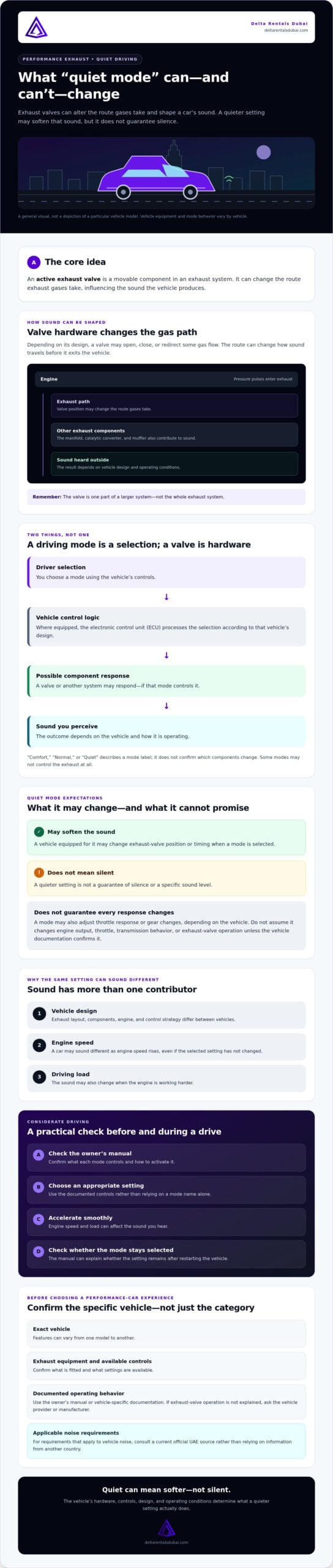
Featured-snippet definition: An active exhaust valve is a movable component inside an exhaust system that can change the route exhaust gases take, influencing the sound the vehicle produces.
The valve is one part of a larger system. The exhaust system carries gases away from the engine and includes components such as the manifold, catalytic converter, and muffler. Their design, along with the engine and selected settings, contributes to the sound you hear.
What is an active exhaust valve?
An active exhaust valve is a movable part fitted within an exhaust path. Depending on its design, it may open, close, or redirect some of the gas flow. That change can alter how sound travels through the system before it exits the vehicle.
It isn’t the entire exhaust system, and performance cars don’t all share one layout or control strategy. A driver may select a setting that controls the valve, or the vehicle may manage it automatically. Check the owner’s manual or vehicle-specific documentation to understand what a particular control does.
Why does a performance exhaust sound different?
The engine and exhaust work together to create a car’s sound. Combustion produces pressure pulses that travel through the exhaust, where its passages and components shape the sound before it reaches the outside. Changing the route gases take may shift the sound’s character, but the valve is only one contributor.
Engine speed and driving load matter, too. A car may sound different as engine speed rises or the engine works harder, even if the selected setting hasn’t changed. A quieter valve position shouldn’t be treated as a promise of a silent car.
For anyone exploring high performance exhaust valve controls and quiet neighborhood driving modes, keep the principle simple: a valve can influence sound, but the result depends on the vehicle. Confirm the specific hardware and controls rather than assuming a model name reveals exactly how its exhaust behaves.
How exhaust valves and driving modes work together
A dashboard mode and an exhaust valve are not the same thing. The mode is a driver’s selection; the valve is hardware in the exhaust path that the vehicle may control. Depending on the model, a mode might affect valve behavior, other vehicle responses, or a combination of functions. Some modes may not control the exhaust at all.
That distinction matters when a setting is labelled “Comfort,” “Normal,” or “Quiet.” The name suggests an intended driving character, but it doesn’t confirm which components change. Don’t assume every quiet setting reduces engine output, softens throttle response, changes transmission behavior, or operates an exhaust valve. The manufacturer’s description is the reliable guide.
What changes when a driver selects a quieter mode?
On a vehicle equipped for it, selecting a mode may prompt a change in exhaust-valve position or timing. It may also adjust other responses, depending on the car’s design. A mode can influence how the vehicle behaves without guaranteeing a particular sound level or making the car silent.
Check the owner’s manual for the specific mode functions. Look for what the selection controls, how to activate it, and whether it remains selected after restarting the vehicle. If the documentation doesn’t explain exhaust-valve operation, ask the vehicle provider or manufacturer instead of inferring it from the mode name.
What does the control system manage?
Where equipped, an electronic control unit (ECU) can use programmed logic to coordinate vehicle functions. Depending on the design, the ECU may receive the driver’s mode selection and command a component such as an exhaust valve. Sensors, software, and hardware vary, so there’s no universal calibration or standard response shared across performance cars.
- Driver selection: You choose a mode using the vehicle’s controls.
- Control logic: The vehicle processes the selection according to its design.
- Component response: A valve or another system may respond, if that mode controls it.
- Perceived sound: The result depends on the vehicle and its operating conditions.
Use the vehicle’s own documentation to understand its sound-related settings and controls. If you need to check requirements that apply to vehicle noise, consult a current official UAE source rather than relying on information from another country.
If you’re considering a performance-car rental, confirm the exact vehicle and its documented controls before arranging it. You can ask about a performance-car rental and verify which features are confirmed for that vehicle.
Quiet mode expectations: what it changes and what it cannot promise
A quieter setting doesn’t necessarily make a performance car silent. It may alter exhaust sound, but it can’t erase every sound from the engine, tyres, or road. The result depends on the car’s design, how it’s operating, and the conditions around it. Treat “quiet” as a description of the intended character, not a guarantee of silence or a particular sound level outside a home.
Does quiet mode make a performance car silent?
Not necessarily. If the vehicle’s system is designed to respond to a quieter setting, it may soften or change the exhaust note. Engine sound can still be audible, and road and tyre noise remain. The car may also sound different during startup or acceleration than it does while moving steadily.
Surroundings affect perception, too. Buildings, open spaces, and nearby surfaces can change how sound carries or reflects. A mode label alone can’t confirm how noticeable a particular vehicle will be in a residential setting. If considerate driving is the goal, use the quieter setting where available and pair it with smooth acceleration.
How do quiet and sportier settings differ?
Names and functions vary by manufacturer. In general, a quieter setting is intended to deliver a more restrained sound character, while a sportier setting may provide a more pronounced exhaust note. These are broad descriptions, not promises about every car. A louder setting doesn’t automatically mean more power or better performance.
| Setting type | General intended character | What to keep in mind |
|---|---|---|
| Quieter setting | More restrained sound, where supported | It may not eliminate engine or road noise. |
| Sportier setting | More pronounced sound, where supported | It doesn’t necessarily change engine output. |
These are general examples only. Actual behavior depends on the vehicle and should be verified in its owner’s manual or manufacturer documentation.
Startup behavior, engine speed, acceleration, and load can all affect perceived sound, even when a setting is selected. Don’t assume the car will sound the same in every situation or that a setting remains active after restarting. Check the manual for how modes work and when they apply.
Understanding high performance exhaust valve controls and quiet neighborhood driving modes means separating a mode’s intended sound character from what it can guarantee. For a specific vehicle, confirm its documented settings and remember that thoughtful driving matters alongside equipment.
How to use quieter driving modes considerately
A quieter setting is useful only if you know what it controls. Before driving, learn the vehicle’s controls, select an appropriate setting, and keep your inputs smooth. A mode can influence sound where the vehicle supports it, but considerate driving still matters. Avoid unnecessary revving, especially around homes, and don’t assume the car’s hardware or sound will change just because a dashboard label suggests “quiet.”
A simple pre-drive checklist for exhaust settings
- Find the control. Check the owner’s manual to identify the relevant setting and confirm whether it affects the exhaust, other vehicle systems, or both.
- Check whether it persists. The selected mode may reset after the vehicle is switched off. Verify its restart behavior in the manual rather than relying on memory.
- Choose before you enter residential surroundings. If the car offers a documented quieter setting, select it in advance rather than changing controls while driving.
For a rental, ask which controls are documented for the exact vehicle and request an explanation before setting off. Features can differ even between models with familiar names, so don’t infer valve operation from the badge or assume a quiet mode is available.
How driving style affects perceived sound
Accelerate progressively and avoid repeated or unnecessary revving. A sharp increase in engine speed can create a noticeable burst of sound, while smooth inputs help keep the drive measured. Leave space, anticipate traffic, and brake gently where conditions allow. These choices can reduce avoidable noise, but they don’t override the vehicle’s exhaust design or guarantee a particular sound level.
Sound also carries differently depending on distance and surroundings. Nearby walls or enclosed streets can reflect it, while open areas may feel different. Be mindful of the people around you, not just what you hear from inside the cabin. With high performance exhaust valve controls and quiet neighborhood driving modes, pair the right setting with calm driving rather than treating the setting as a complete solution.
Requirements for vehicle noise can depend on the applicable rules and circumstances. Check current UAE requirements through an appropriate official source rather than relying on assumptions. Don’t treat a dashboard mode as proof that a vehicle meets every applicable requirement.
Considering a performance car? Ask about the specific vehicle’s confirmed features before arranging your rental.
What to check before choosing a performance-car experience
Choose based on confirmed details, not assumptions about a badge or mode name. A model name alone doesn’t tell you whether a specific vehicle has selectable exhaust valves, what its driving modes control, or how those controls behave. Confirm the exact vehicle, its documented features, and its operating instructions before arranging a rental.
Delta Rentals Dubai offers a Porsche 911 GT3 RS rental, but the available information doesn’t confirm whether a particular vehicle has exhaust-valve controls or a quiet mode. For model-specific context, review the vehicle’s manufacturer documentation and confirm any feature you’re interested in for the exact car being offered.
Questions to ask about a specific vehicle
Before confirming your choice, ask direct questions and request vehicle-specific confirmation. This helps distinguish general information about high performance exhaust valve controls and quiet neighborhood driving modes from the equipment and settings of the car you’ll drive.
- Does this specific vehicle have selectable exhaust-valve controls? Ask whether the feature is confirmed for the vehicle instead of assuming it comes with the model.
- What do its driving modes actually change? Request documented details rather than applying another model’s behavior to this one.
- How should the controls be used? Confirm the operating instructions, including whether a selected mode remains active after restart.
- What rental terms should I know? Review the relevant terms and vehicle instructions before setting off.
A clear answer should distinguish confirmed features from general possibilities. If exact valve behavior or mode functions aren’t documented, treat them as unverified rather than expecting a particular sound or performance effect.
Explore performance-car options with clear expectations
General exhaust guidance can explain how a valve might influence sound, but it can’t confirm a rental vehicle’s specifications. Compare the available options, identify the exact car you’re considering, and ask about the details that matter to your drive. You can browse performance car rental options as a next step, then confirm features directly before arranging your experience.
For help checking available vehicle details, ask about available performance cars.
Choose your next performance drive with confidence
Exhaust valves can shape how a car sounds, while driving modes may influence valve behavior or other vehicle responses. The exact effect varies by model, and a quieter setting doesn’t promise silence. Check the owner’s manual or manufacturer information, choose a suitable setting, and drive smoothly to help avoid unnecessary bursts of sound.
The practical takeaway from high performance exhaust valve controls and quiet neighborhood driving modes is to know what the specific vehicle’s controls do. Don’t rely on a mode name or model badge as proof of its equipment. Confirm the features and operating instructions before arranging your drive.
Delta Rentals Dubai offers performance and luxury vehicle rentals, including a Porsche 911 GT3 RS rental. Particular exhaust controls or modes aren’t confirmed for a specific vehicle, so ask before making assumptions. Ask Delta Rentals Dubai about available performance cars and their confirmed features before choosing your rental. A little preparation helps make the experience rewarding and considerate.
Frequently Asked Questions
What does an exhaust valve do in a performance car?
An exhaust valve can change the path exhaust gases take through part of the exhaust system, which may alter the sound heard outside the car. It’s a component, not the entire exhaust system, and its layout and operation vary by vehicle. The engine, exhaust hardware, driving conditions, and selected settings all contribute to the final sound. Check the vehicle’s documentation for details about a specific valve and its controls.
Can exhaust valve controls affect performance?
Exhaust valve controls can change how gases travel through the exhaust, but that doesn’t mean selecting a louder setting always adds power or improves performance. The valve’s role and any connection to other systems depend on the vehicle’s design and calibration. For high performance exhaust valve controls and quiet neighborhood driving modes, rely on the owner’s manual or manufacturer information for model-specific details rather than assuming every setting changes engine output.
How do I know whether a car has active exhaust valves?
Check the owner’s manual, manufacturer specifications, or vehicle documentation for explicit confirmation of active exhaust valves and their controls. A model name, dashboard button, or “sport” setting alone doesn’t prove that the car has this hardware. If you’re considering a rental, ask whether the specific vehicle has selectable exhaust-valve controls and what its modes are documented to change. Confirm the answer for that vehicle, not just the model range.
What happens if I start the car in quiet mode?
It depends on the vehicle. Some cars may retain a selected setting after being switched off, while others may start in a default mode or manage exhaust behavior automatically. Startup sound may also differ from the sound during steady driving, and a selected mode may not control every part of the startup sequence. Check the manual for the specific car’s restart behavior, and don’t assume the previous setting remains active.
How can I drive a performance car more quietly in residential areas?
Read the manual, select a documented quieter setting if the vehicle offers one, and accelerate smoothly. Avoid unnecessary revving and abrupt bursts of acceleration, especially near homes. Sound can carry differently depending on distance and surroundings, while driving style can’t override the car’s hardware or guarantee silence. If you’re unsure whether a particular setting is available or what it changes, ask the vehicle provider and check current applicable noise requirements.