

A blinking GPS pin won’t save an engine when someone drops two gears and redlines a twin-turbo powertrain on cold oil. Standard trackers tell you where a vehicle sits, but they leave you blind to clutch pack temperatures, lateral load spikes, and internal fluid pressures. That is why modern exotic car telemetry data tracking systems have become essential for anyone serious about preserving high-performance machinery.
You already know that protecting an elite asset requires deeper insight than basic geofencing, especially when third-party drivers take the wheel. You shouldn’t have to risk voided factory warranties or drained electrical systems just to verify proper powertrain handling. This guide reveals how cutting-edge telemetry monitors, protects, and optimizes exotic supercars without mechanical compromise. We’ll unpack high-frequency bus architectures, explore non-intrusive logging solutions, and look at how elite prestige services use real-time data streams to keep track-bred icons like the Porsche 911 GT3 RS performing in absolute peak condition.
Key Takeaways
- Discover how advanced exotic car telemetry data tracking systems capture critical CAN bus metrics and thermal dynamics far beyond standard satellite positioning.
- Learn how non-intrusive inductive sensor technology reads real-time powertrain data without splicing delicate factory harnesses or compromising manufacturer warranties.
- Compare high-frequency motorsport loggers with continuous fleet tracking to balance precise trackside dynamics against long-term asset security.
- Understand how continuous multi-channel monitoring identifies mechanical strain early, keeping high-performance engines like the McLaren Artura operating at factory standards.
- Explore how predictive edge-AI diagnostics and digital twin models turn raw sensor streams into proactive, stress-free maintenance schedules.
What Are Exotic Car Telemetry Data Tracking Systems?
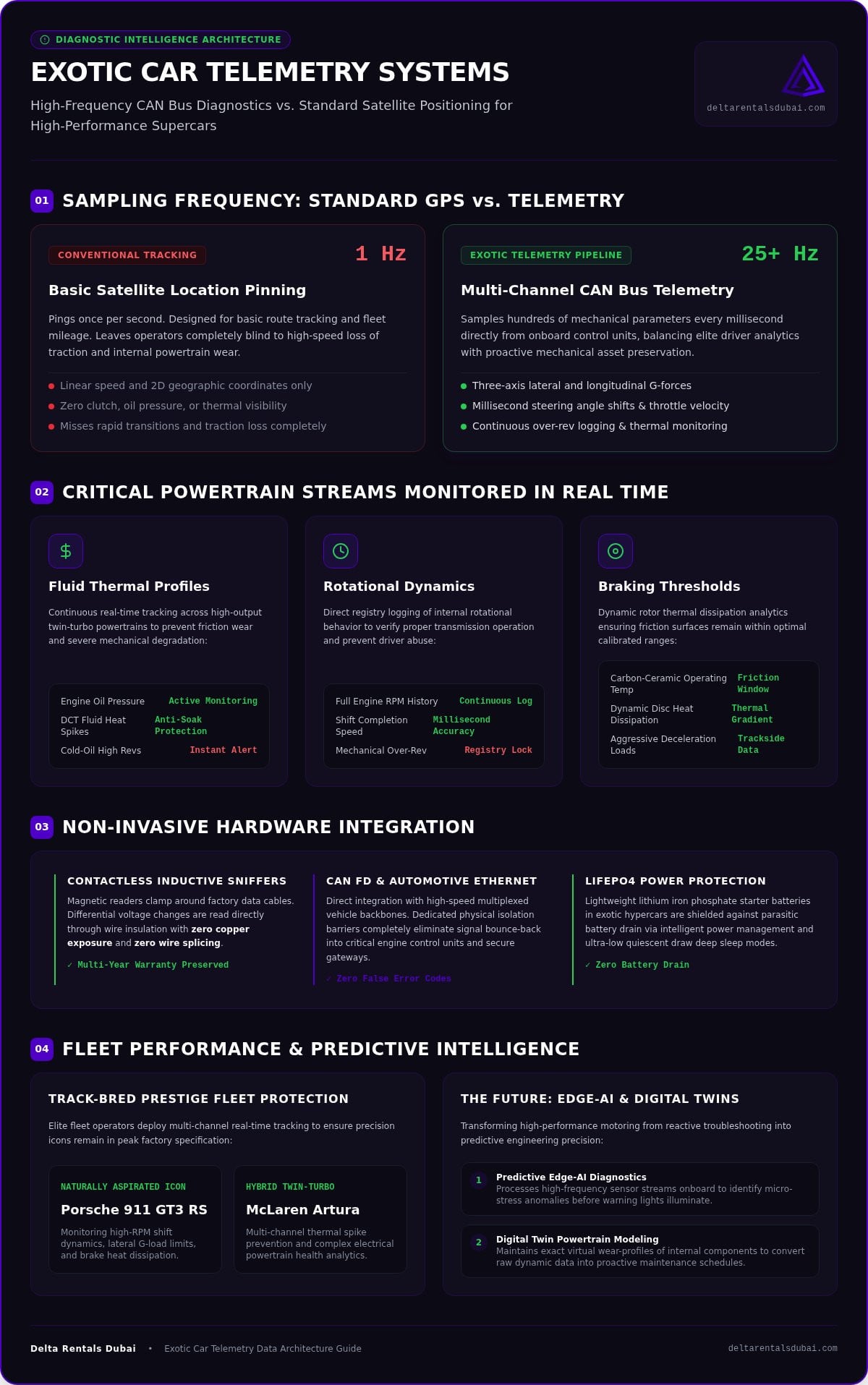
Most commercial tracking devices focus on fuel economy and basic route delivery. That approach fails completely when applied to high-performance hypercars. Standard vehicle trackers ping location data at sluggish 1 Hz intervals, which tells you where a vehicle sits but nothing about how it is running. In contrast, advanced exotic car telemetry data tracking systems are high-frequency diagnostic pipelines. They sample real-time mechanical dynamics directly from onboard control units, ensuring every high-output machine stays within safe engineering parameters.
Instead of logging simple mileage, modern supercar telemetry captures hundreds of mechanical parameters every millisecond. The goal is simple: balance elite driver analytics with aggressive asset preservation. As engineering teams recognize, telemetry transforms high-performance motoring from reactive troubleshooting into predictive engineering precision. When vehicles generate massive torque and extreme cornering loads, real-time data transparency becomes your primary defense against mechanical failure.
The Core Difference Between Telemetry and Basic GPS
Basic GPS systems record simple coordinates, directional heading, and linear speed. Supercar telemetry works on a completely different level. It tracks three-axis lateral and longitudinal G-forces, millisecond steering angle shifts, and throttle pedal velocity. High-frequency motorsport loggers operate at 25 Hz or higher, capturing split-second driver inputs during rapid transitions where standard 1 Hz units miss critical loss-of-traction events entirely.
Critical Powertrain Data Points Monitored in Real Time
Exotic drivetrains operate under immense thermal pressure. Dedicated telemetry platforms monitor high-risk metrics continuously to protect vehicle health across every journey:
- Fluid Thermal Profiles: Real-time oil pressure and dual-clutch transmission fluid spikes across twin-turbo platforms, catching lubrication breakdown before heat-soak causes friction wear.
- Rotational Dynamics: Complete engine RPM history, gear shift completion speeds, and continuous over-rev detection across mechanical registries to verify proper transmission handling.
- Braking Thresholds: Dynamic brake disc thermal dissipation and carbon-ceramic operating temperatures, ensuring rotors remain within their calibrated friction ranges during aggressive deceleration.
By capturing these intricate data streams continuously, professional operators eliminate the blind spots left by standard trackers. For prestige fleets delivering turnkey performance across the country, advanced exotic car telemetry data tracking systems serve as the silent guardian behind the scenes, ensuring icons like the Porsche 911 GT3 RS or McLaren Artura retain factory-fresh precision for every driver who steps inside.
Technical Architecture: How Telemetry Integrates with Modern Supercars
High-performance exotics don’t tolerate crude wiring modifications. Splicing into an intricate carbon-fiber chassis loom risks triggering false error codes, electrical shorts, or voiding a multi-year manufacturer warranty. Modern exotic car telemetry data tracking systems bypass these hazards through non-invasive hardware. They link directly with multiplexed Controller Area Network (CAN FD) and high-speed automotive Ethernet backbones, packaging raw metrics into encrypted cellular data streams without interfering with factory control modules.
Contactless CAN Bus Integration and Electrical Protection
Professional installations avoid physical wire splicing entirely. Instead, they deploy contactless inductive readers that clamp around vehicle data cables. These magnetic sniffers read high-frequency differential voltage changes straight through the factory wire insulation. Because there’s zero exposed copper, the vehicle warranty stays intact. Dedicated physical isolation barriers also prevent signal bounce-back into critical engine control units, ensuring the system remains invisible to sensitive factory secure gateways.
Power Management for Exotic Battery Systems
Supercars rely on ultra-lightweight lithium iron phosphate (LiFePO4) starter batteries. These compact packs save weight, but they’re vulnerable to parasitic electrical drains from cheap aftermarket trackers. Sophisticated telemetry hardware eliminates battery strain through intelligent power management:
- Ultra-Low Quiescent Draw: Deep sleep modes draw negligible standby current, protecting delicate lithium battery cells even during weeks of vehicle storage.
- Intelligent Motion Triggers: Onboard multi-axis accelerometers wake the telemetry system instantly the moment an ignition switch turns or a door handle moves.
- Dedicated Backup Power: Internal lithium-ion reserve cells keep satellite tracking and tamper notifications active if the primary vehicle battery disconnects.
This technical balance of passive data collection and battery preservation is critical for fleet operations. It ensures vehicles maintain pristine mechanical reliability while collecting granular operating metrics on every run. If you want turnkey access to impeccably maintained machinery backed by non-stop diagnostic standards, you can connect with our prestige concierge team to schedule your next high-performance drive with complete confidence.
Evaluating Telemetry Solutions: Motorsport Grade vs. Fleet Tracking
Choosing an exotic telemetry platform requires balancing diagnostic depth with non-intrusive hardware architecture. Commercial van tracking platforms simply log location breadcrumbs and harsh braking flags. Trackside loggers, on the other hand, record granular suspension travel and yaw rates to shave tenths off a lap time. Selecting the right setup means deciding whether you need pure driver coaching, long-term mechanical preservation, or centralized asset protection.
The sweet spot for supercars merges both worlds. You want high-frequency mechanical alerts alongside robust, continuous security. Modern exotic car telemetry data tracking systems bridge this divide by pairing deep diagnostic reads with always-on cellular cloud connectivity.
Key Performance Criteria to Compare
Evaluating specialized platforms requires analyzing three baseline performance metrics:
- Sampling Resolution: Consumer trackers update every 30 to 60 seconds, which misses critical powertrain spikes entirely. Motorsport-grade units record at 20 Hz to 25 Hz, capturing microsecond wheel slippage and abrupt throttle inputs.
- Diagnostic Depth: Systems must read deep CAN bus registers without attempting bidirectional writes. Read-only architecture prevents external signals from triggering unwanted safety overrides or locking engine controllers.
- Thermal and Environmental Hardening: Engine bays in mid-engine supercars generate scorching ambient heat. Hardware modules must feature automotive-grade potting and high-temperature circuitry to survive punishing heat cycles.
Manufacturer Track Apps vs. Independent Commercial Telematics
Factory systems offer breathtaking visual interfaces. High-performance models like the Porsche 911 GT3 RS leverage integrated track applications that sync PCM data with cockpit video, rendering sector times, friction circles, and braking points effortlessly. However, factory apps are driver-centric; they require an active smartphone connection and lack remote centralized monitoring.
Independent commercial telematics fill this operational gap. They provide automated cloud ingestion, continuous battery voltage tracking, and perimeter alerts without requiring driver input. For high-end fleet managers, combining factory track apps with dedicated hardware creates an unbreakable diagnostic safety net, delivering transparent driving dynamics while safeguarding mechanical longevity on every stretch of road.
Operational Benefits: Preserving Mechanical Integrity and Driver Safety
High-output engines generate extreme thermal stress that driver gauges rarely reveal in time. Advanced exotic car telemetry data tracking systems detect internal strain long before a physical warning lamp illuminates on the dashboard cluster. By streaming high-density CAN bus metrics directly to centralized monitoring platforms, operators identify premature component fatigue early, keeping twin-turbo V8s and naturally aspirated V10s operating strictly within factory tolerances.
Asset preservation extends far beyond regular fluid inspections. Continuous digital logging tracks launch control counts, dual-clutch transmission clutch-pack temperatures, and cooling circuit flow rates. This granular history provides indisputable mechanical provenance, validating pristine upkeep, preventing catastrophic downtime, and safeguarding the long-term investment value of exotic assets.
Mitigating Mechanical Abuse and Premature Wear
Powertrains suffer severe premature wear when driven aggressively before circulating fluids achieve stable operating viscosity. Automated telemetry rules proactively mitigate these hidden stresses:
- Cold-Engine Rev Limiting: Automated threshold alerts trigger if a driver exceeds calibrated RPM boundaries while oil and coolant temperatures remain below baseline targets.
- Dynamic Tire Monitoring: Live internal tire pressure and temperature telemetry prevents catastrophic delamination and high-speed blowouts caused by excessive heat accumulation or under-inflation.
- Chassis Impact Detection: High-G vertical accelerometer spikes flag harsh curb strikes, aggressive speed bump compression, or front splitter scrapes to trigger immediate suspension geometry checks.
Elevating High-Speed Safety and Emergency Response
Performance vehicles demand rapid emergency protocols. When onboard multi-axis sensors detect deceleration forces exceeding severe impact thresholds, intelligent systems instantly flag vehicle coordinates for direct emergency assistance dispatch. Paired with precise polygon geofencing, this technology ensures exotic machinery remains on suitable national highways rather than rough, unpaved terrain. This high-standard mechanical oversight is equally vital whether managing a track-bred coupe or booking an ultra luxury SUV for refined national touring.
Ready to experience true automotive engineering with absolute peace of mind? You can book your pristine supercar rental on WhatsApp and enjoy national delivery backed by uncompromising fleet maintenance standards.
The Future of Supercar Telemetry: AI Diagnostics and Connected Fleets
The evolution of connected hypercars is moving beyond static data logging into active artificial intelligence. Next-generation exotic car telemetry data tracking systems leverage neural networks at the hardware edge to interpret live CAN bus metrics in real time. Instead of waiting for a technician to extract log files after a track session, onboard AI algorithms compare live thermal curves and pressure graphs against digital twin models to predict component fatigue instantly.
This closed-loop modeling transforms exotic fleet preservation. Machine learning engines run continuous simulations of engine stress, drivetrain wear, and aerodynamic trim settings based on recorded operating loads. The result is total transparency. Maintenance shifts from calendar-based intervals to dynamic, condition-based servicing that protects multi-million dirham vehicle architectures.
Predictive Component Wear Modeling and Machine Learning
Modern machine learning models track micro-stresses that human inspection cannot see. Specialized algorithms analyze deceleration pressures, brake disc thermal soak, and pedal release rates to forecast the exact remaining lifespan of carbon-ceramic friction layers. Similarly, acoustic vibration telemetry flags microscopic drivetrain harmonic variations before gear lash or bearing failure occurs. This predictive refinement keeps whisper-quiet engineering at peak performance, a crucial standard when enjoying effortless high-speed cruising in a vehicle like the Rolls Royce Cullinan Black Badge.
Experience Immaculate Performance with Professional Fleet Standards
For discerning enthusiasts, telemetry provides absolute reassurance. You don’t have to wonder whether the machine delivered to your driveway was properly warmed up, meticulously serviced, or driven gently by previous drivers. Elite prestige services rely on integrated telematics to maintain their entire fleet to exacting factory standards:
- Turnkey Mechanical Precision: Every vehicle undergoes digital health verifications before national delivery, confirming flawless oil pressures, aligned suspension dynamics, and pristine braking response.
- Pure Driving Freedom: Sophisticated telematics operate silently in the background, allowing you to focus entirely on the open road with total confidence in the car’s structural and mechanical integrity.
- Proven Fleet Trust: Backed by over 300 five-star reviews, systematic data-driven maintenance ensures every icon in the stable performs exactly as its engineers intended.
When you demand uncompromised performance without mechanical friction, professional telematics make all the difference. Connect with Delta Rentals Dubai via WhatsApp to reserve an immaculately maintained exotic vehicle today and experience national luxury delivery at its finest.
Elevate Your Drive with Uncompromised Fleet Precision
Advanced exotic car telemetry data tracking systems have redefined high-performance stewardship. Moving far beyond basic satellite coordinates, non-invasive CAN bus integration and predictive diagnostic modeling protect sensitive powertrains without compromising factory warranties. From logging carbon-ceramic brake thermals to monitoring high-frequency lateral loads, continuous telematics ensure elite machinery stays balanced between breathtaking speed and mechanical longevity.
At Delta Rentals, this real-time oversight operates as an invisible concierge behind every journey. Our national fleet, featuring track-honed benchmarks like the Porsche 911 GT3 RS and the hybrid McLaren Artura, relies on multi-channel diagnostics to deliver turnkey mechanical perfection. Supported by over 300 five-star verified client reviews praising our immaculate standards, we combine rigorous technical care with discreet national delivery and seamless VIP service. Take the driver’s seat with complete confidence. Reserve your immaculately maintained supercar with Delta Rentals via WhatsApp and experience pure, worry-free performance today.
Frequently Asked Questions
How do exotic car telemetry systems differ from standard vehicle GPS trackers?
Standard GPS trackers only report periodic speed and map location. In contrast, exotic car telemetry data tracking systems connect directly into the vehicle’s internal data network. They record dynamic mechanical metrics like multi-axis G-forces, oil pressure, dual-clutch transmission temperatures, and brake rotor heat dissipation at 20 Hz or higher. This diagnostic depth turns passive position logging into real-time mechanical asset preservation.
Can installing an aftermarket telemetry tracking system void a supercar factory warranty?
Traditional hardwired installations that splice into factory wire harnesses can indeed void manufacturer warranties. However, professional setups utilize non-intrusive inductive readers. These magnetic sensors read Controller Area Network signals directly through factory wire insulation without cutting copper or modifying electrical circuits. Because the hardware requires no physical wire alterations and uses read-only architecture, the factory warranty and onboard electronic integrity remain completely protected.
Do high-performance telemetry data tracking systems drain the vehicle battery when parked?
Professional units are engineered specifically to protect lightweight lithium-ion starter batteries. High-performance exotic car telemetry data tracking systems feature ultra-low quiescent draw protocols, dropping into deep sleep modes drawing negligible microamps when the vehicle is stationary. Internal motion sensors immediately wake the unit upon door movement or ignition startup, while internal auxiliary batteries handle security alerts without touching the car’s primary power cell.
What happens if a vehicle experiences mechanical stress or an over-rev event?
The system records the exact mechanical timestamp, engine speed, fluid temperatures, and pedal position directly from the ECU memory registers. Instead of relying on guesswork, operators receive an immediate automated alert flag. Technical teams review the severity of the load profile instantly, allowing proactive fluid checks, component inspections, or clutch recalibrations before minor mechanical strain can develop into premature component wear.
How do telemetry systems communicate data in areas with weak cellular coverage?
Hardware units utilize onboard solid-state flash memory to buffer high-frequency data streams locally when cellular signals drop. The moment the vehicle enters an area with stable mobile network connectivity or reaches a designated garage Wi-Fi uplink, the device securely transmits all queued packets to the cloud analytics engine with complete cryptographic timestamps, ensuring zero gaps in mechanical history logs.
Is telemetry data shared with external insurance providers or third parties?
Discreet fleet operators and private owners keep telemetry streams strictly confidential within secure, encrypted private clouds. Data is utilized internally for preventative maintenance schedules, warranty provenance, and real-time asset security. Information isn’t broadcast or sold to external third-party aggregators, ensuring client driving privacy remains fully guarded while still guaranteeing the car is operating within optimal engineering boundaries.
Can modern telemetry systems monitor hybrid supercar battery packs and electric motors?
Yes, modern high-voltage telemetry bridges directly integrate with hybrid powertrain control modules. They capture critical electric dynamics including high-voltage traction battery cell temperatures, state-of-charge discharge rates, inverter thermal loads, and regenerative braking efficiency. This comprehensive oversight ensures complex hybrid supercars maintain optimal thermal balance across both high-output internal combustion engines and high-discharge electric drive units simultaneously.