
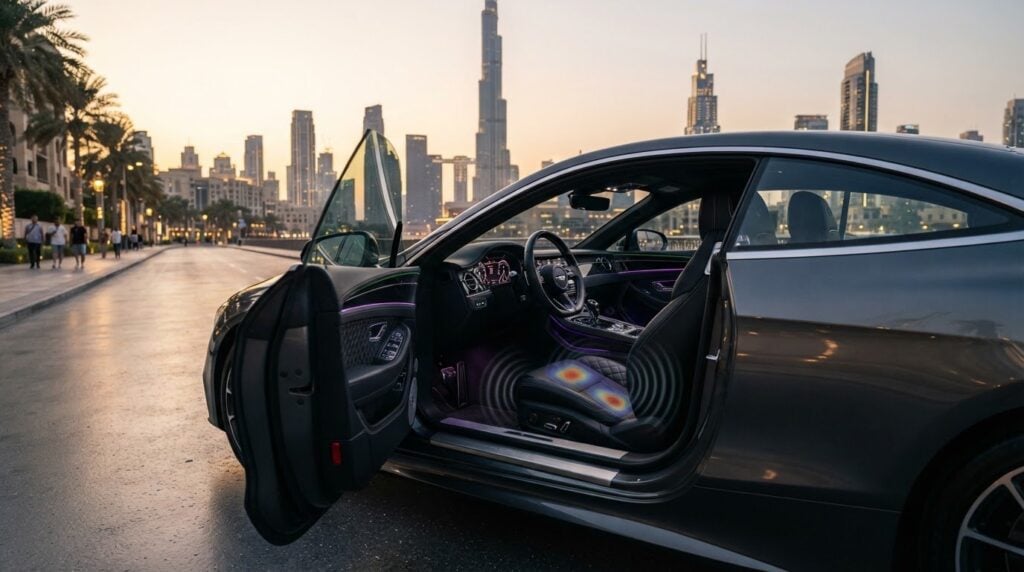
True cross-country pace is worthless if your spine gives out after two hundred miles. Elite performance isn’t just engineered under the hood; it lives directly beneath you. When you’re eating up highway asphalt at speed, mastering ergonomic seating in ultra luxury grand tourers becomes the decisive factor between arriving depleted and stepping out revitalized.
You know the familiar frustration of dull lower back fatigue midway through an ambitious road trip, or fighting lateral roll because your seat lacks proper bolster support through high-speed sweepers. Combine that with weak cabin ventilation in warmer climates, and even the most exotic grand tourer loses its luster. High-speed comfort requires dynamic support, not just soft leather.
Discover how cutting-edge biomechanics, multi-chamber pneumatics, and zoned climate architecture define modern grand touring cockpit comfort. Ahead, we break down active dynamic bolstering versus static multi-way adjustments, explore whole-body vibration dampening, and identify the flagship grand tourers delivering unmatched long-distance driving ergonomics.
Key Takeaways
- Understand how ergonomic seating in ultra luxury grand tourers counters high-g lateral loads and spinal compression, establishing the perfect middle ground between rigid track buckets and upright limousine chairs.
- Analyze the biomechanics of high-speed touring, focusing on weight distribution across ischial pressure points and dampening whole-body road vibrations.
- Compare active pneumatic cornering bladders with electromechanical bolsters to see how real-time lateral support prevents muscular strain through aggressive sweepers.
- Apply a systematic pre-drive cockpit calibration checklist to dial in optimal seat-pan tilt, lumbar depth, and multi-zone climate settings before departure.
- Leverage experiential fleet access to road-test flagship grand tourers and evaluate all-day cockpit ergonomics directly against track-bred configurations.
What Defines Ergonomic Seating in Ultra Luxury Grand Tourers?
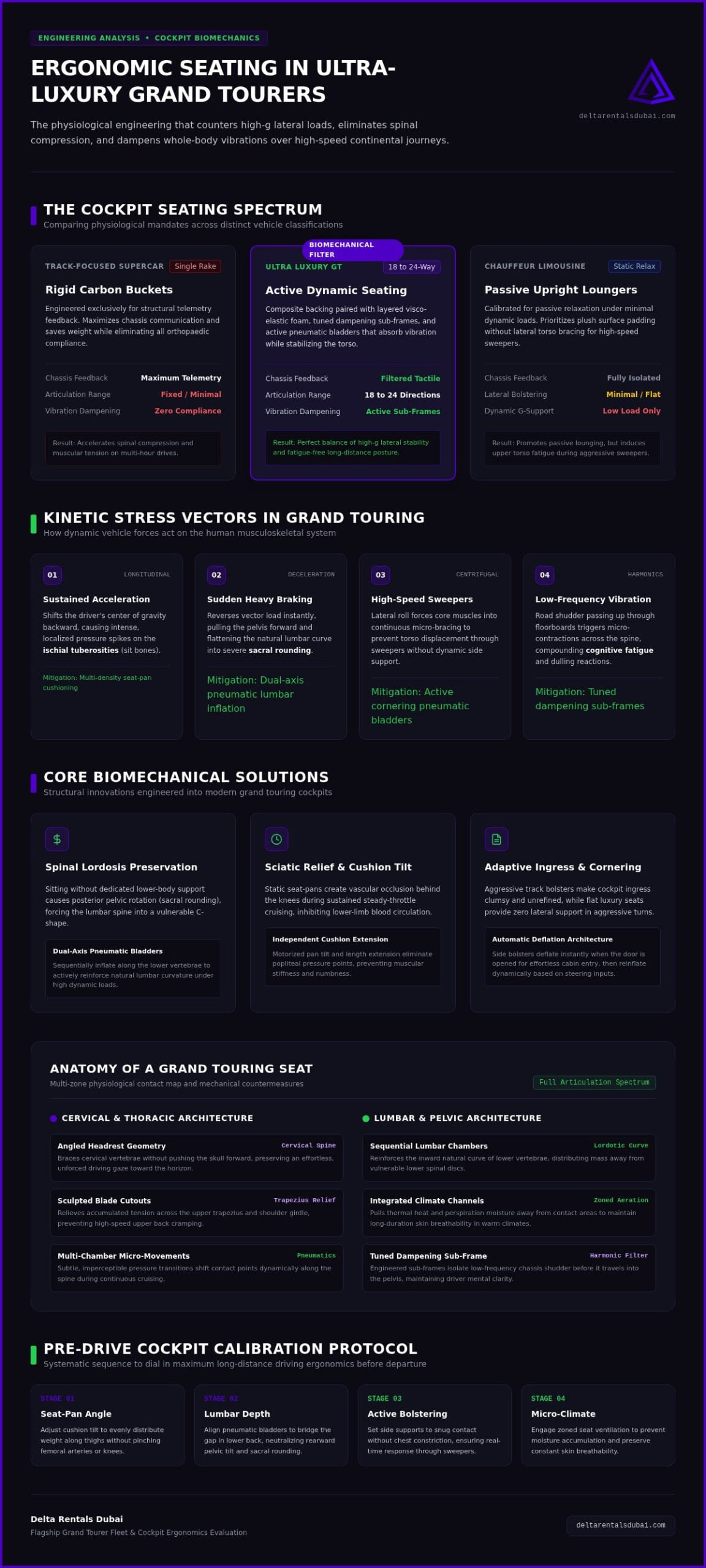
Grand tourers operate under an entirely different physiological mandate than track-focused supercars or chauffeur-driven limousines. In a limousine, seats are tuned for passive, upright relaxation at low dynamic loads. In a stripped-out racer, rigid carbon shells maximize telemetry feedback, sacrificing all compliance to shave ounces. Real-world touring demands something far more complex. Modern ergonomic seating in ultra luxury grand tourers functions as an active biomechanical filtration system. It simultaneously absorbs road-frequency chassis vibration, restrains the human torso against persistent cornering forces, and minimizes muscular exhaustion over multi-hour stints.
Chassis vibration directly influences mental clarity. When low-frequency oscillations from uneven road surfaces pass through the vehicle floor pan and into the driver’s spine, the body engages in micro-contractions to stabilize itself. Over hundreds of continuous miles, this micro-tension accelerates cognitive fatigue, dulling reaction times. By adhering to the structural ergonomic principles of a car seat, elite automotive engineers integrate tuned dampening sub-frames and variable-density foams that isolate the musculoskeletal column from chassis shudder without disconnecting the driver from road feel.
The Core Principles of Grand Touring Cockpit Ergonomics
Mastering the grand touring posture requires an intentional balance between three critical factors:
- Natural Spinal Alignment: Multi-chamber pneumatic bladders within the backrest reinforce the natural lordotic curve of the lumbar spine, distributing weight away from the lower vertebrae.
- Sciatic Relief: Independent cushion length extension and pan tilt relieve pressure behind the knees, preventing blood flow restriction during long stretches at steady throttle.
- Effortless Accessibility: Adaptive side bolsters deflate automatically upon opening the door, pairing aggressive high-speed lateral support with elegant cabin entry.
Grand Tourer Comfort vs Pure Supercar Bucket Seating
True grand tourers exchange the punishing weight savings of single-piece composite buckets for sophisticated 18-to-24-way motorized articulation systems. While track setups lock you into a single uncompromising rake, high-end touring seats allow minute real-time adjustments to seatback angle, shoulder support, and side bolsters. Modern hybrid seat structures bridge this gap entirely. By wrapping lightweight composite backings in layered visco-elastic foam and supple leather, manufacturers deliver the lateral stability needed for high-g cornering alongside the acoustic dampening required for cross-country journeys.
The Biomechanics of Long-Distance High-Speed Driving Comfort
Static sitting places continuous orthopaedic strain on the body, but doing so inside a vehicle traveling at high speeds amplifies the toll exponentially. Sustained acceleration shifts the driver’s center of gravity backward, spiking localized pressure on the ischial tuberosities, commonly known as the sit bones. Sudden, heavy braking reverses this vector instantly, pulling the pelvis forward and flattening the lower lumbar curve. Advanced research into the engineering of luxury car seats demonstrates that unyielding contact surfaces trigger vascular occlusion and muscular stiffness over long stretches. To counteract this, modern systems introduce imperceptible pneumatic micro-movements that continuously shift pressure points while integrated climate channels pull away heat and moisture to maintain skin breathability.
Lumbar Lordosis and Cervical Spine Alignment
Sitting without active lower-body support causes posterior pelvic rotation, known clinically as sacral rounding. This slump forces the lumbar spine out of its natural lordotic curve into a vulnerable C-shape. Dedicated grand touring seats integrate dual-axis pneumatic bladders that inflate sequentially along the lower vertebrae to stabilize spinal posture under cornering loads. Up top, sculpted shoulder blade cutouts relieve tension across the trapezius muscles, while angled headrests brace the cervical spine without pushing the head forward, preserving an effortless driving gaze.
Circulation and Vibration Dampening Science
Harsh road harmonics travelling through floorboards and mounting rails cause whole-body vibration that accelerates driver exhaustion. To neutralize this energy, contemporary ergonomic seating in ultra luxury grand tourers relies on variable-density polyurethane bases paired with memory foam contact layers. This layered matrix filters low-frequency chassis oscillations before they reach your lower back. Motorized thigh extensions adjust cushion depth to support the underside of your legs, preventing pressure spots that hinder femoral blood flow during uninterrupted multi-hour stints.
Planning an extended road route demands seating engineered for continuous physical recovery. If you are preparing an itinerary and want zero compromise on interior posture support, connect with an elite reservation specialist to reserve a flagship grand tourer tailored for cross-country stamina.
Engineering Comparison: Key Seating Technologies in Elite Marques
Elite touring cabins take distinct technical paths to achieve peak support. Where performance sports cars often rely on rigid electromechanical tracks to clamp occupants into place, modern ergonomic seating in ultra luxury grand tourers favors closed-loop pneumatic architectures. Examining the divide between mechanical motor gears and pneumatic air chambers reveals why flagship marques prioritize adaptive air cells for sustained cross-country travel.
Pneumatic Multi-Chamber Architecture vs Mechanical Linkages
Electromechanical systems rely on stepper motors driving rigid worm gears. They offer millimeter precision and firm stability under static loads, but they cannot adapt fluidly to continuous chassis inputs. Pneumatic arrays, by contrast, utilize rapid-response micro-compressors paired with multi-chamber bladders embedded beneath the foam padding.
- Dynamic Lateral Bladders: Integrated sensors detect steering angle and lateral acceleration, instantly inflating the outside bolster to brace your torso through sweepers, then deflating on straights to restore relaxed posture.
- Closed-Loop Wave Cycling: Instead of crude mechanical rolling drums that press uncomfortably against spinal vertebrae, pneumatic bladders pulse in sequenced wave patterns to stimulate capillary blood flow without creating localized pressure spikes.
- Variable Lumbar Profiling: Multi-tiered air cells adjust contour depth and vertical elevation independently, allowing exact calibration to your lower spine’s unique geometry.
Climate Engineering: Active Ventilation and Surface Thermoregulation
Maintaining physical stamina requires active thermal management. Basic ventilation systems merely use suction fans to draw ambient cabin air through seat perforations, an approach that falls flat during intense summer heat. Advanced grand tourers employ closed-circuit thermoelectric cooling modules that force chilled, dehumidified air directly through the seat surface.
Zoned ceramic heating elements pair with this active cooling architecture, targeting the kidneys, lower lumbar, and upper hamstrings with pinpoint accuracy. Wrapped in breathable, perforated full-grain leather, this climate matrix regulates skin temperature and prevents perspiration buildup, ensuring you step out of the cockpit completely composed after hours on the open road.
How to Evaluate Cockpit Ergonomics Before Long-Distance Touring
Static showroom assessments reveal almost nothing about real-world touring comfort. A seat that feels plush during a three-minute sit-in can trigger excruciating lower spine agony after three hours on the open highway. Evaluating ergonomic seating in ultra luxury grand tourers requires a methodical calibration process. You must systematically dial in base geometry, balance dynamic bolster tension, and observe how your body interacts with chassis inputs under load.
The Four-Point Ergonomic Calibration Protocol
Take five minutes to execute this sequence before departing on any cross-country route:
- Step 1: Sightline and Pan Height: Lower the seat base completely, then raise it until your eye level rests roughly halfway up the windshield. Tilt the front edge upward so your thighs remain fully supported without lifting your tailbone off the cushion.
- Step 2: Pedal Reach and Knee Flex: Depress the brake pedal to its floor stop. Your right knee must retain a 120-degree bend. Locking your leg straight transfers emergency braking shocks directly into your hip socket.
- Step 3: Neutral Lumbar Profiling: Inflate the lumbar bladder until it gently bridges the gap in your lower back. Never over-inflate; forcing your vertebrae forward disengages your upper spine from the seatback.
- Step 4: Cushion Length Clearance: Extend the front thigh cushion forward. Stop precisely two fingers’ width short of your inner knee crease to prevent pressure on the popliteal artery.
Identifying Latent Discomfort Signs During Test Drives
Subtle physical signals expose improper seat alignment long before severe pain sets in. Tingling in your right heel indicates that the cushion front edge is raked too steep, restricting venous return. Tightness in the upper neck means the headrest is canted too far forward, forcing your chin down toward your chest. If low-slung cockpits feel restrictive on longer trips, an ultra luxury SUV rental delivers a commanding, upright seating posture with expanded knee clearance for continuous cruising comfort.
Experiencing grand touring cockpits at speed is the only way to pinpoint your ideal driving setup. To test premier grand tourers across varied highway terrain, book your tailored luxury rental handover and take the wheel of an impeccably prepared touring machine.
Experiencing Uncompromising Cockpit Craftsmanship with Delta Rentals
Reading engineering schematics can never replace the tactile reality of hours spent behind the wheel. Experiential luxury hire offers the ultimate real-world test drive, letting you evaluate ergonomic seating in ultra luxury grand tourers across actual cross-country itineraries. Delta Rentals provides immediate access to an immaculate nationwide fleet, backed by transparent booking and zero-deposit options designed for discerning motorists.
Tailoring Your Vehicle Selection to Your Travel Route
Every long-distance journey demands a seating architecture matched to your driving style and physical requirements. When your route weaves through high-speed motorways and sweeping bends, flagship grand tourers provide the low-slung torso bracing and adaptive spinal cushioning required to stay alert.
Drivers who prioritize an elevated hip point and upright posture often favor commanding cabins like the Rolls Royce Cullinan Black Badge, which combines lounge-grade multi-contour seats with acoustic whisper-quiet insulation. Those seeking uncompromising road connection can contrast that plush isolation against the track-honed rigid carbon shells of the Porsche 911 GT3 RS. During each personalized handover, a concierge guides you through the vehicle’s specific pneumatic settings so your posture is dialed in before departure.
Seamless Access to the World’s Finest Grand Tourer Cabins
Brief dealer drives around local blocks can’t reveal whether a cockpit supports your back over a four-hundred-mile journey. Experiencing premier models over a multi-day trip is the definitive way to test ergonomic seating in ultra luxury grand tourers in true touring conditions.
- Nationwide Concierge Handover: Receive your chosen model directly at your private aviation terminal, hotel, or private estate anywhere across the country.
- Multi-Point Quality Assurance: Every vehicle undergoes an exhaustive multi-point inspection before release, guaranteeing flawless mechanical operation and immaculate leather condition.
- Direct Fleet Reservation: Connect with dedicated luxury concierges ready to match your itinerary with the exact seat architecture, climate controls, and dynamic performance you require.
Command the Open Highway in Unrivaled Comfort
True high-speed grand touring is about arriving as energized as when you set out. As automotive design advances, ergonomic seating in ultra luxury grand tourers proves that real comfort isn’t about passive plush padding. It demands active pneumatic contouring, structural vibration mitigation, and zoned thermoregulation working in complete harmony with your spine.
Experiencing these sophisticated cabins on extended itineraries reveals how much cockpit engineering transforms driving endurance. Backed by over 300 five-star customer reviews nationally, Delta Rentals delivers an elite fleet featuring flagship marques from Porsche, Rolls-Royce, and McLaren. Benefit from transparent booking terms with convenient zero deposit options, paired with white-glove vehicle preparation before every departure.
Connect with Delta Rentals on WhatsApp today to reserve your ultimate grand tourer cabin and experience pure cockpit craftsmanship on your next journey.
Frequently Asked Questions
How do 18-way or 24-way adjustable seats improve driving comfort over standard electric seats?
They isolate individual musculoskeletal segments instead of forcing uniform posture adjustments. Standard power seats only alter fore and aft distance, general cushion height, and gross backrest tilt. Advanced 18- to 24-way systems let you adjust upper-back curvature, seat-pan tilt, under-thigh cushion extension, and multi-chamber lumbar depth. This granular control eliminates pressure hot spots and matches the exact anatomical contours of your spine.
Are active dynamic bolsters beneficial for normal highway cruising, or only spirited driving?
Active bolsters provide subtle yet noticeable fatigue reduction during everyday cruising. While their primary role is counteracting high-g forces during aggressive cornering, they also stabilize your torso through sweeping highway interchanges and abrupt lane changes. By preventing your core muscles from constantly firing to stay upright, these dynamic air chambers conserve your energy across multi-hour journeys.
What is the difference between ventilated seats and cooled seats in luxury vehicles?
Ventilated seats use internal fans to circulate ambient cabin air through perforations, which can struggle to cool occupants during intense heat. True cooled seats incorporate thermoelectric cooling modules or air-conditioned ducting to pump chilled, dehumidified air directly against your back and thighs. This active temperature drop prevents perspiration buildup and keeps your skin surface dry and comfortable.
Can high-performance grand tourer seats prevent lower back pain during all-day road trips?
Yes, dedicated grand touring seats actively mitigate spinal fatigue by combining continuous lordotic support with multi-layer vibration dampening. Modern ergonomic seating in ultra luxury grand tourers utilizes sequential pneumatic adjustments to stimulate micro-movements across your lower back. This redistributes weight away from your sit bones and insulates your spine from road harmonics, stopping deep muscular stiffness before it starts.
Why do some ultra-luxury grand tourers still offer fixed carbon bucket seats as an option?
Manufacturers provide carbon shells for drivers who demand maximum chassis feedback and track-ready weight reduction. A rigid carbon bucket bolts tightly to the vehicle floor, transferring vital telemetry directly to your hips. While unyielding on cross-country road trips, these seats eliminate lateral body slip during track days, keeping you anchored without needing to brace your knees against interior trim.
How does seat cushion firmness impact posture and fatigue over long touring distances?
Progressive, firm cushioning provides vastly superior long-distance support compared to plush, overly soft seats. Ultra-soft padding compresses quickly, allowing your pelvis to sink unevenly and forcing your spine into an unnatural slump. High-density layered foam distributes pressure across your entire pelvic structure, maintaining spinal alignment and encouraging healthy blood circulation through the legs during uninterrupted cruising.
What should I test first in an unfamiliar grand tourer seat before embarking on a long journey?
Always calibrate pedal reach, seat-pan tilt, and thigh extension before touching lumbar or massage controls. Establishing the core baseline of ergonomic seating in ultra luxury grand tourers ensures your right knee retains a 120-degree bend at maximum brake pressure. Leaving a clear two-finger gap behind your knee crease prevents circulatory restriction, giving you a fatigue-free foundation for your trip.