

What if rear passengers could hear clear dialogue without turning up the volume for everyone? Understanding entertainment system multi zone audio balancing for rear executive passengers starts with distinguishing separate listening zones from a shared system with basic volume or balance controls. The difference matters when front and rear occupants want different audio, or when passengers need dialogue at a comfortable level.
A premium cabin may look well equipped, but a vehicle’s description doesn’t always explain what rear passengers can control. This guide explains how audio zones differ from basic volume adjustment, compares shared speakers, separate sources and headphones, and outlines what to check before choosing a vehicle.
For a rental, confirm the selected vehicle’s specific setup before booking. Ask whether rear passengers have independent volume controls, can select a separate source, and can listen without changing the front audio. The checks below can help you compare options based on what passengers can actually use, rather than a model name or an unverified feature list.
Key Takeaways
- Understand how entertainment system multi zone audio balancing for rear executive passengers differs from a simple front-to-rear balance control.
- Learn how audio processing and speaker placement can affect sound across the cabin, while remembering that controls vary by vehicle.
- Compare shared speakers, separate listening zones, and headphones by passenger control, dialogue clarity, and potential impact on the driver.
- Test spoken dialogue and music from the rear seats at a moderate volume, with the vehicle safely stationary.
- Before booking, ask about the exact vehicle’s rear controls and source options instead of assuming features from its luxury branding.
What Multi-Zone Audio Balancing Means for Rear Executive Passengers
Multi-zone audio describes a system that can manage sound for separate areas of a vehicle, such as the front seats and rear cabin. If the equipment supports it, occupants may be able to adjust their listening area or hear audio routed differently from another zone. The options vary by vehicle. A premium badge alone doesn’t confirm independent rear volume, separate source selection, or private listening.
That distinction matters for entertainment system multi zone audio balancing for rear executive passengers. A rear listener might want to follow a film or conversation while the driver listens to navigation or music. Whether the cabin can support those preferences independently depends on the installed system, its controls, and how audio is routed.
How audio zones differ from ordinary front-to-rear balance
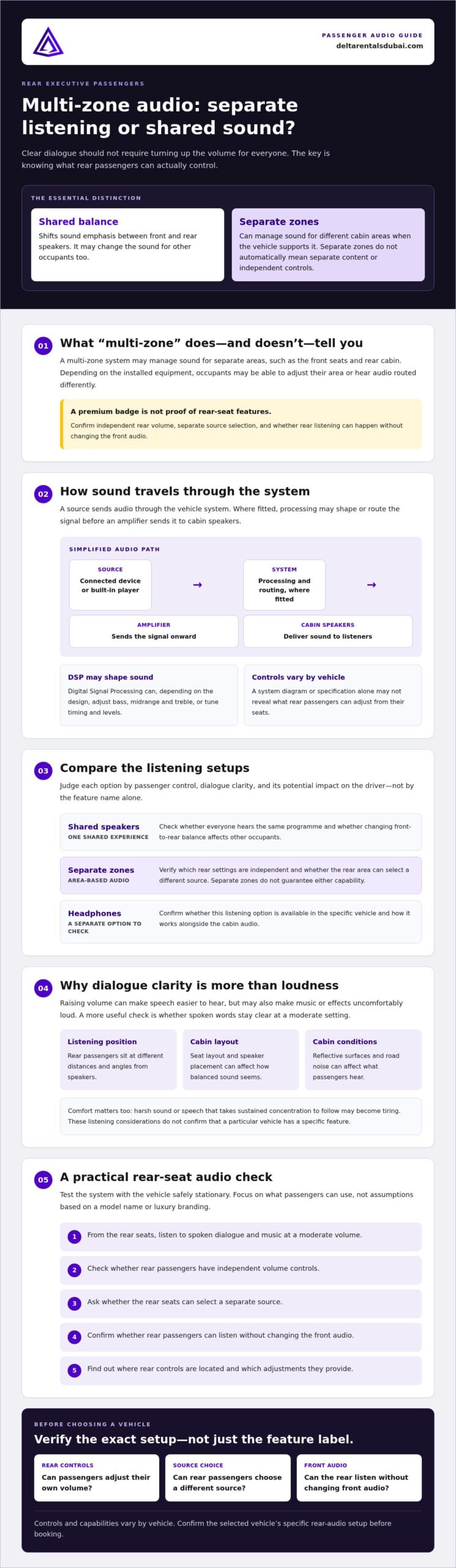
A basic front-to-rear balance control shifts sound emphasis toward the front or rear speakers. It can change where shared audio seems strongest, but it doesn’t necessarily create separate listening experiences. Everyone may still hear the same programme, and changing the balance could affect sound for other occupants.
A zone is a listening area managed separately when the vehicle’s equipment allows it. For example, a rear passenger might adjust sound for the back seats while front occupants keep their own setting. Separate zones don’t automatically mean separate content or fully independent controls, so ask which adjustments and sources are available. For a useful overview of the components involved, see this vehicle audio overview.
Why rear-seat audio comfort is more than loudness
Turning up the volume may make speech easier to hear, but comfort also depends on dialogue clarity and how sound reaches the listener. If voices are difficult to follow, raising the level can make music or effects uncomfortably loud. A more useful check is whether spoken words remain clear at a moderate setting.
Position matters. Rear passengers sit at different distances and angles from cabin speakers than front occupants, and seat layout or speaker placement can affect how balanced the sound seems. Audio that feels harsh or takes sustained concentration to follow may also be tiring. Consider comfort as well as volume, but don’t treat these listening considerations as proof of a specific vehicle feature.
A separate zone doesn’t automatically mean privacy or isolation from other occupants. That depends on the equipment and arrangement. Confirm whether rear controls are independent, whether the source can differ from the front, and whether any listening option keeps sound within the intended area. Check each capability for the specific vehicle instead of assuming it is standard in a luxury cabin.
How Multi-Zone Systems Balance Rear Audio Across the Cabin
Audio passes through a chain of components. A media source, such as a connected device or built-in player, sends sound to the vehicle’s system. Where fitted, processing can shape or route the signal before an amplifier sends it to cabin speakers. Layouts and adjustments vary, so a system diagram or specification alone may not show what rear passengers can control.
Multi-zone audio is a vehicle system’s ability, where supported, to manage sound for separate cabin areas through distinct settings or audio routing. That definition doesn’t guarantee separate content, independent volume, or privacy. Those functions depend on the specific equipment.
Sources, zones, and rear-seat controls
A shared source means occupants hear the same media, even if the system allows sound adjustments by area. Some vehicles may let separate zones select different sources, but don’t assume this is available. Check whether rear passengers can change volume, choose a source, or adjust sound settings from their seats. Depending on the vehicle, controls may be on a screen, console, remote, or another interface.
Digital Signal Processing, or DSP, can help a system tune and distribute audio. Depending on its design, it may use equalization to adjust bass, midrange, and treble, or timing and level adjustments to shape how sound reaches listeners. For example, reducing excessive bass or bringing speech frequencies forward may help dialogue stand out without raising the overall volume. These are possible functions, not a promise that every vehicle offers passenger-adjustable DSP controls.
Cabin acoustics and dialogue intelligibility
Rear-seat sound is shaped by more than system settings. Distance from speakers, seating position, surfaces that reflect sound, and road noise can all affect what a passenger hears. Prioritize clear speech at a comfortable level. Raising the whole system may make music or effects too loud without resolving unclear dialogue.
Some vehicles may have noise-control features, but their presence and operation depend on the equipment. Confirm them rather than assuming they’re included. If you’re considering a rental, ask about the selected vehicle’s rear source routing and controls before booking. You can ask about a vehicle’s rear audio setup as part of your inquiry.
Shared Speakers, Separate Sources, or Headphones: Which Rear Audio Setup Fits?
The right arrangement depends on whether passengers want to share one programme or listen independently. Shared speakers can suit a group enjoying the same music or film. Separate zones, sources, or headphones may offer more choice, but only if the exact vehicle supports them. Compare options by control, speech clarity, passenger preferences, and whether adjustments could distract the driver.
The central trade-off: shared speakers keep listening simple, while separate listening options can give passengers more independence, depending on the vehicle’s equipment.
| Setup | Useful when | What to confirm |
|---|---|---|
| Shared cabin speakers | Everyone wants the same audio. | Whether rear dialogue is clear at a comfortable shared volume. |
| Independent zones or sources | Passengers want different levels or content. | Whether rear controls and source selection are genuinely separate. |
| Headphones | A passenger wants to listen without playing audio through the cabin. | Whether headphones are provided, supported, and connect to the relevant source. |
When shared cabin speakers are the practical choice
If occupants are watching or listening together, cabin speakers are straightforward. Everyone hears the same programme, without the need to manage separate devices. The trade-off is shared control: changing the common volume may affect more than one listener, depending on the system. Test spoken dialogue from the rear seats at a moderate level. If speech is hard to follow, simply turning up the audio may make music or effects uncomfortable for others.
When independent sources or headphones may help
Separate sources can suit passengers who want different content, provided the vehicle can route audio independently. Ask whether rear passengers can select a source and adjust it from their seats, and whether those changes affect front occupants. Headphones may let one passenger listen without using the cabin speakers, but they aren’t necessarily supplied or enabled. Compatibility also depends on the equipment. Don’t assume headphones guarantee privacy or complete noise isolation.
For entertainment system multi zone audio balancing for rear executive passengers, assess the actual controls rather than relying on feature labels. Can a rear passenger adjust their listening without changing the driver’s audio? Can everyone follow speech at a comfortable level? Confirm the answers for the exact vehicle before booking, especially if separate content or headphones are essential.
How to Test Rear Executive Audio Before Choosing a Vehicle
Confirm the equipment first, then test what passengers can hear and control. For a rental, ask about the exact vehicle instead of relying on a general model description. Features can vary with configuration, and luxury branding doesn’t confirm rear audio zones, separate sources, or included accessories.
Questions to ask about rear-seat entertainment
Get specific answers before comparing vehicles. Ask whether the rear seats have independent volume or zone controls, whether passengers can select a separate source, and where those controls are located. Confirm which speakers, screens, headphones, and device connections are included, if any. Ask what the system cannot do, too. A rear control, for example, may adjust volume without letting passengers choose different content.
A quick listening test for balance and clarity
If a test is possible, keep the vehicle safely stationary. Have a passenger sit in the intended rear position and listen to spoken dialogue and music at a moderate, comfortable level. Don’t test while the driver is moving or adjusting settings.
- Confirm the features. Check which rear controls, sources, speakers, screens, and listening accessories are present in this specific vehicle.
- Listen from the rear. Play speech, then music. Notice whether dialogue is easy to follow without raising the overall level uncomfortably.
- Try the controls. Adjust rear volume or settings, if available. Check whether the change affects only the rear listening area or the whole cabin. Test source selection only if the system supports it.
- Compare seats. If practical, repeat from the other rear seat. Speaker position and seating location can change how balanced the sound feels.
- Check front-seat impact. With front passengers seated, confirm whether rear adjustments change their listening. Keep the driver’s attention on the road and out of the test.
Judge the whole experience, not just loudness. Clear speech, comfortable music, and predictable controls matter more than a feature label. The phrase entertainment system multi zone audio balancing for rear executive passengers describes a useful capability only when the selected vehicle’s equipment supports the controls you need.
Before booking, share your requirements and ask for confirmation of the specific vehicle’s rear audio setup. Ask about the selected vehicle’s rear audio features.
Confirm the Vehicle’s Rear Audio Setup Before Your Executive Journey
A confident choice comes down to the exact cabin, not the badge on the bonnet. Prioritize clear speech, controls passengers can use comfortably, and confirmation of the specific vehicle’s rear-seat equipment. Independent audio zones or sources can help when passengers have different preferences, but don’t assume they’re available based on a model name or luxury positioning.
Match the audio setup to the passenger experience
If everyone plans to share music or a programme, focus on balanced sound and intelligible dialogue from the rear seats. If passengers expect different content, ask whether separate sources or rear zones are available and what each passenger can control. For executive travel, consider the whole experience: seat position, access to controls, and whether adjustments are straightforward without involving the driver.
These details matter whether the journey is self-driven or chauffeured. A rear passenger may value easy access to controls, while the driver needs to stay focused on the road. Treat headphones, screens, speaker arrangements, and noise-control features as items to verify, not standard inclusions.
Ask Delta Rentals Dubai about the exact vehicle configuration
Delta Rentals Dubai is a premium vehicle rental provider, not an audio-system specialist. Its listed fleet includes vehicles such as the Rolls Royce Cullinan Black Badge and Porsche 911 GT3 RS, but its available vehicle information doesn’t confirm rear audio specifications or the configuration of a particular booking. Confirm the exact vehicle and its equipment before deciding.
For a vehicle-specific inquiry, ask direct questions: Are rear volume controls independent? Can passengers choose a different source? Which screens, speakers, connections, or headphones are included, if any? If a feature is essential, request confirmation for the selected vehicle rather than relying on a general description.
Explore Delta Rentals Dubai vehicle options, then compare the cabin and audio details with your passengers’ needs. To discuss a particular vehicle, message Delta Rentals Dubai on WhatsApp with your vehicle-specific audio question before booking. A few clear checks can help you choose a setup that suits your journey, without assuming that entertainment system multi zone audio balancing for rear executive passengers is available in every luxury vehicle.
Choose a Rear Audio Setup That Fits Your Journey
A comfortable rear-seat listening experience depends on more than volume. Look for clear speech, controls that suit your passengers, and audio features confirmed for the exact vehicle. Shared speakers may work well when everyone wants the same programme; separate sources or zones can offer more flexibility if the system supports them.
Understanding entertainment system multi zone audio balancing for rear executive passengers helps you ask specific questions instead of assuming a feature from a vehicle’s luxury branding. Delta Rentals offers premium vehicle rentals and chauffeuring services, with listed models including the Rolls Royce Cullinan Black Badge and Porsche 911 GT3 RS. Rear audio configurations aren’t confirmed, so check the selected vehicle’s setup before booking.
Have a vehicle in mind? Ask about its rear-seat audio setup on WhatsApp, including available controls and source options. Confirming those details can help you choose a vehicle that suits your passengers.
Frequently Asked Questions
What is multi-zone audio in a vehicle?
Multi-zone audio lets a vehicle manage sound for separate cabin areas, if its equipment supports that function. Depending on the system, a zone may have its own volume or sound settings, and some systems may route different sources to different areas. The term alone doesn’t confirm separate content, independent rear controls, or privacy. Check the selected vehicle’s controls and capabilities to see what passengers can actually adjust.
Can rear passengers listen to different audio from the driver?
Sometimes, but only if the vehicle supports separate sources or another independent listening option. A system may let rear passengers choose different content, while another may play one shared source throughout the cabin. Ask whether rear passengers can select a source from their seats and whether that selection affects the front audio. Don’t assume this capability is included just because a vehicle has rear entertainment features.
How do you balance audio for rear-seat passengers?
Start by listening from the intended rear seat, using spoken dialogue and music at a comfortable, moderate level. Adjust any rear volume or sound controls, then check whether they change only the rear area or the whole cabin. A practical approach to entertainment system multi zone audio balancing for rear executive passengers prioritizes clear speech and listening comfort over simply increasing overall loudness. Test only while the vehicle is safely stationary.
Is multi-zone audio the same as front-to-rear balance?
No. Front-to-rear balance shifts sound emphasis toward the front or rear speakers, but it doesn’t necessarily give each area independent control or content. Multi-zone audio refers to managing sound for separate cabin areas where supported, although the available functions vary. A rear passenger might be able to adjust their own volume, for example, but that doesn’t automatically mean they can select a different source from the driver.
Can rear passengers use headphones with a car entertainment system?
They may be able to if the vehicle’s entertainment system supports compatible headphones and the necessary equipment is available. Confirm whether headphones are provided, how they connect, and which audio source they work with. Compatibility and controls vary by vehicle. Headphones can let a passenger listen without playing content through the cabin speakers, but don’t assume they guarantee privacy or complete noise isolation.
What should I check before renting a vehicle for executive passengers?
Ask about the exact vehicle’s rear volume controls, source selection, speakers, screens, headphone support, and any system limitations. If possible, test dialogue and music from the intended rear seat while the vehicle is stationary. Delta Rentals offers luxury vehicle rentals and chauffeuring, and its listed fleet includes models such as the Rolls Royce Cullinan Black Badge and Porsche 911 GT3 RS. Confirm audio details for the selected vehicle before booking.