

A rear wing can help a car slow down, but it can’t replace the brakes. Understanding dynamic spoiler airbrake operation and emergency braking stopping distance means separating aerodynamic assistance from the forces that ultimately stop the vehicle: brake friction and tire grip.
Not every active spoiler works the same way. Some systems are designed to increase drag during hard braking, while others serve different aerodynamic purposes. An airbrake can add resistance and support stability at high speeds, but its contribution changes as the car slows. The tires, road surface, brake condition, and starting speed remain central to how far the vehicle travels before stopping.
This guide explains what an active rear spoiler may do during deceleration, how it differs from conventional brakes and automatic emergency braking, and why performance claims need context. You’ll also learn which variables shape emergency stopping distance and what to check when evaluating a specific car, including a Porsche 911 GT3 RS. The goal is to understand what active aero may contribute, and what it can’t promise.
Key Takeaways
- Distinguish an active spoiler or airbrake from friction brakes: aerodynamic drag can assist deceleration, but it doesn’t replace the braking system.
- Understand how dynamic spoiler airbrake operation and emergency braking stopping distance relate, and why any aerodynamic benefit depends on vehicle design and speed.
- Assess the complete stop by accounting for both the distance traveled before braking begins and the distance required to slow the car.
- Check stopping-distance claims for the exact vehicle, tires, test speed, road surface, and testing method before comparing results.
- Treat the Porsche 911 GT3 RS as a vehicle-specific example; confirm the model year and active-aero behavior before drawing conclusions.
What Does a Dynamic Spoiler Airbrake Do During Emergency Braking?
An active spoiler is a movable aerodynamic surface that can change position while a vehicle is moving. When designed to act as an airbrake, it can present more surface to the airflow and add aerodynamic drag, helping oppose the car’s motion. This assistance is separate from the friction force created when the brake pads press against the discs.
An automotive airbrake is an aerodynamic device configured to increase drag and support a vehicle’s deceleration. It may also affect aerodynamic load, which can influence tire loading and stability. The precise effect depends on the whole vehicle design, not simply whether a rear wing moves. For background on how spoilers interact with airflow, see this overview of automotive spoilers.
Is a dynamic spoiler the same as an airbrake?
Not necessarily. “Spoiler” describes an aerodynamic component; “airbrake” describes a braking-related function. A fixed spoiler may influence airflow without moving, while an adjustable wing may change angle for aerodynamic balance or other performance goals. It acts as an airbrake only if its design and control strategy use it to create additional drag during deceleration.
Shape, angle, position, and vehicle setup all matter. A rear surface can alter airflow and aerodynamic load, but the direction and size of that change depend on its design and interaction with the rest of the car. Don’t assume every adjustable rear wing deploys as an airbrake.
What changes when the spoiler deploys?
In an airbrake configuration, the surface may move to meet the airflow at a steeper angle. That can increase drag, producing a force that acts against the vehicle’s forward motion. Depending on the system, changes in aerodynamic load may also help manage stability. This is an assisting force, not a substitute for conventional brakes or the grip between tires and road.
Aerodynamic effects depend on speed and vehicle design. As speed falls, the airflow’s contribution generally becomes less pronounced, so the spoiler cannot provide the same support throughout the entire stop. Friction brakes remain essential for reducing speed and bringing the car to rest.
Deployment details are vehicle-specific. Some systems may respond to braking input, speed, or other control settings, but the precise trigger, movement sequence, and operating conditions must be verified for the exact model and year. When assessing dynamic spoiler airbrake operation and emergency braking stopping distance, the feature’s presence alone doesn’t establish when it deploys or how much it contributes.
How Active Aero, Brakes, and Tires Work Together to Stop a Car
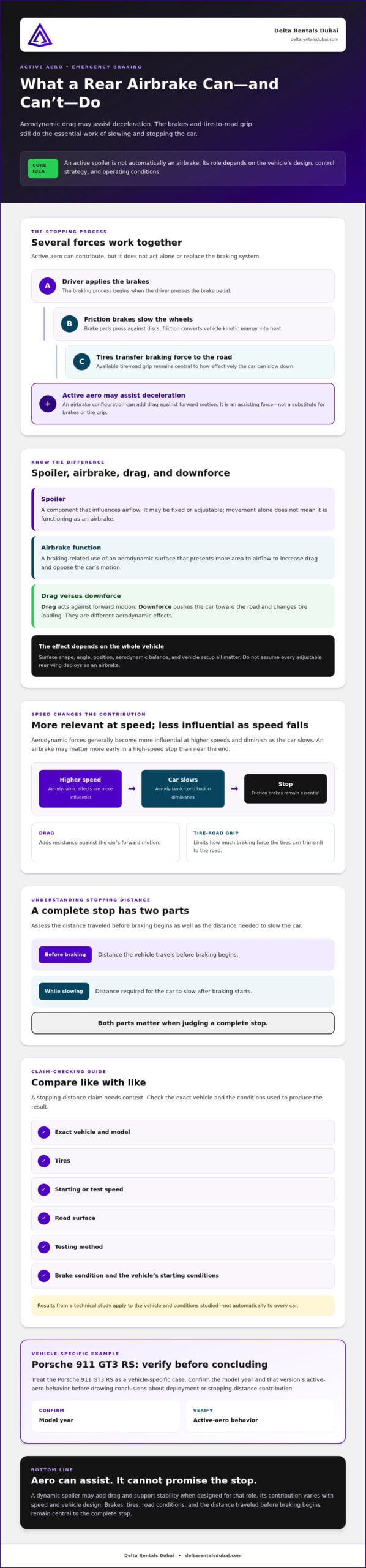
Emergency braking is a coordinated process. The driver presses the brake pedal, the braking system applies force at the wheels, and the tires transfer that force to the road. Active aero can add another influence, but it doesn’t act alone. Tires, brakes, and available road grip remain central to bringing a car to a stop.
Two aerodynamic effects matter, and they’re not interchangeable. Drag pushes against the car’s forward motion. Downforce pushes the car toward the road, changing the load on the tires. Depending on the vehicle’s design and balance, that load may affect the tires’ ability to generate braking force. Neither effect removes the limits of the tire-road contact.
Aerodynamic forces generally become more influential at higher speeds and diminish as the car slows. A spoiler’s contribution can therefore be more relevant early in a high-speed stop than near the end. A technical paper from SAE International examines how a rear spoiler can affect braking dynamics; its findings apply to the model and conditions studied, not every vehicle. See the SAE International paper on rear spoilers and braking dynamics.
What role do conventional brakes and ABS play?
Friction brakes slow the wheels as brake pads clamp against rotating discs. The resulting friction converts the vehicle’s kinetic energy into heat. The braking system manages this force, while the tires must transmit it to the road without exceeding the grip available.
Anti-lock braking systems (ABS) monitor wheel behavior and can adjust brake pressure when a wheel is at risk of locking. This helps the driver retain steering control during hard braking. ABS doesn’t create extra tire grip or guarantee a shorter stop; the outcome still depends on conditions and the vehicle.
How do tires and road conditions affect grip?
Tire condition, temperature, and inflation pressure can all influence how effectively a tire responds under braking. The road surface matters too. Wet pavement, loose material, or an uneven road may reduce or vary the grip available at each wheel. That can limit how much braking force the tires transfer to the ground, regardless of how sophisticated the brakes or active aero may be.
That’s why dynamic spoiler airbrake operation and emergency braking stopping distance can’t be judged from the spoiler alone. Consider the vehicle, tires, brakes, speed, and surface together. If you’re exploring a performance car, you can ask about the Porsche 911 GT3 RS rental while keeping any braking or aero claims specific to the model and configuration.
Does a Dynamic Spoiler Shorten Emergency Braking Stopping Distance?
It may help, but there’s no universal distance reduction. An active aero system can add drag and influence the vehicle’s aerodynamic load, yet its contribution depends on the car’s design, speed, and operating conditions. It can’t overcome limited tire grip or replace the conventional braking system.
Keep the two parts of a stop separate. Reaction distance is the distance traveled between spotting a hazard and beginning to brake. Braking distance is the distance traveled after braking starts until the vehicle stops. Together, they make total stopping distance. A spoiler can only influence the vehicle’s deceleration after braking begins; it can’t reduce the distance covered during the driver’s reaction.
Why does speed change an airbrake’s contribution?
Aerodynamic forces depend on airflow, so they change as vehicle speed changes. An airbrake’s drag contribution is generally greater at higher speeds and diminishes as the car slows. The effect is specific to the vehicle and its aero setup. Even at speed, aerodynamic assistance cannot make tires exceed the grip available at the road surface.
Which variables make stopping-distance comparisons unreliable?
A result is meaningful only with its test context. Starting speed, surface, tire condition, vehicle load, and measurement method can all affect the outcome. Driver reaction time also changes total stopping distance, though it isn’t part of a controlled braking-distance measurement. Compare like with like, rather than comparing a headline figure with a result from a different test.
| Factor | What it can influence | What to check |
|---|---|---|
| Active spoiler | Added drag and, depending on design, aerodynamic load | Exact model, configuration, and deployment conditions |
| Tire grip | How much braking force transfers to the road | Tire type and condition, plus test setup |
| Brakes | How braking force is applied and sustained | Vehicle configuration and test method |
| Starting speed | Both the braking challenge and potential aero contribution | Exact speed at the start of measurement |
| Road surface | Available grip and consistency | Surface type and condition during the test |
For a fair comparison, look for the exact vehicle and model year, tire specification, starting speed, road surface, vehicle load, and measurement procedure. Check whether the figure describes braking distance or total stopping distance, which also includes reaction distance. Treat any reported result as specific to its model and test, not a promise for another car or real-world situation. That’s how to assess dynamic spoiler airbrake operation and emergency braking stopping distance without overstating what active aero can deliver.
How to Evaluate Airbrake and Stopping-Distance Claims Safely
A short stopping-distance claim can sound definitive, but the details determine whether it’s useful. Before accepting a figure, check whether the source describes a controlled test of the exact vehicle configuration. A broad performance statement or dramatic demonstration may not provide enough information to assess the result.
What evidence makes a braking claim credible?
Look for a clear procedure, repeatable measurements, and enough information to understand what was tested. If a comparison changes the tires, surface, starting speed, or vehicle load, it may not isolate the effect of the airbrake. Independent testing can add confidence, but its value still depends on the quality and transparency of the method.
Use this checklist to assess a claim:
- 1. Vehicle: Does the source identify the exact model, model year, and relevant aerodynamic configuration?
- 2. Tires and load: Are tire type and condition, vehicle load, and other important setup details reported?
- 3. Test conditions: Does it state the starting speed and road surface, including relevant surface conditions?
- 4. Method: Is the measurement procedure explained, and were repeat runs or comparable test conditions used?
- 5. Source: Is the result from a documented test, and does the source distinguish measured results from manufacturer claims?
A credible stopping-distance claim identifies what was tested, how it was measured, and under which conditions; missing details mean uncertainty, not proof that the claim is false. Apply the same checks to claims about dynamic spoiler airbrake operation and emergency braking stopping distance. Keep a model-specific measurement tied to its source, configuration, and test conditions. Don’t turn it into a universal promise.
Why should drivers avoid experimenting on public roads?
Emergency-stop tests can put the driver, passengers, and other road users at risk. Public roads also bring unpredictable traffic and changing surfaces, making results difficult to compare. Don’t provoke an airbrake deployment or try to test stopping limits in ordinary driving.
For model-specific operating information, start with the vehicle manual and consult qualified professionals working in a controlled testing environment. Keep the car’s safety systems in their intended configuration; don’t disable them or attempt to force an emergency response.
If you’re considering a Porsche 911 GT3 RS rental, ask about the Porsche 911 GT3 RS rental and verify any vehicle-specific features before drawing conclusions about its braking performance.
Porsche 911 GT3 RS Active Aero: What to Verify Before Drawing Conclusions
The Porsche 911 GT3 RS is a useful example of performance-focused engineering, but it shouldn’t be treated as proof that every active rear wing functions as an airbrake. Equipment and control strategies can differ by model year and configuration. Before connecting this car’s aero system to emergency stopping distance, confirm exactly which version is being discussed and what its manufacturer says the system does.
For broader vehicle context, explore this Porsche 911 GT3 RS guide. Treat any braking or aerodynamic description as specific to the version and evidence cited, not as a general rule for all GT3 RS models.
Which GT3 RS details require model-year verification?
Check the manufacturer’s terminology and documentation for the relevant model year. Confirm which active-aero components are fitted, what functions Porsche assigns to them, and whether emergency braking changes a spoiler or wing position. If it does, verify the conditions that trigger the movement rather than assuming it deploys whenever the driver brakes hard.
Keep these details tied to the exact vehicle:
- Model year and configuration: Identify the version and the aero equipment it has.
- System terminology: Use the manufacturer’s name for each component and function.
- Deployment logic: Confirm whether braking affects aero position, and under what conditions.
- Test evidence: For any stopping-distance figure, check the source, speed, tires, surface, and test method.
Don’t transfer specifications or behavior between generations without supporting evidence. The presence of active aero alone doesn’t establish that a system deploys as an airbrake or shortens a stop by a particular amount. Apply the same care to claims about dynamic spoiler airbrake operation and emergency braking stopping distance.
How can performance engineering be experienced responsibly?
Appreciate the engineering without turning public roads into a test track. A rental experience is not a controlled braking test, and it shouldn’t be presented as a performance guarantee. Follow the vehicle’s operating guidance and keep driving within safe, appropriate conditions.
Delta Rentals Dubai offers Porsche 911 GT3 RS rentals. If you’d like to ask about the rental, visit the Porsche 911 GT3 RS rental page for information. Verify the specific vehicle’s details rather than assuming an aero feature or braking behavior.
Read Airbrake Claims with Confidence
An active spoiler can support deceleration by adding aerodynamic drag, especially at higher speeds, but it isn’t a substitute for friction brakes or tire grip. Total stopping distance also includes the driver’s reaction distance, while road conditions, vehicle setup, and test methods shape braking results.
That’s the key to understanding dynamic spoiler airbrake operation and emergency braking stopping distance: judge each claim in the context of the exact vehicle and test conditions. A feature’s name or presence alone doesn’t confirm when it deploys or how much it contributes. For a Porsche 911 GT3 RS, verify the specific model year and system behavior before drawing conclusions.
Delta Rentals offers Porsche 911 GT3 RS rentals for drivers interested in experiencing a performance-focused vehicle. For rental enquiries, ask about the Porsche 911 GT3 RS rental. Keep the focus on informed, responsible driving, and enjoy exploring the engineering with confidence.
Frequently Asked Questions
How does a car’s active spoiler work during emergency braking?
On a vehicle designed for this function, the active spoiler may change position during hard braking to meet the airflow at a different angle. This can increase drag, which resists forward motion, and may also alter aerodynamic load. The trigger, movement, and resulting effect are specific to the vehicle’s design and settings. Check the owner’s manual or manufacturer information for the exact model and year.
Does an airbrake reduce emergency stopping distance?
It may contribute to deceleration, particularly at higher speeds, but there’s no universal stopping-distance reduction. The result depends on the vehicle, aero setup, speed, tires, brakes, and surface. Understanding dynamic spoiler airbrake operation and emergency braking stopping distance also means separating braking distance from total stopping distance: driver reaction distance occurs before braking begins, and an airbrake can’t reduce it.
What affects a car’s emergency braking stopping distance most?
Starting speed, tire-road grip, brake performance, and road conditions are central factors. Tire condition and temperature, vehicle load, and the surface can also affect the stop. Driver reaction time adds distance before the brakes are applied. Because these variables interact, a result from one vehicle and test setup can’t automatically predict another car’s performance or a stop in different conditions.
Does an airbrake work at every speed?
An airbrake’s aerodynamic effect changes with vehicle speed because it depends on airflow. Its contribution is generally more pronounced at higher speeds and diminishes as the vehicle slows. The exact operating range and deployment behavior vary by vehicle, so check model-specific documentation. An airbrake isn’t a substitute for tire grip or friction brakes, particularly as the car approaches a stop.
Can an active spoiler replace a car’s brakes?
No. An active spoiler can provide aerodynamic assistance on vehicles designed to use it, but it can’t replace the conventional braking system. Friction brakes apply force at the wheels, and the tires transfer that force to the road. A spoiler’s effect depends on speed, design, and available grip. Never treat active aero as a reason to delay braking or rely less on the brakes.
How can I verify a claimed stopping-distance improvement?
Look for a documented test that identifies the exact vehicle and configuration, starting speed, tires, road surface, vehicle load, and measurement method. Check whether the comparison kept those conditions consistent and whether results were repeatable. A manufacturer statement may be useful, but missing test details mean the claim remains uncertain, not necessarily false. Don’t attempt emergency-stop tests on public roads; rely on documented testing and vehicle guidance.