
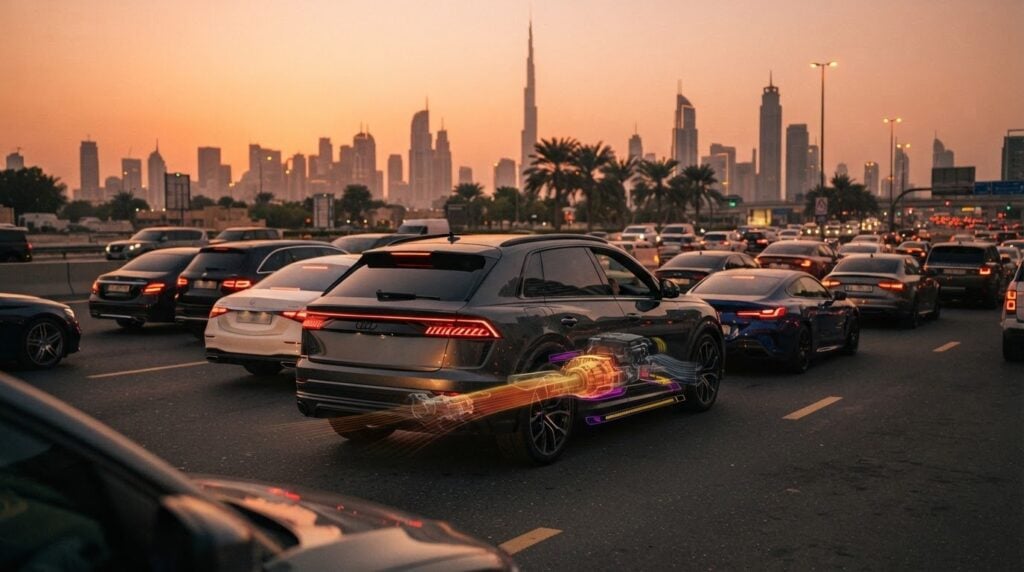
What if inching forward feels gentler on your car but creates more clutch heat? In dense stop-and-go traffic, repeated slow starts can make a dual-clutch gearbox slip as it manages movement, producing friction and heat. That’s why dual clutch gearbox temperature management in dense stop and go traffic is less about one universal trick and more about reducing unnecessary clutch slip.
If you’ve heard conflicting advice about creeping, shifting to Neutral, or staying in Drive, the uncertainty is understandable. Dual-clutch systems aren’t all alike: dry and wet clutches manage heat differently, and the right approach depends on the vehicle’s design and manufacturer guidance.
This guide explains how heat develops during crawling traffic, which driving habits may limit avoidable slip, and why using the accelerator to hold a car on a hill can add strain. You’ll also learn how to respond to a temperature warning, when to check the owner’s manual, and when a qualified inspection is the safer next step. Use the vehicle’s own instructions rather than treating every DCT the same.
Key Takeaways
- Dual-clutch designs vary, so check the vehicle’s manual before deciding how to handle creeping, brake-hold, or Neutral.
- Frequent short movements, slopes, load, ambient conditions, and driving style can all affect clutch workload in slow traffic.
- For dual clutch gearbox temperature management in dense stop and go traffic, anticipate traffic flow and leave space for smoother, more deliberate movement.
- Keep your attention on safe driving, not temperature checks while moving. Follow the vehicle’s instructions if a warning appears.
- Before choosing a rental for your planned drive, ask about the exact vehicle’s transmission specification and verify current availability.
Why dual-clutch gearbox temperatures can rise in stop-and-go traffic
A dual-clutch transmission (DCT) uses two clutches to manage gear changes, typically preparing one gear while the other is engaged. The design, control software, and cooling arrangement vary between vehicles, so one model’s behaviour or recommended driving technique may not apply to another. For an overview of the basic technology and wet- and dry-clutch designs, see Dual-clutch transmission (DCT).
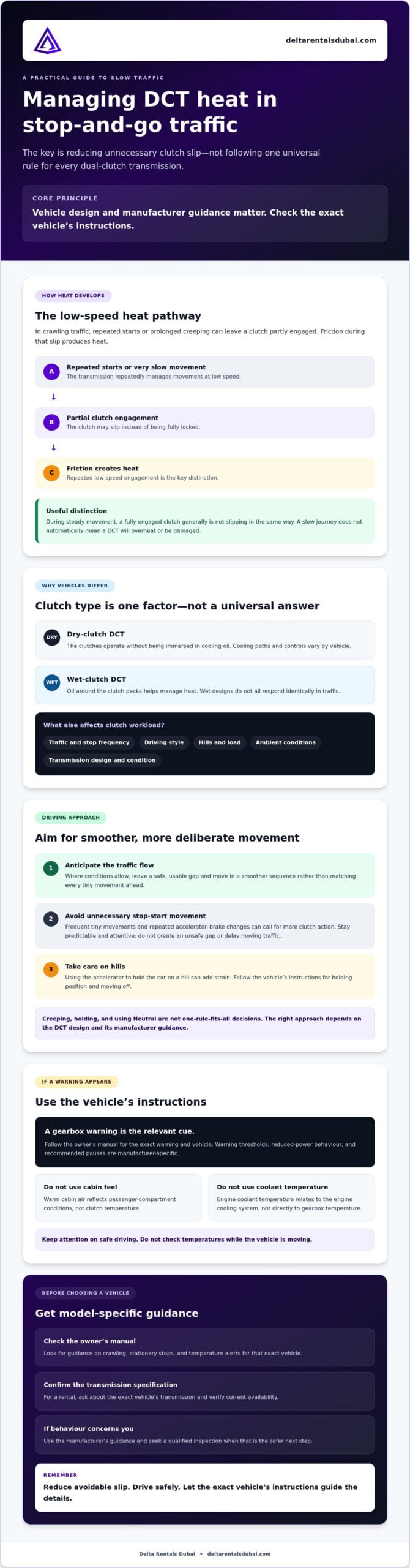
In crawling traffic, the gearbox may repeatedly engage and partially release a clutch to start the car or maintain very slow movement. That friction produces heat. This doesn’t mean every slow journey will overheat a DCT or cause damage. The amount of heat depends on how the vehicle is driven and how its transmission is designed to manage it.
How clutch slip creates heat at low speeds
As the vehicle pulls away, a clutch moves from disengaged to engaged, transferring engine power to the wheels. At walking pace, repeated starts or prolonged creeping can keep it partly engaged rather than fully locked. That slipping contact creates friction and heat. During steady movement, a fully engaged clutch generally isn’t slipping in the same way, so repeated low-speed engagement is the key distinction.
Keep transmission heat separate from other temperature cues. Engine coolant temperature relates to the engine’s cooling system, while warm cabin air reflects conditions inside the passenger compartment. Neither directly tells you the clutch temperature. If the vehicle displays a transmission or gearbox warning, follow the manual rather than using cabin feel or the coolant gauge to assess the gearbox.
Why wet- and dry-clutch DCTs may behave differently
Dry clutches operate without being immersed in cooling oil, while wet clutches use oil around the clutch packs to help manage heat. Cooling paths and controls differ, so “wet” doesn’t mean every system responds identically in traffic. Clutch type is one factor, not a guarantee that heat can’t build up.
For dual clutch gearbox temperature management in dense stop and go traffic, start with the vehicle’s owner’s manual. Check its guidance on crawling, stationary stops, and temperature alerts. Model-specific advice is more useful than applying a universal rule to every DCT.
What changes DCT heat build-up during dense stop-and-go driving?
There isn’t one traffic pattern that affects every dual-clutch transmission (DCT) in the same way. Clutch workload depends on how often the car starts, how long it moves at very low speed, and how the transmission’s software responds. A journey with steady stretches between queues may place different demands on the gearbox than repeated inching, stopping, and starting.
Clutch slip is the partial engagement of clutch surfaces as they transfer power, and the friction created during that slip produces heat. The more often a DCT manages partial engagement, the more its operating demands can change. A slow commute doesn’t automatically cause overheating or damage.
Traffic patterns and driving habits that increase clutch work
Continuous inching can keep the clutch working at low speed, while frequent tiny movements may call for repeated engagement. Where traffic and road conditions allow, leave a safe, usable gap so you can move in a smoother, more deliberate sequence instead of matching every small movement of the vehicle ahead. Don’t create an unsafe gap or delay when traffic is moving. The aim is to avoid unnecessary stop-start movement while remaining predictable and attentive.
Stop frequency matters, as does how the vehicle is operated. Repeatedly alternating between accelerator and brake can demand more clutch action than moving smoothly when space opens. The best approach still depends on the vehicle’s instructions and traffic flow.
Vehicle design, load, and operating conditions
Dry or wet clutch construction is only one factor in how a particular DCT behaves. Transmission design, cooling arrangements, control systems, and vehicle condition also matter. Hills can add demand as the car starts or holds position, and a heavier load may change how much work is required to move it. Frequent starts can combine with these demands.
Ambient conditions can also affect available cooling capacity, but the impact varies by vehicle and circumstances. Don’t assume a specific temperature limit or protective response applies to every model. Warning thresholds, reduced-power behaviour, and any recommended pause are manufacturer-specific. Check the owner’s manual for the exact vehicle, and follow its instructions if a gearbox alert appears.
For dual clutch gearbox temperature management in dense stop and go traffic, focus on what you can control: smooth movement, safe spacing, and model-specific guidance. If you’re planning a drive and want to ask about vehicle options, ask about available rental vehicles, including whether transmission details can be confirmed for the exact model and specification.
Creeping, holding, or using neutral: which approach helps manage DCT heat?
There isn’t one setting that suits every dual-clutch transmission (DCT) or every traffic queue. Continuous creeping can keep the clutch working at low speed, while smooth progress with space ahead may reduce unnecessary tiny starts. For a full stop, whether to remain in Drive, use a hold function, or select Neutral depends on the vehicle’s design and the manufacturer’s instructions.
Creeping versus moving smoothly with space ahead
Repeatedly advancing a short distance, braking, then moving again can require frequent clutch engagement. If traffic conditions allow, leave a safe gap and move smoothly when the queue advances rather than matching every minor roll of the vehicle ahead. Don’t leave a gap that disrupts traffic or compromise a safe following distance to avoid clutch use.
Some vehicles have creep functions or adaptive cruise control that can manage low-speed movement, but their operation and appropriate use vary. Follow the manual and stay ready to control the vehicle yourself. Driver-assistance features don’t replace attention to surrounding traffic.
When to stay in Drive, use a hold function, or select Neutral
Don’t shift to Neutral at every stop based on a blanket rule. Some vehicles are designed to remain in Drive while the brake is applied; others provide brake-hold or auto-hold functions with their own operating conditions. Neutral may be appropriate in certain situations, but the correct choice and any stop-duration guidance are model-specific. Check the owner’s manual before relying on a particular routine.
On an incline, use the brake or the vehicle’s approved hold function to keep the car stationary. Don’t balance it on the accelerator, which can cause clutch slip. Select a gear or function only when you can do so safely. Never look away from traffic or delay controlling the vehicle to change a setting.
General principle: reduce unnecessary creeping and use the brake to hold the car, but follow the owner’s manual for that DCT’s instructions on Drive, Neutral, and hold functions.
That balance is central to dual clutch gearbox temperature management in dense stop and go traffic: make smooth, safe progress where possible, then use the controls as the manufacturer directs. Prioritise road awareness over trying to manage gearbox temperature while moving.
How to manage a dual-clutch gearbox in stop-and-go traffic
A calm, consistent routine can reduce unnecessary clutch work without taking attention away from the road. Anticipate changes in traffic, move smoothly when there’s safe space, and follow the instructions for the specific vehicle. Don’t try to control gearbox temperature with abrupt moves or by watching a display while driving.
A simple routine for crawling traffic
- Look ahead. Notice when the queue is slowing or moving so you can avoid unnecessary last-second starts and stops.
- Leave safe space. When traffic allows, let a useful gap open and move with the flow rather than repeatedly inching forward. Never create a gap that makes your driving unpredictable or unsafe.
- Accelerate smoothly. Use measured inputs when it’s time to move. Avoid pressing harder to force progress through congestion.
- Hold position with the brake. Use the foot brake or an approved hold function as directed in the owner’s manual. Don’t use the accelerator to keep the vehicle stationary, especially on a slope.
Driving conditions can change quickly. Keep your focus on following distance, surrounding vehicles, and safe control. Don’t monitor a temperature display or change transmission settings while moving if doing so distracts you from traffic.
Responding to a warning or unusual transmission behavior
If a transmission warning appears, read the dashboard prompt when it’s safe to do so and follow the owner’s manual. If it tells you to stop, find a safe place as soon as conditions allow. Don’t ignore a warning or continue driving against the vehicle’s instructions. If the message persists or the transmission behaves unusually, seek qualified assistance.
If symptoms recur, note the warning wording and the conditions around it, such as slow crawling, a hill, or repeated stops. Record details only when safely parked. This information can help a qualified technician assess the concern, but it isn’t a diagnosis. Avoid repeatedly reproducing the symptom to test the car.
For dual clutch gearbox temperature management in dense stop and go traffic, use smooth, safe driving habits as a general guide, then let the vehicle’s manual govern its specific warnings and controls. If you’re planning a drive and want to confirm vehicle options, ask about available rental vehicles. Transmission details should be verified for the exact model and specification.
Choosing a vehicle for dense traffic and getting model-specific guidance
The right vehicle depends on the drive you’re planning, not on a blanket assumption that one transmission type suits every driver. Consider how much of the route is likely to involve slow queues, what matters for comfort, and whether you’re familiar with the vehicle’s controls. A vehicle overview can explain a model’s features, but it doesn’t confirm the gearbox in a specific rental car or how that transmission should be operated.
For example, the Porsche 911 GT3 RS rental guide offers an overview of that vehicle. Treat it as model information, not proof of a particular transmission or a recommendation for dense traffic. Confirm the exact vehicle and specification before relying on transmission-specific expectations.
Questions to ask before selecting a rental vehicle
Before confirming a vehicle, ask for its exact model year and specification. Then check:
- What transmission is fitted to that exact vehicle?
- Can the provider share the relevant operating guidance or owner’s manual?
- Which controls or instructions apply to low-speed traffic and stationary stops?
- Does the vehicle’s comfort and operation suit the planned route and your preferences?
These questions help you make an informed choice without assuming that a particular gearbox is automatically better for every journey. Model year and specification matter; vehicles with the same model name may not always have identical equipment.
Where to get reliable, vehicle-specific instructions
Use the owner’s manual and official manufacturer guidance for instructions on transmission modes, hold functions, warnings, and safe stopping. If a warning recurs, overheating is indicated, or the vehicle behaves abnormally, follow the manual and seek help from a qualified technician. A rental provider can help confirm vehicle details, but shouldn’t replace manufacturer guidance or a technical assessment.
For dual clutch gearbox temperature management in dense stop and go traffic, verify the details for the exact vehicle rather than choosing based on assumptions. Explore vehicle rental options, then ask about rental options and confirm the vehicle’s specifications before making a decision. Check transmission details and current availability for the exact vehicle.
Drive with confidence by checking the details first
Dual-clutch gearboxes can build heat when repeated low-speed clutch engagement creates extra friction, but slow traffic doesn’t automatically mean overheating or damage. Smooth, safe progress can reduce unnecessary starts, while the right use of Drive, Neutral, and hold functions depends on the exact vehicle. Follow its owner’s manual, and take transmission warnings or recurring unusual behaviour seriously.
Good dual clutch gearbox temperature management in dense stop and go traffic starts with calm driving and model-specific guidance. Before choosing a vehicle for your planned route, confirm its exact model year, transmission specification, and relevant operating instructions. A model overview is helpful, but it isn’t proof of the gearbox fitted to a particular rental vehicle.
Delta Rentals Dubai’s listed fleet includes the Porsche 911 GT3 RS. Ask about the exact vehicle specification and current availability before making plans. Ask Delta Rentals Dubai about available vehicles and make your next drive with greater clarity and confidence.
Frequently Asked Questions
Can stop-and-go traffic overheat a dual-clutch gearbox?
Yes, repeated clutch engagement and slip in crawling traffic can generate heat, but congestion alone doesn’t prove the gearbox is overheating or damaged. The risk depends on the transmission’s design, driving conditions, and how the vehicle is operated. Follow the owner’s manual rather than relying on a universal temperature threshold. If a transmission warning appears and persists, take it seriously and follow the vehicle’s instructions.
Should I shift a dual-clutch car into neutral at every traffic light?
No, there’s no universal rule for every DCT or every stop. The manufacturer may specify when to remain in Drive, select Neutral, or use brake-hold or auto-hold. Check the owner’s manual and keep the vehicle securely controlled with the recommended brake or hold function. Don’t change modes if doing so distracts you from traffic or conflicts with the vehicle’s instructions.
Is it bad to let a dual-clutch car creep in traffic?
Occasional low-speed movement isn’t automatically harmful, but repeated or prolonged creeping can involve clutch slip and add heat. When it’s safe and traffic allows, move smoothly instead of inching forward repeatedly. Don’t hold the car in place with the accelerator. Acceptable operation depends on the transmission design and the vehicle’s instructions, so check the owner’s manual for guidance specific to your model.
How can I reduce dual-clutch gearbox heat in dense traffic?
Anticipate traffic, leave a safe space ahead, and move smoothly when the queue advances. Avoid repeated tiny accelerations, and use the brake or a hold function as specified by the manufacturer. For dual clutch gearbox temperature management in dense stop and go traffic, treat these as general habits, not a substitute for model-specific instructions. Road safety comes first, so keep your attention on traffic and vehicle control.
What should I do if my dual-clutch gearbox temperature warning appears?
Follow the dashboard message and the owner’s manual. If the instructions tell you to stop, prioritise finding a safe place to do so. Don’t ignore the warning, continue driving against the vehicle’s guidance, or attempt a roadside diagnosis. If the warning returns or the transmission behaves unusually, contact qualified assistance. Share the warning message and the driving conditions in which it appeared.
Do dry-clutch and wet-clutch DCTs handle traffic heat differently?
Yes, their clutch and cooling arrangements differ, so heat behaviour and recommended operation may differ too. A wet-clutch system uses oil around the clutch packs, while a dry-clutch system doesn’t use that arrangement. That distinction alone can’t predict how a specific car will respond, and neither type is always best for congestion. Identify the transmission fitted to your vehicle and check its manual or manufacturer guidance.
Can a rental car’s transmission type be confirmed before booking?
Ask the rental provider to confirm the exact vehicle, model year, and transmission specification before relying on gearbox-specific expectations. A model name alone doesn’t confirm the transmission fitted to a particular car, and fleet specifications may vary. Request relevant operating guidance as well, especially if your planned drive includes dense traffic. Confirm current availability for the exact vehicle before making plans, then follow its owner’s manual while driving.