

When deep cleaning fees for car rentals explained means more than a label, the key distinction is between routine turnover cleaning and extra interior treatment for a substantial mess, stain, or lingering odour. A fee name alone doesn’t tell you what work was needed. The useful evidence is the vehicle’s documented condition, the treatment described, and the rental terms that apply.
It’s reasonable to want a clear line between an ordinary return and an additional cleaning charge, especially when a deduction could affect your security deposit. Rental agreements can define cleaning responsibilities differently, and phrases such as “excessively dirty” may need context. A charge label by itself doesn’t show what work was required or whether the condition was already present.
This guide explains what a deep-cleaning fee may cover and how to review one using practical evidence. You’ll learn which agreement terms to read, how pickup and return photos can help establish the vehicle’s condition, and how to compare a cleaning claim with the records. For a premium rental in the United Arab Emirates, a few careful checks can make expectations clearer and help you return the car with a useful record.
Key Takeaways
- Deep cleaning fees for car rentals explained: a fee label alone doesn’t show what treatment was needed or whether the rental terms support the charge.
- Assess a charge by connecting the recorded condition to the affected area, the work described, and the relevant agreement terms.
- Compare an ordinarily used cabin with specific issues such as spills, persistent odours, or residue across multiple surfaces.
- Use a simple timeline: review the agreement, document the vehicle at handover and return, and keep any charge records.
- Before booking a premium vehicle, understand the cleaning terms and how the return condition and any charges are documented.
What do deep cleaning fees for car rentals actually cover?
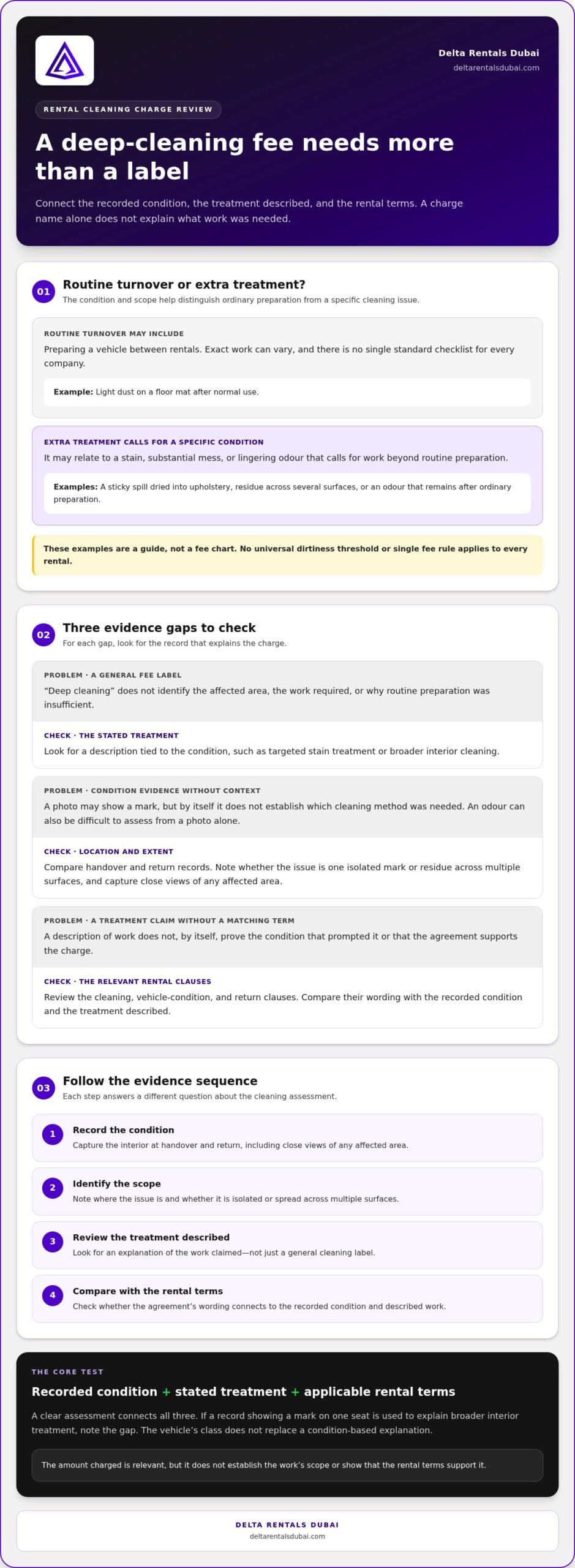
A deep-cleaning fee is an additional charge that may relate to interior work beyond routine vehicle turnover. It could cover targeted treatment for a stain or more extensive cleaning linked to the vehicle’s recorded return condition. The label alone doesn’t establish what work was needed, whether it was carried out, or whether the rental agreement allows the charge.
Rental vehicles are prepared for successive customers as part of the wider car rental industry. That general context doesn’t determine the terms of an individual rental. Agreements and assessment practices differ, so there is no universal dirtiness threshold or single fee rule for every vehicle.
Routine turnover cleaning versus additional interior treatment
Routine turnover cleaning is the preparation a vehicle may receive between rentals. The exact work can vary, and there isn’t one standard checklist for every company. Additional treatment is different: it should relate to a specific condition, such as a drink spill dried into upholstery, residue across several surfaces, or an odour that remains after ordinary preparation.
For example, light dust on a floor mat after normal use is different from a sticky, visible spill on a seat. The first condition alone doesn’t show that a deep-cleaning charge is appropriate. The second gives you a specific issue to assess against the return record, the work described, and the cleaning terms in the agreement.
What the phrase deep-cleaning fee does, and doesn’t, tell you
“A fee label describes a category; the evidence should explain the condition, the work required, and the agreement term behind the charge.” A description such as “deep cleaning” isn’t an itemized account. It doesn’t identify the affected area, the treatment performed, or why routine preparation was insufficient.
Review those details separately. First, identify the recorded condition, such as a stain on one seat or residue across several interior surfaces. Next, look for a description of the work said to be required, such as targeted stain treatment or broader interior cleaning. Then compare that explanation with the agreement’s cleaning terms. The amount charged is also relevant, but it doesn’t establish the work’s scope or show that the terms support it.
That’s the practical way to get deep cleaning fees for car rentals explained: connect the vehicle’s condition with the treatment claimed and the rental terms, rather than relying on a label or the car’s premium status.
How are rental-car deep-cleaning assessments usually evaluated?
A useful assessment follows a clear sequence: document the vehicle’s condition, identify the affected area, explain the work said to be necessary, then compare that explanation with the rental terms. Each step answers a different question. What was present? Where was it? What treatment was proposed? Which agreement clause applies?
Keep the visible condition separate from the cleaning method. A photo may show a mark on a seat, but it won’t establish by itself whether spot treatment or broader interior work was needed. Similarly, a description of a treatment doesn’t prove the condition that prompted it. A clear review connects both records.
Which condition details can affect a cleaning assessment?
Stains, residue, and odours can all be relevant, but none automatically proves that an extra charge applies. Note the location and extent: one small mark differs from residue across several surfaces, while an odour may be difficult to assess from a photo alone. Clear handover and return records help show what changed during the rental and what was already present.
Use this evidence sequence:
- Record the condition: Capture the interior at handover and return, with close views of any affected area.
- Identify the scope: Distinguish one isolated mark from an issue spread across multiple surfaces.
- Describe the treatment: Look for an explanation of the work claimed, not just a general cleaning label.
How cleaning scope and rental terms fit together
Find the agreement’s cleaning, vehicle-condition, and return clauses. Compare their wording with the condition recorded at return, then check whether the described treatment relates to that condition. The agreement sets expectations, while the charge description and condition evidence help explain how those terms apply.
A cleaning assessment is clearest when the recorded condition, stated treatment, and applicable rental terms support the same explanation. If one part is missing or doesn’t align, note the specific gap. For example, a record showing a mark on one seat may not, on its own, explain a claim for broader interior treatment. The vehicle’s class doesn’t fill that gap. A premium model still calls for a condition-based explanation, not an assumption based on its badge.
This evidence-first approach helps get deep cleaning fees for car rentals explained without assuming a universal threshold, formula, or standard rate. If you’re planning a premium vehicle rental, you can discuss your rental plans and consider the agreement and condition records as part of your preparation.
Which return scenarios may lead to routine cleaning or extra treatment?
Use these examples as a guide, not a fee chart. A return condition may fit routine turnover cleaning or prompt a closer look at additional treatment, depending on its extent, the recorded condition, and the rental agreement. The same type of mark can have different implications if it is isolated in one spot or spread across the cabin.
| Return condition | Likely cleaning category | Useful evidence | Agreement check |
|---|---|---|---|
| Light dust or minor signs of ordinary use | May fit routine turnover cleaning | Clear return photos showing the cabin overall | Review the clauses describing acceptable return condition and cleaning responsibilities. |
| A few crumbs or a small, dry mark | May be handled during routine preparation, depending on the terms | Close-up photo that shows the mark’s size and location | Check whether the agreement distinguishes everyday use from extra cleaning. |
| A concentrated drink spill on upholstery | Could call for targeted treatment if the condition warrants it | Photos showing the affected area, extent, and any visible residue | Compare the relevant cleaning clause with the described condition and treatment. |
| Residue across several interior surfaces | May require broader interior work, depending on its extent | Wide and close views that show how far the residue reaches | Look for terms covering excessive dirt or additional interior cleaning. |
| Odour that remains at return | May prompt further assessment; a photo alone may not establish it | A dated return record and any written condition notes | Review any clause addressing odours and how return condition is recorded. |
Examples that may fit routine turnover cleaning
Light dust on a dashboard or faint signs of normal cabin use can be consistent with an ordinarily used vehicle. These examples don’t show that extra work was needed. Compare the return record with the agreement’s cleaning terms, and check whether the charge description identifies a condition beyond routine preparation.
Examples that may need specific interior treatment
A concentrated spill, substantial residue, or persistent odour may call for more than general turnover work, but none automatically triggers a fee. For a spill, record its location and spread. For residue, show the affected surfaces. For an odour, keep any written inspection notes with the return record. The evidence should clarify both the condition and the scope of treatment being claimed.
This is how deep cleaning fees for car rentals explained becomes practical: assess what the vehicle looked like, how extensive the issue was, and whether the agreement addresses it. Don’t treat an example as a guaranteed outcome. Use it to identify which records and terms matter.
How can you document a rental car’s condition and review a cleaning charge?
A simple timeline gives you a clearer record if a cleaning charge appears later. Keep the rental agreement, condition report, and photos together so you can compare handover and return records with the charge description. Take photos or video only where permitted and practical. Make sure images are clear and time-stamped where possible.
Before and during the rental
Start with the paperwork. Before accepting the vehicle, review the agreement’s cleaning, return-condition, and inspection wording. Save a copy you can access during the rental. At handover, record the interior consistently: take wide views of the cabin, then close-ups of existing marks, stains, or residue. Note each issue’s location and make sure the record reflects the vehicle’s condition rather than relying on memory.
Keep the condition report with your photos. If you notice a detail that isn’t captured clearly, use the rental company’s stated process to have it recorded. A useful handover record can help distinguish a pre-existing condition from something first documented at return.
At return and if a cleaning charge appears
Before handing the vehicle back, take another set of interior photos or a short video, if permitted. Include wide views and clear close-ups of relevant areas. Keep the files with the return receipt or condition report, along with any messages about the vehicle’s condition.
- Save the charge record. Keep the notice, receipt, or other charge information with the agreement and return documents.
- Review the description. Where the rental company’s process allows, request or review an itemized explanation of the cleaning work said to be required.
- Compare the records. Match the described area and treatment against your handover and return evidence, then review the relevant agreement wording.
- Use the stated process. If details don’t align, raise the specific discrepancy through the rental company’s stated channel. Keep your communication and any response in writing where possible.
For example, if a notice refers to treatment across the cabin but your return record shows a single marked area, compare the claimed scope with the explanation and applicable terms. Documentation can help clarify the facts, but it doesn’t guarantee a particular outcome. This evidence-led approach helps get deep cleaning fees for car rentals explained without assuming that a label alone proves what happened.
If you’re planning a premium rental, discuss your rental plans with the Delta Rentals Dubai team.
How to set clear expectations before choosing a premium car rental
A well-planned rental starts before pickup. Understand three things before reserving: what the agreement says about interior condition, how the vehicle’s condition is recorded at handover and return, and how any additional cleaning charge is described. These details give you a practical reference if questions arise later.
What to understand before reserving a premium vehicle
Read the cleaning and return-condition terms, including any wording about additional interior treatment. Look for how handover and return inspections are documented, and what information a charge description should provide. Review the full agreement rather than relying on a booking summary or a label such as “deep cleaning.” Keep a copy accessible so you can refer to the exact wording during the rental.
- Cleaning terms: Note what the agreement says about routine condition and additional interior work.
- Condition records: Understand how the vehicle’s interior is documented at handover and return.
- Charge descriptions: Look for an explanation that connects a claimed treatment with the recorded condition.
A vehicle’s premium status doesn’t, by itself, explain or justify a cleaning charge. The relevant questions remain the same: what condition was recorded, what work was described, and how do the applicable terms relate to it? Clear expectations benefit both renter and rental business, particularly when the vehicle is a high-performance or luxury model.
A clear next step for planning your rental
Careful preparation helps make the experience more straightforward, without assuming that every rental has identical policies. Delta Rentals offers premium and luxury vehicles, including the Porsche 911 GT3 RS, Rolls Royce Cullinan Black Badge, and McLaren Artura. Explore the premium vehicle rental options while keeping the rental terms and condition-record process in mind.
The main point in having deep cleaning fees for car rentals explained is to judge a charge by its evidence and the agreed terms, not by the vehicle badge or fee label alone. A clear record gives you a more useful basis for understanding expectations before you drive.
Explore your rental options with Delta Rentals.
Make your next rental feel clearer from the start
Deep cleaning fees for car rentals explained comes down to three practical checks: distinguish routine preparation from extra interior treatment, read the agreement’s cleaning and return terms, and compare any charge description with the vehicle’s documented condition. A label alone isn’t the full explanation. Keep clear handover and return records so you can review the details with confidence.
These habits are useful for every rental, including a premium vehicle. Delta Rentals offers a fleet of high-performance and luxury vehicles for customers across the United Arab Emirates. A little preparation can help set expectations and support a smoother rental experience.
Ready to plan your drive? Discuss your rental plans with the Delta Rentals team. Choose your next vehicle with clarity and enjoy the road ahead.
Frequently Asked Questions
Is a deep-cleaning fee the same as routine car-rental cleaning?
No. Routine turnover cleaning prepares a vehicle between rentals; a deep-cleaning charge may refer to additional interior treatment linked to a particular condition. There’s no universal rule that defines the boundary for every rental. Read the agreement to see how it describes cleaning and return condition, then compare those terms with handover and return records. Ordinary use alone doesn’t establish that extra treatment was needed or that a charge applies.
Can a rental company charge a cleaning fee for a small stain?
A small stain alone doesn’t establish whether a cleaning charge is justified or unjustified. Its location, type, and effect on the interior may influence the work said to be necessary, while the rental terms describe applicable responsibilities. Compare the charge description with condition records from handover and return. A close-up photo can help show the stain’s size and location, but the agreement and stated treatment also matter.
What evidence should I keep if I am charged a deep-cleaning fee?
Keep the rental agreement, handover and return condition records, dated interior photos where practical, and the charge description. Photos should show both the overall cabin and close views of any relevant mark or residue. Together, these records help establish what was present at pickup, what was recorded at return, and what work the company says was needed. Keep related messages or receipts with the same file for easy comparison.
Are deep-cleaning fees included in a rental car’s standard cleaning?
That depends on the rental agreement. Routine preparation between rentals is distinct from additional treatment for a particular interior condition, but policies can vary. Don’t assume every cleaning task is included, or that every task is charged separately. Review the agreement’s cleaning, vehicle-condition, and return terms before accepting the car. If a charge appears, compare its description with the condition record and relevant wording.
Can a security deposit be used to cover a cleaning charge?
How a security deposit is handled depends on the rental agreement and applicable process. Review the deposit terms alongside the cleaning-charge description to understand what the company says the amount relates to and how it was applied. Keep the notice, agreement, and condition records together. Don’t assume a particular deduction, refund timeline, or outcome. Follow the rental company’s stated process if you need clarification.
How can I avoid unexpected car-rental cleaning charges?
Before booking, review the cleaning and return-condition terms. At handover, document the interior with clear, dated photos where practical, and keep the condition report and agreement accessible. Record the vehicle again at return and save any receipt or inspection notes. These steps can make expectations and condition easier to review if questions arise, but they can’t guarantee that no cleaning charge will be assessed.
What should I do if a rental car deep-cleaning charge seems unclear?
Save the charge notice, then compare its description with the rental agreement and your handover and return records. Check whether the stated work connects to a condition documented at return. The central point in deep cleaning fees for car rentals explained is to assess the evidence, not rely on the label alone. If something remains unclear, follow the rental company’s stated review process and keep your communications and supporting records.