

What if a cold engine’s changing rev behaviour is a safeguard, not a fault? It’s easy to confuse a raised idle after startup with a rev limiter, or to worry that any increase in engine speed could cause damage. But cold start engine rev limiting systems on high performance sports engines are only one possible control, not a universal warm-up rule. Some systems temporarily restrict revs; a higher idle, by contrast, can simply be part of the engine’s startup behaviour.
The distinction matters. Engine oil and other components need time to reach operating temperature, but that doesn’t mean every performance car requires the same routine or a long stationary warm-up. Understanding the controls can help you drive with confidence without mistaking one model’s behaviour for a rule that applies to all.
This guide explains why a cold-start rev limit may be used, how it differs from elevated idle and other rev limiters, and what a responsible warm-up looks like in practice. You’ll learn why gentle driving is generally preferable to aggressive acceleration while the engine is cold, which dashboard cues may help, and why the owner’s manual should take priority for model-specific instructions. Before driving an unfamiliar performance car, take a moment to understand its guidance and controls.
Key Takeaways
- Learn how cold-start rev limits differ from elevated idle and the engine’s normal rev limiter.
- Understand how cold start engine rev limiting systems on high performance sports engines may use temperature-related inputs, while behaviour varies by model.
- See what cold-start controls, normal rev limits, and driver-selected modes are designed to do, and which details depend on the vehicle.
- Use a measured warm-up approach: check warnings, drive gently, and follow the owner’s manual rather than relying on prolonged idling.
- Before driving an unfamiliar performance car, review its controls and guidance. A rev limit alone doesn’t tell you when the engine is warm.
What Do Cold Start Engine Rev Limiting Systems on High Performance Sports Engines Mean?
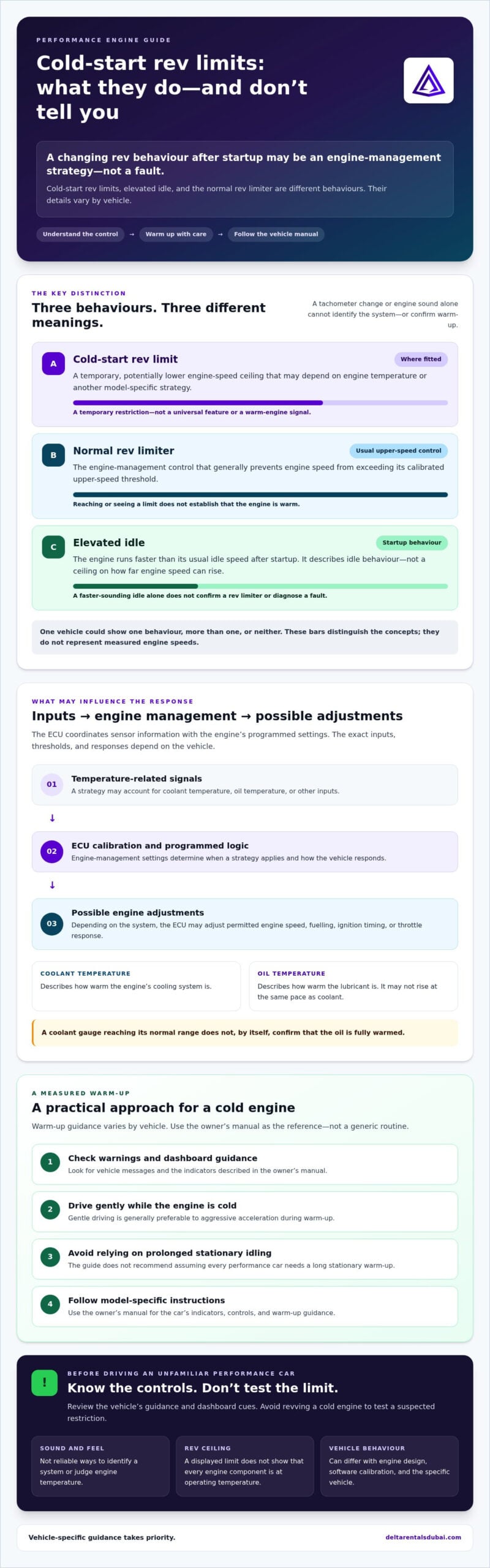
A cold-start rev limit, elevated idle, and normal rev limiter describe different behaviours. A rev limiter is an engine-management control that restricts engine speed under specified conditions. The standard limiter generally prevents the engine from exceeding its calibrated upper-speed threshold. A cold-start limit, where fitted, can temporarily set a lower ceiling based on engine temperature or another model-specific strategy.
In brief: A cold-start rev limit is a temperature-dependent engine-speed restriction. The normal rev limiter is the engine’s usual upper-speed control, not necessarily a signal that the engine is warm. The distinction matters because the tachometer’s red zone, a displayed limit, and the engine’s current readiness may not mean the same thing.
The exact control method varies. A Rev limiter may manage engine speed through fuel or ignition intervention, while the vehicle’s broader calibration determines when and how a limit applies. Cold start engine rev limiting systems on high performance sports engines aren’t universal. Behaviour can differ with engine design, software calibration, and vehicle. Don’t assume every sports car uses a separate cold limit.
Is a Cold-Start Rev Limiter the Same as High Idle?
No. Elevated idle means the engine runs faster than its usual idle speed after startup. A rev limit restricts how far engine speed can rise, including when the driver presses the accelerator. A car could exhibit one behaviour, both, or neither. If the engine sounds unusually fast at startup, that alone doesn’t confirm a limiter or diagnose a fault. Check the tachometer and any dashboard messages instead.
Why Can Cold-Start Behaviour Feel Different?
Startup calibration may affect idle speed, throttle response, or permitted engine speed. You might notice a different pedal response or a changing tachometer display, but some vehicles provide no obvious visual cue. Sound and feel aren’t reliable ways to identify the system or judge engine temperature. Check the owner’s manual for the car’s indicators and instructions, especially before driving an unfamiliar performance vehicle.
Think of a cold-start restriction as one possible engine-management strategy, not a universal warm-up gauge. Even if a displayed rev ceiling changes, it doesn’t establish that every engine component has reached its operating temperature. Use the vehicle’s specific guidance as your reference, and avoid testing a suspected limit by revving a cold engine.
How Engine Management Controls Revs Before the Engine Warms Up
The engine control unit (ECU) coordinates information from sensors with the engine’s operating settings. Depending on the vehicle’s design, it can adjust functions such as fuelling, ignition timing, and throttle response. For an overview of the system, DSPORT Magazine’s Engine Management Systems guide explains the ECU’s role in managing engine operation.
Sensor inputs, ECU calibration, and conditional engine-speed control work together: a vehicle may use temperature readings to select a cold-start strategy, then adjust permitted engine speed or other responses according to its programmed logic. The sensors, thresholds, and resulting behaviour vary by model. That’s why cold start engine rev limiting systems on high performance sports engines can’t be described by one universal rule.
Which Temperature Signals Can Influence Cold-Start Calibration?
Coolant temperature describes how warm the engine’s cooling system is; oil temperature describes how warm the lubricant is. These readings are related, but they don’t necessarily rise at the same pace. A coolant gauge reaching its normal range therefore doesn’t, by itself, confirm that the oil is fully warmed.
Some engine-management strategies may account for coolant temperature, oil temperature, or other inputs. The specific sensors used and any operating guidance depend on the vehicle. Don’t rely on a generic temperature threshold or fixed warm-up time. Check the owner’s manual for the particular car.
How Does a Rev Limiter Restrict Engine Speed?
Depending on the system, electronic control may limit engine speed by adjusting fuel delivery, ignition, or throttle operation. These are possible approaches, not a checklist used by every manufacturer. A driver might notice reduced response or a displayed limit, but the exact signal and sensation depend on the vehicle’s calibration.
A temporary cold-operation limit is not the same as the engine’s redline or its maximum rated performance. Redline refers to the upper engine-speed range specified for operation; a conditional limit may apply under particular circumstances. Neither the displayed ceiling nor a change in response should be treated as proof that all components are warm. Exact thresholds and control logic require manufacturer documentation.
Before driving an unfamiliar performance car, learn its controls and read its operating guidance rather than trying to test the limiter. If you’re considering a performance-car rental, ask which vehicle-specific instructions are available so you can familiarise yourself before setting off.
Cold-Start Limits, Redlines, and Engine Protection: What’s Different?
These controls can all affect engine speed, but they serve different purposes. A cold-start limit may temporarily restrict revs under certain conditions. The normal rev limiter prevents the engine from exceeding its programmed upper-speed threshold. Driver-selected modes can alter how the car responds, but their effect on revs depends on the vehicle. None makes hard acceleration on a cold engine automatically safe.
| Control | When it may operate | What it affects | What varies by model |
|---|---|---|---|
| Cold-start control | During specified cold-engine conditions | May temporarily restrict permitted engine speed | Temperature inputs, thresholds, and control method |
| Normal rev limiter | As engine speed approaches its programmed upper limit | Restricts engine speed to help prevent exceeding that limit | Limit value and how the system intervenes |
| Driver-selected mode | When the driver selects a mode, if available | May change throttle response or other settings; it may not change the rev limit | Which settings change and whether cold-operation controls remain active |
Does a Cold Engine Need a Lower Rev Limit?
Manufacturers may calibrate cold operation differently because engine conditions change as components and fluids warm. Oil temperature and circulation, for example, are part of the broader picture. A temporary engine-speed restriction can be one element of a model’s strategy. Not every car uses a separate cold limit, and there’s no universal RPM ceiling or damage threshold that applies to every sports engine.
Think of a limiter as a control, not an invitation to approach its ceiling. Cold start engine rev limiting systems on high performance sports engines can shape how the engine responds, but their presence doesn’t make aggressive revving harmless or replace careful operation.
Does the Rev Limiter Mean the Engine Is Ready for Hard Driving?
No. A rev limit is not a complete measure of oil temperature or the condition of every engine and drivetrain component. Even if a limit changes or disappears, that alone doesn’t confirm the whole vehicle has reached operating condition. Warm-up involves more than the engine-speed threshold.
Follow the owner’s manual for the specific car, including any instructions about warm-up, temperature displays, and driving modes. A general rule or dashboard cue can’t replace manufacturer guidance. If you’re learning an unfamiliar performance car, identify its relevant warnings and controls before driving, and keep acceleration measured until its instructions indicate normal operation.
How to Warm Up a High-Performance Engine Responsibly
A careful warm-up doesn’t require guessing at a universal idle time or testing the rev limiter. Start normally, check the vehicle’s instructions, then build speed and engine load smoothly. Follow the manufacturer’s guidance for that specific car, since warm-up indicators and procedures can vary.
- Start normally. Use the vehicle’s standard starting procedure. Don’t press the accelerator to make the engine rev.
- Check the instrument cluster. Look for warning lights, messages, or temperature information. Respond as the owner’s manual directs.
- Set off gently when appropriate. Use smooth throttle inputs and avoid high engine speeds, heavy acceleration, or hard engine load while the vehicle is warming up.
- Follow the manual. Use its instructions for warm-up, operating temperatures, and any model-specific restrictions.
A rev limiter is not permission to push a cold engine. It may restrict engine speed under certain conditions, but it can’t make aggressive driving harmless or confirm that every component is ready for hard use.
What Should You Do Immediately After a Cold Start?
Take a moment to read the instrument cluster and note any warnings before driving. If the manual permits you to continue, keep your inputs smooth and engine load conservative. Don’t rev the car to discover where a limit engages. A higher idle or unfamiliar response alone doesn’t establish whether the vehicle is operating normally, so use the car’s guidance rather than trying to diagnose it by sound.
Prolonged stationary idling isn’t a universal substitute for gentle driving. Idling may warm some parts differently from driving, while a cautious journey can bring several vehicle systems up to temperature together. The right approach depends on the model and conditions, so don’t apply a fixed routine if the manufacturer gives different instructions.
When Should You Stop and Seek Guidance?
Don’t ignore a persistent warning, unusual noise, or unexpected engine behaviour. If one appears, reduce demand on the vehicle and stop somewhere safe when appropriate. Consult the owner’s manual and seek qualified assistance if the warning or symptom continues. A cold-start sound or sensation alone isn’t enough to identify a mechanical fault.
Before driving an unfamiliar performance car, make sure you know where to find its warnings and operating instructions. If you’re considering a performance-car rental, ask Delta Rentals Dubai about the vehicle’s operating guidance so you can clarify the instructions before setting off. The same principle applies to cold start engine rev limiting systems on high performance sports engines: understand the specific vehicle, then drive within its instructions.
What to Know Before Driving a Rented High-Performance Sports Car
Cold-start behaviour is specific to the vehicle. A rev limiter, if present, isn’t a warm-up gauge and can’t tell you whether the engine or other components are ready for demanding driving. Before setting off in an unfamiliar performance car, take time to review its operating instructions, dashboard warnings, and controls. The details matter more than assumptions based on another model.
Which Questions Should You Ask Before Setting Off?
Ask the provider to show you where to find the vehicle’s manual or operating instructions and explain any key dashboard warnings. Clarify which start-up sounds or displays are normal for that specific car, and what to do if a warning appears. Rental-specific guidance can differ, so confirm it directly rather than assuming that a cold-start system works like one you’ve encountered before.
- Where can you find the owner’s manual and the instructions for dashboard warnings?
- What start-up behaviour is expected for this vehicle?
- Are there any vehicle-specific warm-up or operating instructions to follow?
These questions don’t require you to diagnose the engine. They help you understand the controls, identify relevant guidance, and know who to contact if the car behaves unexpectedly.
Make an Informed Performance-Car Rental Choice
Delta Rentals Dubai lists the Porsche 911 GT3 RS as a rental offering. That makes it a relevant performance-car example, not evidence of any particular cold-start limiter or engine-management behaviour. Confirm the specific vehicle’s instructions with the provider and consult its manual before relying on assumptions. The same care applies to cold start engine rev limiting systems on high performance sports engines: general principles can explain why controls may differ, but only vehicle-specific guidance can tell you what to expect.
Understanding the car’s start-up procedure, warnings, and driving modes helps make the experience more confident and considered. Keep your questions practical, follow the manufacturer’s instructions, and avoid testing a limiter to find its threshold.
If you’re considering this model, you can ask about renting a Porsche 911 GT3 RS and request the vehicle-specific operating guidance before you set off.
Drive with Confidence by Knowing the Car
A cold-start rev limit, elevated idle, and normal rev limiter serve different roles, and their behaviour depends on the vehicle. A limiter isn’t a warm-up gauge or permission to accelerate hard while the engine is cold. For cold start engine rev limiting systems on high performance sports engines, the practical rule is simple: understand the specific car’s instructions, watch its warnings, and warm it up as the manufacturer directs.
That preparation matters even more in an unfamiliar performance car. Delta Rentals Dubai lists the Porsche 911 GT3 RS among its rental offerings, but its specific cold-start behaviour should be confirmed through the vehicle’s own guidance, not assumed from general principles.
To explore the car, ask about renting a Porsche 911 GT3 RS and request the vehicle-specific operating instructions before you set off. A little familiarisation helps you approach the drive with greater confidence.
Frequently Asked Questions
Do all high-performance sports cars have a cold-start rev limiter?
No, cold-start rev limiters aren’t fitted or calibrated identically across all high-performance cars. Some vehicles may use temperature-related engine controls, while others may manage cold operation differently or show no obvious rev limit to the driver. The sensors, dashboard cues, and thresholds depend on the model. Check the owner’s manual for the specific car rather than assuming that a feature found in one sports engine is present in another.
Can I rev a sports car while its engine is cold?
Avoid deliberately revving a cold engine or testing where its limiter engages. Use smooth throttle and keep engine speed and load modest while the vehicle warms according to its manufacturer’s instructions. A limiter may restrict revs, but it doesn’t make aggressive acceleration harmless or prove that the oil and other components are ready. If you’re driving an unfamiliar car, check its manual and dashboard guidance before setting off.
What is the difference between a cold-start rev limiter and a normal rev limiter?
A cold-start rev limit, if the vehicle uses one, may temporarily restrict engine speed during specified cold conditions. A normal rev limiter is the engine-management control that limits speed near its programmed upper threshold. Their operating conditions and methods depend on the vehicle. Neither should be confused with elevated idle, which changes the engine’s idle speed rather than necessarily restricting how high the engine can rev.
How long should I wait before driving a high-performance car?
There’s no single waiting time that applies to every performance car. For many modern vehicles, a short startup period followed by gentle driving is generally preferable to prolonged idling, but the manufacturer’s instructions take priority. Check the manual and instrument cluster for model-specific guidance. Avoid high engine speeds and heavy acceleration until the car’s indicators and instructions show it’s appropriate to drive more normally.
Does a cold-start rev limiter protect the engine from damage?
It may be one part of an engine’s operating strategy, but it isn’t a guarantee against damage. The system can restrict engine speed under specified conditions; it can’t replace careful driving, maintenance, or the manufacturer’s warm-up instructions. Cold start engine rev limiting systems on high performance sports engines vary by model, so don’t treat a limiter as permission to push the engine or as proof that every component is warm.
What should I do if my sports car will not rev normally after starting?
Don’t assume the cause from the sensation alone. A temporary limit or reduced response may be part of the car’s cold-operation strategy, but persistent warnings, unusual noises, or unexpected behaviour deserve attention. Check the dashboard and follow the owner’s manual. If the issue continues, stop safely when appropriate and seek qualified assistance or contact the vehicle provider. Don’t repeatedly accelerate to test whether the restriction will clear.