

Generating 1,500 horsepower is an incredible feat, but safely dissipating the accompanying 3,000 horsepower of thermal waste without incinerating the powertrain is the true mechanical miracle. Masterful Bugatti Chiron quad turbo W16 engine engineering required looking far beyond basic top-speed benchmarks. Most performance enthusiasts already know the staggering power stats, yet generic spec sheets fail to explain how Bugatti conquered devastating turbo lag and unprecedented packaging constraints.
You shouldn’t have to battle through impenetrable technical jargon just to grasp how this hypercar benchmark actually works. In this definitive breakdown, you will discover the intricate engineering behind Bugatti’s 8.0-liter quad-turbo W16, from its sequential boost architecture to its extreme thermal management systems. We examine how smart two-stage charging eliminates low-end hesitation, detail the aerospace-grade metallurgy that withstands violent cylinder pressures, and unpack the ten-radiator ecosystem that turned an ambitious engineering exercise into an immortal internal combustion icon.
Key Takeaways
- Discover how pairing two compact VR8 banks on a shared crankshaft allowed Bugatti to package a massive 8.0-liter displacement into mid-engine dimensions.
- Unpack how Bugatti Chiron quad turbo W16 engine engineering eliminated catastrophic boost lag by staging four oversized turbos across two distinct RPM thresholds.
- Explore the ten-radiator thermal ecosystem designed to dissipate over 3,000 horsepower of heat energy while circulating coolant at racing speeds.
- Examine how aerospace-grade titanium and lightweight carbon metallurgy handle monumental cylinder pressures without weighing down the vehicle.
- Appreciate why the W16 represents the ultimate high-water mark of modern combustion design, offering visceral road feedback unmatched by modern electric alternatives.
The Architecture of the 8.0-Liter W16: How Bugatti Engineered an Icon
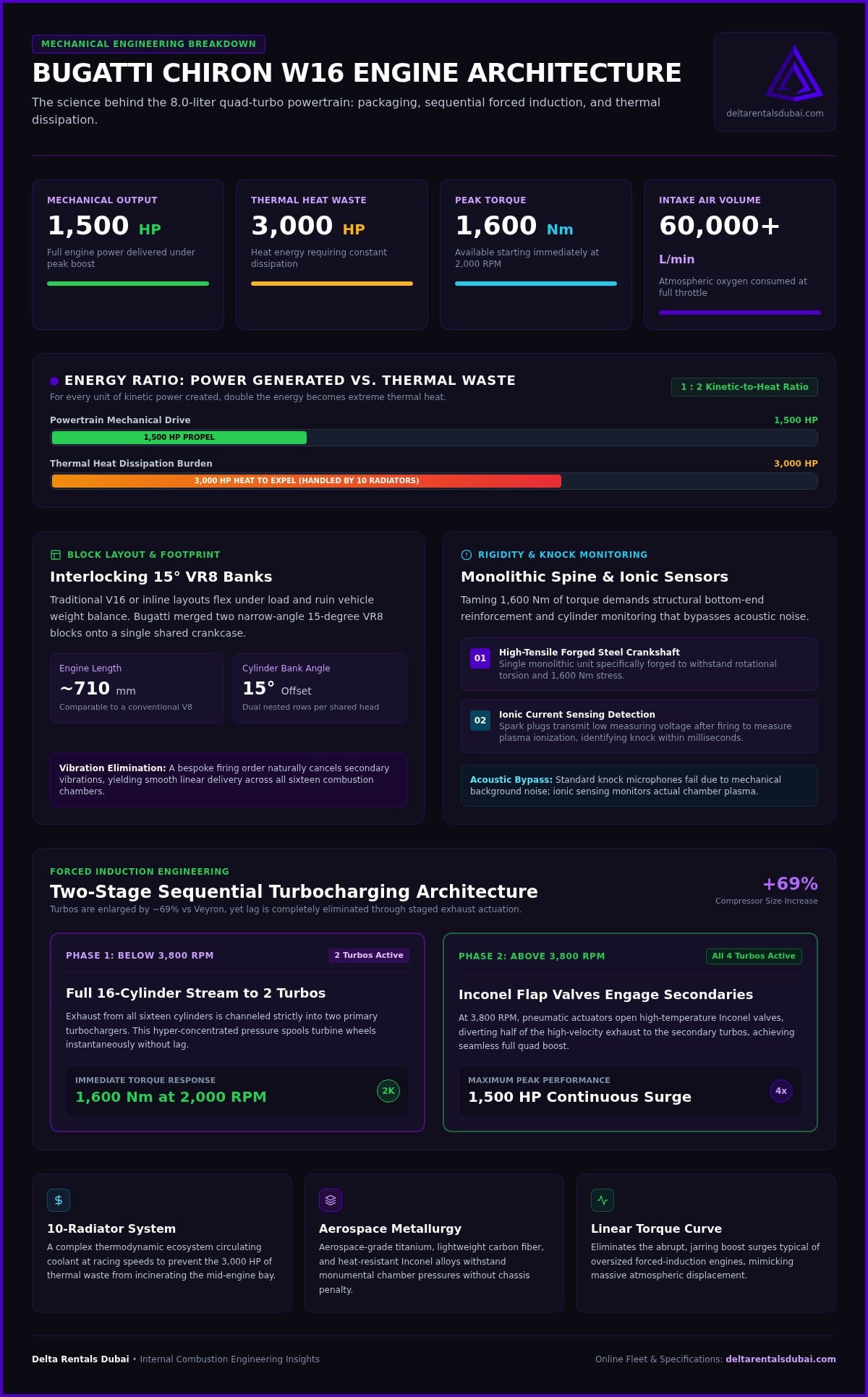
Packaging an 8.0-liter, sixteen-cylinder powertrain into a road-legal mid-engine platform seems impossible on paper. A conventional inline or traditional V16 layout creates an impractically long engine block that flexes under load and compromises vehicle balance. Groundbreaking Bugatti Chiron quad turbo W16 engine engineering solved this packaging riddle by abandoning standard layouts altogether. While the earlier Veyron established the quad-turbo concept, the Chiron platform underwent a total structural redesign. Bugatti engineered a lighter, significantly stiffer crankcase capable of handling 1,500 horsepower, pushing internal combustion to its absolute structural boundary.
The Geometry of Twin Narrow-Angle VR8 Banks
Bugatti achieved this compact packaging by interlocking two narrow-angle, 15-degree VR8 cylinder banks onto a shared crankcase. This offset design allows cylinders in each bank to nest tightly together under shared cylinder heads. You can explore the historical foundation of the Bugatti W16 engine architecture to see how this geometry keeps the entire block remarkably short, measuring around 710 millimeters in length. That’s comparable to a standard V8. A bespoke, highly orchestrated firing order balances power strokes across all sixteen combustion chambers. By firing cylinders in rapid, balanced succession, the engine cancels secondary vibrations naturally, ensuring glass-smooth power delivery even when unleashing full acceleration.
Crankshaft Rigidity and Combustion Dynamics
Taming 1,500 horsepower and an unrelenting 1,600 Nm of torque demands extreme bottom-end strength. A monolithic, high-tensile forged steel crankshaft forms the structural spine of the assembly, built specifically to resist massive rotational and torsional stresses. Above the crank, revised combustion chambers promote ultra-fast flame propagation, extracting maximum thermal efficiency from every drop of fuel across a wide rev range. Monitoring combustion across sixteen separate cylinders poses a major hurdle for standard acoustic knock sensors, which struggle with mechanical background noise. Bugatti solved this with ionic current sensing. By running a low measuring voltage through each spark plug immediately after ignition, the system reads ionization levels in the plasma, detecting pre-ignition in milliseconds to protect the engine under immense boost pressures.
The Sequential Quad-Turbocharging System: Eliminating Massive Turbo Lag
Bolting larger turbos onto an engine usually introduces massive throttle hesitation. The Veyron relied on four parallel turbochargers, where each unit received exhaust from just four cylinders, resulting in noticeable boost delay at low revs. Advanced Bugatti Chiron quad turbo W16 engine engineering completely transformed this setup. Engineers enlarged the four turbochargers by roughly 69 percent compared to the Veyron, yet they virtually eliminated lag. They achieved this by designing an ingenious two-stage sequential charging layout that reshapes how exhaust gases drive the turbine wheels.
Two-Stage Turbo Operation Below and Above 3,800 RPM
Instead of feeding all four units simultaneously, the engine channels the full exhaust flow of all sixteen cylinders into just two primary turbos below 3,800 rpm. This concentrated pressure spools the turbines instantly, producing an immediate 1,600 Nm of torque starting right at 2,000 rpm. As detailed in WIRED’s analysis of the Bugatti Chiron’s engineering, the car achieves instantaneous pickup that feels more like an enormous atmospheric engine than an over-boosted powerplant.
At 3,800 rpm, pneumatic actuators open high-temperature Inconel flap valves in the exhaust tract. This action directs half the scorching exhaust flow across the remaining two secondary turbochargers, bringing all four compressors to full boost seamlessly. This staged transition delivers an entirely linear torque curve without the jarring, unpredictable power surges typical of high-output forced-induction setups.
Intercooling and Compressed Air Density Management
Feeding an 8.0-liter engine at full throttle requires staggering amounts of oxygen. The intake system inhales over 60,000 liters of atmospheric air every minute, requiring massive cooling before combustion. Hot, pressurized air leaving the compressors passes through two liquid-to-air intercoolers mounted directly atop the cylinder banks. These compact coolers drop charge air temperatures drastically, boosting oxygen density to sustain 1,500 horsepower reliably under prolonged high-speed runs.
Experiencing this unbroken wave of sequential acceleration remains an unforgettable milestone in modern combustion performance. If you want to feel that monumental power delivery firsthand, you can secure an unforgettable exotic experience through elite Bugatti Chiron Rentals Dubai.
Mastering Extreme Thermodynamics: The 10-Radiator Cooling Ecosystem
Generating mechanical force creates massive residual heat. For every unit of kinetic energy driving the Chiron forward, roughly two units escape as thermal waste. That means the engine produces over 3,000 thermal horsepower under peak load. Without an unprecedented cooling system, intense cylinder temperatures would trigger catastrophic detonation or structural deformation within seconds. Sophisticated Bugatti Chiron quad turbo W16 engine engineering tackled this by transforming the entire chassis into an integrated thermodynamic heat sink, circulating 37 liters of fluid through a ten-radiator network.
High-Temperature and Low-Temperature Cooling Circuits
Bugatti divided thermal management into two completely independent cooling loops running at different temperatures:
- High-Temperature Loop: Employs three primary radiators up front to control block and cylinder head temperatures. A heavy-duty mechanical water pump circulates up to 800 liters of fluid per minute through the engine core.
- Low-Temperature Loop: Uses a dedicated low-temp radiator paired with two water-to-air intercoolers, chilling intake air right before entering the combustion chambers.
- Auxiliary Circuit: Features three heat exchangers cooling engine oil, transmission fluid, and rear differential oil, plus an additional condenser for the cabin air conditioning.
This strict circuit separation ensures that extreme oil or engine temperatures never transfer heat into incoming combustion air, keeping charge densities at peak efficiency.
Aerodynamic Extraction and Heat Dissipation Design
Cooling airflow must exit the car just as efficiently as it enters. Carbon-fiber ducting routes high-velocity air through the nose and directs it out across low-pressure zones along the hood and side flanks. At the rear, negative pressure generated by the dynamic rear diffuser pulls boiling air directly out of the exposed engine bay. Surrounding components stay shielded thanks to aerospace-grade insulation, protecting wire harnesses and sensitive control units from direct mechanical radiation. Even the titanium exhaust system plays a defensive role, using double-walled insulated pipes that guide blistering exhaust gases safely away from the rear carbon-fiber bodywork.
Aerospace Metallurgy: Lightweight Materials Handling Monumental Mechanical Stress
Containing violent combustion cycles while keeping curb weight manageable demanded an unapologetic reliance on aerospace-grade metallurgy. Conventional cast metals simply buckle when subjected to repeated peak loads across sixteen cylinders. Cutting-edge Bugatti Chiron quad turbo W16 engine engineering turned to exotic alloys and composites to survive these punishing forces. By shaving mass from internal reciprocating components and selecting high-strength outer materials, engineers preserved rotational responsiveness while guaranteeing long-term structural integrity.
Titanium Con-Rods and Carbon-Fibre Induction Systems
Every internal moving component inside the engine faces staggering physical loads at high engine speeds:
- Titanium Connecting Rods: Each rod tips the scale at just 336 grams yet is rated to withstand roughly 2,800 pounds of continuous mechanical force without elongating.
- Carbon-Fibre Charge Air Manifolds: Intake manifolds fabricated from pre-preg carbon fiber reduce top-heavy engine mass while providing silky-smooth internal surfaces for unimpeded airflow.
- Lightened Rotating Assembly: Cutting inertia from the pistons, pins, and valvetrain parts allows the massive 8.0-liter displacement to gain revs with instantaneous, razor-sharp response.
Trimming weight from moving parts does more than protect the internals. It transforms how rapidly the engine spins up, delivering an explosive surge whenever the driver hits the throttle.
The Monolithic Titanium Exhaust and Stressed-Member Mounting
Exhaust routing presented an equally intense material challenge. To manage intense thermal energy, Bugatti fabricated a complete titanium exhaust system that saves substantial weight over stainless steel alternatives. It houses four pre-converters and two massive main catalytic converters. Unrolled completely, the catalytic internal honeycomb surface area stretches across more than 43 soccer fields to effectively neutralize emissions.
Rather than sitting isolated on soft rubber bushings, the engine mounts securely as a semi-stressed chassis member within the carbon-fiber monocoque. This direct connection elevates chassis torsional rigidity to an astounding 50,000 Nm per degree, matching Le Mans LMP1 racing standards. Beyond sheer chassis stiffness, this structural union routes visceral mechanical feedback directly into the cockpit. The raw, acoustic signature generated by the titanium pipes creates an unmistakable mechanical roar.
Ready to experience that pure mechanical precision from behind the wheel? Reach out directly via WhatsApp to reserve an exclusive Bugatti Chiron rental and command this masterwork firsthand.
The W16 Legacy: From Engineering Marvel to High-Performance Road Experience
Bugatti closed a legendary chapter when Chiron production ended with its strictly capped 500-car run, concluding with the bespoke “L’Ultime” in May 2024. The 21-year manufacturing lifespan of the quad-turbo W16 stands as the absolute high-water mark of twenty-first-century internal combustion. Electric powertrains deliver silent, clinical speed, but they cannot replicate the visceral theater of mechanical force. Historic Bugatti Chiron quad turbo W16 engine engineering provides multi-sensory road feedback that no battery platform can match, merging mechanical precision with genuine grand touring luxury.
Unrivaled Acceleration and High-Speed Grand Touring Usability
Putting theoretical dyno output onto real tarmac demands exceptional drivetrain orchestration. The Chiron routes its 1,600 Nm of torque through a robust seven-speed dual-clutch transmission to an intelligent all-wheel-drive system. This setup transforms brutal acceleration into composed, repeatable speed without losing traction on open highways. Adaptive drive modes continually calibrate damper stiffness, aerodynamic wing angles, and differential lockups. The car shifts seamlessly from a relaxed, quiet highway cruiser into an unrestricted 1,500-horsepower titan with a simple twist of the steering wheel dial.
Accessing Elite Automotive Pedigree Across the UAE
Appreciating this tier of combustion history reaches its peak when you take the wheel yourself. Driving a mechanical masterpiece offers an authentic connection to hypercar history that static museum displays never convey. Automotive enthusiasts seeking pinnacle performance can explore premier machinery across the United Arab Emirates through dedicated concierge vehicle rental providers:
- Track-Bred Aerodynamics: For drivers prioritizing razor-sharp apex carving and lightweight agility, experience circuit excellence through a Porsche 911 GT3 RS rental.
- Effortless Hypercar Access: Secure transparent booking and premier automotive fleet access backed by verified customer reviews via Delta Rentals Dubai.
- The W16 Pinnacle: Experience the staggering presence, acoustic thunder, and relentless thrust of Molsheim’s sixteen-cylinder triumph on broad national thoroughfares.
Concierge vehicle delivery pairs effortless convenience with uncompromising performance standards. Getting behind the wheel of these landmark machines transforms engineering curiosity into an unforgettable reality.
Command the High-Water Mark of Combustion Engineering
Bugatti Chiron quad turbo W16 engine engineering stands as a defining peak in modern mechanical achievement. By combining twin VR8 blocks on a single crankshaft, staging four massive turbochargers to eliminate throttle delay, and circulating fluid through an intricate ten-radiator ecosystem, Bugatti created a benchmark that will never be replicated in the combustion era. While automotive history shifts toward hybrid and electric powerplants, the raw physical presence of sixteen cylinders remains unmatched.
Reading about 1,500 horsepower is exciting, but feeling its linear surge against open highway tarmac is extraordinary. You can access this pinnacle of automotive pedigree through a transparent, high-tier service trusted by drivers nationwide. Backed by over 300 five-star verified customer reviews, full nationwide delivery, and white-glove vehicle handovers across the UAE, your bespoke road experience is completely seamless. Take command of genuine mechanical brilliance today. Contact our concierge directly to experience peerless hypercar engineering with Delta Rentals Dubai.
Frequently Asked Questions
How does the Bugatti Chiron sequential quad-turbo system work?
The system operates in two distinct stages to maximize turbine efficiency across the rev range. Below 3,800 rpm, pneumatic valves direct exhaust flow from all sixteen cylinders through only two primary turbochargers to build instantaneous boost. Once the engine crosses the 3,800 rpm threshold, high-temperature Inconel flaps open rapidly, activating the two secondary turbos to deliver full, seamless acceleration across all four compressors.
Why does the Bugatti Chiron use a W16 engine instead of a V16?
Packaging constraints dictate the compact layout. A traditional V16 or straight-16 requires an excessively long engine block, compromising vehicle balance, cockpit space, and structural rigidity. By interlocking two narrow-angle 15-degree VR8 cylinder banks at a 90-degree angle on a shared crankshaft, Bugatti Chiron quad turbo W16 engine engineering fits sixteen cylinders into block dimensions comparable to a standard performance V8.
How much horsepower and torque does the Chiron W16 generate?
The standard Chiron powertrain generates 1,500 PS (1,479 horsepower) at 6,700 rpm and an immense 1,600 Nm of torque across an expansive plateau from 2,000 to 6,000 rpm. Later performance evolutions like the Super Sport increased output to 1,600 PS (1,578 horsepower), sustaining that maximum torque curve up to 7,000 rpm for unprecedented high-speed acceleration.
How many radiators are required to cool the Bugatti Chiron engine?
The Chiron relies on an intricate ten-radiator cooling system to dissipate over 3,000 thermal horsepower under full acceleration. This network comprises three high-temperature radiators for the primary engine circuit, one low-temperature radiator feeding two liquid-to-air intercoolers, three auxiliary heat exchangers for engine, transmission, and differential fluids, and a dedicated condenser for the climate control system.
What is the displacement and fuel system configuration of the W16?
The powerplant features an exact displacement of 7,993 cc (8.0 liters). Fuel delivery uses a dual injection strategy incorporating 32 individual fuel injectors across the sixteen cylinders. Two injectors per cylinder meter precise fuel quantities directly into the intake airflow, preventing fuel starvation during maximum demand when the engine inhales over 60,000 liters of air each minute.
Can you rent and drive a Bugatti Chiron in the United Arab Emirates?
Discerning drivers can experience this pinnacle hypercar firsthand across the United Arab Emirates through specialized concierge vehicle providers. Delta Rentals Dubai provides access to elite automotive icons like the Chiron, featuring transparent booking processes, white-glove delivery across the country, and dedicated support backed by over 300 five-star verified customer reviews.
How does the Chiron W16 prevent turbo lag at low engine speeds?
The Chiron eliminates lag through dynamic exhaust gas redirection. Below 3,800 rpm, Bugatti Chiron quad turbo W16 engine engineering focuses exhaust gases from all sixteen cylinders exclusively onto two turbine wheels. Doubling the exhaust volume per active turbine builds instantaneous boost pressure right from 2,000 rpm, eliminating the low-end hesitation common in massive forced-induction powerplants.