
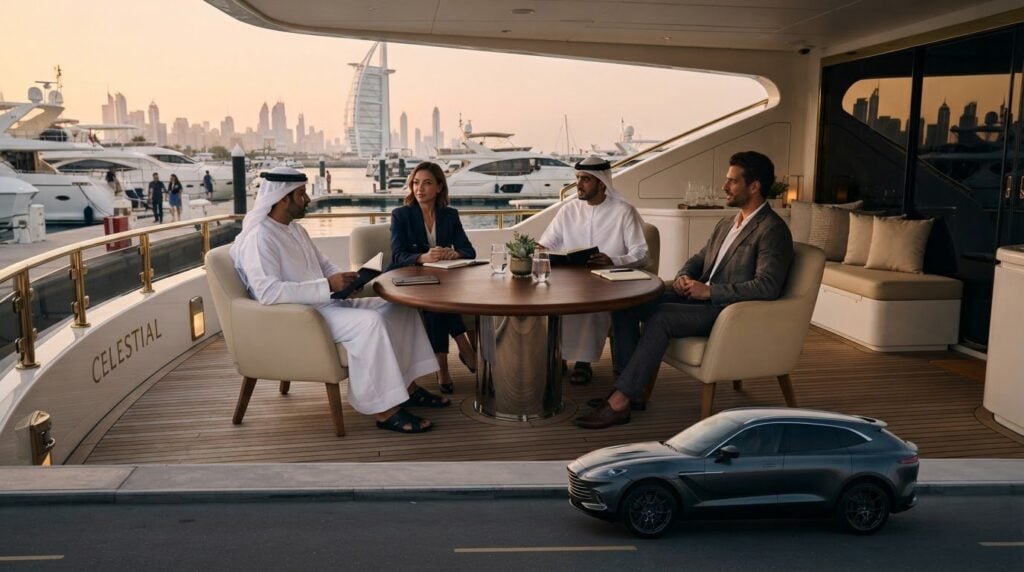
The best seating layout for client negotiation on private charter yachts isn’t always the most formal one. A conference-style setup can signal business, but it may also create distance or make one person appear to hold the advantage. Look beyond appearance: everyone should be able to hear, contribute, and sit comfortably in the space available.
The right arrangement depends on your group, agenda, privacy needs, and the yacht’s actual layout. A lounge can suit open discussion, a dining arrangement can give everyone a shared focus, and a conference-style setup can help when the meeting calls for structure. This guide explains how to compare those options, avoid awkward power dynamics, and leave room for comfortable movement. It also covers what to confirm with the charter provider, including available seating, sightlines, and whether the space is practical for your discussion. With a few considered choices, you can set a confident tone before the negotiation begins.
Key Takeaways
- Choose seating to support the meeting’s purpose and encourage balanced participation, rather than defaulting to the most formal-looking setup.
- The best seating layout for client negotiation on private charter yachts depends on the group, discussion style, privacy needs, and confirmed vessel layout.
- Compare face-to-face, side-by-side, and angled seating based on how participants need to talk, listen, or review materials together.
- Before confirming a yacht, ask the charter provider about actual seating, table availability, movement routes, privacy, and potential distractions.
- Use a simple planning sequence: define the agenda, count attendees, confirm the space, review the setup, and reconfirm the details.
Why the Best Seating Layout Matters for a Client Negotiation on a Private Charter Yacht
A productive negotiation needs more than an impressive setting. The best seating layout for client negotiation on private charter yachts helps everyone hear clearly, contribute without awkward barriers, and stay comfortable throughout the conversation. It should work in the vessel’s real space, not just look polished in a photograph.
Seating influences how people communicate. The science of personal space explores how physical distance shapes interaction, which matters in a close onboard setting. A seat that leaves one participant apart, blocks eye contact, or places someone in a visibly dominant position may affect the tone. Aim for an arrangement where people can see and address one another comfortably, with enough room to move without disrupting the discussion.
Start with the meeting’s purpose and tone
Decide what the meeting needs to achieve before choosing seats. A confidential discussion may call for a quieter, more contained area. Collaborative problem-solving may benefit from a shared focal point, such as documents participants can review together. A formal proposal may need a structured arrangement, but formality should support the agenda rather than overpower it.
Different occasions call for different setups. A negotiation involves listening, responding, and reaching decisions. A presentation directs attention toward a speaker or materials. An informal relationship-building meeting allows more relaxed conversation, while a hosted meal also needs to account for dining and service. An arrangement that feels too formal can make open discussion harder; one that is overly casual may not convey the seriousness the conversation requires. Match the layout to the purpose, not appearance alone.
Account for the yacht as a working environment
A yacht isn’t a standard meeting room. Sound, passenger movement, shade, weather exposure, and interruptions can all affect whether a particular space will work. A conversation that depends on privacy or careful listening may be difficult if people need to pass through the area or nearby activity competes for attention. Don’t assume an indoor or outdoor space will be suitable without checking the details.
Ask the charter provider which spaces are available for your booking and what seating is present. Check whether participants can move in and out comfortably, hear one another, and stay comfortable if conditions change during the meeting. Let the confirmed layout guide your decision, rather than relying on a generic yacht image.
Purpose, participant count, and the vessel’s confirmed layout should guide every seating choice. Start with those essentials, then assess whether the proposed arrangement supports clear conversation and an appropriate level of formality.
How to Choose a Yacht Seating Arrangement That Keeps Negotiations Balanced
There’s no universally correct configuration. The best seating layout for client negotiation on private charter yachts depends on how participants need to communicate, the size of the delegation, and the space the vessel can actually accommodate. Treat each arrangement as an option to assess, not a tactic guaranteed to influence the outcome. Harvard Law School’s Program on Negotiation also considers arranging the meeting space part of negotiation preparation.
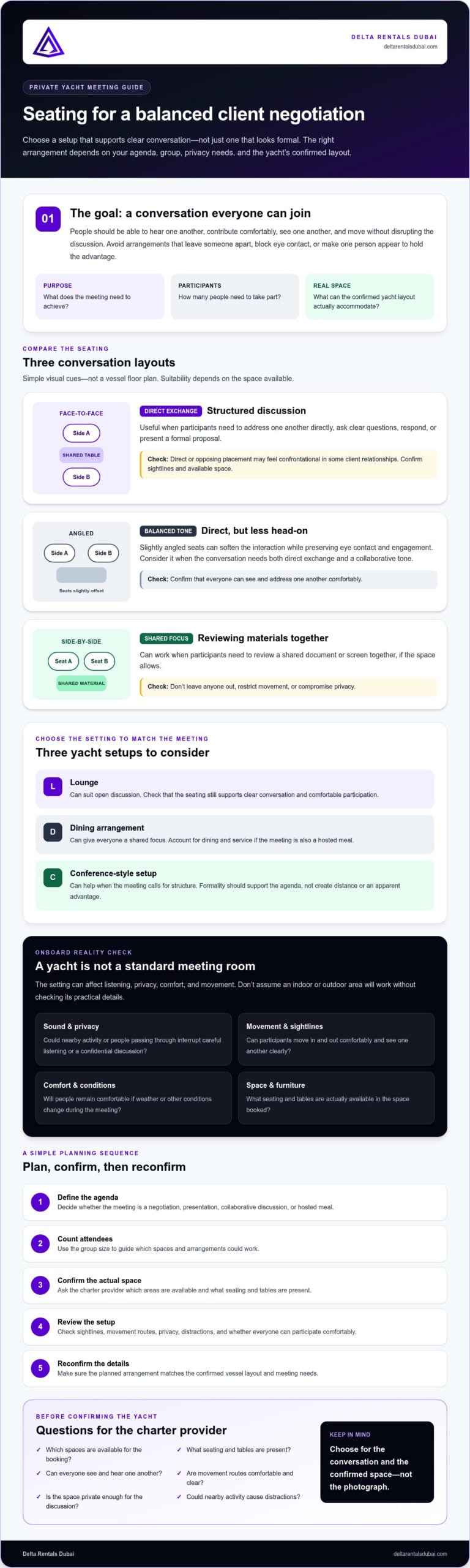
- Face-to-face: Useful for structured discussions where participants need to address one another directly. It can make turn-taking clear, but a straight line or highly formal placement may feel confrontational in some client relationships. Check sightlines and available space before choosing it.
- Angled: Seats participants at a slight angle rather than directly opposite each other. This can soften the interaction while preserving eye contact and engagement. It may suit a discussion that needs both direct exchange and a collaborative tone.
- Side-by-side: Can work when participants need to review a shared document or screen together, if the space allows. Make sure the arrangement doesn’t leave anyone out, restrict movement, or compromise the discussion’s privacy.
When a face-to-face arrangement helps
Choose direct seating when the agenda calls for clear questions, responses, or a formal proposal. Consider the relationship as well as the format: placing each side in opposing rows may feel overly adversarial when the goal is to explore options together. Confirm that everyone can see and hear one another, and that the layout fits the area without obstructing movement.
When angled or side-by-side seating supports collaboration
An angled setup offers a middle ground for a discussion that should feel professional without becoming rigid. Side-by-side seating may be practical for reviewing materials, but it shouldn’t make some participants feel like observers. Ask the host or charter provider whether the space can support the arrangement while allowing suitable access and privacy for everyone.
Group size changes the decision. A small group may be able to talk comfortably in a compact arrangement, while a larger delegation may need more room and a clearer way for everyone to participate. Don’t infer meeting capacity from a yacht image or assume every available seat works for a discussion. Verify how many participants the intended space can accommodate and whether the seating can be arranged as needed.
Before settling on a layout, share the attendee count and discussion format with the charter provider. Ask what seating is available and whether the proposed arrangement is practical aboard that vessel. Then choose the option that supports respectful conversation, privacy, and movement, without treating any seat as a guarantee of agreement or advantage.
Will a Private Yacht Feel Too Informal or Distracting for a Client Negotiation?
It can, if privacy, quiet, and suitable conditions can’t be confirmed for the meeting space. A yacht may offer a distinctive setting, but atmosphere alone won’t make a negotiation productive. If the discussion involves sensitive terms, confidential information, or decisions that need careful attention, assess whether the environment can support that level of focus. If it can’t, choose a more suitable setting.
Before booking, describe the discussion’s sensitivity to the charter provider and ask what privacy can realistically be arranged in the requested area and at the planned time. Clarify whether other guests or routine activity may pass nearby. Where operationally practical, ask whether movement around the meeting area can be limited during the discussion, but don’t assume complete privacy or uninterrupted service.
Prepare for discretion yourself, too. Keep sensitive documents with the appropriate participants, avoid displaying confidential material where others might see it, and secure devices when they aren’t in use. These are sensible precautions in any shared environment, not a substitute for confirming that the space is appropriate.
Protect privacy and keep the discussion focused
Match the level of confidentiality to the setting you can verify. A general relationship-building conversation may tolerate occasional activity nearby; a negotiation involving private commercial details may require a more secluded space. Ask specific questions about who could access the area and what interruptions to expect. If the answers don’t meet your needs, leave sensitive agenda items for another venue.
Plan around comfort, noise, and movement
Confirm whether the proposed meeting area is indoors or outdoors and ask what conditions could affect conversation. Outdoor exposure, nearby activity, and changing onboard conditions may influence comfort and how clearly participants can hear. Don’t assume the vessel will remain stationary or that every guest will be equally comfortable with the conditions. Ask the provider what to expect for the planned booking instead of relying on general assumptions.
Timing matters. Embarkation can involve arrivals and settling in, while refreshments or breaks may bring movement through or near the meeting area. Consider using that time for greetings and informal conversation, then begin substantive negotiation once participants are settled and the provider has confirmed the space is ready. Plan breaks deliberately rather than allowing activity to interrupt a key discussion.
The best seating layout for client negotiation on private charter yachts only works if the surrounding conditions support the conversation. Weigh the distinctive experience against practical risks, and proceed only when the intended space, privacy expectations, and likely distractions are clear. A polished setting is valuable; a suitable one is essential.
How to Plan the Seating Before Your Private Yacht Client Meeting
Set up the space before the agenda gets underway. A few checks with the charter provider can prevent a polished meeting plan from clashing with the vessel’s actual layout. Work through this sequence:
- Define the meeting. Note whether the priority is confidential negotiation, collaborative discussion, or presenting a proposal. Identify any materials participants need to review together.
- Count attendees. Include everyone who will take part, and distinguish active participants from guests who may join only briefly.
- Confirm the space. Ask which area is available for the booking and request a current layout or a clear description.
- Review the arrangement. Check seating, table availability, sightlines, and whether people can enter, exit, and move around comfortably.
- Reconfirm before the meeting. Verify that the space and expected conditions still suit the agenda, and adjust your plan if anything has changed.
Confirm the precise meeting space and seating before finalizing your plans. General passenger capacity doesn’t tell you whether a particular area can comfortably support your discussion. Ask about the practical group size for the intended setup, accessible movement, and any restrictions that may affect your attendees. Clarify which details are confirmed and which may depend on the vessel or conditions.
Questions to ask the charter provider before confirming
Keep your questions specific. Is the proposed area available for the meeting? What seating is actually there, and is a table available? Can participants see and hear one another from the planned positions? Is there enough room for attendees to move comfortably? Ask for a current layout if one is available; if not, request a precise description. Share the group’s needs so the provider can help assess whether the space is suitable, without assuming particular facilities or services.
A simple seating and agenda walkthrough
Once the space is confirmed, map the seats to the conversation. Avoid placing the client or a key decision-maker apart from the group, and consider whether everyone can contribute without one person dominating by position alone. If there’s a suitable table, place shared documents where participants can review them together. Then compare the arrangement with the agenda, privacy needs, and the provider’s operational guidance.
Build in time for arrival and settling before substantive negotiation begins. Use that transition for greetings, getting seated, and resolving practical questions. Start the focused discussion when participants are ready and the confirmed meeting area is available. This small buffer helps keep arrivals and setup from interrupting an important point.
Use this process to identify the best seating layout for client negotiation on private charter yachts for your specific group and vessel. Confirm the details with the charter provider, then reconfirm them before the meeting rather than relying on an assumed layout.
Choosing a Private Charter Yacht Setup That Fits Your Client Meeting
Choose the setting and seating together. The right arrangement depends on the meeting’s purpose, participant count, how people need to interact, privacy requirements, and the vessel’s confirmed layout. There’s no single setup that works for every yacht or client relationship. A polished arrangement only helps if it supports the conversation you’re planning to have.
Match the arrangement to the negotiation format
For a structured discussion, consider face-to-face seating or a table-based setup if the confirmed space supports it and participants can see one another comfortably. For collaborative reviews, angled seating may help people share documents without placing them directly opposite each other. If the goal is relationship-building, choose a more conversational arrangement while preserving a clear path into the business discussion. Treat these as options to assess, not guaranteed ways to influence an outcome.
Before confirming a charter, compare the proposed setup with your agenda. If you’ll review documents, ask whether the available table and seating can accommodate them. If privacy is essential, confirm what can realistically be arranged in that specific space. For a larger group, check that everyone can participate and move comfortably rather than relying on general passenger capacity as a measure of meeting suitability.
Confirm a charter that can support the plan
Ask the provider to confirm which vessel and meeting area are proposed, what seating is available, and whether the arrangement is practical for your group and discussion. Request a current layout or a clear description, and clarify which details are confirmed and which may depend on the vessel or conditions. Don’t rely on a generic image or assume that a particular table, seating configuration, or level of privacy will be available.
Delta Rentals Dubai offers luxury yacht rentals alongside its premium vehicle rentals. If you’re considering a yacht for a client meeting, confirm the proposed vessel, available areas, and any seating arrangements directly with the provider before making plans. The best seating layout for client negotiation on private charter yachts is the one that fits the actual vessel, supports balanced participation, and matches the tone of the meeting.
For vehicle enquiries, you can use the car rental enquiry link. Its prefilled message refers to car rental, so confirm the appropriate enquiry route with the provider for yacht rentals.
Plan a Seating Setup That Sets the Right Tone
The best seating layout for client negotiation on private charter yachts is the one that fits the discussion, the group, and the vessel’s confirmed space. Face-to-face seating may suit a structured exchange; angled or more conversational arrangements may better support shared review or relationship-building. None is right by default.
Before confirming a charter, compare the proposed setup with your agenda. Ask the provider to verify the specific meeting area, available seating, practical group size, and any privacy or movement considerations. A yacht’s appearance alone can’t tell you whether it will support focused conversation.
Once the details are clear, you can approach the meeting with confidence and give every participant a more comfortable opportunity to contribute. For a general enquiry, you can message Delta Rentals Dubai on WhatsApp. The prefilled message is for car rental, so confirm the correct enquiry route before using it for a yacht rental. With the right questions and a verified setup, you can create a polished setting for a productive client conversation.
Frequently Asked Questions
What is the best seating layout for a client negotiation on a private charter yacht?
There’s no single arrangement that suits every negotiation. The best seating layout for client negotiation on private charter yachts depends on the agenda, participant count, desired tone, and confirmed onboard space. Face-to-face seating can support a structured exchange, while angled seating may feel more conversational. If participants need to review shared materials, side-by-side seating could work if space allows. Ask the charter provider to confirm the available setup before choosing.
Is a private yacht an appropriate place for a business negotiation?
A private yacht can suit a business negotiation if the meeting space, privacy expectations, and likely conditions match the discussion. A distinctive setting may support relationship-building, but noise, movement, or changing conditions can distract from detailed negotiations. Consider the sensitivity of the agenda and how much uninterrupted focus participants need. Confirm the proposed space and practical arrangements with the charter provider before deciding whether it’s the right setting.
Can you hold a confidential meeting on a charter yacht?
You may be able to discuss confidential matters aboard a charter yacht, but don’t assume the meeting will be private. Ask the provider what privacy can realistically be arranged in the specific area and at the planned time, including whether others may pass nearby. Keep sensitive documents and devices secure, and avoid displaying confidential information where it could be seen. If the privacy available doesn’t meet your needs, use another venue for sensitive agenda items.
How many people should sit at a negotiation table on a yacht?
Seat only the participants the confirmed meeting area can accommodate comfortably, with room to see, hear, and move around one another. There’s no universal table capacity for yacht negotiations, and general passenger capacity doesn’t establish how many people can use a particular space for discussion. Give the provider your attendee count and ask about the actual seating, table availability, and practical group size for the intended meeting.
What seating arrangement feels least confrontational during a client negotiation?
Angled seating can feel less confrontational than placing participants directly opposite one another, while still allowing eye contact and conversation. A side-by-side arrangement may also feel collaborative if participants are reviewing shared materials and everyone can take part. Neither layout guarantees agreement or a particular response. Consider your relationship with the client, the discussion’s purpose, and whether the available space supports balanced participation.
What should I ask before booking a yacht for a client meeting?
Ask which specific vessel and meeting area are proposed, what seating is available, whether a table can be used, and how many people the space can comfortably accommodate. Check sightlines, movement access, privacy, and possible noise or other interruptions. Clarify which details are confirmed and which depend on the vessel or conditions. Share the agenda and attendee count so the provider can help assess whether the setup is practical.
Should a yacht negotiation use a formal table or lounge seating?
Choose a formal table if the agenda involves structured discussion or reviewing documents together, provided the vessel has a suitable table and enough room. Lounge seating may suit a more conversational meeting, but check that participants can see and hear one another and that the arrangement supports the discussion’s level of formality. Decide based on the agenda, group, privacy needs, and confirmed layout rather than appearance alone.