

Could a tire that looks ready for the road still be too old or worn for a long tour? Checking tire manufacturing dates and tread depths before long distance luxury touring gives you a clearer answer than appearance alone. In the UAE, heat, sustained highway speeds, luggage and passengers make it especially important to check tires before you set off.
It’s sensible to want confidence before committing to a long drive, especially if you’re unsure how to read the sidewall date code or judge tread wear by sight. A consistent check can help you spot concerns before the journey begins.
This practical checklist explains where to find the tire’s manufacturing date, how to assess tread depth, and what to look for in pressure, visible damage and uneven wear. It also covers when to seek a professional inspection rather than guess. Record your checks and use the results to choose a suitable vehicle and prepare for the tour.
Key Takeaways
- Learn how to locate and interpret a tire’s manufacturing date code, including when it isn’t visible on the outward-facing sidewall.
- Understand why checking tire manufacturing dates and tread depths before long distance luxury touring means assessing age and tread as separate factors.
- Use a consistent inspection routine to measure tread and note pressure, visible damage, uneven wear and signs that call for professional advice.
- Check pressure against the vehicle placard or manual, and consider load, spare equipment and vehicle-specific requirements before departure.
- Save a readiness checklist. If renting, ask about the vehicle’s specifications, tire suitability and handover inspection process.
Why Check Tire Manufacturing Dates and Tread Before a Long Tour?
Before setting out, check five things: the tire date code, tread depth, cold pressure, visible damage and the vehicle’s requirements. This gives you a fuller picture than a glance at the tires. Age and tread are separate checks: deep tread doesn’t make an older tire new, and a recent manufacturing date doesn’t rule out worn tread or damage.
A visual inspection is useful, but it has limits. You can spot some warning signs on the surface, but you can’t confirm every internal condition or identify every developing problem by sight alone. If anything looks unusual or you’re unsure about a tire’s condition, seek an assessment from a qualified tire professional before a long drive. Checking tire manufacturing dates and tread depths before long distance luxury touring is a practical first step, not a substitute for professional advice when needed.
What does a tire manufacturing date tell you?
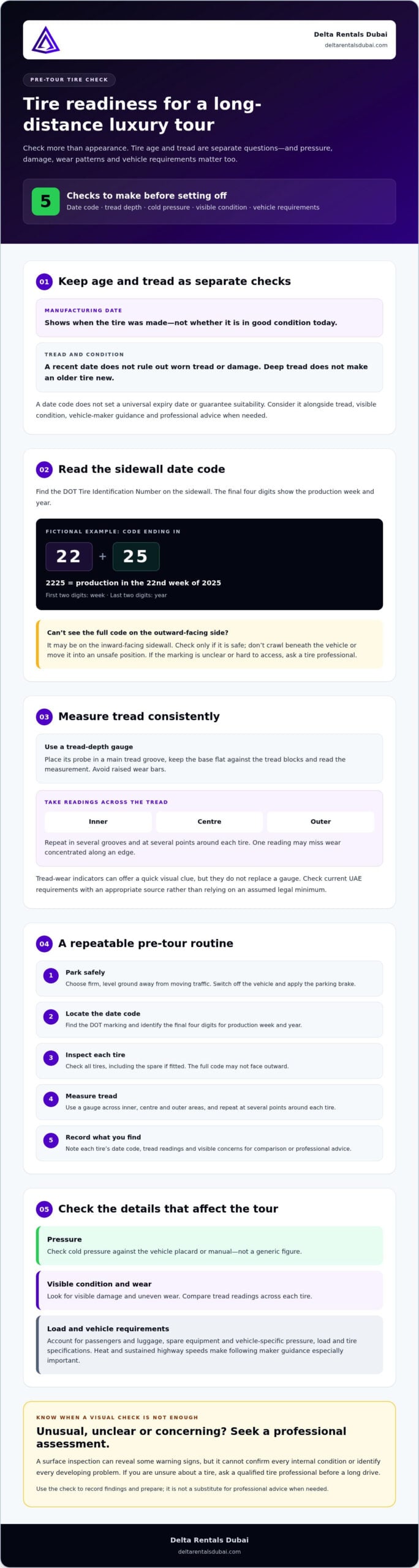
Find the DOT Tire Identification Number on the tire sidewall. Its final four digits show the production week and year: the first two digits represent the week, and the last two the year. For example, a fictional code ending in 2225 indicates production in the 22nd week of 2025. The full code may not be visible on the outward-facing side, so don’t assume it’s absent if you can’t see it. For more detail on reading tire sidewall codes, consult this reference.
The date tells you when the tire was made, not whether it’s in good condition today. It doesn’t set a universal expiry date or guarantee suitability. Consider it alongside tread, visible condition, the vehicle maker’s guidance and, if there’s any doubt, a professional assessment.
Why do touring conditions make a basic check worthwhile?
Long-distance driving means sustained use, often with passengers and luggage. Ambient heat and speed are additional reasons to follow the vehicle and tire makers’ guidance for pressure, load and tire specifications. A tire that seems acceptable during a quick walk-around still needs to meet those requirements before a demanding journey.
In the UAE, keep the check specific to the vehicle you’ll drive. Use the vehicle placard or manual for pressure guidance, rather than relying on a generic figure. You can look for visible issues and record your findings, while a qualified tire professional can assess concerns that a surface check can’t resolve. This helps you decide whether to proceed, seek advice or address a problem before departure.
How to Read Tire Dates and Measure Tread Depth Correctly
Use the same method on every tire, then record what you find. A repeatable check makes differences easier to spot and gives you useful details to discuss with a tire professional.
- 1. Park safely. Choose firm, level ground away from moving traffic, switch off the vehicle and apply the parking brake.
- 2. Locate the date code. Look on the sidewall for the DOT marking and Tire Identification Number. The final four digits indicate the production week and year: the first pair is the week, and the second pair is the year.
- 3. Inspect all tires. Check each tire, including the spare if fitted. The full date code may appear on only one sidewall, so it may not face outward.
- 4. Measure tread depth. Use a tread-depth gauge and take readings across the inner, centre and outer tread areas. Repeat at several points around each tire.
- 5. Record the results. Write down each tire’s date code, tread readings and visible concerns. This gives you a clear comparison and a record to share if you seek professional advice.
How to locate and interpret the tire date code
The DOT marking and identification code are moulded into the sidewall. If the code you can see doesn’t include its final four digits, check the inward-facing sidewall only if you can do so safely. Don’t crawl beneath a vehicle or move it into an unsafe position to read a code. If the marking is missing, unclear or difficult to access, ask a tire professional to identify it. For general background, see the NHTSA tire safety guidelines. This is a US source, not a statement of UAE legal requirements.
How to check tread depth and wear patterns
Place the gauge probe into a main tread groove, press its base flat against the tread blocks and read the measurement. Avoid placing it over a raised wear bar. Take readings in several grooves and positions, since one measurement may miss wear concentrated on an inner or outer edge. Tread-wear indicators offer a quick visual clue, but they don’t replace a gauge. Don’t rely on a legal minimum without checking current UAE requirements from an appropriate source.
Compare readings across each tire. Uneven wear may warrant professional assessment of alignment, inflation or suspension. Checking tire manufacturing dates and tread depths before long distance luxury touring helps you gather useful information, but a visual check and gauge reading can’t diagnose every tire issue.
If you’re planning a rental for a UAE tour, you can ask about vehicle options and trip requirements as part of your planning.
What Tire Condition Signs Matter Most Before Luxury Touring?
Check every tire on every axle, not just the easiest side to reach. Compare their condition as you go, and note anything that looks or feels different. Cracks, a bulge or a change in road feel may not reveal the full cause, but they are reasons to pause and get professional advice before departure.
| What you notice | Sensible next step |
|---|---|
| Cracks in the sidewall or tread | Ask a qualified tire professional to assess the tire before touring. |
| A bulge or bubble | Don’t set off on a long drive. Seek professional advice. |
| A cut, especially one that appears deep | Have the tire assessed rather than judging its condition by appearance alone. |
| An embedded object, such as a nail | Leave it in place and ask a professional to assess the tire. Removing it may change the situation. |
| Exposed cords | Do not proceed with the tour before getting professional advice. |
| New vibration or unusual road noise | Stop somewhere safe and arrange an assessment before continuing the journey. |
Which visible tire problems need professional attention?
Sidewall bulges, deep cuts, exposed cords and significant cracking all call for professional attention before a long trip. Treat punctures and embedded objects cautiously. Don’t pull an object out, attempt a roadside repair or rely on a photograph to decide whether internal damage is present. A visual check can flag a concern, but it can’t confirm what’s happening inside the tire. Use this tire inspection guide for general checking tips, then seek qualified advice if you spot a warning sign.
How should drivers think about age, tread, and vehicle fitment together?
Consider age, tread and fitment as related but separate checks. Tire-age guidance can vary by manufacturer, vehicle maker and use, so verify the applicable recommendations rather than relying on a universal expiry date. Check the vehicle placard or manual for approved tire size, load index and pressure specifications. For a high-performance touring example, see the Porsche 911 GT3 RS rental guide. It’s a vehicle overview, not a source for tire specifications.
Consistent checks matter for any vehicle, including a luxury rental. If one tire differs from the others, or you notice vibration or unusual noise, don’t assume the issue will clear. Get professional advice before departure. Checking tire manufacturing dates and tread depths before long distance luxury touring helps you spot questions early, but a warning sign calls for assessment, not guesswork.
A Practical Pre-Tour Tire Checklist for Pressure, Load, and Spares
Work through the same sequence before departure: check pressure under the conditions specified by the vehicle maker, scan each tire for damage, review tread and date-code records, confirm the planned load is within vehicle limits, then check the spare or repair equipment. Keep the vehicle placard or manual close at hand. Pressure values vary by vehicle and operating conditions, so don’t substitute a generic figure.
What should go on a long-distance tire checklist?
- Pressure: Use a reliable gauge and follow the manual or placard for the specified checking conditions, including whether tires should be cold. If you’re unsure how those conditions apply, check the handbook or ask a qualified tire professional.
- Condition and tread: Look over every tire for visible damage and compare tread readings across each tire. Record the readings and date codes, noting differences so you can track changes or ask focused questions.
- Monitoring alerts: Check the dashboard for tire-pressure monitoring system (TPMS) warnings. A monitoring system can alert you to a pressure issue, but it doesn’t replace a manual check for cuts, bulges, embedded objects or tread wear.
- Load and fitment: Confirm the tire size and load guidance in the vehicle documentation. Passengers and luggage together must remain within the vehicle’s stated limits. Don’t assume a larger vehicle can carry any load.
- Spare or repair equipment: Use the vehicle handbook to confirm whether the car has a spare tire, repair kit or mobility kit, and check that the relevant equipment is present and appears ready for use.
This sequence makes checking tire manufacturing dates and tread depths before long distance luxury touring part of a complete readiness review, rather than an isolated visual glance. Save your notes with the inspection date. For a luggage-heavy trip, compare the vehicle’s capacity and layout with your needs. A luxury SUV rental option may be worth considering, but no one vehicle suits every itinerary or load.
What should you do if a check raises a concern?
Pause departure if you find visible damage, abnormal pressure loss or a warning light that remains unexplained. Don’t try to diagnose internal damage, remove an embedded object or continue on the assumption that a warning will clear. Contact a qualified tire professional or vehicle assistance provider for an appropriate assessment, and follow their advice before setting off.
Planning a rental for a UAE tour? Ask about vehicle options and your trip requirements, including the passenger and luggage load you expect to carry.
How to Make Tire Readiness Part of a Confident Luxury Tour
A calm departure starts with a clear record, not a last-minute guess. Save or print this checklist and complete it for the vehicle you’ll actually drive. Checking tire manufacturing dates and tread depths before long distance luxury touring works best as part of a wider handover and trip-readiness routine.
- □ Note each tire’s date code and tread readings, and record any differences.
- □ Check pressure using the vehicle’s placard or manual and the stated checking conditions.
- □ Look across all tires for visible damage, unusual wear or an embedded object.
- □ Confirm the planned passengers and luggage fit within the vehicle’s stated limits.
- □ Check the handbook for the supplied spare, repair kit or mobility equipment, and locate roadside-assistance instructions.
- □ Record dashboard warnings and raise anything unexplained before departure.
What should you confirm before collecting a rental car?
Ask which vehicle is available and whether its configuration suits your passenger count, luggage and journey plans. Before setting off, review the visible tire condition and dashboard for warnings. Raise concerns during handover rather than waiting until you’re on the road. Ask about the vehicle specifications, tire suitability for your intended trip and the handover inspection process. Keep your rental agreement and roadside-assistance instructions accessible throughout the journey.
What is the next step if you are planning a premium tour?
Prepare the route, expected load and questions about the vehicle before making an enquiry. This helps you discuss practical needs clearly without assuming one model fits every trip. A considered rental choice and a careful pre-drive review go hand in hand. If you’re exploring premium options across the UAE, share your requirements and ask which vehicle options may suit them.
Ask about a premium rental for your tour
Make Your Next Tour a Confident One
A composed long-distance drive starts before you turn the key. Check the tire date codes and measure tread across each tire, since age and tread reveal different things. Then review pressure using the vehicle’s own guidance, inspect for visible damage, and confirm that passengers and luggage fit within its stated limits. Checking tire manufacturing dates and tread depths before long distance luxury touring gives you a practical record, but unusual wear, damage or unexplained pressure loss calls for professional advice before departure.
For a rental, ask about the available vehicle’s specifications, suitability for your passenger and luggage requirements, and handover inspection process. Delta Rentals Dubai offers premium and high-performance vehicle rentals, including the Porsche 911 GT3 RS, McLaren Artura, Rolls Royce Cullinan Black Badge, Ferrari and Lamborghini models, and the Range Rover Sport V8. The company serves customers across the United Arab Emirates. A thoughtful vehicle choice complements a careful pre-drive review; neither should be treated as a promise about tire condition.
Planning a premium tour? Ask about a premium rental for your tour and share your route, expected load and vehicle needs. Make the checks, raise questions early and set off with a clearer plan.
Frequently Asked Questions
How do I check the manufacturing date on a tire?
Look for the DOT Tire Identification Number moulded into the tire’s sidewall and read its final four digits. The first two show the production week, and the last two show the year. For example, a code ending in 2225 indicates the 22nd week of 2025. The full code may be on the inward-facing sidewall, so ask a tire professional if you can’t locate or clearly read it.
What tread depth is safe for a long-distance drive?
There isn’t one tread reading that guarantees a tire is safe for every trip. Some tire safety experts recommend replacement at 4/32 of an inch, about 3.2 mm, especially for wet-road traction. Measure the inner, centre and outer tread areas with a gauge, then check the vehicle and tire maker’s guidance. Don’t treat a general recommendation as a UAE legal minimum. Verify current local requirements separately.
Can tires look fine but still be too old for a road trip?
Yes. A tire can have usable-looking tread and no obvious surface damage while its age or condition still warrants closer attention. The date code tells you when it was manufactured, but it can’t confirm its current condition or set a universal expiry date. Tire-age recommendations vary by manufacturer, vehicle and use. If the tire’s age raises questions, check the relevant guidance and ask a qualified tire professional to assess it.
How often should I check tire pressure before long-distance touring?
Check pressure before departure, following the vehicle manual or placard for the correct pressure and checking conditions, including whether tires should be cold. During the trip, follow the vehicle maker’s inspection guidance and respond promptly to a pressure warning or visible change. A tire-pressure monitoring system can alert you to a problem, but it doesn’t replace manual checks with a suitable gauge or a visual inspection.
Should I replace a tire if it has a bulge or a crack?
A bulge, significant crack or deep cut needs professional assessment before you continue or begin a long trip. Don’t rely on appearance alone to decide whether replacement is required, because a visual check can’t confirm internal damage. Avoid driving on a tire with a concerning bulge or exposed cords, and don’t remove an embedded object yourself. Contact a qualified tire professional for advice on the appropriate next step.
What should I check on a rental car’s tires before a long trip?
At handover, inspect every tire for visible damage and unusual wear, check the tread, and look for dashboard pressure warnings. Ask where to find the vehicle’s pressure and load guidance, and confirm the spare, repair kit or mobility equipment listed in the handbook. Raise concerns before setting off, and ask about vehicle specifications, suitability for your passengers and luggage, and the handover inspection process.