

Relying on cosmetic repairs to fix damaged exotic rims is a losing battle. When ultra-low-profile rubber meets concrete, even minor contact can destroy mirror-polished step lips, shear titanium fasteners, and compromise sensitive modular seals. You already know that replacement outer lips are difficult to source and re-machining often ruins factory tolerances. That’s why successfully avoiding curb rash on multi piece forged supercar wheels comes down to absolute spatial discipline behind the wheel rather than post-incident fixes.
In this 2026 guide, you’ll master precision maneuvering tactics, advanced driver-assist configurations, and defensive wheel setups designed to shield your running gear from severe depreciation. We examine the exact parking protocols and mechanical safeguards elite fleet operators use to keep wide-track supercars pristine in demanding urban environments.
Key Takeaways
- Understand why modular 6061-T6 forged construction makes conventional rim re-machining difficult and risks damaging factory barrel seals.
- Master the wide-angle reverse approach protocol for avoiding curb rash on multi piece forged supercar wheels during tight parking maneuvers.
- Learn the operational blind spots of ultrasonic sensors against low curbs and how to program tilt mirrors for true rim-to-stone visibility.
- Evaluate the performance impacts of adhesive rim protectors versus square-shoulder tire setups on high-speed exotic fitments.
- Adopt the multi-point inspection routines used by professional supercar fleet operators to catch surface scuffs before structural oxidation sets in.
The Anatomy of Multi-Piece Forged Wheels and Supercar Curb Vulnerability
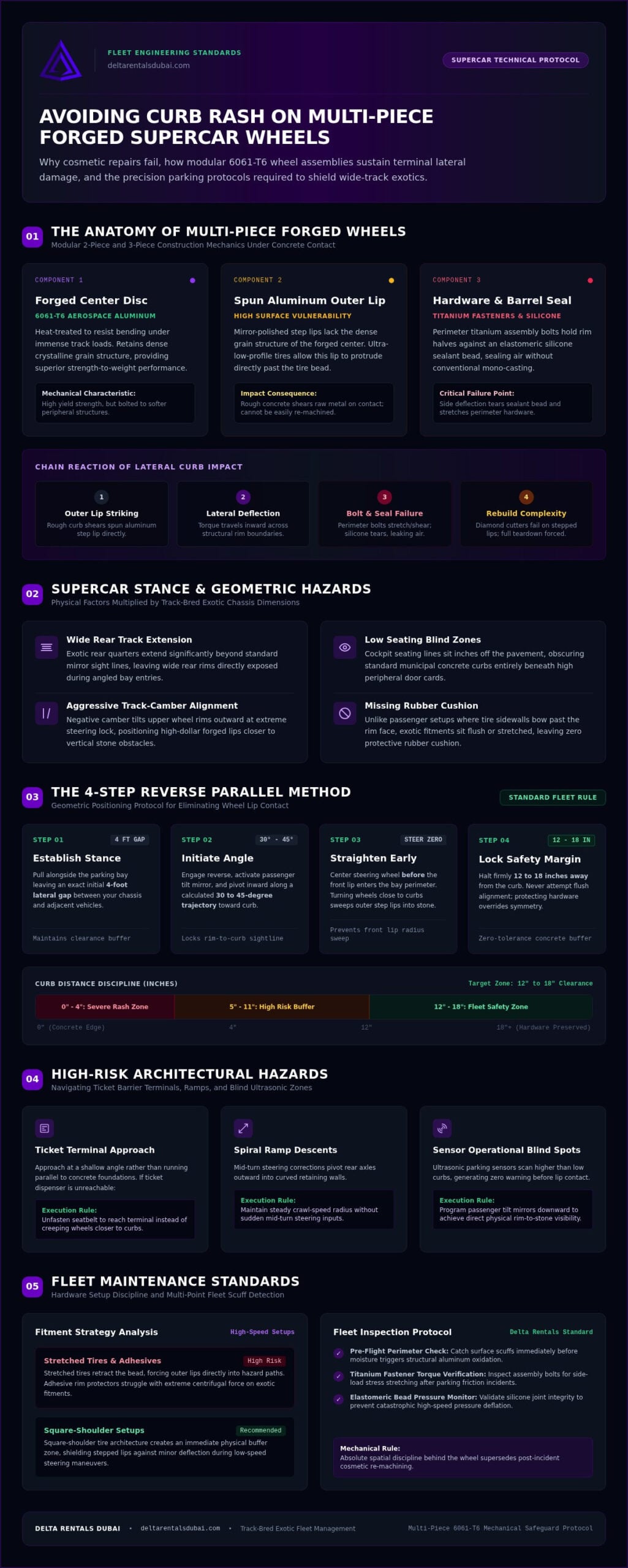
Forged modular wheels deliver unmatched strength-to-weight ratios, but their mechanical architecture makes them uniquely susceptible to physical damage. Unlike monoblock designs cast from a single mold, multi-piece configurations use distinct structural elements: a forged center face, an inner barrel, and an outer rim lip. While foundational alloy wheel construction utilizes heat-treated 6061-T6 aerospace aluminum to resist bending under immense track loads, this material remains remarkably soft against rough concrete. Stone curbs act as aggressive abrasives that shear raw metal on contact.
When paired with extreme low-profile rubber, the outer lip protrudes past the tire bead. You lose the protective rubber barrier found on standard passenger vehicles. As a result, avoiding curb rash on multi piece forged supercar wheels requires recognizing how fragile these structural boundaries truly are.
Modular 2-Piece and 3-Piece Wheel Construction
Modular wheels rely on precision engineering that doesn’t tolerate side impacts. Spun aluminum outer lips offer brilliant mirror finishes, but they lack the dense grain structure of the forged center disc. When an outer lip strikes a curb, lateral energy travels inward across the wheel:
- Fastener Stress: Perimeter titanium assembly bolts stretch or shear under sudden side-load torque.
- Seal Failure: Lateral deflection twists the rim half, tearing the elastomeric silicone sealant bead and causing immediate air pressure loss.
- Rebuild Complexity: Standard diamond-cutting machines cannot true a stepped outer lip without damaging perimeter hardware, forcing an expensive complete teardown at specialized rebuild facilities.
Why Supercars Face Extreme Curb Rash Hazards
Supercar stance multiplies your margin of error. Wide rear track widths extend far beyond the line of sight provided by standard driver-side mirrors, leaving rear quarters exposed to angled entry curbs. Aggressive track-camber alignments tilt the upper rim lip closer to vertical hazards during tight turns, while ultra-low seating positions hide high concrete curbs beneath your peripheral door line.
Professional luxury operators like Delta Rentals Dubai mitigate these exact dynamics across track-bred exotics by enforcing strict mechanical inspection standards. Mastering clear spatial awareness is your primary safeguard against permanent cosmetic and structural wheel failure.
Precision Parking Techniques for Protecting Multi-Piece Wheel Lips
Standard parking routines fail when piloting track-width exotic platforms. A low-slung seating position distorts curb geometry, making visual guesswork a direct path to wheel destruction. Consistently avoiding curb rash on multi piece forged supercar wheels requires strict geometric positioning every time you approach the pavement. Integrating fundamental safe parking lot practices with precise vehicle control ensures you never risk high-dollar running gear against concrete edges.
The 4-Step Reverse Parallel Parking Method
Eliminate wheel lip contact during parallel parking by executing this calculated reverse sequence:
- Establish Stance: Pull alongside the target space leaving an initial four-foot lateral gap between your car and adjacent vehicles.
- Initiate Angle: Engage reverse, activate the passenger mirror tilt, and pivot inward at a thirty to forty-five-degree trajectory toward the curb line.
- Straighten Early: Center the steering wheel before your front lip enters the bay perimeter. Turning the front wheels while in close proximity sweeps the outer step lips directly into the stone.
- Lock the Safety Margin: Halt twelve to eighteen inches away from the curb. Never attempt to align flush with the curb; preserving mirror-polished hardware takes priority over street-side symmetry.
Navigating Spiral Driveways and Concrete Parking Ramps
Tight architectural ramps and parking barriers present unforgiving vertical hazards. When approaching barrier ticket dispensers, enter at a shallow angle rather than swinging parallel to the concrete foundation. If the ticket terminal sits too far, unfasten your belt to reach it instead of creeping closer and risking a forged outer lip. Keep your front wheel aligned against a visible reference point on the flat ground.
Avoid abrupt mid-turn steering corrections on spiral descent ramps. Sudden inputs pivot the rear axle outward, sweeping wide rear lips into curved retaining walls. Maintain a steady, crawl-speed steering radius throughout the entire turn.
Mastering these defensive maneuvers guarantees total confidence behind the wheel. If you want to experience track-level precision in pristine condition, secure your next drive through our dedicated WhatsApp concierge service.
Technological Safeguards: Optimizing Supercar Sensors, Mirrors, and Cameras
Modern driver assistance suites offer unmatched situational awareness, but relying blindly on automated warnings often leads to sheared outer rims. Ultrasonic sensors operate within focused conical zones, while low pavement boundaries sit below their detection field. Successfully avoiding curb rash on multi piece forged supercar wheels requires calibrating these digital tools to offset their physical limitations.
Combine onboard driver aids with physical visual references to build an active perimeter buffer around vulnerable step lips. Even when custom modular offsets adhere to dimensional guidelines set by The Tire and Rim Association, vehicle electronics require human confirmation during tight maneuvers.
Overcoming Ultrasonic Sensor Blind Spots
Factory parking radar systems are engineered to track upright objects like bumper covers, posts, and pedestrians. Standard road curbs sit just four to six inches off the tarmac, slipping directly beneath the beam emission angle. Here is how to manage these radar gaps:
- Clearance Deception: Front carbon splitters and low bodywork may sit inches above the curb while protruding modular rim edges remain squarely in the impact strike path.
- Radar Silence: A continuous warning tone indicates an obstacle ahead, but total acoustic silence doesn’t guarantee your outer lip is clear of stone curbs.
- Hydraulic Axle Lifts: Engage the vehicle’s front suspension lift when entering driveways or tight spaces. Raising the nose clears low obstructions and broadens the forward sensor sweep angle.
Maximizing Digital Cameras and Optical Assist Tools
Surround-view camera systems provide valuable overhead reference points, yet high-end optical systems introduce fish-eye distortion along external screen borders. This optical warping makes wide forged lips appear farther from concrete curbs than their actual proximity. Prioritize precise mirror positioning over camera screens during the final twelve inches of travel.
Program your passenger exterior mirror to tilt downward automatically when reverse gear engages. Adjust the glass until the lower rim lip and rear tire contact patch dominate the lower third of the mirror housing. Before maneuvering in demanding conditions, wipe down external side camera lenses to remove road grime, dust film, or moisture that can conceal curb heights under direct sunlight.
Evaluating Protective Hardware: Rim Guards, Stretched Tires, and Sacrificial Trims
Aftermarket accessories claim to provide an impenetrable barrier between expensive modular aluminum and unforgiving stone edges. On high-horsepower platforms, these physical add-ons introduce severe performance compromises. When considering methods for avoiding curb rash on multi piece forged supercar wheels, choosing the correct tire profile alongside specialized films yields far better protection than generic stick-on hardware.
Pros and Cons of Physical Wheel Rim Protectors
Sacrificial rim guards come in adhesive rubber strips or interlocking nylon rings that slot between the tire bead and the rim edge. While they absorb low-speed parking scrapes, they create distinct hazards on high-performance vehicles:
- High-Speed Detachment: Centrifugal force at triple-digit speeds stresses adhesive bonds. A loose guard can detach, whipping against carbon-fiber fenders and brake lines.
- Rotational Imbalance: Uneven distribution along the rim circumference throws off precision dynamic wheel balancing.
- Trapped Road Debris: Interlocking rings trap fine brake dust, sand, and moisture against mirror-polished step lips, causing deep clearcoat hazing over time.
- Thermal Degradation: Extreme heat radiated by carbon-ceramic brake systems melts lower-grade adhesives, turning sacrificial trims into tacky residues.
Tire Profile Optimization and Rim Protection Flanges
Tire geometry serves as your primary mechanical defense. Many exotic builds run stretched sidewalls to achieve flush fender fitment, but pulling narrow rubber across wide barrels leaves polished aluminum completely exposed. Even light curb contact bypasses the tread entirely, gouging the outer lip directly.
Opt instead for performance tires featuring an integrated, heavy-duty rim protection flange. This molded rubber ridge extends outward past the wheel bead, creating a protective cushion against low obstacles. Pairing a squared-shoulder tire profile with specialized wheel paint protection film (PPF) creates a clean, durable setup. High-grade urethane film absorbs gravel spray and light scuffs without altering wheel balance or disrupting raw metal aesthetics.
Maintaining factory-spec wheel protection requires continuous attention to detail. If you want to experience pristine exotics maintained under these exacting standards, book your next drive via our WhatsApp concierge.
Professional Supercar Maintenance Standards and Exotic Fleet Care
Preserving the structural integrity and aesthetic precision of exotic running gear requires rigorous oversight. Luxury fleet operators manage wide-track performance machines daily, relying on disciplined evaluation protocols rather than reactive fixes. Consistently avoiding curb rash on multi piece forged supercar wheels preserves vehicle equity, prevents air seal failures, and ensures that dynamic capabilities remain uncompromised.
Every vehicle delivery and return cycle should feature a multi-point inspection protocol. Technicians run tactile checks along outer step lips, measure rim runout tolerances, and verify that polished surfaces remain free of stone abrasions. Catching minor clearcoat disruptions early prevents moisture from penetrating the raw aluminum substrate beneath.
Immediate Action Plan for Minor Wheel Lip Contact
Minor contact requires swift, calculated remediation to stop permanent structural deterioration:
- Deflection Analysis: Inspect the wheel lip using a runout gauge to determine whether contact caused physical distortion or remained a cosmetic clearcoat rub.
- Hardware Torque Check: Inspect nearby titanium assembly bolts. Lateral curb stress can cause micro-loosening, compromising multi-piece sealing pressure.
- Corrosion Barrier: Clean any scuffed surface immediately with isopropyl alcohol. Apply a dedicated synthetic polymer sealant over exposed bare metal to halt immediate aluminum oxidation until precision resurfacing occurs.
Experiencing Flawless Performance with Delta Rentals Dubai
Elite automotive stewardship guarantees that supercars perform exactly as factory engineers intended. At Delta Rentals Dubai, every high-performance exotic undergoes strict multi-point wheel and tire inspections before each booking. This commitment to maintenance ensures clients pilot pristine machinery without worrying about compromised running gear or previous rim neglect.
You can experience true track calibration firsthand with a Porsche 911 GT3 RS Rental, exploring aerodynamic balance backed by pristine forged center-lock running gear. Whether navigating tight urban corridors or taking long highway tours, access an immaculate supercar lineup backed by proven 5-star service standards. Reserve your preferred exotic through our dedicated WhatsApp Concierge today.
Master Precision Driving and Preserve Exotic Running Gear
Shielding modular forged wheels from unforgiving concrete requires active technical discipline rather than reactive repairs. By executing wide-angle reverse entries, programming passenger mirror dips, and running performance tires with built-in rim protection flanges, you eliminate contact hazards before they develop. True automotive stewardship means knowing your platform’s track width and treating spatial awareness as non-negotiable.
Mastering spatial discipline remains the ultimate standard for avoiding curb rash on multi piece forged supercar wheels. When you pilot machinery maintained to strict factory tolerances, every transition feels sharp, predictable, and controlled. Experience this precision firsthand with a pristine, multi-point inspected fleet delivered in immaculate showroom condition. To reserve your next high-performance drive, connect with our VIP concierge on WhatsApp and hit the road with complete peace of mind.
Frequently Asked Questions
Can multi-piece forged wheels be repaired after scraping a concrete curb?
Yes, but the process is far more complex than fixing standard monoblock wheels. Standard diamond-cutting machines often can’t work around perimeter hardware and stepped lips. Light scuffs can occasionally be hand-polished out, but deep gouges require full wheel disassembly, unbolting titanium hardware, and breaking silicone seals. In severe cases, replacing the spun-aluminum outer barrel half entirely is the only safe way to restore structural trueing.
Why do multi-piece wheels suffer more curb damage than standard cast wheels?
Multi-piece forged wheels feature softer outer lips and zero tire cushioning. Outer rims are typically formed from spun 6061-T6 aluminum to reduce rotational mass. While resilient under track compression, this alloy shears easily against stone. Additionally, exotic track widths push wheels flush with fenders, eliminating tire bead cushion. Prioritizing spatial discipline is critical for avoiding curb rash on multi piece forged supercar wheels.
Do parking sensors detect low curbs when driving a low-clearance supercar?
No, factory ultrasonic parking sensors frequently miss low curbs. Most automotive sonar sensors project an acoustic cone calibrated for vertical obstacles at least ten inches high. Standard road curbs sit four to six inches tall, allowing them to remain completely undetected beneath the sensor radar beam. You shouldn’t rely solely on audible parking beeps; always cross-reference downward-tilted exterior mirrors to verify physical wheel-to-ground distances.
Are clip-on rim protectors safe to use on track-capable supercars?
No, physical clip-on or adhesive rim protectors are unsafe on high-speed performance cars. At highway speeds, intense centrifugal forces can cause adhesive strips or nylon rings to dislodge, potentially damaging body panels, carbon splitters, or brake ducting. Extreme thermal transfer from carbon-ceramic brake systems also melts lower-grade adhesives. Dedicated clear paint protection film or square-profile tire shoulders offer a safer, more stable alternative.
What should I do immediately after my multi-piece wheel touches a curb?
Stop immediately and inspect the contact zone before continuing to drive. Check the outer lip with a dial runout gauge for bends, verify tire pressure, and ensure nearby assembly bolts haven’t loosened or stretched. Next, wipe away stone grit and degrease the scrape with isopropyl alcohol. Seal the exposed raw metal with a temporary clear ceramic or polymer coat to prevent immediate aluminum oxidation until professional repairs are arranged.
Does tire stretching make multi-piece supercar wheels more vulnerable to damage?
Yes, tire stretching dramatically increases the risk of damage. Mounting undersized rubber pulls the tire sidewall inward, exposing the outer forged lip ahead of the tread block. The raw aluminum rim edge becomes the primary point of impact against curbs and road debris. For optimal safety and avoiding curb rash on multi piece forged supercar wheels, install squared tire profiles featuring an integrated heavy-duty rubber rim guard bead.