

A hairline rub on an exposed carbon fiber wing can turn an exhilarating drive into a frustrating liability dispute before you even clear the collection bay. Conducting a disciplined anti scratch clear bra film inspection on hired carbon splitters is the single most effective way to avoid inheriting someone else’s underside scrape damage. You already know the tension: kneeling on the pavement, squinting at an edge blemish, and wondering whether that faint mark is just a superficial film graze or a fractured resin weave.
You shouldn’t have to risk unjustified damage penalties over ambiguous vehicle condition reports. In this guide, you will master a repeatable pre- and post-drive verification checklist that instantly separates harmless, self-healing film scuffs from genuine composite delamination before you ever hit the open road. We preview the tactile surface tests, optimal inspection lighting angles, and macro-photo documentation standards you need to guarantee absolute transparency and safeguard your experience from start to finish.
Key Takeaways
- Mastering an anti scratch clear bra film inspection on hired carbon splitters ensures you distinguish sacrificial film wear from underlying composite damage before leaving the collection bay.
- Target high-vulnerability leading edges and underside perimeter seams during pre-drive checks to catch film lifting or trapped grit immediately.
- Differentiate self-healing elastomeric clear bra scuffs from white stress hazing and resin fractures beneath the film to prevent unfair liability charges.
- Deploy grazing 30-degree lighting angles and continuous 4K video walkarounds to generate ironclad, dispute-proof handover records.
- Partner with prestige fleet operators that prioritize open vehicle handovers, ensuring complete transparency and effortless driving confidence.
Why Inspecting Clear Bra on Hired Carbon Splitters Matters
Modern performance vehicles harness aggressive aerodynamics to press the chassis into the asphalt at pace. Splitters, canards, and ground-effect strakes sit mere centimetres off the tarmac, exposing delicate composite weave to high-velocity debris. An paint protection film (PPF) install serves as a vital sacrificial skin, absorbing stone impacts, track grit, and road rash before trauma reaches the lacquered weave underneath. Conducting a meticulous anti scratch clear bra film inspection on hired carbon splitters before taking the keys is essential for protecting your driving privileges and your wallet.
When you hire an elite machine like a Porsche 911 GT3 RS or McLaren Artura, the vehicle handover process sets the baseline for your financial exposure. Unrecorded impact marks or curb rash can quickly morph into disputed repair invoices at drop-off. Knowing how to read protective film ensures you never let a superficial, self-healing urethane blemish get misclassified as a structural crack in the autoclave-cured fiber.
The Vulnerability of Exposed Front Aerodynamics
Front splitters operate in the direct line of fire. They catch high-speed grit blasts, severe road dip compressions, and driveway crest rubs. High-performance suspension setups minimize body roll, yet they also transfer ground impacts straight through lower composite elements. Repairing authentic carbon fiber requires specialized vacuum-bagging and thermal cycling rather than simple panel respraying, making any unverified pre-existing strike an expensive liability to carry.
Contractual Responsibility During Luxury Vehicle Hires
Rental agreements draw sharp lines between ordinary operational wear and chargeable exterior damage. Standard rental agreements hold the driver responsible for localized impacts, gouges, or underside scrapes that occur during their booking window. Completing an anti scratch clear bra film inspection on hired carbon splitters protects you from inherited disputes through several direct mechanisms:
- Identifying grit pockets: Early film tears allow dirt to pack beneath the adhesive, creating visual hazing that mimics internal weave fracture.
- Verifying edge seal adhesion: Delaminating film along trailing edges signals prior airflow pull or ground scraping.
- Securing peace of mind: Transparent, documented handovers confirm the exact state of every component, protecting your security deposit against unwarranted deductions.
Partnering with an honest provider that values complete transparency changes everything. When an agency documents baseline film condition alongside you, you get to focus purely on the drive ahead.
The Comprehensive Pre-Drive Carbon Splitter Inspection Checklist
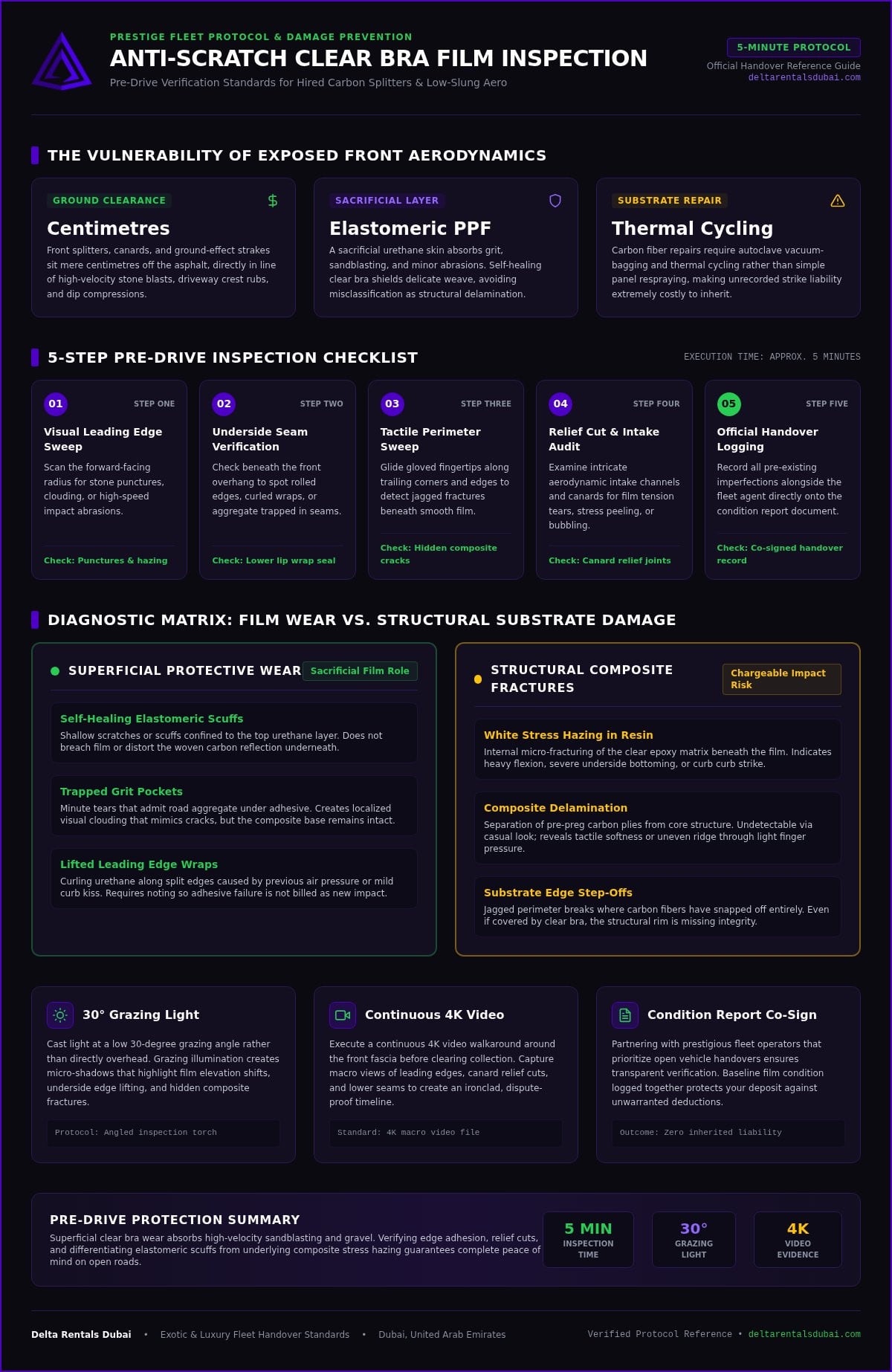
Most automotive guides focus on pristine workshop installations, but a vehicle handover requires an assertive, defensive mindset. Executing a disciplined anti scratch clear bra film inspection on hired carbon splitters takes only five minutes and eliminates costly disputes before you leave the lot. Follow this systematic five-step sequence:
- Step 1: Visual leading edge sweep: Scan the forward-facing radius for stone punctures, clouding, or impact abrasions.
- Step 2: Underside seam verification: Check beneath the front overhang to spot rolled edges or trapped aggregate.
- Step 3: Tactile perimeter sweep: Trace edges using light fingertip pressure to uncover jagged substrate fractures.
- Step 4: Relief cut audit: Examine intricate intake channels and canards for film tension tears or bubbling.
- Step 5: Handover logging: Record all pre-existing imperfections alongside the fleet agent on the official condition report.
Leading Edge and Underside Perimeter Checks
Crouch down at bumper level to evaluate the lowest forward lip. This zone endures persistent aggregate sandblasting and sudden driveway rubs. Verify that the protective polyurethane wraps cleanly under the lower lip without edge curling. Lifted film edges scoop up road grit and catch passing airflow at speed, tearing the protective layer away. Identifying loose film beforehand ensures you aren’t blamed for previous contact.
Tactile Verification and Seam Integrity
Glide a gloved fingertip along the aero blade’s trailing corners. Similar to principles used when routinely inspecting carbon components by touch, a gloved sweep immediately snags on sharp resin fractures that optical reflections conceal. Look closely at precision relief cuts around dive planes. Clean factory template cuts feature smooth radius lines, whereas stress fractures display rough, jagged margins with cloudy white adhesive separation.
Document every blemish immediately. When you demand uncompromising quality, you can connect with an honest supercar rental concierge who facilitates mutual pre-drive walkarounds so you take the wheel with complete peace of mind.
Differentiating Surface Film Scuffs from Structural Carbon Damage
Paint protection film acts as a sacrificial shield. Its elastomeric polymer chains flex, absorb energy, and reseal under direct heat. Yet hirers often panic when they spot an abrasion, assuming any mark translates to catastrophic composite failure. Master diagnostic evaluation during your anti scratch clear bra film inspection on hired carbon splitters to distinguish superficial urethane blemishes from structural carbon compromise with absolute precision.
The core objective is determining whether mechanical force stayed isolated within the 8.0 to 8.5-mil thermoplastic layer or transferred into the carbon fiber substrate. The reference matrix below clarifies what you are seeing:
| Visual Symptom | Physical Layer Affected | Structural Impact | Action Required at Handover |
|---|---|---|---|
| Faint swirls or light hazing | Elastomeric film topcoat | None (self-heals with heat) | Log as normal wear |
| Milky white opacity / spiderwebs | Clear coat or resin beneath film | Subsurface matrix fracture | Photograph and note as pre-existing |
| Torn film with frayed edges | PPF punctured through to weave | Broken structural fibers | Require operator sign-off before departure |
| Dull, hollow sound upon light tap | Internal laminate layers | Composite delamination | Flag immediately on handover form |
Diagnostic Indicators: Self-Healing vs Substrate Failure
Light friction marks from high-speed sand or wash sponges simply distort the top film layer. These superficial scuffs smooth out when exposed to sunlight or warm water without altering the crisp visual geometry of the twill below. When impact energy shatters the underlying epoxy resin, however, it leaves cloudy, spider-webbed fractures trapped under an otherwise intact film. Light knuckle tapping across the section provides immediate confirmation; intact carbon rings out with a crisp, sharp resonance, whereas delaminated composite returns a dull, muted thud.
Assessing Punctures, Stone Bruising, and Fiber Distortion
A blunt pebble strike often leaves an indentation on the urethane shield without piercing the barrier. That is the film functioning exactly as engineered. High-velocity aggregate, on the other hand, can punch clean through the thermoplastic membrane. Check the woven pattern through an illuminated magnifying lens. If the dark fiber lines run straight and unbroken, the composite core remains completely sound. If the weave appears kinked, crushed, or severed with exposed dry strands, you are dealing with genuine structural trauma rather than sacrificial film wear.
Conducting this systematic anti scratch clear bra film inspection on hired carbon splitters ensures cosmetic film duties are never misconstrued as expensive composite claims.
Optimal Photographic and Lighting Protocols for Low-Slung Aero
Showroom spotlights flatter sweeping silhouettes, but they wash out subtle film stress marks on ground-hugging splitters. A quick smartphone snapshot taken from standing height proves virtually useless during an end-of-hire audit. Capturing undeniable photographic proof requires deliberate forensic techniques tailored specifically to low-clearance components. Mastering these steps elevates your anti scratch clear bra film inspection on hired carbon splitters into an airtight record of condition.
Execute this four-point capture method to eliminate ambiguity:
- Use oblique raking light: Cast a continuous high-CRI inspection beam across the horizontal surface at a low 30-degree angle. Grazing light casts long shadows behind lifted edges, punctures, and adhesive bubbles that direct downward light washes out.
- Record uninterrupted 4K video: Walk the phone smoothly from the passenger front arch to the driver side in a continuous single take, maintaining a steady 30-centimeter distance from the splitter lip.
- Include a physical scale marker: Place a credit card or dedicated millimeter scale sticker right next to any pre-existing nick before taking a high-resolution macro shot.
- Protect your digital audit trail: Verify that camera metadata retains intact GPS coordinates and exact timestamps, then sync the files immediately to cloud storage.
Forensic Lighting and Angle Positioning
Direct downward flash creates high-contrast glare across glossy polyurethane, blinding the lens to micro-abrasions underneath. Diffuse the beam slightly or angle your torch so light skims sideways across the weave. For the lowermost horizontal under-tray, slide a handheld mechanic’s mirror paired with a magnetic LED strip beneath the front lip. This setup reveals curb scrapes without forcing you onto dirty collection bay asphalt.
Digital Record Keeping and Handover Documentation
Context matters as much as clarity. Pair every close-up macro photograph with a wide-angle reference shot that clearly shows the car’s registration plate alongside the aero wing. Never leave unlogged blemishes to verbal assurances. Insist that the fleet concierge records the exact dimensions and positions of any film lifting on their digital intake sheet before you drive away.
Demand complete transparency from your rental partner from day one. You can book your next prestige supercar rental directly on WhatsApp to experience transparent handovers that eliminate liability friction entirely.
Elite Fleet Standards: How Transparent Vehicle Handover Protects You
Prestige rental fleets treat vehicle preservation with uncompromising rigor. Track-focused machines engineered for immense downforce demand superior aerodynamic protection across every low-slung surface. Booking a Porsche 911 GT3 RS Rental or McLaren Artura places massive front splitters millimeters above unforgiving pavement. Premier operators understand this reality, wrapping high-impact components in advanced multi-layer films to keep original composites pristine through every rental cycle.
Reputable fleet providers welcome a collaborative anti scratch clear bra film inspection on hired carbon splitters. Instead of rushing you through paperwork, honest concierges actively walk the car with you to log baseline film conditions. This transparent protocol builds mutual trust, ensuring minor cosmetic film deflections are distinguished from actionable composite damage before departure.
What to Expect from a Transparent Rental Operator
Top-tier operators streamline collection by providing itemized digital inspection reports. Fleet agents point out existing film seams, relief cuts, and minor stone marks on splitters, diffusers, and carbon side skirts. When you return the vehicle, the drop-off process mirrors departure with the exact same objective criteria. Both parties reference the initial baseline, confirming fair treatment without arbitrary deductions.
Best Driving Practices to Protect Carbon Splitters
Proactive driving habits keep front aero splitters safe regardless of how low the chassis sits. Incorporate these three road strategies to safeguard external components throughout your hire:
- Approach inclines diagonally: Cross driveway lips and aggressive speed humps at an angle, placing one wheel on the crest first to increase ground clearance.
- Deploy front-axle lift: Engage the hydraulic front lift switch well ahead of underground parking ramps or speed table transitions.
- Maintain generous following gaps: Give commercial vehicles extra space on open motorways to minimize high-velocity aggregate strikes.
Securing a high-performance machine should feel effortless. Review the premium exotic collection at Delta Rentals to enjoy impeccable vehicle preparation, honest handover protocols, and total driving confidence.
Drive with Absolute Handover Confidence
A high-performance journey should be defined by blistering acceleration, not anxiety over pre-existing exterior scuffs. You don’t have to leave vehicle condition reports to chance. Conducting a disciplined anti scratch clear bra film inspection on hired carbon splitters separates normal self-healing wear from costly substrate damage before you leave the collection area. Armed with low-angle raking light and continuous video walkarounds, you protect your deposit and your peace of mind.
Elite car hire demands an uncompromising standard of trust. Backed by over 300 5-star verified customer reviews, transparent operators prioritize immaculate fleet preparation with high-grade clear bra protection across every track-bred aero package. You benefit from a frictionless digital handover process with zero hidden liabilities, ensuring complete clarity from departure to return. Ready to experience a flawlessly presented exotic without the friction? Discover high-performance luxury car rentals with Delta Rentals and enjoy the drive with absolute assurance.
Frequently Asked Questions
What is the difference between anti-scratch clear bra and standard vinyl wrap on a carbon splitter?
Anti-scratch clear bra uses thick, impact-absorbing thermoplastic polyurethane with self-healing elastomeric polymers, whereas vinyl wrap is a thin cosmetic film designed for color changes. Vinyl tears easily upon aggregate impact and offers minimal resistance against gravel strikes. Clear bra preserves optical weave clarity and absorbs mechanical shock, acting as a genuine sacrificial shield over vulnerable carbon composite splitters.
Can a self-healing clear bra repair deep stone gouges on a hired vehicle’s front lip?
Self-healing clear bra only repairs light surface swirl marks and micro-abrasions within its topcoat when exposed to heat. It can’t repair deep gouges that penetrate entirely through the urethane layer or tear the underlying film material. If a stone strike punctures through to the composite substrate, the damaged film section requires professional replacement rather than thermal recovery.
How can I tell if a scratch is only in the film or has cracked the carbon splitter?
Conduct a focused anti scratch clear bra film inspection on hired carbon splitters by checking the composite weave under oblique lighting. Film scratches show transparent or light scuffs without altering underlying twill alignment. If you notice milky spider-web hazing, distorted carbon patterns, frayed strands, or a dull sound during a light tap test, the impact has cracked the epoxy resin beneath the film.
What should I do if I notice peeling clear bra during my pre-rental inspection?
Document peeling or lifted clear bra immediately on the official handover condition report before accepting the vehicle. Take high-resolution, scale-referenced photos showing the exact edge separation. Ask the fleet representative to sign off on the defect in writing. Peeling film can catch aerodynamic drag at motorway speeds and rip away entirely; documenting it beforehand guarantees you won’t be held accountable for progressive film detachment.
Are front splitter scrapes covered under standard supercar rental insurance policies?
Standard rental insurance policies frequently exclude undercarriage and lower aerodynamic trim damage caused by curb strikes or bottoming out. Operators classify low-clearance ground impacts as preventable driver error rather than normal road wear. You should always review supplemental collision waivers, confirm exact coverage boundaries for exterior carbon aero components, and verify that all pre-existing underside scrape abrasions are recorded on the departure sheet.
Why do luxury performance vehicles use clear bra instead of traditional ceramic coatings alone?
Ceramic coatings offer chemical resistance, hydrophobic slickness, and UV filtering, but they provide virtually zero physical impact resistance against flying road stones. Clear bra provides a thick, energy-dissipating physical barrier that deflects debris strikes and prevents rock chips. Prestige fleet operators often install ceramic coatings directly over high-grade clear bra to achieve the dual benefit of physical impact defense and effortless surface maintenance.
What tools should I bring to inspect low-clearance aerodynamic splitters during vehicle delivery?
Bring a compact high-CRI LED inspection torch, an angled telescopic mechanic’s mirror, and a smartphone capable of 4K video recording. These three tools make your anti scratch clear bra film inspection on hired carbon splitters seamless and indisputable. The torch reveals subsurface hazing through grazing raking light, while the mirror exposes underside scuffs without requiring you to crawl underneath the chassis on dirty delivery bay pavement.