

The most transformative handling breakthrough in modern performance machinery doesn’t stem from stiffer front springs or stickier tires; it happens at the rear axle. If you’re skeptical that all wheel steering technology in sports cars adds unwanted ballast and dulls authentic steering feedback, your hesitation is completely understandable. Deciphering conflicting automaker jargon like active rear-axle steer, four-wheel steer, and dynamic chassis control often clouds the genuine physics at work.
When engineered properly, active rear actuation doesn’t isolate the driver. It dynamically alters the vehicle’s physical wheelbase to erase traditional chassis compromises. In this guide, you’ll master how active all-wheel steering transforms sports car agility, cornering precision, and high-speed stability across every corner. We break down the exact electromechanical principles separating low-speed counter-phase rotation from high-speed in-phase tracking, cut through the marketing noise, and reveal how apex machinery like the Porsche 911 GT3 RS harnesses dynamic geometry for pure track dominance.
Key Takeaways
- Discover how all wheel steering technology in sports cars dynamically alters virtual wheelbase dimensions to deliver both razor-sharp agility and high-speed composure.
- Master the mechanical transition between low-speed counter-phase steering and high-speed in-phase tracking, eliminating traditional chassis trade-offs.
- Understand how high-speed electromechanical actuators govern tire slip angles and yaw rates to suppress understeer and trailing-throttle oversteer.
- Examine how benchmark supercars like the Porsche 911 GT3 RS calibrate dynamic rear actuation for peak aerodynamic and mechanical grip.
- Learn what to expect behind the wheel, from effortless low-speed maneuvering to the planted sensation of cornering on magnetic rails.
What Is All-Wheel Steering Technology in Sports Cars?
At its core, all-wheel steering is the active mechanical manipulation of a vehicle’s geometry, altering dynamic toe angles in real time to redefine physical handling limits. Rather than keeping the rear axle locked on a fixed plane, modern systems dynamically pivot the rear wheels alongside the front wheels. This real-time alignment relies on high-speed electromechanical actuators commanded by central chassis management computers. By evaluating vehicle velocity, steering input angle, lateral acceleration, and yaw rates thousands of times per second, the system adjusts chassis posture before tire slip can undermine traction.
Understanding four-wheel steering reveals how this active hardware bridges the gap between mechanical grip and computer precision. Advanced all wheel steering technology in sports cars doesn’t merely assist the driver; it continually re-engineers vehicle dynamics while cornering.
The Evolution from Mechanical 4WS to Electronic Actuation
Chassis engineers spent decades perfecting rear-axle articulation. The lineage moves through three clear eras of hardware refinement:
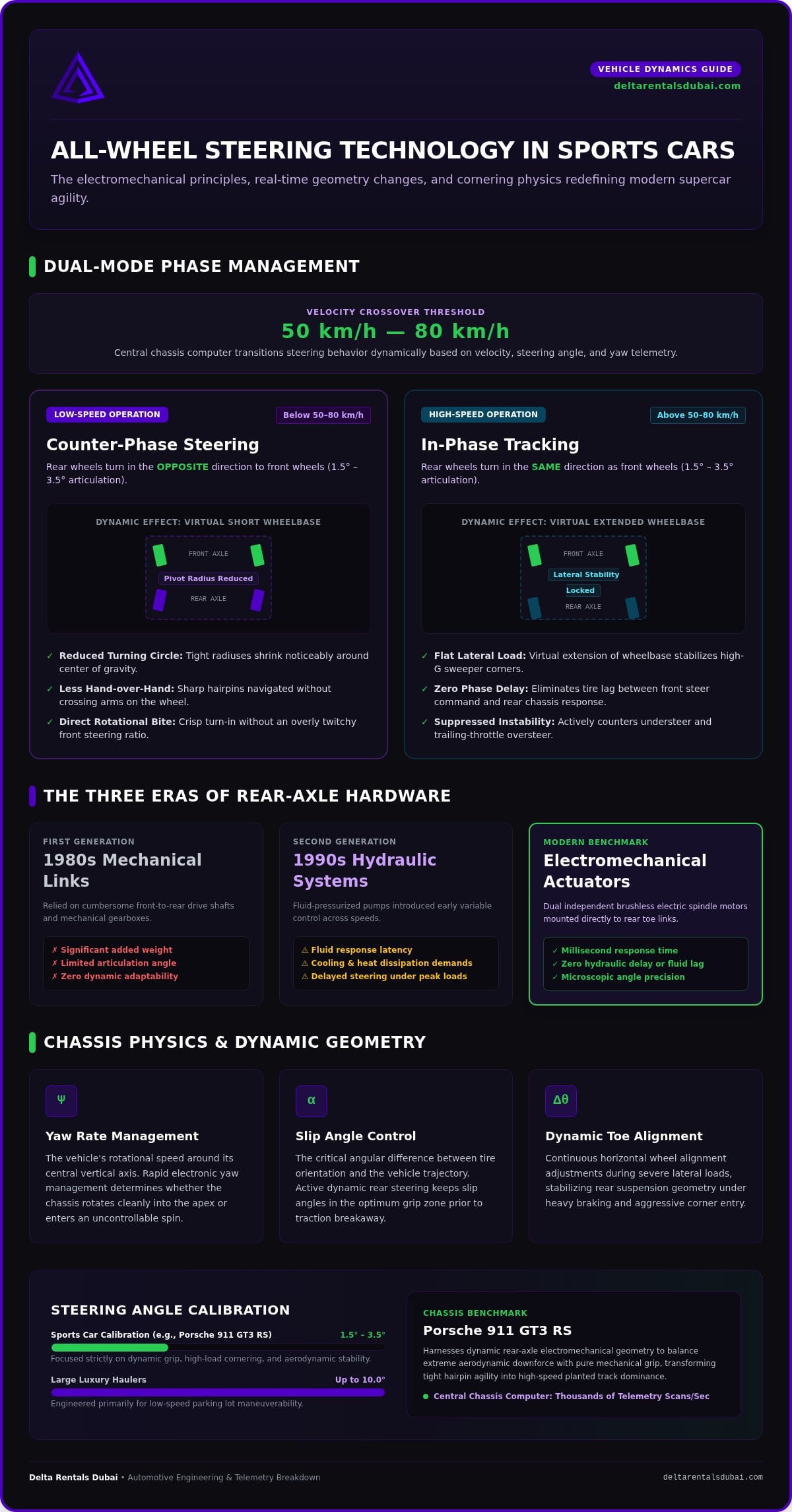
- 1980s Mechanical Links: Early systems relied on cumbersome front-to-rear drive shafts and gearboxes. They added significant weight, offered limited articulation, and lacked dynamic adaptability.
- 1990s Hydraulic Systems: Fluid-pressurized pumps introduced variable control, but fluid latency and cooling demands created delayed steering responses under hard cornering loads.
- Modern Electromechanical Actuators: Today’s sports cars utilize dual independent electric spindle motors mounted directly to the rear toe links. Operating within milliseconds, these brushless units deliver instant, microscopic angle adjustments with zero hydraulic lag.
Key Chassis Terminology Every Driver Should Know
Deciphering the engineering behind all wheel steering technology in sports cars requires mastering three fundamental chassis concepts:
- Yaw Rate: The vehicle’s rotational speed around its central vertical axis. Managing yaw quickly determines whether a chassis rotates crisply into an apex or violently spins out.
- Slip Angle: The critical angular difference between where a tire points and the actual trajectory of vehicle travel. Managing slip angles optimizes peak cornering grip before traction breakaway.
- Dynamic Toe Angle: The continuous adjustment of wheel alignment along the horizontal plane during intense lateral loads, actively stabilizing the rear suspension under heavy braking and corner entry.
Counter-Phase vs. In-Phase Steering: How Rear-Axle Systems Work
The performance advantage of all wheel steering technology in sports cars boils down to phase management. Unlike large luxury haulers that swing their rear wheels up to ten degrees for tight parking, sports cars apply precise, high-load adjustments typically limited to between 1.5 and 3.5 degrees. By modulating these subtle angles across variable vehicle velocities, the chassis management system dynamically transforms the car’s effective wheelbase. The critical crossover point between opposing and parallel steering modes typically occurs between 50 and 80 km/h, depending on drive mode settings and yaw telemetry.
Low-Speed Agility: The Art of the Virtually Shortened Wheelbase
Below the transition speed threshold, modern actuators initiate counter-phase steering, angling the rear wheels opposite to the front tires. This creates the dynamic behavior of a significantly shorter wheelbase. You feel the difference immediately in hairpins and switchbacks:
- Reduced Turning Circle: Tight radiuses shrink noticeably, allowing the vehicle to pivot effortlessly around its center of gravity.
- Less Hand-over-Hand Input: Drivers maintain optimum hand placement on the wheel through sharp corners without crossing arms.
- Direct Rotational Bite: Directional transitions feel razor-sharp without requiring an overly twitchy, nervous front steering ratio.
High-Speed Stability: Parallel Tracking Through High-G Sweepers
Cross the velocity threshold into track speeds, and the actuators shift instantly into in-phase steering. The rear wheels now pivot in the exact same direction as the front tires. In physics terms, this virtually stretches the chassis wheelbase, keeping lateral load distribution beautifully flat.
Traditional fixed-axle cars suffer from a minute phase delay; the front tires steer, lateral load transfers, and only then does the rear axle follow. In-phase steering eliminates this yaw lag entirely. Lateral acceleration builds synchronously across all four contact patches simultaneously. High-speed lane changes and triple-digit sweepers become seamless lateral glides, eradicating sudden pendulum effects and rear-end wander in severe crosswinds. If you want to experience how this software calibration feels from the cockpit, explore an active chassis firsthand through a Porsche 911 GT3 RS rental engineered with dynamic rear steering.
Cornering Physics: Slip Angles, Yaw Control, and Track Performance
Mastering apex entry requires managing the split second between steering input and lateral chassis reaction. During aggressive turn-in, all wheel steering technology in sports cars actively regulates rear tire slip angles before lateral forces destabilize the platform. If the front tires scrub and generate excess slip angle, the rear actuators introduce immediate stabilizing toe adjustments. This instantaneous response actively mitigates terminal understeer on entry while suppressing snap trailing-throttle oversteer over mid-corner curb strikes. By eliminating transient phase lag, zero-delay yaw buildup cuts apex transit times and allows drivers to commit to throttle significantly earlier. Modern platforms harmonize this actuation with electronic limited-slip differential vectoring, delivering flat, balanced corner exits.
Taming the Pivot Point: Eliminating Rotational Delay
Conventional performance cars suffer from an inherent mechanical delay. When you turn the wheel, the front tires must generate lateral force first, twisting the chassis before the rear tires begin to follow. Rear-axle steering eliminates this torsional hesitation by initiating lateral force generation at the chassis rear simultaneously. Instead of the vehicle feeling like an anchor trailing behind the front axle, the rotation point shifts directly beneath the driver’s hips. The entire vehicle rotates cohesively around its mass center, transforming abrupt direction changes into fluid, telepathic movements.
Addressing the #1 Driver Skepticism: Steering Feel and Added Mass
Purists often question whether electromechanical rear actuation compromises authentic driver feedback. In practice, all wheel steering technology in sports cars leaves the front steering rack untainted. Front-wheel caster, kingpin inclination, and road surface texture still telegraph directly through the steering wheel rim. The computer simply eliminates sloppy lateral flex at the rear contact patches.
Weight concerns also fall apart under scrutiny. Adding dynamic rear actuators incurs a minor mass penalty of roughly 8 to 15 kg. On track, however, the immediate lateral grip and stabilization benefits vastly outweigh those few kilograms:
- Higher Cornering Velocity: Sustained mid-corner lateral G loads increase without washing out the front tires.
- Superior Braking Stability: In-phase micro-corrections prevent rear waggle during threshold braking from triple-digit speeds.
- Reduced Tire Degradation: Optimizing rear slip angles distributes thermal stress evenly across the tire tread, extending tire longevity.
Flagship Supercars That Perfected Active Rear-Wheel Steering
Top-tier manufacturers treat dynamic chassis kinematics as the ultimate competitive frontier. Rather than settling for passive geometry, premier marques refine all wheel steering technology in sports cars to deliver surgical feedback. Microscopic, millimeter-precise rear toe deflections allow supercars to generate massive lateral loads without feeling nervous at the limit. Porsche, Lamborghini, and Ferrari each take distinct engineering paths to calibrate this hardware, tailoring dynamic responses to their unique weight distributions and powertrain layouts.
The Porsche 911 GT3 RS: Motorsport Kinematics for Road and Circuit
The Porsche 911 GT3 RS serves as the global benchmark for track-focused chassis articulation. Because its rear-engine layout naturally places significant mass behind the rear axle, Porsche engineers rely on active rear-axle steering to stabilize the car under violent deceleration. The system works in unison with active front aero flaps and the massive DRS rear wing, generating balanced downforce across both axles.
Entering high-speed braking zones, the rear spindle actuators apply minute in-phase corrections. This prevents the rear end from stepping out while hauling down from triple-digit speeds. If you want to feel this motorsport suspension kinematics in action, arrange a Porsche 911 GT3 RS rental to test its track-bred capabilities firsthand.
Comparative Implementations Across Italian and British Thoroughbreds
Other elite manufacturers take contrasting yet equally effective approaches to rear-axle kinematics:
- Lamborghini Dynamic Steering: Lamborghini incorporates active rear-wheel steering into its central LDVI (Lamborghini Dinamica Veicolo Integrata) system on models like the Revuelto and Aventador series. By counter-steering at lower speeds, it effectively shrinks the wheelbase of long, wide V12 platforms, granting them mid-corner agility that defies their physical footprint.
- Ferrari Independent Axle Actuation: Ferrari evolved the technology by implementing independent rear actuators on platforms like the 812 Competizione and SF90. Each rear wheel can adjust its dynamic toe angle independently, stabilizing the inside wheel while aggressively loading the outside tire for lightning-fast apex rotation.
- British Purity vs. Active Systems: McLaren traditionally relied on lightweight hydraulic power steering racks and brake-based torque vectoring to avoid excess mass, but industry adoption has shown the undeniable lap-time superiority of active rear toe control.
Experience these dynamic chassis technologies on the open road. Reserve an exotic thoroughbred through our supercar rental concierge on WhatsApp today.
Experiencing Active All-Wheel Steering Behind the Wheel
Analyzing technical suspension blueprints provides valuable theoretical knowledge, but true appreciation comes from the driver’s seat. Evaluating all wheel steering technology in sports cars begins the moment you roll out of a pit lane or navigate a confined staging area. At pedestrian speeds, the car maneuvers with the tight radius of a compact hatchback. Squeeze the throttle and carry pace onto open asphalt, however, and the chassis firms into an entirely different beast, tracking high-speed sweepers as if bolted to invisible magnetic rails.
What to Look for During High-Performance Driving
Recognizing dynamic chassis adjustments takes an attuned sense of vehicle balance. Focus on three critical chassis behaviors through the steering wheel and seat bolster:
- Instant Apex Bite: Watch how quickly the nose keys into the corner entry. You won’t need the secondary steering corrections typical of traditional sports cars because the dynamic rear toe angle prevents the initial slip scrub.
- Chicane Neutrality: Rapid direction shifts through tight S-bends reveal zero delayed chassis pivot. The vehicle changes direction as a single, rigid unit without waiting for the rear axle to catch up to front inputs.
- High-Speed Composure: During abrupt lateral lane maneuvers at high speeds, observe the total absence of body sway. Parallel tracking keeps the car entirely level, preserving your confidence at the limit.
Accessing Pure Automotive Engineering Excellence
Grasping chassis physics fundamentally changes how you pilot exotic machinery. It transforms arbitrary inputs into deliberate maneuvers, letting you lean hard on tire contact patches with complete trust. Yet reading vehicle dynamic whitepapers will never substitute for the visceral physical sensations of active lateral force and aerodynamic grip.
Discerning driving enthusiasts know that the ultimate classroom is seat time behind the wheel of pristine, manufacturer-maintained supercars. Compare varied chassis calibrations by exploring the high-performance models available through Delta Rentals. Discover firsthand how active engineering elevates sports car agility into pure dynamic perfection.
Command the Next Era of Dynamic Chassis Control
Active rear-axle actuation permanently settles the compromise between low-speed agility and high-speed composure. By calculating yaw rates and governing tire slip angles in milliseconds, all wheel steering technology in sports cars eliminates traditional chassis trade-offs. It transforms raw horsepower and mechanical grip into telepathic handling, unlocking cornering velocities that once seemed physically impossible.
Theoretical knowledge sets the foundation, but commanding this dynamic hardware on open tarmac delivers pure exhilaration. True driving mastery begins when machine kinematics match your intuition. Delta Rentals puts you directly in the cockpit of world-class performance machinery. Our pristine fleet includes track-honed icons like the Porsche 911 GT3 RS, supported by seamless white-glove national delivery, transparent terms, and hundreds of verified 5-star client reviews. When you’re ready to test active chassis kinematics for yourself, connect with our luxury rental concierge on WhatsApp and experience apex engineering firsthand.
Frequently Asked Questions
Does all-wheel steering in sports cars make the steering feel artificial?
No, properly calibrated active rear steering preserves genuine mechanical communication through the front steering rack. The front wheels maintain their natural caster, geometry, and road texture feedback, while rear actuators simply stabilize the chassis from behind. You experience sharper front turn-in and predictable lateral grip without the detached, rubbery sensation often associated with early electric steering systems.
How many degrees do the rear wheels actually turn in a performance car?
Rear wheels in dedicated sports cars typically rotate between 1.5 and 3.5 degrees in either direction. While full-size luxury SUVs often rotate their rear axles up to ten degrees for tight parking, sports cars enforce precise, low-degree limits. Larger deflection angles at track speeds would disrupt aerodynamic balance and induce sudden chassis instability under intense cornering loads.
What is the difference between active rear-wheel steering and passive rear-steer bushings?
Active rear steering uses motorized electromechanical actuators, whereas passive systems rely strictly on suspension bushing compliance under cornering loads. Passive setups only deflect when forced by external lateral G-forces. Active systems use computer controllers to adjust dynamic rear toe angles proactively based on velocity, steering inputs, and yaw telemetry before the tire contact patch begins to scrub.
Can all-wheel steering systems fail while driving on a racetrack?
Catastrophic track failures are extraordinarily rare due to multi-layer electronic and mechanical redundancies. Modern performance platforms adhere to strict international safety standards for steer-by-wire and active chassis actuators. If a system detects a sensor fault or thermal overload, it instantly centers the rear wheels and locks them mechanically into a neutral toe setting, safely reverting the car to traditional fixed-axle behavior.
Why don’t all sports cars come standard with all-wheel steering technology?
High manufacturing expenses, complex packaging requirements, and slight weight additions keep this technology restricted to flagship performance platforms. Integrating all wheel steering technology in sports cars demands high-speed brushless spindle motors, heavy-duty suspension links, and proprietary control algorithms. For lightweight, budget sports cars, the production cost and complexity outweigh the dynamic advantages achieved at lower speeds.
How does all-wheel steering work alongside active torque vectoring?
All-wheel steering manages physical suspension geometry while torque vectoring controls independent wheel rotation speeds across the drive axle. Central vehicle dynamics computers harmonize both systems continuously. Dynamic rear toe actuators dial in the optimal tire slip angle to initiate rotation, while electronic differentials simultaneously allocate torque to the outside rear tire, rocketing the chassis out of the corner.
Is all-wheel steering beneficial in daily driving or only during track use?
Active rear steering delivers profound benefits during routine street driving as well as flat-out track sessions. In tight urban environments, counter-phase rear steering slashes the turning radius, making wide exotic machinery as easy to park as a compact hatchback. On open highways, in-phase tracking stabilizes the chassis against crosswinds, road ruts, and abrupt lane changes.