

Comfort in a Porsche GT3 RS comes from finding a repeatable fit, not necessarily one perfect seat setting. If the seat feels firm or unfamiliar, adjusting the seat in a Porsche GT3 RS for comfort can seem like guesswork, especially if you’re unsure how close to sit to the pedals and steering wheel.
A useful driving position may not feel plush. It should let you operate the pedals smoothly, hold the wheel without straining, and feel supported as you steer. This guide gives you a practical sequence to follow while parked, with clear cues for checking your leg reach, arm movement, backrest support, and view of the instruments.
Make small adjustments and reassess the whole position each time. Seat controls and available adjustments can vary by model year and fitted seat, so use the relevant Porsche owner’s manual for exact instructions. Take time to get familiar with the car before setting off, and stop if a control or adjustment isn’t clear.
Key Takeaways
- Comfort means feeling supported while keeping clear access to the controls and a good view, not simply reclining farther.
- Judge seat distance, backrest angle, and steering-wheel reach by your posture rather than guessed settings.
- A firm seat may feel unfamiliar, but pressure, pain, numbness, or reduced control are reasons to pause and reassess.
- For adjusting the seat in a Porsche GT3 RS for comfort, secure the car, set pedal reach first, then make small changes to backrest support and steering reach.
- Consult the relevant Porsche owner’s manual for your model year and fitted seat, then settle in before focusing on the drive.
Why comfort in a Porsche GT3 RS starts with the right seating position
Feeling comfortable in a GT3 RS doesn’t mean leaning the backrest farther and settling into a relaxed cruising posture. The aim is to feel supported while keeping the pedals and steering wheel easy to operate and the instruments clearly visible. A position that looks relaxed but makes you stretch, brace, or shift around can distract from the drive.
The Porsche 911 GT3 RS is a track-focused sports car, so its seating experience may feel different from that of an everyday vehicle. Expect a more connected, supported feel rather than a soft, lounge-like posture. That unfamiliarity alone doesn’t mean the fit is wrong. Check how your body rests and whether you can reach the controls naturally.
There isn’t one ideal setting for every driver. Body proportions, preferred posture, and the seat fitted to the car all affect how the position feels. Controls and available adjustments can also vary by model year and seat. Don’t assume another driver’s settings will suit you, or that your car has particular controls. Follow the relevant Porsche owner’s manual, then assess the result by your own posture and access to the controls.
What does a comfortable GT3 RS driving position feel like?
Look for balanced support through your back and hips without feeling pinned into a rigid pose. You should be able to operate the pedals and turn the steering wheel deliberately, without reaching, hunching, or tensing your shoulders. A brief period of unfamiliarity may ease as you settle in. Pain, numbness, or restricted movement are different signals: pause and reassess rather than trying to push through them.
Why an everyday-car seat position may not transfer
An everyday car may encourage a more relaxed posture for routine journeys. In a sports car, look for a position that supports attentive control and a clear view. Copying someone else’s setting can overlook differences in leg length, torso height, and arm reach. Treat another driver’s position only as a reference. There’s no single backrest angle or seat distance that suits everyone; your reach and support are the useful measures.
Think of comfort as a practical balance, not a contest to sit as low, close, or reclined as possible. Check that you can see the instruments, reach the controls without strain, and remain supported without pain or numbness. To assess the fit, make one adjustment at a time so you can tell what improves your position.
How seat distance, backrest, and reach affect GT3 RS comfort
Each part of your position has a different job. Seat distance affects how easily your legs reach the pedals. The backrest supports your torso and affects how freely your arms move. Steering-wheel reach determines whether you can guide the car without stretching or crowding yourself. Since adjusting one part can change how another feels, make small changes and check your full posture again.
Start with the car stationary and safely secured. Use the controls gently, following the relevant Porsche owner’s manual for the exact adjustment procedure and model-specific safety guidance. Controls differ by fitted seat and model year. Don’t assume every car has powered adjustment, lumbar support, or the same range of movement.
Set pedal reach before fine-tuning the backrest
Position the seat so you can operate each pedal through its travel while keeping a comfortable bend in your legs. Your hips should stay supported rather than sliding forward as you reach. If your knee locks or your foot has to stretch, move closer. If your legs feel cramped or movement is restricted, create more room. Avoid fixed distance measurements: your proportions and fitted seat determine the useful position.
Check the pedals in your normal footwear, with your legs relaxed. Don’t lean your torso forward to compensate for a seat that is too far away. Notice whether you can move between pedals smoothly while keeping your body settled against the seat. Once the distance feels natural, keep it in place while assessing the backrest. This gives you a consistent starting point instead of changing several variables at once.
Check steering-wheel reach and back support
Rest your back against the seat and hold the steering wheel as you normally would. Your shoulders should remain supported rather than lifting or reaching forward, and your arms should move comfortably as you turn the wheel. If you have to shift your torso to reach, reassess the seat or wheel position. Keep the instruments in view as you make adjustments.
Set the backrest to support your torso without forcing you upright or reclining so far that steering becomes a stretch. Make a small change, then check shoulder contact, arm movement, pedal reach, and visibility again. If the seat or steering wheel doesn’t move as expected, stop rather than forcing a control or attempting a modification.
This gradual sequence makes adjusting the seat in a Porsche GT3 RS for comfort easier to assess: pedal reach first, back support next, then steering reach. The owner’s manual takes precedence for controls and safety instructions. Delta Rentals Dubai offers Porsche 911 GT3 RS rentals. Message Delta Rentals Dubai about a Porsche 911 GT3 RS rental.
Is a Porsche GT3 RS seat supposed to feel firm or uncomfortable?
A firm, supportive feel doesn’t automatically mean the seat is a poor fit. A GT3 RS may feel less forgiving than an everyday car, and the fitted seat’s construction and adjustment range depend on the vehicle’s specification. The useful question isn’t whether the seat feels plush. It’s whether you can sit supported, reach the controls, and move without persistent discomfort.
Notice how the sensation changes as you settle into the position. A seat that’s new to you may feel unfamiliar at first. That’s different from a concentrated pressure point that persists, growing pain, numbness, or difficulty operating the pedals. Don’t try to prove you can tolerate discomfort. Reassess while parked, and pause before driving if your movement or control is affected.
Firm support versus a position that needs changing
Even support through your back and hips can be a useful fit cue, while uncomfortable pressure in one area deserves attention. Check whether you can move your legs freely and operate the pedals through their travel without shifting your body. If pressure or restricted movement continues, stop and reassess the position. Follow the owner’s manual for instructions that match the fitted seat.
Make one change at a time, then notice what improves or worsens. A seat that feels firm but allows relaxed, deliberate control may simply be different from what you’re used to. Persistent pressure, pain, numbness, or a need to brace yourself are reasons not to continue in the same position. This is a practical comfort check, not a diagnosis.
Why another driver’s preferred setting may not work for you
Drivers differ in leg length, torso height, and arm reach, so a seat distance that feels natural to one person may feel awkward to another. Clothing and footwear matter too: a thick sole or bulky layer can change how close the pedals or seat feel. Treat the previous driver’s position only as a starting point, then check your own reach and support.
Before adjusting the seat in a Porsche GT3 RS for comfort, identify the controls actually fitted and consult the relevant manual for safe use. Don’t force a control or assume the seat has a particular adjustment. If the setting feels wrong, return to a parked position and reassess rather than making changes while driving.
- Reassess: Notice whether discomfort is brief unfamiliarity or persistent pressure.
- Check movement: Make sure your legs can operate the pedals without restriction.
- Personalise: Set the position for your own proportions, clothing, and footwear.
Comfort should support attention, not compete with it. If you can’t settle into a position that feels manageable and preserves control, pause the drive. Use the model-specific Porsche guidance for seat controls and safety instructions, and don’t treat worsening discomfort as something you need to endure.
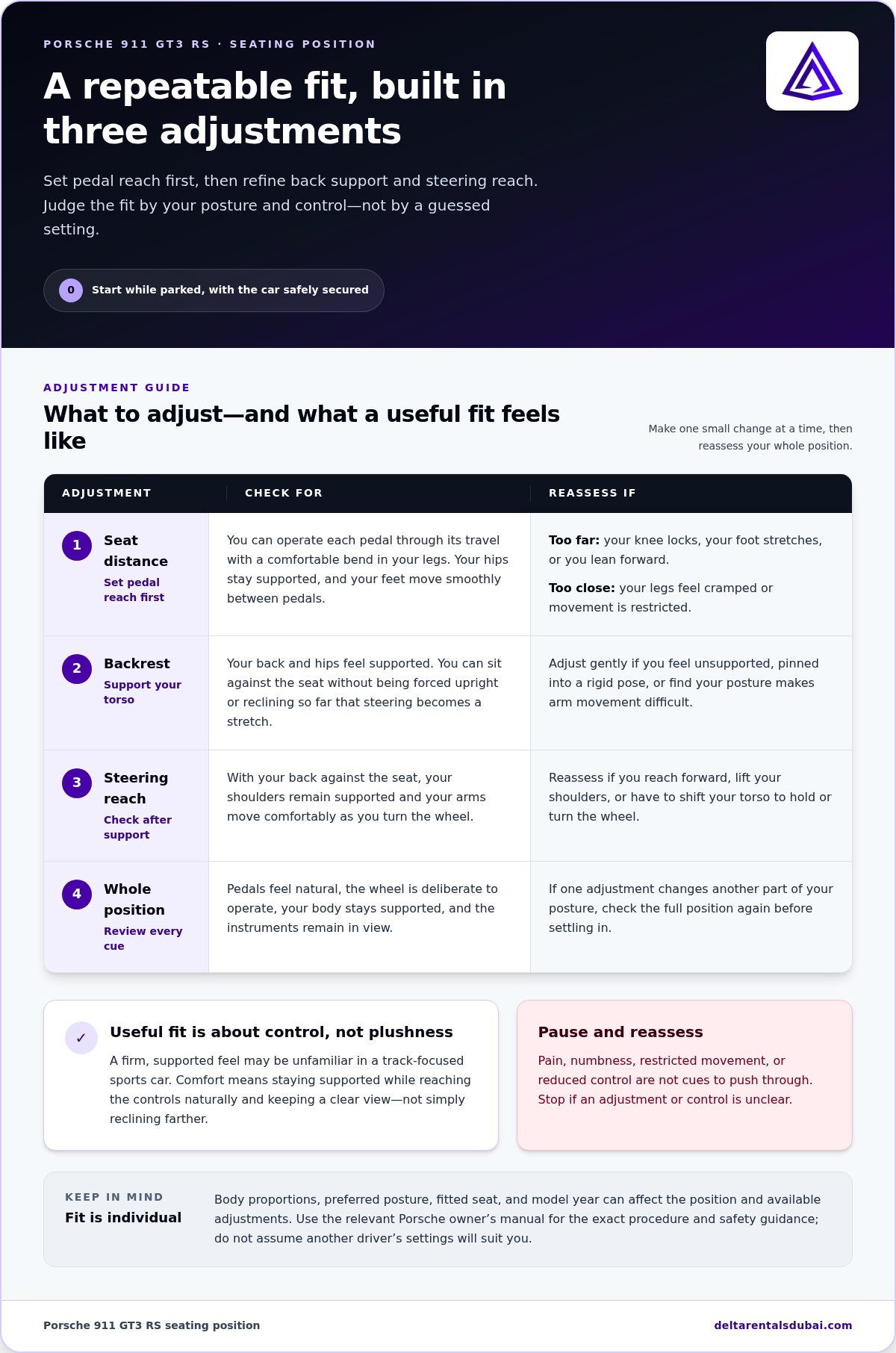
How to adjust a Porsche GT3 RS seat for comfort before driving
A repeatable setup comes from changing one thing at a time, then checking how the whole position feels. Keep the car stationary and safely secured before making adjustments. Follow the operating guidance for the specific vehicle, since controls and procedures can differ by model year and fitted seat. Don’t force a control or try to adjust your position while driving.
Use this sequence as a practical check, not as a set of fixed measurements. The goal is to reach the pedals and steering wheel without stretching or bracing, while keeping a clear view.
A repeatable parked-car adjustment sequence
Start with pedal reach. Sit back against the seat and check that you can operate the pedals through their travel while keeping your legs comfortably bent. Make a small distance adjustment, then check again. Once the pedal position feels natural, assess the backrest and steering reach, changing only one setting at a time.
- Secure the car. Park safely and follow the vehicle’s operating guidance before using any adjustment controls.
- Set pedal reach. Check that you can operate the pedals smoothly without locking your legs, stretching your feet, or shifting your hips.
- Check back support. Adjust the backrest, if the fitted seat allows it, so your torso feels supported and you can move your arms freely.
- Assess steering reach. Hold the wheel in your usual driving position. Your shoulders should remain supported, and your arms shouldn’t need to reach forward.
After each change, pause and reassess. A seat adjustment can alter your relationship to the wheel and pedals, so repeat the reach checks before moving on. The relevant Porsche owner’s manual contains the exact controls and model-specific safety instructions. Follow it if a control is unfamiliar or the seat doesn’t respond as expected.
Final checks for visibility, belt fit, and comfort
Once the position feels settled, check that you can see the instruments and have a clear view through the windows. Set the mirrors from your normal seated posture, then confirm the belt sits comfortably and follows the vehicle’s instructions. If changing the seat affects your view or belt fit, make a small correction and recheck pedal and steering reach.
Before setting off, notice any pressure, restricted movement, or need to brace against the seat. Don’t drive if your position limits safe control. Pause and consult the manual if you’re unsure how to make an adjustment or complete the belt check. Adjusting the seat in a Porsche GT3 RS for comfort is useful only when the final position supports clear visibility and confident access to the controls.
Ready to take time to settle into a GT3 RS before your drive? Message Delta Rentals about a Porsche 911 GT3 RS rental.
Enjoy a Porsche GT3 RS drive from a position that feels right
A few calm minutes before setting off can make the car feel more familiar. Treat the seat check as part of your pre-drive routine, not a search for a flawless setting. Your proportions and the fitted seat shape what feels right, so focus on clear access to the controls, steady support, and a comfortable view.
Make the seat check part of your pre-drive routine
Keep the car parked while you adjust. Check pedal reach first, then notice whether the backrest supports you without making your arms or shoulders tense. Confirm you can reach the steering wheel comfortably, see the instruments and mirrors, and wear the seat belt comfortably according to the vehicle’s instructions. Make small changes and reassess rather than shifting several settings at once.
Before setting off, consider how the position works as a whole. Can you operate the pedals without stretching or bracing? Can you steer while remaining supported? Is your view clear, and does the belt sit comfortably? If any answer is no, pause and reassess while parked. Use the relevant Porsche owner’s manual for exact controls and safety guidance for the model year and fitted seat. Don’t adjust your position while driving.
A consistent routine gives you a familiar starting point for future drives, even if the exact seat setting changes from car to car. Remember the cues that helped you settle in rather than relying on a number or another driver’s preferred position. If you can’t find a position that allows comfortable movement and safe control, don’t force it. Pause and consult the vehicle guidance before continuing.
Explore the Porsche 911 GT3 RS rental experience
Taking time to settle into the car is part of enjoying the drive. Delta Rentals offers Porsche 911 GT3 RS rentals, giving drivers a chance to explore the car after getting comfortable with its position and controls. These seat checks are practical preparation, not a substitute for the specific vehicle’s manual or a guarantee that one setting will suit everyone.
Interested in experiencing a Porsche 911 GT3 RS? Message Delta Rentals to discuss a rental. Take a moment to get settled before focusing on the drive.
Make your next GT3 RS drive feel more familiar
A repeatable pre-drive routine can help you find the same useful comfort cues each time, even if the seat feels different. Treat adjusting the seat in a Porsche GT3 RS for comfort as a personal check, not a search for one setting that works for every driver. Take your time while parked, and use the relevant owner’s manual whenever a control or instruction isn’t clear.
With the setup settled, you can give more attention to the experience ahead. Delta Rentals offers Porsche 911 GT3 RS rentals. For a next step, ask about a Porsche 911 GT3 RS rental. Settle in at your own pace, then enjoy the drive.
Frequently Asked Questions
Is the Porsche GT3 RS seat comfortable for a long drive?
It can be, but comfort depends on the fitted seat, your proportions, clothing, and how well the position suits you. A focused sports-car seat may feel firmer than an everyday seat, but firmness alone doesn’t tell you whether the fit is right. Before a long journey, assess your seat position while parked. If discomfort persists or affects control, stop safely and reassess rather than pushing through.
Can I adjust the GT3 RS seat while the car is moving?
No. Adjust the seat only while the vehicle is safely stationary. Changing position in motion can distract you and affect how you reach the pedals or steering wheel. If you become uncomfortable on the road, choose a safe place to stop before checking your posture. Use the Porsche owner’s manual for instructions specific to the model year and fitted seat, since control layouts and procedures can differ.
What should I do if the GT3 RS seat controls will not move?
Don’t force a control. The fitted seat and model year determine which adjustments are available and how they operate. Park safely, then consult the matching Porsche owner’s manual and follow its instructions. If the control appears damaged or remains stuck, don’t improvise a repair or continue adjusting it. Avoid driving if the seat position prevents comfortable, safe access to the controls; arrange appropriate assistance before setting off.
Does the GT3 RS have adjustable lumbar support?
That depends on the fitted seat and the car’s model year, so don’t assume lumbar support is present. Check the seat controls and refer to the matching Porsche owner’s manual for equipment and instructions. If there’s no lumbar adjustment, don’t force a control or add an unsupported modification. Instead, assess whether the backrest supports you comfortably while allowing natural movement and access to the pedals and steering wheel.
Can I use a cushion to make a Porsche GT3 RS seat more comfortable?
Be cautious: a cushion can change your seated height and affect pedal or steering reach, belt fit, and restraint positioning. Its effect depends on the cushion and vehicle setup. Check the Porsche owner’s manual and any relevant accessory instructions before using one. Once seated, verify that it stays in place and doesn’t interfere with control access. Remove it before driving if it shifts or compromises your position.
What happens if I feel numbness or pain after adjusting the seat?
If pain, numbness, or restricted movement affects your comfort or control, stop at a safe place as soon as possible. Reassess the seat position while parked and consult the vehicle guidance rather than continuing with a poor fit. If symptoms persist or concern you, seek appropriate medical advice. Seat-position guidance can help you check your setup, but it can’t diagnose symptoms or replace professional care.