

A flawless carbon fiber blade tells you almost nothing about whether an aerodynamic system survived triple-digit speeds intact. When track-bred machines like the Porsche 911 GT3 RS generate up to 860 kg of downforce, physical appearance alone cannot confirm operational health. That makes executing rigorous active rear wing deployment checks during high speed vehicle return an absolute priority for protecting both drivers and fleet operators from hidden mechanical failures.
You probably already know the tension that surrounds exotic vehicle handoffs. Wondering how technicians inspect and verify active rear wing deployment shouldn’t keep you on edge, nor should the fear of wrongful damage claims caused by silent ECU shadow codes or routine thermal expansion. You deserve complete transparency. You will master the exact technical protocols required to evaluate dual hydraulic actuators, cross-reference onboard telemetry, and distinguish superficial road debris from genuine mechanical misalignment. Here is your definitive 2026 inspection guide for auditing active aerodynamics with effortless precision.
Key Takeaways
- Understand how dynamic downforce loads stress mechanical linkages, helping you separate routine high-speed operational wear from true structural failure.
- Master the standardized protocol for active rear wing deployment checks during high speed vehicle return to protect yourself against wrongful damage disputes.
- Learn the visual and tactile indicators of hydraulic fluid cavitation, thermal heat soak, and electromechanical lead screw misalignments.
- Discover how onboard diagnostic platforms record high-velocity aerodynamic telemetry and extract silent shadow fault codes that bypass the dashboard warning lights.
- Adopt a transparent, paired digital intake standard that guarantees mutual accountability and preserves peak mechanical integrity across the entire fleet.
The Mechanics of Active Aerodynamics: Why High-Speed Deployment Verification Matters
High velocities transform a modern supercar into an aerodynamic balancing act. At triple-digit speeds, active rear wings constantly recalibrates downforce and drag to keep the chassis planted through high-speed sweepers and stable under heavy braking. Performing active rear wing deployment checks during high speed vehicle return guarantees that intense aerodynamic loading hasn’t caused structural fatigue, protecting the vehicle’s integrity before the next driver takes the keys.
Dynamic Downforce and Drag Reduction Architecture
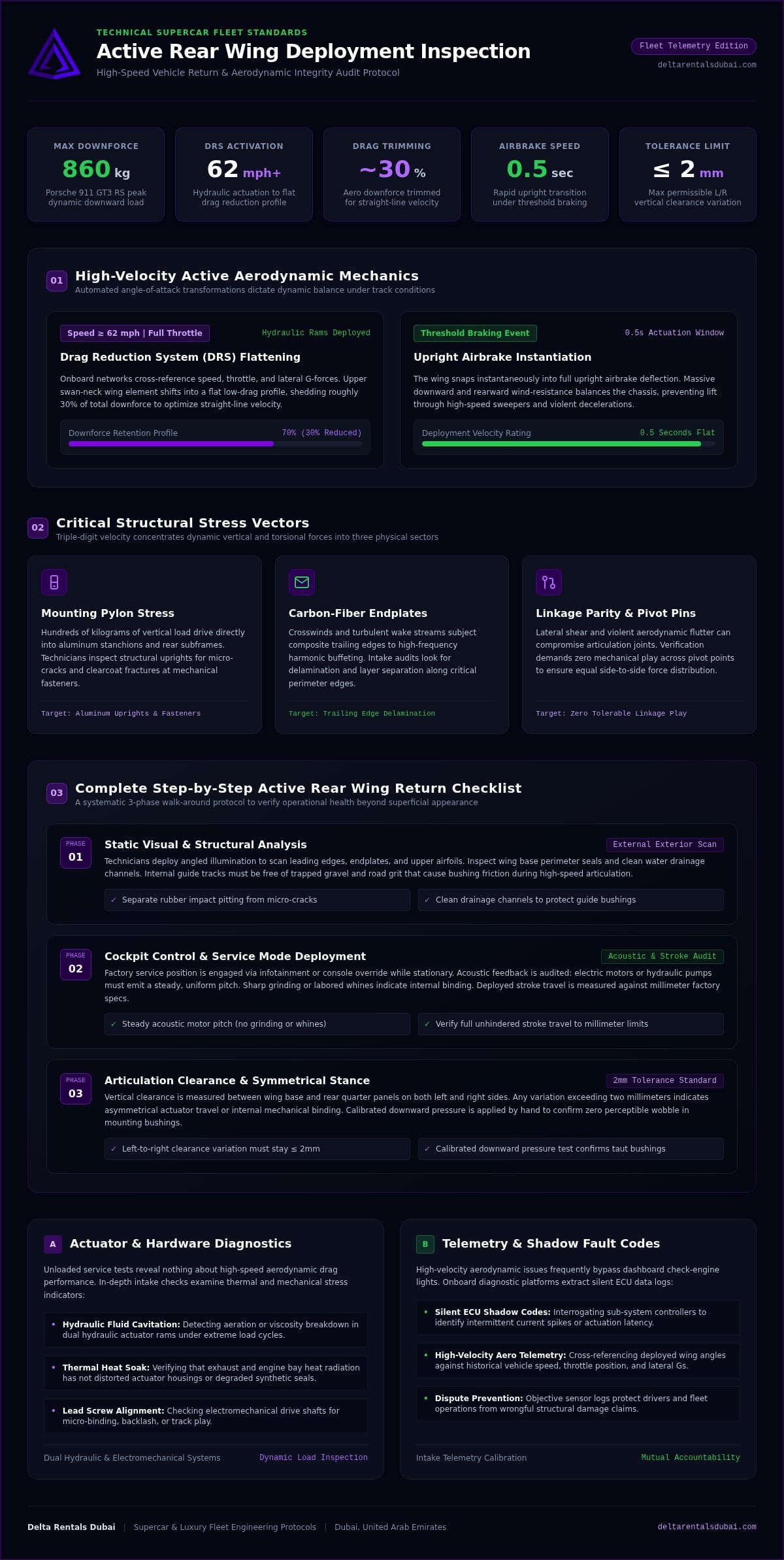
Modern performance platforms rely on sophisticated sensor arrays to dictate wing geometry. In track-bred supercars like the Porsche 911 GT3 RS, the onboard network continuously monitors vehicle speed, throttle position, and lateral G-forces. When accelerating past 62 mph at full throttle, hydraulic rams actuate the upper swan-neck wing element into a flat Drag Reduction System (DRS) profile, trimming overall aerodynamic downforce by roughly 30% to maximize straight-line speed. Under sudden threshold braking, the wing snaps into an upright airbrake position in just 0.5 seconds. Intake checks confirm that these automated angle-of-attack transformations fired cleanly without actuator hesitation or binding.
Mechanical Stresses Incurred During High-Velocity Driving
Sustained velocity exerts immense downward and torsional forces directly onto structural mounting points. Generating hundreds of kilograms of downforce drives vertical loads down through aluminum stanchions and into the rear subframe, while crosswinds and turbulent slipstreams induce severe lateral shear. Standard road vibrations are harmless, but violent aerodynamic flutter can compromise high-stress joints over time.
Thorough active rear wing deployment checks during high speed vehicle return identify these critical structural stress points immediately:
- Mounting Pylon Stress: Inspecting structural uprights for micro-cracks or hairline clearcoat fracturing around mechanical fasteners.
- Carbon-Fiber Endplates: Checking composite trailing edges for delamination caused by high-frequency harmonic buffeting.
- Linkage Parity: Confirming mechanical pivot points show zero play, ensuring side-to-side load distribution remains perfectly symmetrical at track speeds.
Complete Step-by-Step Active Rear Wing Return Checklist
A systematic walk-around eliminates guesswork during vehicle intake. Crucially, running a stationary service mode test only confirms that an actuator cycles without load. It reveals nothing about how linkages withstand real dynamic drag, an operational distinction explored in this SAE high-speed active wing handling study detailing high-velocity yaw and stability forces. Conducting thorough active rear wing deployment checks during high speed vehicle return ensures both renter and provider walk away completely protected.
Phase One: Static Visual and Structural Analysis
Begin by scanning the leading edges, endplates, and upper airfoils with clean, angled illumination. Look for clearcoat impact pitting from high-velocity track rubber or road gravel, which differs significantly from stress-induced micro-fractures. Inspect the wing base perimeter seals and water drainage channels. Trapped grit along internal guide tracks creates friction that damages internal guide bushings during high-speed articulation.
Phase Two: Cockpit Control and Service Mode Deployment
Initiate the factory service position from the infotainment display or console override switch to raise the aero assembly while stationary. Pay close attention to acoustic feedback. Smooth electric motors or hydraulic pumps should emit a steady, uniform pitch rather than sharp grinding or labored whines. Measure the deployed wing extension against factory millimeter tolerances to confirm complete, unhindered stroke travel.
Phase Three: Articulation Clearance and Symmetrical Stance
Measure the vertical clearance between the wing base and the rear quarter panels on both the left and right sides. Any variation exceeding two millimeters points toward uneven actuator travel or internal mechanical binding. Technicians then apply gentle, calibrated downward pressure by hand to verify that mounting bushings and pivot pins remain taut with zero perceptible wobble. Finish by logging high-resolution, timestamped photographs of both stanchions and hinges directly into the digital intake file.
Executing paired baseline inspections preserves performance standards across the entire fleet. If you plan to get behind the wheel of a precision-engineered machine, you can connect with an exotic car specialist to experience pristine track-level readiness from pickup to drop-off.
Actuator, Hydraulic, and Hardware Diagnostics: Inspecting High-Stress Components
Behind the visible carbon fiber aero foil lies an intricate powertrain of micro-mechanics. When vehicles run at sustained track velocities, immense aerodynamic forces transfer straight into the internal drive assemblies. Intake technicians must evaluate whether the mechanical drive units have sustained thermal or structural stress during the run.
Electromechanical Spindles vs. Hydraulic Ram Mechanisms
Supercar architectures split into two distinct engineering camps. Linear electromechanical systems use high-torque stepper motors turning internal worm gears. These offer precise micro-adjustments, but repeated shock loads can strip gear teeth or bend lead screws. In contrast, platforms engineered for extreme downforce utilize high-pressure hydraulic rams driven by dedicated pump circuits. On models like the McLaren 720S, the wing’s hydraulic actuation circuit shares fluid directly with the dual-clutch transmission clutch-oil loop. A drop in hydraulic line pressure or fluid cavitation will trigger an immediate airbrake lockout. Spotting subtle fluid film around the piston wiper seals prevents catastrophic hydraulic failure under heavy braking.
Torque and Fastener Inspection on Aerodynamic Mounts
Thermal cycling around the rear engine bay represents a major point of vulnerability. Exhaust manifolds and turbochargers radiate extreme heat directly beneath active aero cradles, cooking wire harnesses and breaking down thread-locking compounds. Incorporating targeted fastener audits into active rear wing deployment checks during high speed vehicle return keeps the entire mounting assembly rock solid.
Intake protocols target several critical physical checkpoints:
- Fastener Witness Marks: Checking factory paint-pen torque stripes across primary upright bolts to ensure zero rotational slippage.
- Subframe Tie-Down Brackets: Inspecting the hidden structural hardpoints under the rear decklid for stress cracks or elongated mounting holes.
- Pivot Bushing Degradation: Examining spherical bearings and Teflon-coated bushings for heat distortion or play caused by sustained aerodynamic vibration.
Catching micro-play early preserves dynamic alignment. Meticulous active rear wing deployment checks during high speed vehicle return isolate natural mechanical wear from genuine component abuse, keeping the vehicle operating within its factory design parameters.
Telemetry Verification, Sensor Calibration, and Error Code Analysis
Modern aerodynamic management extends far beyond mechanical hardware into the vehicle’s electronic architecture. Onboard CAN-bus networks continuously record actuation commands, speed thresholds, and potentiometer voltage responses. For drivers, understanding this data stream provides complete protection against unjustified security deposit deductions for pre-existing mechanical wear or routine thermal expansion. For intake technicians, auditing digital logs transforms subjective opinions into undeniable physical data during active rear wing deployment checks during high speed vehicle return.
Decoding Aerodynamic Control Module Trouble Codes
Specialized factory diagnostic platforms interface with body and chassis control units to reveal silent “shadow codes.” These manufacturer-specific B- and C-series trouble codes log micro-stalls, thermal delays, and transient pressure dips without ever illuminating a Check Engine Light on the instrument binnacle. Dual-sensor potentiometers track millimeter travel in real time. If sensor one and sensor two diverge by more than 5% or drop toward a 0.00 V offset, the control unit flags an aerodynamic travel fault. Technicians also evaluate motor current draw curves. Elevated amperage indicates mechanical drag or foreign debris binding the linkages, whereas normal baseline current clears the renter of mechanical abuse.
Telemetry Matching: Speed Thresholds vs. Wing State
ECU freeze-frame data reveals exactly how the vehicle behaved at speed, cross-referencing velocity with physical wing geometry:
- Velocity Threshold Triggers: Confirming active deployment initiated precisely at factory parameters, such as passing 93 mph under open throttle on a McLaren or triggering Drag Reduction System modes above 62 mph.
- Dynamic Deceleration Response: Auditing brake-pressure inputs against rapid wing tilt transition logs to ensure emergency airbrake deployment occurred within 0.5 seconds.
- Lateral Stability Modulation: Verifying that dual-actuator platforms trimmed downforce levels symmetrically based on steering angle and lateral G-load sensors.
Pairing electronic telemetry readouts with physical checks eliminates post-drive ambiguity and establishes absolute transparency. When you are ready to command an impeccably maintained exotic, book your next high-performance supercar rental with full confidence in our verified mechanical standards.
Transparent Vehicle Return Standards: Driving Supercar Fleet Excellence
Trust forms the foundation of every elite driving experience. Transparent intake protocols turn vehicle handoff from an anxious chore into an effortless demonstration of engineering standards. Conducting standardized active rear wing deployment checks during high speed vehicle return protects drivers while keeping the nation’s most capable exotics dialed in for their next outing.
Joint Inspection Protocols Between Driver and Concierge
A mutual walk-around creates an open, friction-free return experience. Professional intake concierges guide drivers through a collaborative checklist, reviewing the physical spoiler assembly alongside the digital baseline created before departure. The key lies in distinguishing operational patina from true mechanical distress:
- Aerodynamic Air-Wash Patina: Fine, superficial micro-abrasions from high-velocity road grit or airborne track rubber represent normal, expected airflow wear.
- Physical Structural Distress: Fastener shifts, gouges, or misaligned panel gaps indicate mechanical binding or physical contact.
Digitally pairing departure logs with timestamped check-in photography allows immediate sign-off. This transparent routine eliminates friction and clears security deposits without delay.
The Elite Fleet Standard for Active Aero Supercars
Track-bred exotics demand uncompromising maintenance routines. Benchmark performance platforms like a Porsche 911 GT3 RS Rental operate with extraordinarily fine tolerances, relying on active aerodynamics to stabilize the chassis under dynamic track loads. Between reservations, fleet technicians run automated diagnostic routines, verifying potentiometer voltage baselines, refreshing hydraulic loops, and cycling actuators across full travel strokes.
Maintaining active aero systems isn’t merely about setting lap records; it directly safeguards driver stability when slowing down from triple-digit velocities. Meticulous active rear wing deployment checks during high speed vehicle return reinforce the mechanical excellence that earned over 300 five-star verified customer reviews, ensuring that every driver takes the wheel of an exotic operating at its absolute peak.
Command Pure Track Performance with Complete Peace of Mind
Mastering modern active aerodynamics protects your experience from start to finish. When you combine physical hardware audits with live diagnostic telemetry, you don’t have to worry about ambiguous handoffs. Symmetrical actuator parity, uncompromised hydraulic loops, and clean diagnostic scans confirm that high-downforce systems remain mechanically pure.
Standardizing active rear wing deployment checks during high speed vehicle return ensures every transition is frictionless, eliminating deposit disputes and safeguarding dynamic chassis stability. Whether you want to pilot an aerodynamic benchmark like the Porsche 911 GT3 RS or another elite exotic, our nationwide white-glove concierge standards and photo-verified protocols guarantee effortless peace of mind.
Experience track-bred precision with Delta Rentals today and step into an uncompromised high-performance drive.
Frequently Asked Questions
Can an active rear wing be manually opened for inspection when the engine is off?
Never attempt to physically pull or pry open an active aero wing by hand. Forcing an active wing risks stripping precision motorized lead screws or damaging hydraulic piston seals. Instead, switch the ignition on without starting the engine and engage the dedicated cabin service mode or infotainment toggle. This safely extends the wing to full height for visual inspection without placing unintended mechanical strain on internal linkages.
What happens if an active rear wing fails to retract during vehicle return?
If a wing fails to retract, technicians immediately hook up an OEM diagnostic scanner to diagnose the lockout condition. Control modules will intentionally freeze wing positions if dual position sensors diverge or if electrical voltage dips below safety thresholds. Technicians separate electronic limp-mode holds from physical binding or motor failures, ensuring drivers aren’t blamed for routine sensor hiccups or electronic recalibration requirements.
Is minor carbon weave clouding on the rear wing considered normal wear?
Slight resin clouding or superficial micro-pitting along leading carbon fiber edges is recognized as standard high-velocity wear. High-speed runs expose rear aero elements to turbulent airflow, heat cycling, and track grit. Standard active rear wing deployment checks during high speed vehicle return differentiate harmless resin oxidation and air-wash etching from genuine structural delamination, impact fractures, or bent support struts that require mechanical component repair.
How do technicians verify that DRS deployed correctly at high speeds?
Technicians verify high-speed Drag Reduction System functionality by reviewing OBD-II freeze-frame telemetry and aerodynamic control unit history logs. The vehicle records specific operational parameters, including velocity, throttle percentages, and exact actuator stroke angles. Comparing vehicle speed logs against wing position records confirms whether the upper airfoil flattened at prescribed speed thresholds and quickly returned to high-downforce trim under braking.
Can high ambient temperatures cause hydraulic active aero system warnings?
Intense heat can thin hydraulic fluid or trigger thermal safety cutoffs in supercars running sustained high-speed runs. Because many hydraulic active aero systems sit directly above exhaust pathways or share fluid loops with transmissions, elevated fluid temps can cause transient pressure dips. Intake technicians verify fluid reservoir levels and thermal telemetry to confirm whether an error is simply a temporary heat-soak advisory rather than a blown seal.
Will I be held liable if an aerodynamic actuator throws an electronic code?
You won’t be held liable for internal electronic component failures, provided there is no evidence of impact damage or external tampering. Integrating diagnostic data into active rear wing deployment checks during high speed vehicle return protects drivers. Telemetry readouts distinguish routine electrical sensor drift, software adaptation faults, and normal component fatigue from driver abuse, giving you complete financial peace of mind upon handoff.