

Could a few unclear lines turn a premium car rental into an unexpected bill? The red flags to watch for in a rental agreement often hide in everyday details: damage responsibility, insurance exclusions, mileage limits, fuel rules, and return deadlines. A headline rate tells only part of the story. Before you sign, check that the written terms explain each cost, condition, and possible extra charge.
Pause over any clause that leaves you unsure what happens if the vehicle is damaged or returned late. A clear agreement sets expectations before collection and gives you a record to refer to at handover and return.
This 2026 checklist explains how to review charges, deposits, insurance, mileage, fuel, late returns, and cancellations before committing to a rental in the UAE. You’ll also learn what to document around the vehicle’s condition and which written details deserve a closer look. Whether you’re considering a high-performance model or another premium vehicle, a careful review can help you decide with confidence.
Key Takeaways
- Spot red flags to watch for in a rental agreement by looking for unclear, inconsistent, or overly broad wording.
- Identify each stated charge and when it may apply. Distinguish rental costs from deposits, payment authorizations, and possible deductions.
- Review insurance terms, exclusions, excess, and damage-reporting steps without assuming what the agreement covers.
- Compare your booking details, agreement, and written messages. Resolve contradictions before signing.
- Document the vehicle’s condition at handover and keep your booking details and signed agreement accessible throughout the rental.
Red flags in a rental agreement: why unclear terms deserve attention
A red flag isn’t proof that a rental company has acted improperly. It’s an unclear, inconsistent, or unexpectedly broad term that deserves your attention before you commit. In a car rental agreement, that might be wording that leaves you unsure who pays for a particular type of damage, when an extra charge can apply, or what counts as a late return.
Some terms may be inconvenient but still clear. A stated return time might not suit your plans, but you can understand the requirement. The concern is different when the agreement says a vehicle must be returned in “acceptable condition” without explaining what that means or how condition will be assessed. The legal effect of a clause depends on the applicable law and circumstances, so don’t assume that concerning wording is automatically unlawful.
What makes a car rental clause a warning sign?
Look for wording that leaves key details open to interpretation. “Additional charges may apply” doesn’t explain what triggers a charge or how it will be calculated. “Damage” without a clear process for recording and assessing it may leave you uncertain about responsibility. A clause about “excess mileage” should state the mileage limit and what happens if you exceed it.
These are practical warning signs because they make it harder to anticipate your responsibilities and the consequences of a decision. For a broad introduction to understanding rental agreements, you can review how rental contracts set out terms between parties. For your booking, focus on how the specific wording applies to the vehicle, rental period, and return process.
How to review the agreement without jumping to legal conclusions
Read the full agreement alongside your booking confirmation and any written amendments. Compare the vehicle, rental dates, charges, and other key details. If the documents conflict, don’t assume which one takes priority. Point out the difference and request clear written wording that explains what applies before you sign.
Verbal explanations may help you understand a clause, but they can be difficult to rely on later if they aren’t reflected in writing. Keep the signed agreement and written changes together, and make sure you understand the version you’re accepting. If a clause could have significant consequences or raises a jurisdiction-specific legal concern, consult an authoritative legal source or qualified professional rather than treating a general checklist as legal advice.
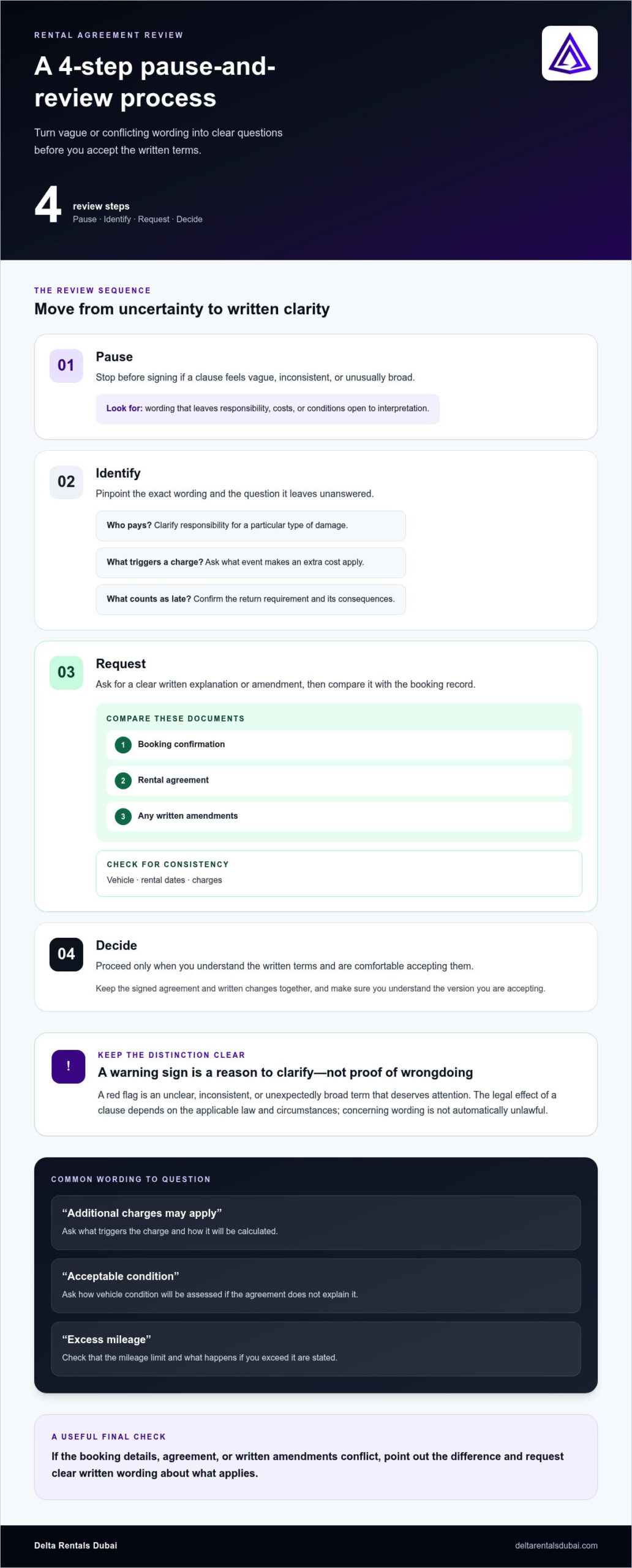
Use a simple pause-and-review process:
- Pause before signing if a clause feels vague, inconsistent, or unusually broad.
- Identify the exact wording and the question it leaves unanswered, such as who pays or what triggers a charge.
- Request a clear written explanation or amendment, then compare it with the booking record.
- Decide only when you understand the written terms and are comfortable proceeding.
This approach turns the red flags to watch for in a rental agreement into specific questions you can resolve before the keys change hands. Clear written terms make it easier to approach a premium rental with confidence and fewer unwelcome surprises.
Check the rental agreement for unclear charges, deposits, and payment terms
A rental total can be difficult to assess if the agreement lists charges without explaining when they apply. Read beyond the headline rental amount. Identify every stated cost, the event that triggers it, and whether it’s included in the amount shown in your booking details. The goal is to understand what you may pay, not to assume every possible charge will apply.
Which charges should be explained before you sign?
Review the rental charge alongside any listed additional-driver terms, delivery conditions, service charges, taxes, or surcharges. The agreement should make clear whether each item is included, optional, or conditional. Labels such as “other charges” are not enough unless the agreement defines them.
Ask for the total payable and the circumstances that could alter it in writing. Check whether a stated charge is tied to a specific choice, a booking change, or an event during the rental. Don’t treat “additional costs may apply” as a complete explanation. Red flags to watch for in a rental agreement include unexplained amounts and wording that allows charges to change without describing how or when you’ll be told.
How should a deposit or payment authorization be described?
Keep these terms distinct. A rental charge is an amount due for the booking or another stated service. A deposit or payment authorization may serve a different purpose, while a penalty or post-rental deduction may arise only under specified conditions. The agreement should identify what each amount represents instead of grouping them under a broad label such as “payment.”
For any deposit or authorization, look for the stated amount in AED, its purpose, how it will be handled, and the conditions for release or deduction. The wording should explain which circumstances may lead to a deduction and how the amount is determined. If it says deductions can be made “as required” without describing the relevant circumstances, ask for a clearer written explanation before accepting the term.
Use this quick charge-by-charge review:
- List each amount. Record every rental charge, deposit, authorization, penalty, and possible post-rental deduction separately.
- Find the trigger. Note when each amount becomes payable or may be applied, including any conditions in the agreement.
- Check what’s included. Compare the agreement with the booking details, paying attention to additional drivers, delivery, taxes, and surcharges.
- Clarify changes. Look for a defined process explaining how a change to the total is communicated and documented.
- Keep your records. Save the signed agreement, booking confirmation, written clarifications, and payment records together.
Clear terms make it easier to plan your rental and distinguish an agreed charge from a later deduction. For a premium vehicle rental, keep your written booking details with the agreement. You can share your requirements through WhatsApp.
Spot insurance, damage, mileage, and return-condition red flags
Insurance and return terms can shape your responsibilities throughout the rental, but wording varies by agreement. Read the clauses themselves rather than relying on assumptions about what a policy usually covers. Red flags to watch for in a rental agreement include exclusions or responsibilities that are difficult to interpret, and return conditions that leave room for disagreement about the vehicle’s condition, fuel, mileage, or timing.
What insurance wording should you read closely?
Find the sections describing coverage, exclusions, any excess payable by the renter, and the steps for reporting damage or an incident. Check whether the agreement treats types of damage differently, such as damage to glass, tyres, or the interior. Don’t assume a category is covered or excluded unless the written terms say so.
Look for practical instructions, too. The agreement may specify who must be notified, how quickly to report an incident, or which documents to provide. If it uses broad phrases such as “all damage” or “subject to assessment,” ask what they mean in the context of the agreement. A clear explanation should identify the relevant process and any renter responsibility. Don’t rely on labels such as “comprehensive” or “all-inclusive” unless the document explains what they mean.
Which vehicle handover and return terms can cause disputes?
Check how the agreement records the vehicle’s starting condition and defines the expected return condition. Look for an inspection or reporting process that accounts for existing marks and explains how new damage is documented. Clarify how the fuel level is recorded, whether mileage is limited, what happens if the stated limit is exceeded, and what return time and location apply. An undefined return standard can make it harder to understand what may be considered a problem.
At collection and return, record the vehicle’s condition, mileage, and fuel level. Take dated photographs where appropriate, including clear images of existing marks and the exterior and interior. Keep inspection records and relevant written communications until the rental is fully settled.
Use this table to turn unclear wording into specific questions. Fill in the final column only after you receive a written clarification.
| Clause | What it says | What remains unclear | Written clarification received |
|---|---|---|---|
| Coverage and exclusions | Record the agreement’s wording | Which situations or vehicle areas does it address? | Note the written explanation or amendment |
| Damage reporting | Record the required steps | Who must be notified, and what documents are needed? | Save the written process |
| Mileage and fuel | Record limits and return expectations | What happens if a limit or expectation isn’t met? | Note the clarified terms |
| Return condition and timing | Record the stated standard, time, and location | How are condition and return time assessed? | Keep the written response |
Keep this record with your agreement and booking documents. Clear, written answers help you understand the responsibilities attached to the rental before you drive away.
Pre-signing checklist for rental agreement red flags
Give the paperwork a calm, focused review before vehicle handover. This five-step checklist helps you compare what was booked with what you’re being asked to accept, then keep a useful record for the rental. Red flags to watch for in a rental agreement are easier to spot when you check the details in a consistent order.
- Match the booking details. Check that the renter’s name, vehicle, rental dates, and agreed terms match your booking confirmation and written messages. Pause if the vehicle or dates differ, or if a promised term appears only in a message and not in the agreement. Ask for the documents to be brought into line in writing.
- Review charges and payment terms. Identify each stated charge, payment condition, deposit, or authorization. Make sure the agreement explains when each may apply and what circumstances could change the amount due. Don’t leave a blank field or rely on a verbal explanation for a payment term.
- Check responsibilities and return rules. Read the coverage and exclusions, damage responsibilities, mileage conditions, fuel expectations, and return requirements. Look for terms that leave you unsure about what you’re responsible for or how a condition will be assessed.
- Resolve unclear points in writing. Mark each question and request a written clarification or amendment before signing. Compare the answer with the booking record and the agreement. If the documents still conflict, ask for a corrected, complete version rather than choosing which one to rely on yourself.
- Keep the completed agreement. Before you sign, check that all pages are present and relevant fields are completed. Save the signed version and any written amendments where you can access them during the rental and afterward.
Know when to pause. Missing pages, unexplained blank fields, unclear liability, or pressure to sign terms you haven’t read are reasons to stop and seek clarification. Don’t sign on the assumption that an incomplete detail will be fixed later. If a written amendment changes a term, retain it with the final agreement so the record is clear.
At collection and return, document the vehicle condition with clear, time-stamped photographs where appropriate. Capture existing marks and keep a copy of the handover record, including written notes about condition. Record the return time, fuel condition, and mileage as stated in the agreement. Keep those records and related messages until the rental is fully settled.
A careful review supports a more straightforward premium rental experience. You can discuss your rental requirements on WhatsApp.
Choose a premium rental with clear expectations before the keys change hands
A confident rental decision starts with terms you can understand. The agreement should be readable, consistent with your booking details, and clear about what you’re responsible for from collection through return. If key wording remains unclear, pause and resolve it before signing. For questions about legal effect, seek current, authoritative UAE guidance rather than relying on a general checklist.
A confident rental decision starts with clear written terms
Before you commit, make sure you understand the rental period, payment conditions, damage responsibilities, and return requirements that apply to your booking. Keep written answers and amendments alongside the completed agreement. If a message describes a term differently from the signed document, ask for the final paperwork to reflect the agreed details. Retain the booking confirmation and signed agreement where you can access them throughout the rental, not just at handover.
This final review isn’t about treating every unfamiliar phrase as a problem. It’s about knowing what the wording means for your plans. Red flags to watch for in a rental agreement are terms that remain vague, contradict other written details, or leave an important responsibility open to interpretation. If you can’t explain a key obligation in your own words, take time to clarify it before the keys change hands.
Explore premium vehicle options for your plans
Delta Rentals Dubai provides premium and high-performance vehicle rentals across the UAE. Choose a vehicle experience that fits the purpose and practical details of your trip, then review its written rental terms with the same care. The Porsche 911 GT3 RS is one of the available rental options. You can also explore premium vehicle rental options to consider what fits your plans.
Think through the experience you want, your rental dates, and the vehicle that suits your requirements. A clear agreement helps you understand the conditions attached to that choice. Keep the final documents accessible so you can refer to what was agreed during the rental. Don’t let excitement rush the paperwork. A few careful minutes can help you approach collection with greater confidence.
For a rental enquiry, message Delta Rentals Dubai on WhatsApp.
Make your next rental decision with confidence
Use the red flags to watch for in a rental agreement as a decision tool, not just a final check before signing. Once the written terms make sense, consider whether the vehicle and rental arrangement suit the experience you have in mind. A clear choice starts with confidence in what you’re agreeing to and a vehicle that fits your plans.
Give yourself room to make that choice without rushing. Think about the kind of drive you want, how the rental fits your schedule, and what would make the experience feel right for you. If an important point remains unsettled, take the time to resolve it before moving forward. Your decision should feel considered, not pressured.
Ready to take the next step? Discuss your premium car rental plans with Delta Rentals Dubai on WhatsApp. Make your choice with clarity, then enjoy the anticipation of the drive ahead.
Frequently Asked Questions
What are the biggest red flags in a car rental agreement?
The biggest red flags to watch for in a rental agreement are terms that make an important consequence hard to predict, such as a charge with no clear trigger, an undefined damage standard, or responsibility for “any loss” without explaining its scope. Compare the agreement with your booking record, too. If it names a different vehicle or rental period, treat the mismatch as unresolved before collection, not as a detail to sort out later.
Should I sign a rental agreement with blank spaces?
Don’t sign until you understand why a field is blank and whether it could affect your obligations. A missing value in a section about an amount, date, or vehicle condition can create confusion about what was agreed. Ask for relevant fields to be completed or clearly marked as not applicable, then keep the finished copy. If you’re asked to sign before you can read every page, pause and request time to review it.
Can a car rental agreement charge me for damage?
An agreement may set out renter responsibility for specified damage, but the outcome depends on the wording and circumstances. For instance, a mark noted at collection is different from damage first identified at return, so keep a copy of the initial condition record. If a charge is raised, compare the explanation with the agreement and your handover evidence. Request an itemized written account showing what damage is claimed and how the amount was determined.
What should I check about insurance in a rental agreement?
Check the exact coverage description, exclusions, any excess you may have to pay, and the steps required after an incident. Pay attention to whether the agreement treats glass, tyres, or interior damage differently. Look for reporting deadlines, contact instructions, and required documents. Don’t infer that a type of damage is covered just because the agreement uses a broad insurance label. If a term affects your decision, get its meaning clarified in writing before signing.
Can a rental company change the charges after I book?
Whether a charge can change depends on the booking terms, the signed agreement, and the reason for the change. A requested change to your booking may be treated differently from a charge you weren’t told about. Compare the new amount with your booking confirmation and ask for a written, itemized explanation of what changed and why. If the documents conflict or the explanation is unclear, seek current, authoritative UAE guidance before deciding how to proceed.
What happens if I return a rental car late?
The agreement determines how a late return is handled, so check the stated return time, location, and any consequences for missing them. Don’t assume a grace period or that a short delay is automatically ignored. If your plans change, use the stated process to request an extension and keep the response in writing. Record when and where you returned the vehicle, and retain any handover confirmation in case the recorded return time is disputed.
Are verbal promises part of a rental agreement?
A verbal assurance may be difficult to rely on if the signed document says something different. Before signing, ask for any promise that affects your booking, payment, vehicle, or responsibilities to be written into the agreement or a clear amendment. Keep that record with your signed copy. The legal effect of spoken or written terms can depend on the circumstances and applicable law, so consult an authoritative UAE source for a consequential legal question.