

Parking a widebody supercar is a clearance routine, not a confidence test. From the driver’s seat, it can be difficult to judge the car’s width and front clearance, especially near a kerb, pillar, wheel stop or neighbouring vehicle. Add the pressure of waiting drivers and it’s easy to rush. Whether driving a prestige vehicle from LA Car Hub or an unfamiliar sports car, the best practices for parking a widebody supercar replace guesswork with a calm, repeatable approach.
You don’t need to squeeze into every open bay. Choose a space that gives you room to manoeuvre, enter and exit without risking low bodywork or nearby cars. Before committing, assess the approach as well as the final position. Move at a steady pace and use visibility aids as support, not as a substitute for checking your surroundings.
The same routine can help when you’re driving a high-performance rental, including a Porsche 911 GT3 RS from Delta Rentals Dubai. Take a moment to get familiar with the car, give yourself time and prioritise clearance over speed. With a clear plan, parking can feel like a controlled part of the drive, not a test of nerve.
Key Takeaways
- Start by checking the vehicle’s documented dimensions and identifying where the driver’s sightlines may leave blind spots.
- Compare spaces by approach room and exit options. An open end space may offer more useful clearance than a bay closer to the entrance.
- Use a simple routine: pause, inspect, select, manoeuvre slowly, then stop and reassess before making adjustments.
- Before parking a rental, familiarise yourself with its controls and record any visible pre-existing condition during handover.
- Use a spotter only when you can communicate clearly and their position remains safe throughout the manoeuvre.
Why parking a widebody supercar calls for a different approach
From the driver’s seat, the car’s full footprint isn’t always obvious. The mirrors show only part of each side, while pillars and the angle of the windscreen can make the front corners difficult to judge. Wider bodywork may extend beyond the positions you’re used to, and low front or side sections leave less margin for misjudging kerbs, ramps or wheel stops. A space that looks generous at first glance may feel very different once you begin turning into it.
That’s why widebody parking is about managing clearance around the whole vehicle, not simply keeping the wheels between painted lines. You need room to approach, turn, settle into the bay and leave without bringing a corner close to an obstacle. Vehicle width and turning room are related, but they aren’t the same. A bay might be wide enough once you’re in, yet awkward to enter or exit from a narrow aisle.
What makes a widebody car harder to place?
Wider bodywork changes your reference points. The driver’s seat may be offset from the car’s centre, and each mirror offers a different view of the flank. Don’t assume the visible edge of the bonnet lines up with the outermost bodywork. Use the mirrors and direct views together, and remember that a front corner follows a different path as you turn.
Low bodywork adds a separate challenge. A tyre may clear an obstacle while a front lip or side section remains close to it. Consider the surface and any change in height, not just the painted bay lines.
Why confidence should come from a repeatable routine
It’s reasonable to feel cautious when the car’s proportions are unfamiliar. Caution doesn’t mean you can’t park it; it means taking a moment to get a better view. If the angle feels wrong or clearance is uncertain, pause and reassess rather than pressing on because another driver is waiting. You can reposition or choose another space. A short delay is a composed decision, not a failure.
The best practices for parking a widebody supercar rely on a steady sequence: assess the space, move slowly and keep checking your surroundings. Treat each turn as a chance to update your view of the vehicle’s corners and nearby obstacles. Parking becomes more predictable when you base each adjustment on what you can see, rather than trying to finish in one confident sweep.
A clearance-first parking routine means choosing a space and making each movement with enough room to protect the car’s bodywork and nearby vehicles. That principle guides the practical decisions ahead: which space to choose, how to approach it and when to stop and reassess. You don’t need to force a tight manoeuvre. You need a clear view, a manageable path and permission to take your time.
How to judge width, visibility and ground clearance before parking
Before choosing a manoeuvre, build a reliable picture of the car you’re driving. Use the owner’s manual or trusted vehicle documentation for its width, turning information and ground-clearance guidance. Check the exact model and version rather than relying on figures for a similar car. These details won’t tell you whether a particular bay is suitable, but they give you a firmer starting point than estimating from the driver’s seat.
Then assess the space itself. Look for the edges of the bay, nearby vehicles, pillars and changes in surface height. If you can safely stop and inspect on foot before committing, do so. Pay particular attention to the route the car must take, not just its final position. The front corners can follow a different path as the steering turns, and the rear needs room as the vehicle moves into or out of the space.
Check the vehicle’s proportions and visibility
Set your mirrors for a useful view along both sides, then note where the car’s bodywork disappears from sight. A mirror can show the flank while leaving the front corner hidden; a pillar can interrupt your view of an obstacle beside the windscreen. If the view is unclear, stop and change your position or inspect the area safely before moving again. Don’t treat a guessed bonnet edge as a precise guide to the car’s widest point.
Cameras and sensors, when fitted, can add helpful information, but each has limits. Use them alongside your mirrors and direct observation, and follow the vehicle manual for operating guidance.
A camera can assist your view, but it can’t show every clearance point or replace checking around the car.
Assess ground clearance and obstacles
Low bodywork needs attention beyond the painted lines. Check for kerbs, wheel stops, ramps and uneven transitions, including changes in height where a driveway or garage floor meets the road. Consider whether the car can follow a smooth path over the surface without a low front or side section coming too close. If the route looks uncertain, choose another approach or space rather than testing the clearance.
Use a simple pre-entry check:
- Look for obstacles along both the approach and exit path.
- Consider the front, sides and underside, not only the tyres.
- Leave room to straighten the car without steering toward a kerb or pillar.
- Consult the owner’s manual before using any model-specific lift or clearance system.
The best practices for parking a widebody supercar combine vehicle information with a fresh check of the actual surroundings. Documentation tells you what the car requires; observation tells you what the space offers. Delta Rentals Dubai offers high-performance rentals, including the Porsche 911 GT3 RS. View rental information via WhatsApp, and keep this clearance-first approach in mind before your first parking manoeuvre.
Which parking space works best for a widebody supercar?
Choose the space that gives you the clearest, simplest path in and out, not automatically the one closest to your destination. Compare the approach, turning room, nearby obstacles and likely exit route before committing. A bay that looks generous from the entrance can still be difficult if a pillar blocks your view or another vehicle leaves little room to turn.
Use this comparison as a starting point, then judge the actual layout. No space type is automatically safe. The available clearance and your ability to see the route matter more than the label.
| Space type | Manoeuvring room | Nearby obstacles | Visibility and exit |
|---|---|---|---|
| Open end space | May allow a wider approach on one side | One fewer adjacent vehicle, but possibly a kerb, wall or pillar | Often easier to assess; check the open side and exit path |
| Standard bay | Depends on aisle width and neighbouring spaces | Vehicles, lines and columns can reduce usable room | Check sightlines and whether you can leave without a tight turn |
| Covered or enclosed space | Can be limited by ramps and narrow turns | Pillars, walls, barriers and wheel stops | Assess lighting, visibility, height restrictions and the route back out |
Open spaces, end spaces and standard bays
An end space can reduce concern about a vehicle parked on one side, but it doesn’t remove the need to check both ends and the open boundary. That side may have a kerb, post or drop-off instead. Painted lines show the intended bay, not necessarily the space your car can use once neighbouring vehicles are parked. Look at how much room remains beyond the lines and whether the approach lets you enter without cutting close to an obstacle.
In a standard bay, assess the cars already parked next to it. A clear bay between two vehicles may offer less practical room than an end space, especially if the aisle is narrow or neighbouring cars sit close to the lines. Prioritise a straightforward entry and exit over proximity to an entrance. Extra room on one side can make it easier to position the car and leave without a tight correction.
Covered and enclosed parking areas
Covered parking can offer shelter, but its layout deserves a careful look. Check ramps, pillars, narrow turns, wheel stops and any posted height restriction before entering. Consider the whole route, including whether you can turn around or exit without reversing through a confined area. A space at the end of a tight ramp may be less practical than a more open bay farther away.
If a pillar blocks your view, the turn feels too tight, or you can’t see a clear way out, don’t force the manoeuvre. Find another space or pause until you can reassess safely. The best practices for parking a widebody supercar begin with selecting a space that suits the car and the route, not trying to make an unsuitable bay work.
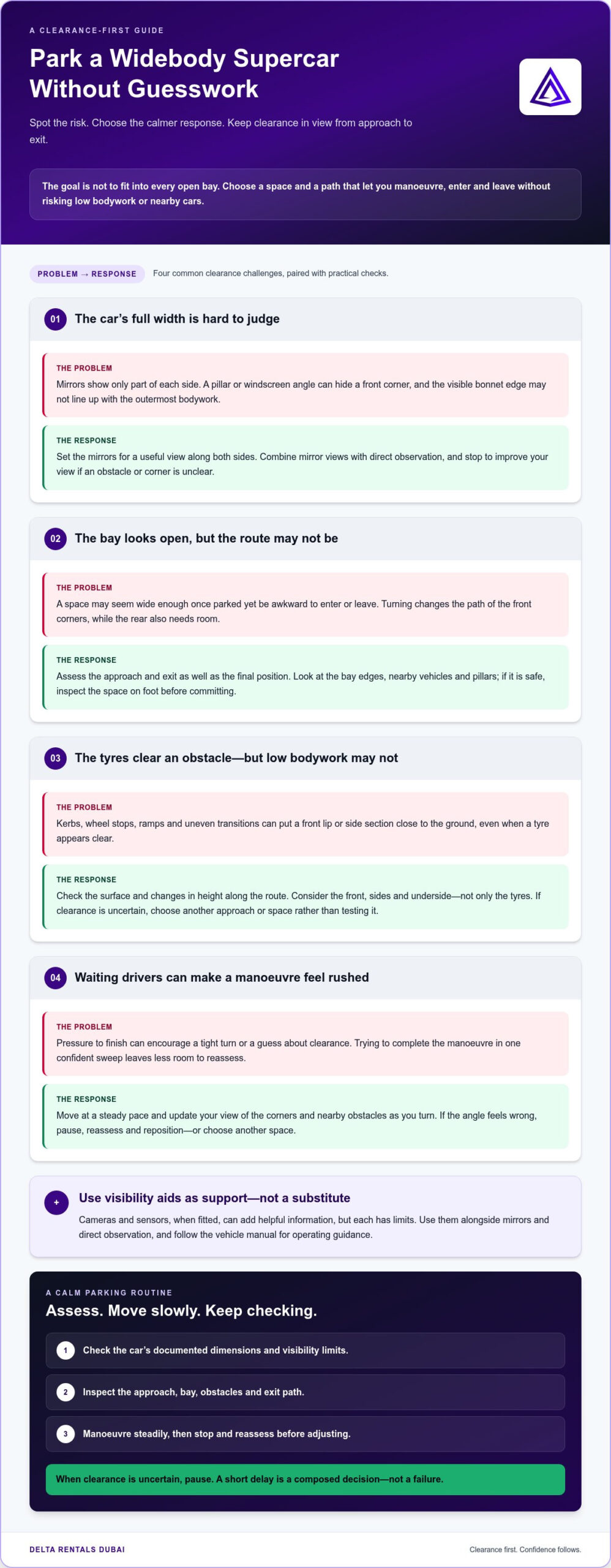
How to park a widebody supercar: a calm step-by-step routine
A consistent sequence makes each parking decision easier to manage, especially when the car’s proportions are unfamiliar. Give yourself permission to pause, even if other drivers are waiting. A clear view and a controlled adjustment matter more than completing the manoeuvre in one attempt.
Prepare before moving into the space
Before you start, settle into a driving position that gives you a clear view through the windscreen and mirrors. Ask passengers to stay inside and avoid distracting you while you manoeuvre. If someone will guide you, agree on simple signals first and make sure they can stand in a safe, visible place outside the vehicle’s path.
- Pause. Stop before the turn. Take a moment to focus, check the surroundings and avoid reacting to pressure from traffic behind you.
- Inspect. Look over the intended route into the bay and the path you’ll need to leave. Note pedestrians, moving vehicles, kerbs, pillars, wheel stops and any change in surface height.
- Select. Commit only if the space gives you a manageable approach and a clear exit. If an obstacle hides a corner or the turn looks too tight, choose another space.
- Manoeuvre slowly. Use a steady pace and make small, deliberate steering adjustments. Keep checking the relevant mirrors and surroundings rather than relying on one view or trying to complete the turn in a single sweep.
- Stop and reassess. If a corner or obstacle becomes hard to judge, stop. Recheck your position and reset the approach if needed. Stopping to regain a clear view is a normal part of the routine, not a mistake.
- Confirm before finishing. Once parked, check the car’s position in the bay and make sure it isn’t too close to a kerb, wheel stop or neighbouring vehicle. Before pulling out, check surrounding traffic and confirm the route is clear.
Use guidance without giving up control
Cameras and sensors, if fitted, can support your awareness, but keep checking with mirrors and direct observation. A spotter can help with a difficult angle only if you can see or hear their instructions clearly and they remain safely outside the vehicle’s path. If you lose sight of them, the directions become confusing, or another person enters the area, stop until it’s safe to continue.
Pause, inspect, choose, move slowly, then stop and reassess whenever the view becomes unclear. That’s the heart of the best practices for parking a widebody supercar: follow a process, not pressure. The same calm routine can help when getting comfortable with a high-performance rental. Explore high-performance rental options via WhatsApp.
Parking a rented supercar: prepare the car and finish with confidence
An unfamiliar supercar can feel different before you’ve even reached a parking space. Take time at handover to understand what you can see from the driver’s seat and where the relevant controls are. This small preparation step makes it easier to apply the best practices for parking a widebody supercar without relying on assumptions about a car you’ve just started driving.
Get comfortable with an unfamiliar car first
Before setting off, locate and adjust the mirrors, and identify any cameras, sensors and parking-related controls. Their layout and operation can vary between vehicles. Read the owner’s manual for model-specific instructions, especially if the car has a lift or clearance system. Don’t test unfamiliar controls while entering a tight space.
If possible, take a moment in a spacious, safe place to get used to the car’s proportions. Check how the bonnet and corners appear from the seat, how the mirrors show the sides, and how the car responds to small steering inputs at low speed. You’re not trying to memorise every angle. You’re building a more accurate sense of what is visible and what needs another check.
Make parking part of a considered rental experience
During handover, look over the vehicle’s visible condition and make a record of any marks you notice. Clear photos can help you keep an accurate personal record of the car’s condition at that moment. Also take a few seconds to confirm your seating and mirror positions before you drive away, since visibility depends on how you’re positioned behind the wheel.
These habits are useful whether you’re driving a Porsche 911 GT3 RS or another high-performance rental. As part of your preparation, learn about the Porsche 911 GT3 RS and the details that may affect how you approach a parking space. You can also explore the performance rental options with the kind of driving experience you want in mind. Familiarising yourself with the car first helps parking feel like a considered part of the drive, rather than a last-minute challenge.
Keep the routine simple: understand the controls, make a careful condition record, choose a space that gives you a clear route, and take the time you need to park. If the view or approach stops feeling clear, pause and reset. There’s no benefit in forcing a manoeuvre just to save a moment.
For rental information, message Delta Rentals Dubai on WhatsApp.
Make your next drive feel composed
Confidence comes from making a deliberate choice, not from threading the car into every available space. Make that mindset part of each drive: leave room for parking decisions, and treat an unfamiliar venue or layout as a fresh assessment. The best practices for parking a widebody supercar are most useful when they become a habit, not a technique reserved for a difficult bay.
A considered approach can make the experience of driving a high-performance car feel more natural, too. Delta Rentals Dubai offers Porsche 911 GT3 RS rental, with premium vehicle rentals serving customers across the UAE. Choose the drive that appeals to you, then give yourself time to get comfortable with the car and enjoy it at your own pace.
Ready to explore a Porsche 911 GT3 RS rental? Ask about a Porsche 911 GT3 RS rental on WhatsApp. Start with a calm plan, and make room to enjoy the drive.
Frequently Asked Questions
Can parking sensors detect every kerb or obstacle?
No, parking sensors shouldn’t be relied on to detect every obstacle. Coverage depends on the vehicle and sensor placement, and an object’s position or shape may make it harder for the system to register. Use sensors as a prompt to pay attention, not as proof that the path is clear. The best practices for parking a widebody supercar still include checking what you can see directly and stopping if clearance is uncertain.
Is a reversing camera enough to park a widebody supercar?
No, a reversing camera is an aid, not a complete view around the car. It mainly shows the area behind the vehicle, and its image may not reveal the position of the front corners, sides or every low obstacle. Check mirrors and the area around the car as well. For example, before reversing near a wall, make sure the route beside the front of the car is clear too.
Should I use a vehicle’s front-lift system when parking?
Use a front-lift system only if the vehicle is equipped with one, and follow the owner’s manual for when and how to operate it. Don’t assume a rental has this feature, or that it removes the need to assess the surface. A lift system doesn’t make every ramp or kerb suitable. If you’re unfamiliar with the control, learn its instructions before approaching an obstacle rather than experimenting during a tight manoeuvre.
What should I do if another vehicle parks too close?
Stay calm and assess the available space before opening a door or moving the car. Check whether you can exit without forcing the vehicle past the neighbouring car or another obstacle. If the route is unclear, don’t try to squeeze through. Wait until the obstruction moves or get help from someone nearby, provided they can assist safely and without directing you into traffic or another hazard.
Can a valet park a widebody supercar?
Valet procedures and staff experience vary, so don’t assume how a facility will handle the car. Before handing over the key, explain any essential controls the driver may need to know, such as how to operate the parking brake or select reverse. Keep the explanation concise and vehicle-specific. If you’re not comfortable handing over the car, park it yourself where it’s safe to do so.
Should I fold the mirrors when parking in a tight space?
Fold the mirrors only if doing so suits the available clearance, surrounding traffic and the vehicle’s instructions. Mirrors can help you judge the car’s position while manoeuvring, so folding them too early may remove a useful reference. Once the car is stationary, folding them may create extra room where appropriate. Check the manual for the correct controls, and make sure a folded mirror won’t obstruct your view when you drive away.
How should I document a rental car’s condition before driving?
Make a calm walkaround before setting off. Take clear photos or a short video of visible areas, including the bumpers, wheels, body panels and interior, and note any marks you notice. Use good lighting where possible, and capture enough context to show where each mark is on the car. Keep your records for reference, and share observations during handover without assuming particular rental-policy requirements.