
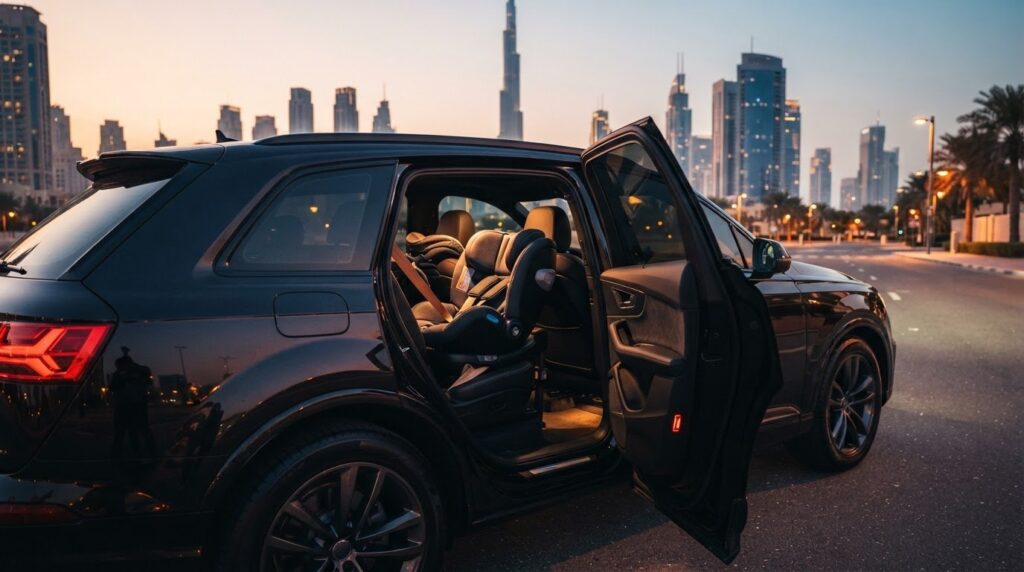
Could a child seat that appears to fit still be the wrong choice for your journey? Child seat compatibility in a Range Rover Sport depends on more than cabin space: the vehicle’s model year, the restraint and the seating position all matter. A seat can fit physically and still be installed incorrectly, so a confident click is not the final check.
It’s sensible to want a clear answer before setting off, especially when you’re balancing child safety, comfort and access for the rest of the family. Start with the handbook for the exact Range Rover Sport and the child-seat instructions, rather than assumptions based on another model year or a similar-looking seat.
This guide explains how to compare second-row positions, understand how ISOFIX and top-tether options affect your plan, and account for the practical limits of a third row. You’ll also find a pre-journey checklist for checking fit and installation. Whether you’re planning a family drive or a Range Rover Sport rental in the UAE, use these steps to prepare a more comfortable, well-considered seating plan.
Key Takeaways
- Assess child seat compatibility in a Range Rover Sport by matching the specific restraint to the exact vehicle and seating position.
- Understand how ISOFIX, top tether and seat-belt installation differ, and use both the vehicle and restraint manuals to guide your choice.
- Compare one-seat, two-seat and three-across arrangements without assuming every combination will fit securely.
- Use a pre-travel checklist to review installation, belt routing, buckle access and the fit of neighbouring seats.
- Plan a Range Rover Sport rental around your child’s needs, restraint and vehicle layout, allowing time for careful installation.
What child seat compatibility in a Range Rover Sport really means
Child seat compatibility in a Range Rover Sport isn’t simply a matter of whether a restraint can be squeezed into the cabin. Compatibility means a particular child seat can be installed correctly in a specific seating position, using a method allowed by the instructions for both the vehicle and the restraint. The child’s size and the seat’s design matter as well.
“Child-seat compatibility is a correct, secure installation of a specific restraint in a specific position in the exact vehicle.” Keep that in mind when comparing advice or planning a family journey. A seat may fit between the doors but be unsuitable for that position, or obstruct a belt, buckle or neighbouring seat. For background on restraint types and general safety concepts, see this Child Safety Seat Overview.
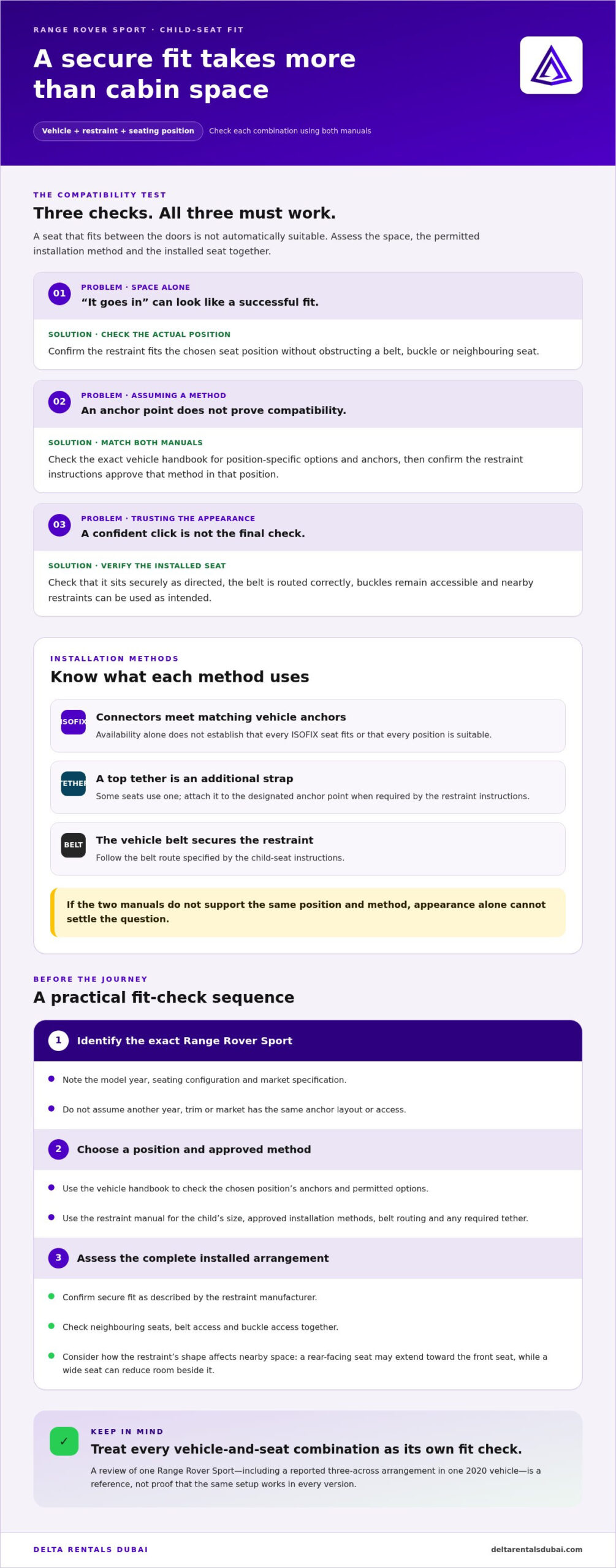
Think of fit as three separate checks: the restraint fits the available space; the installation method is permitted; and the installed seat is secure as its manufacturer describes. Passing the first check alone doesn’t establish compatibility. A confident-looking installation is no substitute for following the manuals.
Why model year and vehicle configuration matter
Identify the Range Rover Sport’s exact model year and configuration, including its seating layout and market specification. Anchor locations, seat shapes and access can differ between versions. A published review describes only the vehicle its author tested. For example, a review reporting three child seats across the second row of one 2020 vehicle is a useful reference, not proof that the same arrangement works in every Range Rover Sport.
Use the vehicle handbook to locate anchor points and check any position-specific guidance. Don’t assume details from another model year, trim or market apply to the vehicle you’re using.
What a child-seat fit check should establish
A proper fit check answers more than “Does it go in?” Confirm that the restraint can be installed in the chosen position using a method allowed by the vehicle and seat instructions. Then check that it sits securely as directed, with belts routed correctly and buckles accessible. The seat must not interfere with the vehicle belt or prevent another passenger’s restraint from being used as intended.
Distinguish a plausible fit from one supported by the relevant instructions. If the manuals don’t support the position or method, appearance alone can’t establish that the installation is suitable.
Before deciding on a seating plan, make these details specific:
- Identify the exact vehicle year and seating configuration.
- Check the vehicle handbook for the chosen position’s permitted installation options and anchor points.
- Follow the restraint manufacturer’s instructions for the child’s size and the selected installation method.
- Assess space, secure fit and access to nearby belts and buckles together.
This approach puts general reviews in perspective and gives you a practical basis for comparing seating positions. Treat every vehicle-and-seat combination as its own fit check, rather than relying on a broad claim that a particular child seat fits the Range Rover Sport.
ISOFIX, top tether, and seat-belt installation in the Range Rover Sport
Child restraints can attach to a vehicle in different ways. ISOFIX uses connectors on the child seat to attach to matching vehicle anchor points. A top tether is an additional strap used by some seats and attached to a designated anchor point. With seat-belt installation, the vehicle’s belt secures the restraint along the route specified in the seat instructions.
An anchor point shows where an attachment may be made; it doesn’t, by itself, confirm that a particular restraint is compatible in that position. Child seat compatibility in a Range Rover Sport depends on the exact vehicle, seating position, restraint and installation method. Equipment and anchor layouts can vary by model year and configuration, so don’t assume one Range Rover Sport’s setup applies to another.
How to identify the correct installation method
Start with the restraint manual. It explains which installation methods are approved for that seat, whether a top tether is required and how to route the belt if you’re using the vehicle belt. Then consult the exact vehicle handbook for the available anchors and guidance for the chosen position. ISOFIX availability alone doesn’t establish that every ISOFIX seat will fit or that every position is suitable.
Use both manuals together. If they don’t support the same position and method, don’t rely on appearance or a general fitment claim to settle the question.
Rear-facing, forward-facing, and booster-seat fit
A rear-facing restraint holds the child facing the rear of the vehicle; a forward-facing seat positions the child toward the front. A booster raises the child so the vehicle belt can be positioned as directed by the restraint’s instructions. These types differ in shape and space needs. A rear-facing seat may extend toward the front seat, while a wide restraint can reduce the room available beside it.
Check how the installed seat relates to the front seat and neighbouring positions, without changing the restraint’s required setup to make it fit. Follow the seat manufacturer’s current instructions and applicable guidance for the child’s size. The NHTSA Car Seat Guidelines offer general information on choosing and installing restraints; use applicable UAE guidance for your journey.
Before travelling, confirm the installation method, required belt route or tether use, and seating position in the manuals. If you’re planning a family trip, Delta Rentals Dubai offers a Range Rover Sport rental. Keep your child’s restraint and its installation requirements central to your vehicle plan.
Which Range Rover Sport seating layout works for your family?
Choose a seating plan around your children’s restraints and how your family uses the cabin, not just the number of available seats. One child may have a straightforward position; two can require balancing access and front-seat space; three across calls for close checks of seat width, buckles and installation. Child seat compatibility in a Range Rover Sport is specific to the vehicle and restraint combination, so treat each layout as a plan to test, not a universal promise.
Use this comparison to decide what to assess in the exact vehicle:
| Seating plan | Fit questions | Practical trade-offs |
|---|---|---|
| One restraint | Is the chosen position approved, and can the seat be installed as directed? | Usually leaves more room for passengers, but position still matters. |
| Two restraints | Can both seats be secured without blocking buckles or affecting each other? | Consider the adults’ access and space beside each restraint. |
| Three across | Do all three seats fit securely, with usable buckles and approved installation? | Seat width and access can make this arrangement demanding. |
| Second and third rows | Does the exact third-row position allow the restraint’s approved installation? | Reaching the rear seats may mean moving a second-row seat and disrupting the setup. |
Can three child seats fit across the second row?
BabyDrive reported fitting three child seats across the second row of the particular 2020 Range Rover Sport it tested. That’s a useful real-world example, not evidence that three seats will fit in every model year, market specification or seat combination. Restraint width, buckle access and the ability to install each seat securely all affect the result. Test the exact combination and follow the relevant instructions, rather than relying on the seat count alone.
Install each restraint in its intended position, then confirm that buckles remain accessible and neighbouring seats haven’t been pushed out of their correct setup. If one seat only fits when another is shifted or left unsecured, the arrangement doesn’t work as planned.
When the third row changes the family seating plan
A third row can add passenger capacity, but it can also change how your family gets in and out. BabyDrive’s 2020 test vehicle was reported to have no ISOFIX or top-tether points in the third row. That finding applies to the tested vehicle, not every Range Rover Sport. Check the exact vehicle handbook for third-row restraint options before assigning a child to those seats.
Access may involve moving an outer second-row seat. If a child restraint is installed there, moving that seat can complicate entry or require you to reset the seating plan. Think through the routine: who sits in each row, which seat needs to move, and whether every restraint remains correctly installed after access. Plan around the actual vehicle layout, not assumptions based on another version.
How to check a child seat fit before travelling
Set aside time to check the restraint in the exact Range Rover Sport you’ll use, with the child and intended seating position in mind. Follow the vehicle handbook and child-seat manual throughout. A careful, repeatable check can catch problems with routing, access or passenger space before they disrupt the journey.
A repeatable installation and fit-check sequence
Work through these steps in order. If the vehicle or restraint instructions don’t support the intended setup, don’t improvise another installation method.
- Read both manuals. Start with the exact vehicle handbook and restraint instructions. Confirm the seat is suitable for the child and that its permitted installation method matches the chosen vehicle position.
- Choose the position. Identify where the restraint will go, then check the handbook for guidance on that specific seat and its available installation options.
- Install as instructed. Use the specified ISOFIX connectors or vehicle belt, and attach a top tether if the instructions require one. Follow the restraint’s belt path exactly.
- Check the installation. Use the manuals to assess how securely the restraint sits. Check that connectors are engaged as directed and that the belt or tether is routed, tightened and positioned correctly.
- Inspect access and neighbouring seats. Make sure the buckle can be reached and used as intended. Check that the restraint doesn’t prevent an adjacent passenger from using their belt or interfere with another child seat’s installation.
- Settle the child and recheck. Secure the child according to the restraint instructions, then review the fit and harness positioning. Repeat the check if you change the seat position or reinstall the restraint.
A seat that looks stable isn’t enough. Use the checks described in the applicable manuals rather than relying on a generic movement test or copying a setup from another vehicle.
Planning for comfort, access, and luggage
Once the restraint is installed correctly, assess the whole cabin. A rear-facing seat may take up space behind the front passenger. Check that the front seat can be positioned comfortably without altering the child seat’s required installation. Consider the child’s comfort and the driver’s and front passenger’s space together.
If your vehicle has a third row, practise how passengers will reach it with the planned restraints in place. Moving a second-row seat for access may affect your routine, so check whether the arrangement remains practical once everyone is seated.
Plan luggage separately. BabyDrive’s review of one 2020 seven-seat Range Rover Sport found boot space tight with all seven seats in use. Treat that as an observation about the reviewed vehicle, not a guarantee for every configuration. Pack for the actual passenger and seating arrangement.
If the restraint is difficult to fit, return to the vehicle and restraint manuals and review the permitted positions and installation methods. For a family journey, Delta Rentals offers a Range Rover Sport rental. Plan around your child seat and allow time for a careful fit check.
Planning a Range Rover Sport rental with child seats
A family-ready rental plan starts with four details: your child, their restraint, the exact Range Rover Sport and the seating position you intend to use. A child seat that worked in your own vehicle may not install the same way in a rental, even if both vehicles share a model name. For child seat compatibility in a Range Rover Sport, base your decision on the specific vehicle and restraint, not a general fit claim.
What to prepare before collecting a rental vehicle
Before your journey, note the child seat’s make and model, its approved installation method and the position you plan to use. Bring the restraint instructions and every required component, such as its belt guides or tether strap. Allow time to review the vehicle handbook, install the seat carefully and inspect the result before setting off. Don’t leave the fit check until you’re ready to depart.
- Record the restraint details. Keep the seat’s model information and instructions together so you can refer to the correct installation guidance.
- Plan the seating position. Consider who will sit beside the child, whether anyone needs access to another row, and how the arrangement works for your family.
- Bring the full setup. Pack the restraint and any components required by its instructions. Don’t assume the rental vehicle includes equipment for your seat.
- Leave time to check. Install the seat in the intended position and review the fit against both manuals before the first drive.
Choose a family-focused luxury SUV with confidence
Delta Rentals offers Range Rover Sport rentals for families looking for a premium SUV with space for passengers and travel essentials. The vehicle is an option to consider, not a guarantee that a particular child seat or seating plan will fit. Treat the specific vehicle as a fresh installation: check its handbook, follow your restraint instructions and make sure the final arrangement suits your family’s access and comfort needs.
Keep your plan practical. If your journey involves several passengers, map out who sits in each row and how everyone will get in and out. Think about luggage once the seats are in place, too. A layout that works for the restraints may leave a different amount of room for bags than your usual car, so prioritise correct installation and passenger access before packing.
Explore the Range Rover Sport rental option as part of your UAE travel planning, and keep your child seat’s instructions close at hand. Preparing in advance gives you time to assess the vehicle and settle on a workable family seating plan, without relying on assumptions about the seat arrangement.
Ready to plan your drive? Message us on WhatsApp to discuss a Range Rover Sport rental.
Make your next family drive feel considered
Turn your fit check into a simple travel plan. Before departure, picture the whole routine: loading bags, securing each child, getting everyone into their seats and making any planned stops. This run-through can reveal awkward access or packing choices that aren’t obvious while the vehicle is parked. Keep the restraint instructions handy, and don’t change a setup unless the relevant guidance allows it.
For child seat compatibility in a Range Rover Sport, confidence comes from planning around the specific vehicle and your family’s needs, rather than relying on assumptions. Give yourself time to make decisions calmly, and use a careful preparation routine to set the tone for a more comfortable journey.
Considering a Range Rover Sport for your UAE plans? Discuss your Range Rover Sport rental with our team, then set off with your family plan ready.
Frequently Asked Questions
Is every child seat compatible with every Range Rover Sport?
No. Child seat compatibility in a Range Rover Sport varies with the vehicle’s year and configuration, the restraint model and the seating position. Before a trip, compare the installation instructions for that exact seat with the handbook for the vehicle you’ll use. Online reviews can offer useful context, but their findings apply to the specific vehicle and restraint combination tested, not automatically to your rental or another family’s setup.
Can a rear-facing child seat fit in a Range Rover Sport?
It may, but fit depends on the restraint, vehicle configuration and chosen position. A rear-facing model can extend farther toward the front seats, which may affect passenger legroom. After installation, check that the front passenger can sit comfortably and that the restraint remains installed as its manufacturer directs. Don’t treat a review of a different model year as confirmation; assess your exact vehicle and seat combination.
Does ISOFIX mean a child seat will fit the Range Rover Sport?
No. ISOFIX means a restraint uses connectors designed to attach to vehicle anchor points, but it doesn’t confirm that every ISOFIX seat suits every position. Some restraints also specify a top tether or other installation conditions. Check the exact instructions before fitting. For example, if a seat requires a tether, an available ISOFIX connection alone doesn’t complete the installation.
Can three child seats fit across a Range Rover Sport’s second row?
BabyDrive reported fitting three seats across the second row in its tested 2020 Range Rover Sport. That result applies to the vehicle and seats in that test, not every version. Seat width and shape can affect how the restraints sit together, while tightly positioned buckles can make fastening difficult. Try the exact seats side by side and ensure each can be installed and used as its instructions require.
Can a child seat be installed in the third row of a Range Rover Sport?
Don’t assume the third row provides the anchorages or installation method your restraint requires. In BabyDrive’s tested 2020 vehicle, the review reported no ISOFIX or top-tether anchorages in the third row. Other configurations may differ. Consult the handbook for the exact vehicle before planning a child’s place there, and use only an installation method allowed by the vehicle and restraint instructions.
What child-seat rules should families check before travelling in the UAE?
Check current official UAE guidance for child-restraint requirements before travelling, since requirements can depend on the circumstances and may change. Then make a separate fitment check: confirm the restraint is appropriate for your child and installed as its manufacturer instructs in the vehicle you’ll use. Don’t treat legal compliance as proof of correct installation, or assume that a general online review answers either question for your setup.
How can I tell whether a used child seat is safe to use?
Review its history, condition, labels and instructions before using it. Don’t rely on a seat with an unknown crash history, visible damage, missing parts or approval details you can’t identify. Check the manufacturer’s guidance for lifespan and replacement, and confirm that the restraint remains suitable for your child. If you can’t establish its history or condition, choose a seat with a known, verifiable background instead.