

What if the price of your dream supercar is only the start of the calculation? If you’re unpackaging the hidden costs of supercar ownership insurance and servicing, the purchase price won’t tell you what it takes to keep the car on the road. Insurance terms, specialist maintenance, tyres and depreciation all affect the real commitment, and the details vary by model and use.
The appeal is clear: few experiences match driving a high-performance car you’ve always wanted. Before committing to ownership, though, it’s sensible to weigh that thrill against recurring bills and less predictable expenses.
This guide breaks down the main costs to consider in the UAE, explains which insurance and servicing details to review for a specific car, and shows how depreciation can affect the long-term picture. You’ll also be able to compare ownership with occasional access, including renting a Porsche 911 GT3 RS, to decide which option fits how often you want to drive and how much responsibility you’re ready to take on.
Key Takeaways
- Separate ownership expenses into fixed, mileage-related and unexpected costs to build a realistic budget.
- When unpackaging the hidden costs of supercar ownership insurance and servicing, focus on policy wording, vehicle-specific maintenance guidance and how you plan to use the car.
- Use the vehicle’s documents and current maintenance guidance to distinguish scheduled servicing from repairs, consumables, storage and depreciation.
- Create a checklist that groups annual, mileage-related and one-off expenses before committing to a specific model.
- Compare long-term ownership responsibilities with rental for selected drives, while accounting for the terms and charges that apply to rental.
What Supercar Ownership Really Costs Beyond the Purchase Price
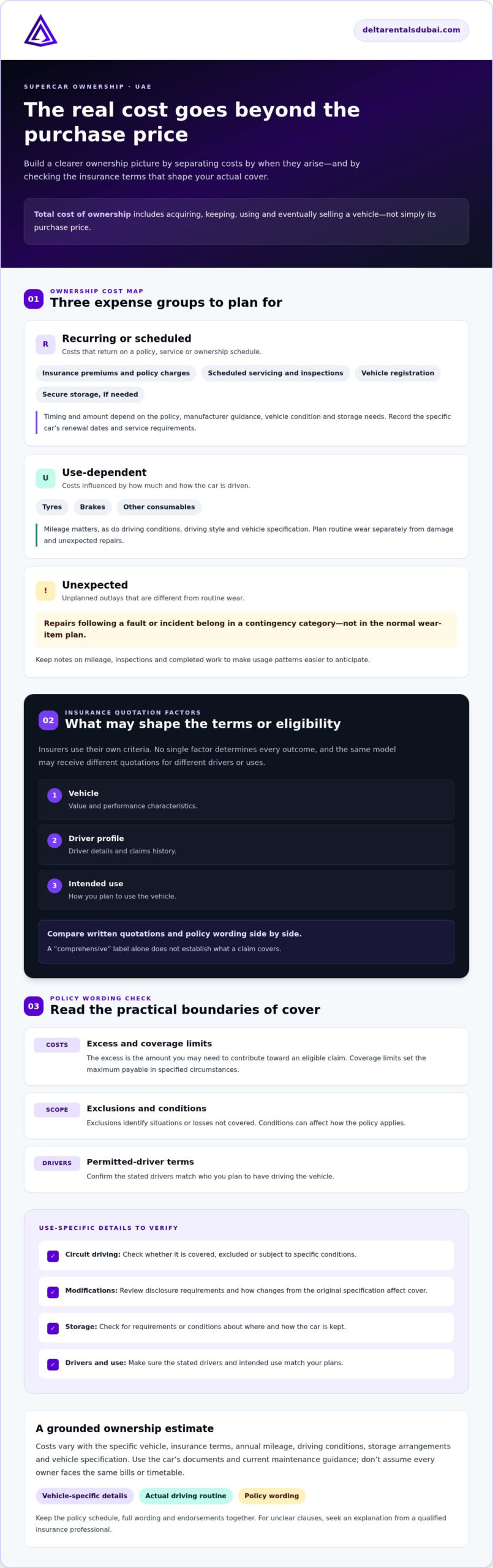
The purchase price gets you the keys, but it doesn’t cover the ongoing commitment of keeping a supercar ready to drive. To see the full picture, group expenses into three categories: recurring costs, use-dependent costs and unexpected costs. This helps you plan without assuming every owner faces the same bills or timetable.
Total cost of ownership is the complete cost of acquiring, keeping, using and eventually selling a vehicle, not simply its purchase price. It includes regular expenses, costs that rise with use, and repairs or other unplanned outlays. A careful approach to unpackaging the hidden costs of supercar ownership insurance and servicing starts by separating these categories, then filling them in with details for the specific car.
A general overview of supercars offers useful context, but your ownership budget depends on your circumstances. Two drivers with the same model may face different costs because of their insurance terms, annual mileage, driving conditions, storage arrangements and vehicle specifications. A car driven sparingly and kept in secure storage has a different pattern of use and care from one driven frequently. Plan around your routine, not an imagined average owner’s.
Which supercar ownership expenses recur?
Start with a category checklist rather than a guessed annual total. Depending on the vehicle and your circumstances, recurring or scheduled expenses may include:
- Insurance premiums and any policy-related charges
- Scheduled servicing and routine inspections
- Vehicle registration costs
- Secure storage, if you need a dedicated space
These costs don’t necessarily fall due at the same time or repeat on the same schedule. Policy terms, manufacturer guidance, vehicle condition and your storage needs affect both timing and amount. Record the renewal dates and service requirements for the specific car, then build a calendar around them. Don’t treat a recurring category as a fixed amount until you have vehicle-specific information.
Which costs depend on how the car is used?
Tyres, brakes and other consumables are sensitive to use. Mileage matters, but so do driving conditions, driving style and vehicle specification. For example, two owners covering different distances or driving in different conditions shouldn’t assume their wear items will need attention on the same schedule.
Budget for normal wear separately from damage and unexpected repairs. Routine replacement belongs in a use-based plan; a repair following a fault or incident belongs in a contingency category. Keep notes on mileage, inspections and completed work to make patterns easier to anticipate. This gives you a more grounded ownership picture and helps prevent predictable wear from being mistaken for a surprise.
Supercar Insurance Explained: Cover, Exclusions, and Cost Variables
Comprehensive motor insurance describes a type of cover, not a universal promise. Its scope depends on the policy wording: which events are covered, what limits apply, what excess you may have to pay, and which exclusions or conditions could affect a claim. A policy name alone doesn’t establish what a claim covers. Read the actual documents, not just a headline description.
For a supercar, a quotation and eligibility decision may reflect several factors, including the vehicle’s value and performance characteristics, the driver’s profile, claims history and intended use. Insurers set their own criteria, so no single factor determines every outcome. A general guide to Sports Car Insurance can explain common considerations, but UAE owners should rely on current policy documents and qualified insurance guidance for their circumstances.
This is a key step in unpackaging the hidden costs of supercar ownership insurance and servicing: budget for the policy you can actually use, not an assumption based on the word “comprehensive.”
What can change a supercar insurance quotation?
Insurers may assess the car’s value and performance, driver details, claims history and intended use when setting terms or deciding eligibility. Criteria differ between insurers, and the same model may receive different quotations for different drivers or uses. Compare written quotations and policy terms side by side, including what each policy covers and the conditions attached.
Which insurance details deserve close attention?
Read each policy for the practical boundaries of cover. The excess is the amount you may need to contribute toward an eligible claim; coverage limits set the maximum payable in specified circumstances. Exclusions identify situations or losses the policy doesn’t cover, while permitted-driver conditions define who can drive under the cover. Compare the wording rather than assuming similar labels mean identical protection.
- Track use: Check whether driving on a circuit is covered, excluded or subject to specific conditions.
- Modifications: Review how changes from the vehicle’s original specification must be disclosed and how they affect cover.
- Storage: Check whether the policy sets requirements or conditions related to where and how the car is kept.
- Drivers and use: Confirm the stated drivers and intended use match how you plan to use the vehicle.
Keep the policy schedule, full wording and any endorsements together. If a clause is unclear, get an explanation from a qualified insurance professional before relying on your interpretation. If you want time behind the wheel without buying a supercar, a Porsche 911 GT3 RS rental offers another way to experience a high-performance car. Rental terms and charges still apply.
Servicing, Tyres, and Depreciation: The Costs Ownership Plans Can Miss
Ownership expenses don’t all follow the same timetable. Scheduled servicing is planned around the manufacturer’s guidance, while tyres and brake components are replaced according to condition and use. Repairs may be unexpected, storage is an ongoing practical consideration, and depreciation can affect what you recover when you sell. Keep these categories separate rather than treating every future expense as one predictable bill.
Scheduled maintenance follows a service plan; wear-related work responds to condition and use, while unexpected repairs arise outside the routine schedule. That distinction matters when unpackaging the hidden costs of supercar ownership insurance and servicing, because each category calls for different planning.
How do servicing and consumables affect ownership?
Use the manufacturer’s maintenance schedule for the exact model and vehicle, then account for its service history and operating conditions. Requirements can vary by model and how the car is used, so don’t apply a generic interval to every supercar. Before purchase, review the service records and current maintenance guidance for that specific vehicle. Verify any model-specific interval or component-life estimate against current manufacturer information.
Tyres and brakes need a separate, condition-based plan. Performance tyres, brake pads and other consumables can wear at different rates depending on mileage, driving conditions and specification. A pre-purchase inspection can help establish their current condition; ongoing checks can help you plan replacement before worn components disrupt your driving plans. Don’t treat normal wear as a mechanical fault, but leave room in your budget for repairs outside routine maintenance.
- Scheduled servicing: Follow the model-specific maintenance schedule and retain service records.
- Wear items: Track tyre and brake condition, not just distance travelled.
- Repairs: Keep a separate contingency for faults or damage outside routine work.
- Storage: Consider the cost and practicality of a secure space suited to keeping the vehicle.
Why can depreciation and storage matter?
Resale value isn’t guaranteed. It may be influenced by the car’s condition, mileage, service history, specification and market demand at the time you sell. Two examples of the same model can therefore have different resale outcomes. Treat depreciation as a possible cost in your ownership plan, not a fixed percentage or a promised future loss. When comparing cars, assess their individual records and condition rather than assuming the badge alone predicts value.
Storage also deserves deliberate thought, particularly in the UAE. Consider whether your parking arrangement provides secure protection and helps limit exposure to sun, heat and dust. The right approach depends on the property and vehicle, but planning ahead can help you care for the car and preserve its condition. Add storage to your checklist as its own line, separate from servicing, repairs and any estimate of future resale value.
How to Build a Personal Supercar Ownership Cost Checklist
A useful ownership estimate starts with the exact car and how you plan to use it, not a generic figure for “a supercar.” When unpackaging the hidden costs of supercar ownership insurance and servicing, build a worksheet that separates annual expenses from mileage-related wear and one-off costs. This makes gaps visible before you commit and helps you compare ownership scenarios without relying on false precision.
What information should an ownership estimate include?
Record the vehicle’s exact model and age, its current condition and service history, your expected mileage, storage plan and intended use. Gather vehicle-specific service guidance and written insurance terms, then enter each item with its source and assumptions. Label figures as confirmed, estimated or unknown. Keep unknowns visible rather than filling them with guesses, and update estimates when better information becomes available.
Use this worksheet as a starting point. Add or remove rows to match the vehicle and your circumstances.
| Expense | Frequency | Source | Assumptions | Verification status |
|---|---|---|---|---|
| Insurance | Annual or policy term | Written policy terms | Drivers, intended use, cover conditions | Confirmed, estimated, or unknown |
| Servicing and inspections | Per manufacturer guidance | Current service schedule and vehicle records | Model, condition, operating circumstances | Confirmed, estimated, or unknown |
| Tyres, brakes, and other consumables | Condition or mileage related | Inspection and vehicle-specific information | Expected use and current wear | Confirmed, estimated, or unknown |
| Registration and secure storage | Recurring, as applicable | Relevant vehicle documents and storage plan | Personal arrangements and timing | Confirmed, estimated, or unknown |
| Repairs, depreciation, and sale preparation | Unplanned or at resale | Vehicle condition and market information | Keep estimates distinct from confirmed costs | Estimated or unknown |
How can owners compare different use scenarios?
Build two versions of the same worksheet: one for occasional driving and another for more frequent use. Keep the categories consistent, then adjust only assumptions that change, such as mileage, expected wear or how often the vehicle is driven. Set aside a contingency for unexpected repairs, but treat it as a planning reserve, not a guaranteed expense.
Revisit the comparison when mileage, insurance terms, vehicle condition or intended use changes. If you expect to drive a supercar only on selected occasions, compare ownership with rental as a separate option. A Porsche 911 GT3 RS rental lets you experience the car without buying and maintaining it long term, though rental terms and charges still apply.
Ownership or Rental: Choose the Supercar Experience That Fits Your Plans
The choice comes down to how you want a supercar to fit into your life. Ownership gives you ongoing access to a specific vehicle, along with responsibility for insurance, maintenance, storage and eventual resale. Rental lets you arrange access for selected occasions without buying and maintaining the car long term. It doesn’t remove every cost or obligation: rental terms and charges still apply.
As you unpackaging the hidden costs of supercar ownership insurance and servicing, compare the options against your actual driving habits. Think about how often you expect to drive, whether you want one particular car on hand, and how much time you’re comfortable spending on ownership responsibilities. Neither route is automatically better. The right fit depends on what you value and how you plan to use the car.
When might ownership suit your driving plans?
Ownership may suit drivers who want regular access, feel a strong personal connection to a particular car and have a suitable storage plan. It also means taking responsibility for ongoing costs and vehicle care, even during periods when you drive less. Insurance eligibility, policy terms, servicing needs and maintenance timing remain specific to the vehicle and owner. Consider both the enjoyment of having the car and the work involved in keeping it ready.
When can renting offer a more flexible route?
Rental can suit a planned drive, event or special occasion, or let you experience a supercar before making a long-term commitment. You can arrange access around your plans rather than take on the purchase and upkeep of a car year-round. Compare the rental terms and applicable charges with your intended use, and make sure the arrangement fits the experience you have in mind.
Delta Rentals Dubai offers a Porsche 911 GT3 RS rental, giving you a way to experience this high-performance model without buying it. Rental is an access option, not a promise that every expense or responsibility disappears; the rental agreement governs the terms of your booking. If ownership feels like too much commitment for the way you drive, occasional access may be worth considering. If you want a specific model for a particular plan, discuss a supercar rental experience.
Choose the Supercar Experience That Fits Your Next Drive
Turn your cost checklist into a decision that reflects how you actually want to drive. If regular access and a lasting connection to one car matter most, ownership may suit your plans. If you’re weighing the commitment against a particular occasion or drive, consider access without a long-term purchase. Unpackaging the hidden costs of supercar ownership insurance and servicing is about making that choice with clarity, not taking the shine off the experience.
Delta Rentals Dubai offers Porsche 911 GT3 RS rentals alongside premium supercar and luxury vehicle options across the UAE. Rental terms and charges still apply, so choose an experience that fits your plans and review the details before booking.
Discuss a supercar rental experience and take the next step toward a drive that feels right for you.
Frequently Asked Questions
What does a supercar insurance excess mean, and when might it apply?
An insurance excess is the amount you may have to contribute toward a claim covered by your policy. For example, if your car is damaged in an incident and the insurer accepts the claim, the excess stated in your documents may affect the amount paid out. The policy explains when it applies and whether different excesses apply to particular drivers, incidents or types of loss. Read the schedule alongside the full wording.
Does comprehensive insurance automatically cover track use or modifications?
No. The word “comprehensive” doesn’t automatically mean track driving or modifications are covered. A policy may restrict certain uses or require vehicle changes to be disclosed, and the details depend on its wording. Before taking a modified car onto a circuit, review the policy and any endorsements for relevant terms. If the wording is unclear, get an explanation from a qualified insurance professional before relying on the cover.
Are supercar servicing schedules different from those of standard cars?
They can be, but the correct schedule depends on the specific model and manufacturer guidance. Don’t assume a service interval from a standard car applies to a supercar, or that every high-performance model follows the same timetable. For a used car, compare its service records with current maintenance guidance for that exact model and year. Ask a qualified technician for clarification if records are incomplete or an upcoming service is unclear.
Can a supercar lose value even if it is driven infrequently?
Yes. Low mileage doesn’t guarantee that a supercar will retain its value. Age, condition, maintenance records, specification and buyer demand can all influence resale interest, even if the car has spent much of its time parked. Infrequent use can also make it harder to judge condition from mileage alone. Keep complete records and assess the vehicle’s overall state rather than treating a low odometer reading as proof of future value.
Do supercar tyres and brakes need to be replaced based on mileage alone?
No. Mileage is useful context, but it doesn’t show the full condition of tyres or brakes. A car driven relatively little may still need attention if components have aged, been stored poorly or show signs of uneven wear. Have their condition assessed during routine inspections, and keep records of checks and replacements. Follow the vehicle’s guidance and seek qualified advice if you notice warning signs or changes in performance.
What documents should I review before estimating the cost of owning a supercar?
Gather the vehicle’s service history, maintenance guidance for its exact model and year, current insurance quotation and policy wording, and records of inspections or repairs. Note the vehicle’s age, condition and expected use alongside those documents. This practical file supports unpackaging the hidden costs of supercar ownership insurance and servicing without confusing estimates with confirmed details. Mark gaps clearly, then update your worksheet when you receive vehicle-specific information.
Can renting a supercar provide access without buying one?
Yes. Renting offers a way to experience a supercar for a planned drive or occasion without purchasing and maintaining it long term. Delta Rentals Dubai offers Porsche 911 GT3 RS rentals, alongside other premium supercar and luxury vehicle options in the UAE. Rental still comes with terms and charges, so read the agreement and understand the conditions that apply to your intended use before booking.